THE COVENANT OF EARTH
The Constitution of One Planetary Government
Foundational Commitments
This Covenant establishes one planetary cooperative system and supersedes the nation-state order. It is not founded against any civilization. It draws on constitutional, customary, scientific, religious, indigenous, communitarian, liberal, republican, market, cooperative, and administrative traditions, and treats none of them as complete or as automatically illegitimate. Institutions are judged by what they permit, what they prevent, and what they correct.
What we reject:
-
Unaccountable coercive power. Birth, wealth, national office, inherited office, military force, religious office, or popular acclaim create no authority. Election, accountable appointment, demonstrated competence, technical expertise, and correctable customary selection may contribute to authority only as this Covenant expressly provides.
-
Capture without correction. No public, private, customary, religious, civic, or technical institution may place its decisions beyond evidence, challenge, review, correction, and peaceful succession where those decisions affect others.
-
Bodily abuse and imposed deprivation. No political objective, market outcome, collective preference, inherited rule, or expert calculation may legalize the non-derogable harms prohibited by Article X.
-
Destruction of shared life-support systems. No property form, state claim, development model, or ideology may authorize irreversible planetary harm.
-
Forced civilizational uniformity. The Covenant supersedes states and sovereignty claims. It does not supersede peoples, cultures, faiths, families, local institutions, legal traditions, markets, or ways of life that remain consistent with this Covenant, Article X, the stewardship duties in Affirmation 3, and the rights of affected persons and communities.
What we affirm:
-
Legitimacy has several necessary sources. Consequential authority requires demonstrated competence, affected-person participation, accountable human judgment, lawful authorization under this Covenant, continuity of service, and effective correction. The weight of each source varies with the function; none may erase the others.
-
Institutional forms are tools, not sacred ends. Election, sortition, examination, accountable appointment, consensus, accountable customary selection, professional qualification, community attestation, and mixed systems may all be used where their incentives fit the task and their failures remain correctable. Inherited office and customary succession by birth create no authority.
-
Property is stewardship with duties. Personal, private, family, cooperative, communal, indigenous, charitable, public, and trusteeship arrangements may coexist as forms of lawful stewardship, not absolute title. Every property interest carries a duty not to externalize human or planetary harm, and control of resources essential to survival carries enforceable obligations to affected communities, humanity, future generations, and the biosphere. Inherited unearned claims, absentee control of the commons, and claims inconsistent with Article X or these duties are void.
-
Supersession and allocation of function. No pre-Covenant political community retains lawful space by inheritance; nations and states are superseded as political authorities at ratification. Where a state or bloc of states declines cooperation with or actively obstructs ratification, referendum administration, or the founding schedule, the provisional authorities shall continue under Article XI, Section 11.4 until the Covenant is functional in the cooperating territories; a non-cooperating territory is not excused from the Covenant's reach by its own obstruction. The provisional authorities, together with the Constitutional Court once constituted, shall determine the lawful minimum of cooperation required for operational continuity in the obstructing territory, applying the burden rule in this Commitment. A substantiated finding of material obstruction is grounds for the provisional bodies to treat the obstructing territory's non-cooperation as a failure of the founding schedule warranting adjusted territorial application, partial activation, or continued provisional administration, provided that continued provisional administration under this clause shall never exceed the absolute 3-year compulsory reset deadline in Article XI, Section 11.4(2.3), in each case without prejudicing the Covenant's claim to planetary reach.
Every local, regional, and planetary function exists within one Covenant government and is allocated by demonstrated competence, affected-person participation, correction capacity, and planetary necessity. Proof that a function requires distinct local or regional administration permits allocation only to an LCC or RCA within the Covenant and never creates sovereignty outside it. A claimant of separate authority bears the burden of proving that the claimed function cannot be performed within the Covenant; the Covenant bears no burden to justify planetary unity.
-
Knowledge is plural but consequences are reviewable. Empirical, professional, practical, historical, customary, indigenous, spiritual, relational, and place-based knowledge may inform governance. No knowledge claim is dismissed because of its origin, and no claim affecting others is exempt from proportionate scrutiny because of its origin.
-
Every person is protected. These guarantees may be understood through inherent dignity, sacred obligation, reciprocal duty, ancestral law, communal responsibility, natural rights, or another tradition. Their protection does not depend on acceptance of one philosophical foundation.
-
Continuity and correction are joint duties. A failed metric, expired office, missed deadline, broken network, rejected proposal, or captured body must activate a lawful fallback. Correction changes the operator or method without abandoning the governed function or the people who depend on it.
-
The future has standing. Decisions must account for generations not yet born and for the living systems on which every civilization depends.
-
Equal worth does not mean interchangeable fitness. Every person has equal dignity, but no person is competent for every role. Authority shall be assigned by the capability the function actually requires, whether analytical, practical, physical, relational, custodial, technical, moral, local, or otherwise demonstrated. Competence in one role creates no general superiority, caste, hereditary claim, or right to rule outside that role.
-
Cooperation without merger. Covenant bodies are differentiated parts of one constitutional system, not rival sovereigns. Institutions shall make truthful disclosure, lawful assistance, and repair more advantageous than concealment, retaliation, obstruction, or escalation, while retaining independent judgment and forbidding collusion and reciprocal non-enforcement.
-
One planetary cooperative system. Local Cultural Councils, Regional Coordinating Assemblies, the Expert Body, and communities are differentiated participants in one planetary government: not separate sovereigns, not a federation of pre-existing states, not self-contained rival economies competing over territorial resource endowments. Geological, ecological, climatic, cultural, technical, and practical differences make regions differently suited to mining, farming, energy, care, production, stewardship, and other functions; the Covenant coordinates those complementary capabilities and moves resources, goods, services, infrastructure, knowledge, and benefits across administrative boundaries for every human and for Earth. Local participation and authority protect people, culture, place, and competent development; they are exercises of Covenant authority and must not be framed as hostile bargaining against the whole. A community's dignity, rights, opportunity, and access never depend on the resources found within its administrative boundaries or the output expected from its population. Interdependence is designed: a source of reciprocal provision and shared capacity, never a permission for domination, extraction, forced uniformity, or treating any community as expendable. Institutional disagreement shall be treated first as a coordination and repair problem within one constitutional system, consistent with Affirmation 10, without removing the system's ability to handle actual defection or rights violations elsewhere.
These commitments are enforced through distributed selection, competence thresholds, plural public participation, rights floors, independent inspection, transparent succession, manual continuity, metric challenge, and institutions capable of correcting one another without stopping essential governance.
Preamble
We, the peoples of Earth, inheritors of many civilizations and many ways of ordering common life, establish this Covenant as the one government of Earth.
We preserve peoples, cultures, communities, faiths, families, traditions, and ways of life consistent with this Covenant and Article X. Institutions and markets may continue only as expressly Covenant-authorized, stewardship-compliant forms and never by inheritance. We supersede nations and states as political authorities and join all public power within one constitutional system to protect human life, peace, and the biosphere.
We reject inherited office and unchecked power whether exercised by a ruler, majority, market, bureaucracy, expert body, armed force, or global institution.
We affirm governance as a practical duty requiring disciplined inquiry, accountable judgment, inherited wisdom, lived experience, consent, competence, and correction.
We establish this Covenant as a living and continuous framework, not a final word.
check, correct, auditselect, succeed, commandadvise, blind spotadminister draws
Choose a body to see what it checks and what checks it.
ARTICLE I: THE EXPERT BODY (EB)
Section 1.0: The three levels of one government
The Covenant government shall operate through three distinct levels with allocated functions. No level is sovereign against another; each shall respect the functions allocated to the others except through the temporary reallocation procedure in Section 1.4.
Level 1: Local Cultural Councils (LCC)
- Jurisdiction: Communities, cities, and cultural blocs (population 10,000 to 10 million).
- Authority: Local language preservation, cultural practices, zoning, community dispute resolution, and local education enrichment (provided global minimum standards are met).
- Composition: Each community may use sortition, election, consensus, customary councils, indigenous institutions, religious or communitarian bodies, or a hybrid. Every method operates under this Covenant; no office passes by birth. Its method must permit meaningful participation by affected persons, disclose who holds authority, provide a non-coercive personal exit from participation or a challenge route, and remain subject to Article X. Personal exit under this provision never means territorial secession.
- Limitation: Shall not make policy that affects neighboring regions, global resources, or planetary systems.
Level 2: Regional Coordinating Assemblies (RCA)
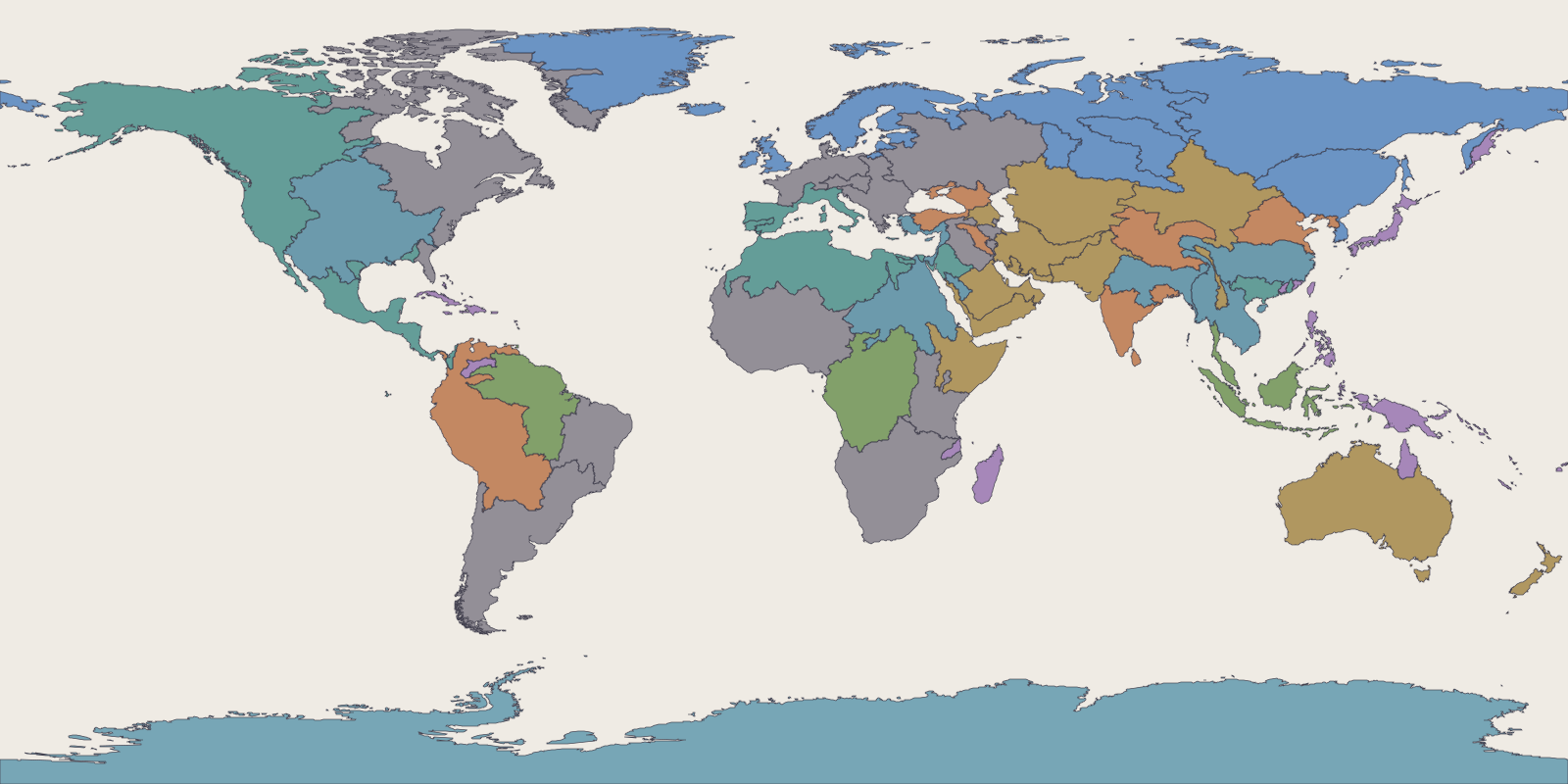
- Jurisdiction: Bioregions or continental coordinating regions (population 10 million to 1 billion, except as Section 1.0.1(a)(4) provides), defined by ecological and cultural boundaries rather than historical nation-states.
- Authority: Infrastructure planning (transport, energy grids), water rights, regional trade coordination including market structure and concentration within the bioregion under Article IX, Section 9.7, disaster response logistics, and regional environmental stewardship.
- Composition: Delegates or representatives authorized by Local Cultural Councils through their Covenant-lawful selection methods, serving 5-year staggered terms. Regional procedure shall accommodate electoral, consensus, customary, and mixed mandates while preventing one selection tradition from excluding the others.
- Limitation: Shall not make policy that affects other bioregions or the global commons (atmosphere, oceans, climate, space).
Level 3: Global Expert Body (EB)
- Jurisdiction: Planetary systems and cross-bioregional functions that no LCC or RCA is competent to govern; the population governed is humanity as a whole.
- Authority: Climate stabilization and carbon-cycle management; global pandemic prevention and response; planetary resource allocation (energy, food, water at the macro scale); market structure and concentration in the planetary and cross-bioregional supply of goods and services on which an Article X right or a Welfare Standard metric depends, under Article IX, Section 9.7; inter-bioregional infrastructure (transoceanic cables, pipelines, satellite networks); artificial intelligence and emerging-technology governance; space exploration and planetary defense; global peacekeeping and enforcement of Constitutional rulings. Detailed scope and the Temporary Reallocation Protocol appear in Section 1.4.
- Composition: An odd number of members within the range set by Section 1.1 (55 to 87 as of ratification), selected by the seven-phase pipeline in Section 1.1 and allocated across the domains in Section 1.5. Single non-renewable staggered terms of 8, 10, 12, 14, 16, 18, or 20 years, with no more than 20% of seats ending in any 2-year window. Sortition-first from binary-threshold qualified pools; no member holds office by wealth, election, or inheritance.
- Limitation: Shall not dictate local cultural practices, religious traditions, or personal conduct; shall not intervene in regional infrastructure unless it affects another bioregion; shall not act outside the domains in Section 1.5 or the scope in Section 1.4; shall not remove, extend, or shorten any Covenant term outside the procedures in this Article, Article III, and Article IV. Sections 1.1 through 1.7 govern where this summary is silent.
Section 1.0.1: Bioregional boundary architecture
(a) Guiding principles
Bioregional boundaries shall be drawn under the following principles, subordinate to Rule Zero (Article XI, Section 11.1) and the inviolable rights floor of Article X:
-
Watershed coherence. A Regional Coordinating Assembly boundary shall follow a major watershed divide. A river system from headwaters to delta shall, where population and geography permit, constitute a single RCA. Closed basins (endorheic systems) may form their own RCAs. An RCA boundary shall never bisect a river's main stem or its primary tributary.
-
Ecological continuity. An RCA shall encompass a coherent biome or set of adjacent biomes that share climate regime, vegetation class, and disturbance dynamics (fire, flood, drought, permafrost). Where a watershed divide also separates biomes, the divide becomes the boundary.
-
Infrastructure and disaster-logistic coherence. An RCA shall enclose transport corridors, energy grids, and disaster-response zones that share physical connectivity. A mountain range, desert, or sea that interrupts infrastructure shall be a boundary. A cyclone belt, seismic fault zone, flood plain, or permafrost region that requires coordinated disaster logistics shall not be split.
-
Population distribution. An RCA other than a custodial RCA under principle 8 shall contain between 10 million and 1 billion persons. Where a watershed meeting principles 1 through 3 exceeds 1 billion, it may be split along sub-basin boundaries; where such a watershed falls below 10 million, it may be combined with an adjacent watershed sharing ecological and infrastructure characteristics. An RCA may fall below 10 million only where the Commission publishes a finding that no adjacent watershed shares ecological and infrastructure characteristics sufficient for combination. The finding shall be recorded in the Boundary Segment Record under subsection (e) and is challengeable under subsections (h) and (i).
-
Mineral and resource basin coherence. A major mineral province, hydrocarbon basin, or aquifer shall not be split across RCAs where avoidable. Where a resource basin straddles a watershed divide, the Commission may adjust the boundary to enclose the basin within one RCA, recording the deviation in the Boundary Segment Record under subsection (e).
-
Cultural legibility. Boundaries shall, where consistent with principles 1 through 5, respect the territorial continuity of language families, customary land-tenure systems, and transhumance corridors. No boundary shall be drawn for the purpose of separating or concentrating any ethnic, linguistic, or religious group.
-
Maritime boundaries. Coastal RCA boundaries follow the low-water line along the coast, consistent with the baselines from which maritime zones are measured under Covenant maritime law. Maritime boundaries between RCAs extend from the land boundary terminus along the line equidistant from the nearest coastal baseline points of each RCA.
-
Antarctica. Antarctica is a custodial RCA with zero permanent population, governed as a planetary commons stewardship zone under direct Expert Body supervision. Its boundary follows the grounding line of the continental ice sheet, surveyed by glaciologists drawn from the pools under subsection (c)(1), published in the evidence repository under subsection (g), and updated at each full redraw. The Expert Body is Antarctica's governance authority for all purposes under this Section, including standing under subsection (h); the Commission draws its boundaries under the same procedure as all other RCAs and shall include at least one glaciologist for Antarctic boundary work.
-
Boundary definition defaults. Where the Commission's ratified geodetic coordinates are silent or ambiguous, the default boundary features are: for rivers, the thalweg (line of deepest channel); for lakes, the median line; for coasts, the low-water line consistent with Covenant maritime baselines. The ratified geodetic coordinates control where specified; these defaults fill gaps only.
(b) Self-correcting criteria architecture
The nine principles in subsection (a) are co-equal; no principle has fixed lexical priority. Where principles conflict for a segment, the Commission shall not resolve the conflict by a standing priority rule:
-
Conflict recording. The Commission shall record every material conflict between principles for that segment in the Boundary Segment Record under subsection (e), stating the competing principles, the evidence supporting each, the Commission's provisional resolution and its reasoning, and a quantitative comparison of the evidence weights for each principle. Where the Commission subordinates one principle to another, it shall state what additional evidence for the subordinated principle would have changed its resolution.
-
Challenge escalation. During the review period under subsection (f), any party with standing under subsection (h) may challenge the resolution of a principles conflict. The challenge shall identify the specific segment, the competing principles, and prima facie evidence that the resolution is materially arbitrary, unsupported by the Commission's own evidence, inconsistent with its reasoning on comparable segments, or based on materially deficient investigation of the subordinated principle.
-
Boundary Review Tribunal. Challenges are decided by a 7-member Boundary Review Tribunal drawn under subsection (i). The Tribunal shall resolve the conflict for that segment on the evidence adduced by the Commission and the challenger, without deference to the Commission's provisional resolution. It may remand the segment for redrawing with specific guidance, or specify the resolution where the correction follows necessarily from the evidence. Its decision is binding on the Commission for that segment, and the Tribunal dissolves after all judgments concerning that boundary cycle are rendered.
-
Epistemic Council referral. The EC may, at any time during the review period, publish a finding that the Commission's pattern of principles-conflict resolution reveals a systematic epistemic bias. The finding is diagnostic only: it creates no veto, stays nothing, and binds neither the Tribunal nor the ratifying body. The Commission and the Tribunal shall each publish a response within 30 days.
-
No single-principle capture. No party may assert that a single principle defeats all others for a segment without engaging the specific conflict and the Commission's published quantitative evidence comparison; the Tribunal shall dismiss any challenge that merely reasserts a principle's primacy. The Tribunal may remand a segment where the evidence for the subordinated principle is materially deficient relative to the dominant principle and additional investigation could reasonably change the resolution.
(c) The Boundary Delineation Commission
-
Constitution. No earlier than 5 years and no later than 8 years after Covenant ratification, and every 50 years thereafter (except as modified by the first-cycle provision at paragraph 7), the Independent Sortition Secretariat ("ISS", established under Article XIII, Section 13.3) shall constitute a Boundary Delineation Commission by constrained lot from openly recruited, independently screened, and independently certified pools. The Commission shall consist of no fewer than 23 and no more than 31 members, an odd number, stratified to include:
a. At least 5 hydrologists or watershed scientists; b. At least 5 ecologists or biogeographers; c. At least 3 infrastructure or disaster-logistics specialists; d. At least 3 demographers or population geographers; e. At least 2 mineral-resource or hydrogeology specialists; f. At least 2 linguists, anthropologists, or affected-community knowledge holders; g. At least 3 generalist geographers or boundary-delimitation specialists; h. At least 2 oceanographers or maritime-law specialists, where the eligible pool permits and maritime RCAs exist; i. At least 1 glaciologist, where the eligible pool permits, for Antarctic boundary work; j. No single discipline enumerated in (a) through (i) shall constitute more than 40% of the Commission's seated members; k. At least one member from each of the six Covenant statistical regions (or, until those regions become operational, the Founding Macroregions under Article XI, Section 11.4(1.1)); l. At least 30% of members drawn from pools of persons whose principal knowledge pathway is vocational, informal, traditional, or indigenous.
-
Hard minimum discipline requirements. The Commission shall not be constituted with fewer than the stated minimums for disciplines (a) through (g). If the pool for any of these disciplines is insufficient after two independent recruitment rounds (each at least 90 days), the ISS shall notify the Constitutional Court and the Epistemic Council, and the Court shall, within 30 days and on published justification, authorize one of:
a. A reduced-size Commission, no fewer than 15 members, maintaining the same discipline ratios where possible; b. Relaxation of one discipline stratum, with recruitment from an adjacent discipline and a published explanation; c. Extension of the draw window by up to 12 months with intensified recruitment funded from the Boundary Architecture appropriation.
The Commission shall not be constituted with fewer than 15 members or without at least one member from each core discipline: hydrology or watershed science, ecology or biogeography, infrastructure or disaster logistics, demography or population geography, mineral resources or hydrogeology, and cultural or local knowledge. If the authorized fallback fails to produce a valid Commission after 12 additional months, the function transfers under Article XII, Section 12.7, and the ISS shall publish a notice identifying the pool insufficiency as a constitutional continuity event.
-
Pool sufficiency audit. No later than 180 days before the scheduled draw, the ISS shall publish an audit certifying that: (a) each discipline stratum (a) through (g) holds at least 3 times its minimum number of eligible, conflict-free candidates; (b) each statistical region pool holds at least 3 eligible, conflict-free candidates; (c) the non-formal knowledge pool holds at least 3 times the minimum implied by the 30% requirement; and (d) conflict exclusions under paragraph 6 have been applied with remaining pools still meeting the 3× threshold. If any stratum fails, the ISS shall immediately open a supplementary recruitment round of at least 90 days; if that round fails, the ISS shall notify the CC and EC and the paragraph 2 fallback applies. The audit, the anonymized raw applicant list, and all qualification determinations shall be published in the evidence repository.
-
Qualification and auditor screening. Each candidate pool shall be assembled by open application and binary threshold review. Qualification is binary; no assessor may rank candidates who meet the published threshold. The ISS administers the draw from the certified pool subject to the ministerial constraints in subsection (m)(1).
Independent reproduction and screening verification. Three independent auditors shall reproduce and verify: (i) pool formation from raw applicant data through qualification determinations to the final certified pool, confirming that every candidate in the pool meets the published threshold and that no candidate who meets the threshold was excluded; (ii) stratification; and (iii) the final draw from the certified pool using published code, canonical inputs, and the public entropy schedule.
Auditor selection. The three auditors shall be drawn by lot by the External Sortition and Records Continuity Network under Article XII, Section 12.7(b.1) from a CGA-certified pool of conflict-free forensic methodologists, statistical auditors, and domain experts. The ISS shall not select, influence, or communicate with the auditors concerning their verification. The auditors shall publish every qualification determination reviewed, with assessor identity, the supporting evidence, and any dissent.
The Commission is not constituted until at least two of the three auditors have published matching reproductions for all three stages. A discrepancy is resolved by a temporary 7-member substitute tribunal drawn under the canonical-record dispute procedure in Article XII, Section 12.7(b.1); the tribunal may not select members, draw a new pool, or adjudicate beyond the disputed material.
-
Post-service bar and dissolution. No commissioner may serve in the Expert Body, Constitutional Court, Expert Reserve, Regional Coordinating Assembly governance, or any subsequent Boundary Delineation Commission, Statistical Region Commission, Boundary Review Tribunal, Interim Correction Commission, or Statistical Region Review Commission for 15 years after the Commission dissolves. Service on the Commission creates no preferential eligibility for any Covenant position. The bar does not extend to service on the ISS, Epistemic Council, Citizen Grievance Assembly, Independent Metrics Council, Independent Coercive-Power Inspectorate, or temporary tribunals, juries, panels, or commissions unrelated to boundaries.
The Commission dissolves upon ratification of the boundaries by the competent body under subsection (f). A commissioner who resigns or is removed before dissolution remains subject to the same 15-year bar, running from the Commission's dissolution date.
-
No outside control. No person may nominate, remove, direct, fund selectively, threaten, induce, or otherwise seek to influence a commissioner, the Commission, or their inputs or outputs, except through the public review, comment, standing, and challenge procedures of this Section. The ISS shall publish every communication between a commissioner and any person outside the Commission concerning a boundary decision, with the commissioner's identity protected until dissolution.
Where a substitute bench under Article X, Section 10.2.1 finds on clear and convincing evidence that a person breached this paragraph as to a boundary segment, that person and any principal on whose behalf they acted lose standing under subsection (h) as to that segment for the remainder of the cycle, any interest either holds in its placement is disregarded under subsection (a), principles 5 and 6, in that cycle and at the next full redraw, and the person is subject to Section 12.13. The finding does not reopen, stay, or invalidate the segment.
-
First-cycle provisions. The first Boundary Delineation Commission constituted after Covenant ratification is provisional. Its boundaries face a mandatory full redraw at 30 years (not 50) by a freshly drawn Commission following the full procedure in this Section, and its review period under subsection (f)(1) is 180 days (not 120). All subsequent Commissions follow the standard 50-year cycle and 120-day review period. During the first Commission's review period, the provisional bodies under Article XI have standing under subsection (h) in addition to the standard standing list.
(d) The Statistical Region Commission
-
Constitution and independence. No earlier than 2 years and no later than 4 years after Covenant ratification, and thereafter as subsection (j)(1) provides, the ISS shall constitute a separate Statistical Region Commission, drawn independently from different pools, using a different entropy source, on a timeline ensuring no membership overlap with the Boundary Delineation Commission. A person who served on that Commission for the same cycle, or applied to its pools, is permanently ineligible for the Statistical Region Commission for that cycle.
-
Composition. No fewer than 11 and no more than 17 members, an odd number, stratified to include:
a. At least 3 statisticians or sampling methodologists; b. At least 3 demographers or population geographers; c. At least 2 constitutional methodologists or sortition-audit specialists; d. At least 3 members from pools of affected-community knowledge holders or persons whose principal knowledge pathway is non-formal; e. At least one member from each of the six Covenant statistical regions (or, until those regions become operational, the Founding Macroregions under Article XI, Section 11.4(1.1)).
-
Qualification and reproduction. The binary-threshold qualification, auditor screening verification (auditors drawn by the External Network under subsection (c)(4)), ISS ministerial-only role, post-service bar, and dissolution rules of subsections (c)(4) through (c)(6) apply to the Statistical Region Commission.
-
Six-region mandate. The Commission shall delineate exactly six Covenant statistical regions solely for global sortition, rotating representation, comparison, and administration. No statistical region shall contain more than three times the population of the least populous statistical region. Where a proposed delineation would exceed that ratio, the Commission shall divide the most populous region or combine the least populous region with an adjacent region until the ratio is met. The Commission shall publish with its proposal the population of each region under a current Metric Passport, the resulting ratio, and the computation. No statistical region boundary shall be drawn for the purpose of separating or concentrating any ethnic, linguistic, or religious group. The six regions are a layer separate from the RCAs; they confer no sovereignty, identity, hierarchy, resource claim, or political boundary. Once operational, they replace the provisional six-region scheme and the Founding Macroregions under Article XI, Section 11.4(1.1).
-
Demographic trigger. The Independent Metrics Council shall compute the ratio between the most and least populous statistical regions at each decadal census, under a current Metric Passport, and shall publish it with the computation. Where that ratio exceeds the band in paragraph 4 of this subsection for two consecutive decadal censuses, the ISS shall constitute a fresh Statistical Region Commission under this subsection within 180 days of the second certification, and that Commission shall redelineate the six regions to satisfy the band. The trigger operates without a petition, and no body's approval conditions it. The existing scheme remains in force until the redelineation is ratified. This paragraph applies the mechanism Section 1.0.1(j)(2)(c) already supplies for the RCA band one layer up: without it the band is tested only when a Commission delineates, every 30 to 50 years, while the populations it constrains diverge on a shorter cycle than that.
-
No Boundary Delineation Commission involvement. The Boundary Delineation Commission shall not draft, review, or influence statistical region assignment. No member of that Commission, no ISS clerk assigned to it, and no auditor who reproduced its draw may serve on, advise, or communicate substantively with the Statistical Region Commission concerning its assignment.
(e) Boundary Segment Record
-
Requirement. Every boundary segment proposed by the Commission shall carry a single unified Boundary Segment Record, published in the evidence repository before the review period begins, containing four components:
Component 1. Placement claim and evidence. The exact claim: "This segment follows [specified geographic feature] as the boundary between [RCA A] and [RCA B]." The hydrological, ecological, demographic, infrastructure, resource, and cultural data supporting the placement; data sources, measurement rules, and material auxiliary assumptions; serious alternative placements considered and reasons for rejection.
Component 2. Principles-conflict analysis. For every material conflict between principles under subsection (b)(1): the competing principles, the evidence supporting each, the Commission's resolution and reasoning, a quantitative comparison of evidence weights, and a statement of what additional evidence for the subordinated principle would have changed the resolution.
Component 3. Disconfirmation Record. An observation or pattern that would count against the placement: a specific change in watershed configuration, biome classification, population distribution, or infrastructure connectivity that would make a different boundary placement demonstrably superior; and the evidence threshold that triggers review, meaning what magnitude of change, in what variable, observed over what time period, would require reopening this segment.
Component 4. Deliberative annotations. The reasoning for rejecting each serious alternative placement, including alternatives raised by commissioners in dissent. Annotations concerning tacit knowledge: terrain conditions, local climatic patterns, informal understandings between affected communities, or other factors not captured in quantitative models but material to the placement. Any political compromises or accommodations between affected RCAs, disclosed with the consent of the RCA governance bodies involved. Known limitations of the data, models, or methods applied to the segment.
-
Standard of specificity and independent measurability. The Disconfirmation Record shall state a disconfirming condition that:
a. Is specific enough that an independent reviewer could determine, from publicly available data, whether the condition has been met, without requiring the Commission's cooperation, access to non-public data, or interpretation of undefined terms; b. References a variable independently measurable by a third party using publicly available instruments, datasets, or direct observation; c. States a quantitative or clearly bounded qualitative threshold; "material," "significant," or "substantial" standing alone are insufficient unless operationalized by a specific metric, magnitude, and measurement rule; d. Is realistically attainable within the redraw cycle; a condition no reasonable observer would expect to occur is presumptively unreasonable and may be flagged by the Independent Metrics Council under paragraph 5.
-
Deliberative Record immunity. No statement in a Deliberative annotation (Component 4) may be used as evidence in any proceeding against the commissioner who made it, except where the statement is an admission of knowing falsification of data or deliberate violation of a principle in subsection (a). This immunity protects candor in institutional deliberation.
-
Relationship to Metric Passport. Where a Boundary Segment Record relies on a hydrological model, ecological classification, population dataset, or other metric, that metric shall carry a current Metric Passport under Article IV, Section 4.7(b). A segment whose Record relies on an expired, suspended, or passport-less metric is flagged under subsection (k) and may not be ratified until the metric is validated or an alternative Record using valid metrics is published.
-
Metrics Council flagging. At each 10-year boundary-relevant metric review under subsection (k)(2), the Independent Metrics Council shall review every Boundary Segment Record in force and may flag any Record whose disconfirming condition is:
a. Unmeasurable without the Commission's cooperation or access to non-public data; b. Dependent on a metric whose Metric Passport has expired or been suspended; c. Stated in terms with no operational definition in the published evidence repository; d. Dependent on a threshold no reasonable observer would expect to be met within the relevant cycle.
A flagged Record is published in the evidence repository and automatically opens a 180-day window during which any RCA whose territory includes the affected segment may petition for Interim Correction under subsection (j)(2) with a reduced threshold: 5% of the RCA's population, verified by the ISS. If no petition is filed, the flag remains but the boundary continues in force. At the next full redraw, the Commission shall replace the flagged Record or redraw the segment.
(f) Ratification
-
Review period. The Commission shall publish its complete proposal (final map, geodetic coordinates of every segment, the evidence repository required by subsection (g), every segment's Boundary Segment Record, all dissent, and all code) for public review: 180 days for the first boundary cycle, 120 days for all subsequent cycles. During this period any party with standing under subsection (h) may file a challenge. The Commission shall maintain the proposal as a version-controlled repository and publish every amendment, correction, or response during the review period.
Plain-language summary. Within 30 days of the proposal's publication, the Commission shall publish a plain-language summary of each segment's rationale in each of the six Covenant working languages, explaining in terms accessible to a person without scientific training: what geographic feature the boundary follows, why that feature was chosen, which principles supported the choice, and how the Disconfirmation Record's defeat condition can be checked. The full proposal in the evidence repository is authoritative.
-
Constitutional Court review. Upon expiry of the review period, the Constitutional Court shall, within 60 days, either ratify the boundaries or remand them to the Commission. The Court may not draw a boundary, rewrite the methodology, substitute its preferred map, reweigh the evidence, resolve a principles conflict de novo, or impose a condition not grounded in a specific provision of this Covenant. Every justice who served on, advised, audited, or materially communicated with the Commission shall recuse; if fewer than 5 conflict-free justices remain, the substitute-bench procedure in Article X, Section 10.2.1 is mandatory.
Deemed ratification when no challenges filed. If no challenge is filed under subsection (h) by the end of the review period, the boundaries are deemed ratified on day 60 after the review period closes, without Court action; the ISS shall publish a ministerial notice of deemed ratification. The Court retains jurisdiction to review procedural defects raised by a justice sua sponte within that 60-day window, but a remand on that basis extends the window only for the affected segments; unchallenged and unremanded segments are ratified.
-
Remand requirements. A remand order shall:
a. Identify the specific boundary segment, subsection, or procedural step that is defective; b. Cite the Commission's own published evidence from the Boundary Segment Record or evidence repository demonstrating the defect, with specific quotations or data references; c. State the specific provision of this Covenant that is violated; d. Identify the evidence that would cure the defect; e. Be decided by at least 5 of the 7 justices (or 5 members of a substitute bench), with dissents published.
Void remand standard. A remand is automatically void and does not count toward the remand limits under paragraph 4 if it:
i. Merely disagrees with the Commission's resolution of a principles conflict without citing a specific procedural or constitutional defect supported by a specific quotation or data reference from the Commission's evidence repository; ii. States a defect in general terms without citing a specific quotation or data reference from the Commission's own published evidence; iii. Cites a provision of this Covenant that does not apply to the cited defect; iv. Demands a remedy not within the Commission's authority.
The ISS shall record every remand, publish it in the evidence repository, and note whether it meets the citation requirements in subparagraphs (i) through (iv); the ISS makes no validity determination, only a record of the presence or absence of specific citations. If the Commission, any party with standing, or any dissenting justice asserts that a remand is void, a §10.2.1 substitute bench shall determine within 30 days whether the remand meets the standard. The bench may not draw a boundary or reweigh evidence; its jurisdiction is limited to whether the remand order satisfies subparagraphs (i) through (iv), and its determination is final. A remand found void counts toward no limit. The 60-day ratification clock is tolled from the filing of a voidness challenge through the bench's determination, whether the remand is found void or valid, and resumes on that date.
-
Remand limits and substitute bench transfer.
a. Two-remand cap. If the Constitutional Court remands the same boundary proposal more than twice, its jurisdiction over that boundary cycle terminates immediately.
b. Single substantive remand per segment. After the Commission corrects a defect identified in a valid remand for a segment, the Court may not remand that segment again on substantive grounds unless the subsequent remand cites new evidence (not available or reasonably discoverable during the original review period) demonstrating a material defect. A procedural defect in the correction itself may be remanded separately. A second substantive remand on the same segment that cites no new evidence is automatically void.
c. Substitute bench transfer. If the CC remands more than twice, the ISS shall, within 7 days, draw a temporary 7-member §10.2.1 substitute bench from pools excluding every justice who participated in any remand of that cycle and every person who served on the Commission. The substitute bench shall ratify or remand within 60 days. It may remand no more than once; a further defect transfers the function to a freshly drawn successor under §12.7. No bench may draw a boundary or resolve a principles conflict de novo. Every substitute bench dissolves upon ratification or transfer.
-
Epistemic Council Blind Spot Report. At any time before ratification, the EC may publish a Blind Spot Report on the boundary proposal; for the first boundary cycle, publication is mandatory. The Report is diagnostic only. The Commission, the Court, and any substitute bench shall each publish a response within 30 days.
-
Effect of ratification. Upon ratification, the boundaries become legally effective, the Commission dissolves, and the redraw clock under subsection (j) begins. Until ratification, the existing boundaries (or, for the first cycle, the RCA boundaries in Schedule A) remain in force. A boundary cycle that reaches its scheduled redraw year without ratification does not extend the Commission: existing boundaries continue under Article XII, Section 12.7(a), and the ISS shall constitute a fresh Commission within 180 days.
(g) Public evidence repository
-
Content. The Commission shall maintain a public, version-controlled evidence repository containing, at minimum: annotated GIS data for every proposed segment; all hydrological models, ecological classifications, population datasets, and code used; every Boundary Segment Record under subsection (e); all dissent by commissioners; all public comments received during the review period with the Commission's responses; and all EC findings, Court remand orders, substitute bench decisions, and Scientific Review Panel certifications concerning the cycle.
-
Permanence and integrity. The repository shall be archived in the Covenant public ledger and remain permanently available, every entry cryptographically hashed (SHA-256 or equivalent). It shall be independently mirrored on at least three geographically distributed storage systems, with at least one air-gapped archival copy maintained by the External Sortition and Records Continuity Network. A format migration audit shall be conducted at least every 10 years, and tamper-detection verified at each full redraw cycle. No body may alter, delete, or restrict access to a published entry except to correct a factual error, with the correction published as a new version and the original preserved.
-
Accessibility and language. The repository shall be accessible through the Digital Grievance Portal under Article V, Section 5.1. All narrative components shall be published in at least the six Covenant working languages, translations certified by conflict-free translator pools administered by the ISS; the original-language version is authoritative. Every Boundary Segment Record shall include a structured-data component (machine-readable threshold values, geographic coordinates, variable names, measurement rules) that is language-independent.
(h) Standing and challenge architecture
-
Standing. During the review period under subsection (f)(1), the following parties have standing to file a challenge:
a. Any Regional Coordinating Assembly, acting through its lawful governance body; b. The Citizen Grievance Assembly, by a 60% supermajority vote; c. The Epistemic Council, by a finding of 6 of its 9 members; d. The Independent Coercive-Power Inspectorate, concerning any boundary affecting its operational jurisdiction; e. Any Local Cultural Council whose territory is materially affected by a proposed boundary; f. Any community of at least 10,000 persons whose principal residence is within 50 kilometres of a proposed boundary and who present specific prima facie evidence that the boundary violates a principle in subsection (a); g. Any citizen who presents specific prima facie evidence, grounded in the Commission's own published data, that a segment's placement is materially inconsistent with its own Boundary Segment Record; h. For Antarctica, the Expert Body, acting as Antarctica's governance authority; i. For the first boundary cycle only, the provisional bodies under Article XI.
-
Intake. A challenge is received on intake under Article XII, Section 12.17. The clerk shall docket all opened challenges and transmit them to the Boundary Review Tribunal under subsection (i) within 7 days.
-
Consolidation. The clerk shall consolidate challenges raising substantially the same objection to the same segment and treat the consolidation as a single proceeding.
(i) Boundary Review Tribunal
-
Constitution. Upon docketing of one or more challenges, the ISS shall, within 14 days, draw a temporary 7-member Boundary Review Tribunal from independently maintained standing pools:
a. Two hydrologists or ecologists; b. Two affected-community representatives, drawn from pools of persons whose principal residence is within 100 kilometres of the challenged segment on either side; if that radius contains fewer than 50,000 persons, it extends to 200 kilometres, applied by the ISS as a mechanical rule without discretion. The affiliation-cluster cap in Article II, Section 2.2 applies verbatim to this pool: no disclosed affiliation, institution, employer, funder lineage, or coordinated applicant cluster (candidates sharing controlling organizational, financial, or familial ties) shall constitute more than one-fifth of the pool's candidates for that Tribunal. No applicant with any of the following ties to an entity whose commercial activity would materially benefit from the contested placement of the challenged segment may enter the pool for that Tribunal: (i) direct or beneficial ownership, including interests held through a trust, holding company, nominee, or other vehicle; (ii) employment or material financial dependency of the applicant or of a parent, sibling, child, or spouse of the applicant; or (iii) a material contractual, consulting, lobbying, or advocacy relationship. "Commercial activity" includes but is not limited to extraction, infrastructure, agribusiness, forestry, fisheries, real-estate development, and tourism operations. This exclusion is independent of and additional to the individual material-personal-interest bar in paragraph (2); c. Two constitutional jurists, drawn from pools meeting Article II plural-law composition requirements; d. One statistician or forensic methodologist.
-
Conflict exclusions. No person who served on the Boundary Delineation Commission, the ISS intake clerk assigned to that Commission, any auditor who reproduced that Commission's draw, any justice who issued a remand in the same boundary cycle, or any person with a material personal interest in the challenged boundary's placement may serve on the Tribunal.
-
Procedure and decision. The Tribunal shall: receive the challenge record and the Commission's evidence; hold a public hearing within 30 days of constitution; decide within 60 days by simple majority of seated non-recused members (4 of 7), with dissents published; state the specific evidence relied upon; and either confirm the Commission's placement, remand the segment for redrawing with specific guidance, or specify the correct placement if the correction follows necessarily from the evidence.
-
Scope limitation. The Tribunal may adjudicate only the challenged segments and the specific objections raised.
-
Dissolution and post-service bar. The Tribunal dissolves after rendering all judgments. Members are subject to the same 15-year post-service bar as commissioners under subsection (c)(5).
-
Continuity. If the Tribunal fails to decide within 60 days, the function and record transfer under §12.7 to a freshly drawn successor Tribunal, and the review period is extended by the period of Tribunal delay but by no more than 90 days.
-
Appeal. A party aggrieved by the Tribunal's specification of a boundary resolution may appeal once to a §10.2.1 substitute bench on the sole ground that the specified resolution does not follow necessarily from the evidence in the record. The bench reviews for clear error only and may not redraw the boundary or reweigh evidence; on finding clear error it remands the segment to a freshly drawn Boundary Review Tribunal. The review shall be completed within 30 days.
(j) Self-correction between redraw cycles
-
Full redraw cycle. RCA boundaries shall be redrawn in full every 50 years, following the complete procedure in subsections (c) through (i), except that the first cycle is 30 years per subsection (c)(7). Each full redraw also triggers a redraw of the six statistical regions by a fresh Statistical Region Commission under subsection (d).
-
Interim Boundary Correction. Between full redraw cycles, an RCA's segments may be corrected as follows:
a. Trigger. An Interim Boundary Correction is triggered by any one of three routes:
Route 1: Automatic Disconfirmation Record trigger. If the pre-stated disconfirming condition in a Boundary Segment Record is met, as certified by a Scientific Review Panel under subparagraph (b), the ISS shall constitute an Interim Boundary Correction Commission under subparagraph (d). No population petition required.
Route 2: Population petition. A petition signed by 5% of an RCA's population, verified through the Covenant identity registry by the ISS, may request Interim Correction. The petition shall identify the specific segments, the ecological or demographic change, and the supporting evidence; the ISS shall provide a secure digital collection mechanism.
Route 3: CGA or EC certification. The CGA, by a 60% supermajority vote, or the EC, by a finding of 6 of its 9 members, may certify that a material ecological or demographic change warrants Interim Correction for specified segments.
b. Scientific Review Panel. Upon a Route 2 petition or Route 3 certification, the ISS shall, within 30 days, constitute a temporary 7-member Scientific Review Panel drawn from independently certified standing pools: three hydrologists, climate scientists, or glaciologists (for Antarctic boundaries); two ecologists or biogeographers; two forensic methodologists or statisticians. Within 90 days, the Panel shall certify whether a material ecological or demographic change has occurred that renders one or more segments demonstrably invalid under the principles in subsections (a) and (b):
i. The change is material: it alters watershed configuration, biome classification, infrastructure connectivity, or population distribution such that a reasonable Commission would place the boundary differently; ii. The change is persistent: a documented trend sustained over at least 10 years, or a single geophysical event confirmed by direct observation to have permanently altered watershed configuration, with permanence confirmed within 180 days of the event; iii. The affected Record's pre-stated disconfirming condition is met, or the change is of a kind not contemplated by the Record but demonstrably material under standard (i).
The Panel's certification shall be published and is appealable to a §10.2.1 substitute bench for clear error: whether the certification follows necessarily from the evidence in the record. The bench may not substitute its own ecological or demographic finding for the Panel's. The Panel dissolves after issuing its certification.
c. Demographic trigger. An Interim Boundary Correction is also automatically triggered if the population of an RCA other than a custodial RCA under subsection (a), principle 8, or an RCA below 10 million under a current finding published under subsection (a), principle 4, falls outside the 10 million to 1 billion range for two consecutive decadal censuses, as certified by the Independent Metrics Council, which shall review RCA population against that range at each decadal census under subsection (k)(2). The Scientific Review Panel shall certify the demographic change, applying the same materiality and persistence standards.
d. Constitution of Interim Commission. Upon Panel certification (Routes 2 and 3) or automatically upon a Route 1 trigger, the ISS shall, within 180 days, constitute an Interim Boundary Correction Commission following the same procedure as the Boundary Delineation Commission, with modifications: (i) 11 to 17 members, same discipline stratification but no region-per-member requirement; (ii) mandate limited to the RCA whose correction was triggered and the specific segments identified; (iii) adjacent segments may be adjusted only to maintain boundary continuity; (iv) 60-day review period with the same standing, challenge, and Tribunal provisions; (v) ratification follows subsection (f), with remand limits applying independently.
e. Queuing. The ISS shall docket Interim Correction petitions in the order received and process them sequentially; no more than 3 Interim Correction Commissions may sit concurrently, and petitions received while 3 are sitting are queued and processed in docket order as Commissions dissolve. A petition queued for more than 2 years may be escalated to the CGA, which may by 60% vote reprioritize the queue. This rule does not apply to Route 1 automatic triggers caused by catastrophic geophysical events certified under subparagraph (b)(ii), which are docketed ahead of all other pending petitions.
f. Non-reset of redraw clock. An Interim Correction does not reset the full redraw clock. The full redraw proceeds on its original schedule and shall incorporate any Interim Corrections made since the last full redraw, subject to de novo review.
-
RCA lifecycle: merger, split, and dissolution.
a. Merger. Two adjacent RCAs may merge by: joint petition of both RCA governance bodies; ISS-verified population petition of 5% in each RCA; CC certification that the merged RCA satisfies subsection (a) principles including the 10M-1B range; and ratification by a Boundary Review Tribunal. The merged RCA assumes the names, identities, and obligations of both predecessors. Merger takes effect upon the next full redraw unless the Tribunal orders immediate effect upon finding material harm from delay.
b. Split. An RCA may split by: petition signed by 60% of the RCA's population, or petition by the RCA governance body with CGA supermajority approval; CC certification that each successor RCA satisfies subsection (a) principles; and constitution of a simplified Boundary Delineation Commission (11-17 members) to draw the new boundaries. Split takes effect upon the next full redraw unless the Commission orders immediate effect.
c. Dissolution. An RCA dissolves when its territory becomes demonstrably uninhabitable: certified by a Scientific Review Panel as incapable of supporting permanent human habitation without continuous life-support infrastructure, due to climate-driven desertification, toxic contamination, permanent submergence, or other irreversible loss of habitability. Upon dissolution, the territory becomes a planetary commons stewardship zone under direct Expert Body supervision, following the Antarctic custodial model; any remaining population shall be assisted in relocation under Article VII human development protections. The RCA's identity is retired; its number is not re-used.
d. Effect on RCA count. The number of RCAs is not fixed. It fluctuates with mergers, splits, dissolutions, and the Commission's output; each change is recorded in Schedule A.
-
Boundary disputes between RCAs. A dispute between two RCAs concerning an existing ratified boundary shall be adjudicated by a Boundary Review Tribunal constituted under subsection (i), with both RCAs as parties. The Tribunal's decision is binding and may be appealed once to a §10.2.1 substitute bench for constitutional or procedural error only. The existing boundary remains in force during adjudication.
(k) Metric governance for boundary data
-
Metric Passport requirement. Every hydrological model, ecological classification, population dataset, climate projection, and other quantitative or taxonomic instrument used by the Commission shall carry a current Metric Passport under Article IV, Section 4.7(b) before the boundary proposal is published. A generic Passport that does not address the boundary-decision context is insufficient.
-
Independent Metrics Council review. The Independent Metrics Council shall review every boundary-relevant metric at each full redraw and, independently, at least once every 10 years, assessing calibration drift, construct validity for boundary delineation, adequacy of Disconfirmation Record trigger thresholds, and the reasonableness of those thresholds under subsection (e)(5). The Council shall also review RCA population against the 10M-1B range at each decadal census for the demographic trigger under subsection (j)(2)(c), shall publish its findings, and may recommend Metric Passport renewal, revision, or suspension challenge. The Council may not adjudicate a challenge to its own work; challenges proceed under §4.7.
-
Effect of metric suspension. If a metric materially relied upon by a segment is suspended under §4.7(e), the segment is automatically flagged. While suspension persists: the boundary continues in legal force under §12.7(a); the ISS shall publish a notice identifying the affected segment; any RCA whose territory includes it may petition for Interim Correction using any trigger route, the suspension constituting prima facie evidence; and at the next full redraw the Commission shall not rely on the suspended metric unless revalidated.
-
No metric override. No metric, model, or dataset may override the principles in subsections (a) and (b), the Boundary Segment Record requirement, the challenge architecture, or Rule Zero.
(l) Statistical Region Review
-
Timing. The ISS shall constitute a Statistical Region Review Commission at the midpoint of each redraw cycle: floor(cycle/2) years from the date the statistical regions were last ratified or certified; 15 years for the first cycle (30 years), 25 years for subsequent cycles (50 years).
-
Frozen pools. The pools for the Review Commission shall be drawn and frozen before the Boundary Delineation Commission publishes its proposal for the preceding full redraw cycle, and held in escrow by the External Sortition and Records Continuity Network. For the first Review Commission, the pools shall be drawn and frozen before the first Statistical Region Commission publishes its proposal under subsection (d).
-
Composition and procedure. Same composition, qualification, auditor screening (auditors drawn by the External Network), post-service bar, and dissolution rules as the Statistical Region Commission under subsection (d).
-
De novo counterfactual. The Review Commission shall publish a de novo counterfactual analysis: "Would a Commission drawing statistical regions from scratch today, without knowledge of the existing scheme, produce materially different regions?" If yes, it shall detail the differences and the supporting evidence.
Automatic review trigger. If the counterfactual finds a material difference, any RCA, the CGA (by 60% vote), or the EC (by 6 of 9 members) may petition for a fresh Statistical Region Commission within 2 years. The review is treated as an Interim Correction with standing reduced from "all RCAs" to "any single petitioner," and the fresh Commission follows the full procedure in subsection (d).
-
Certification or ratification. The Review Commission's proposal is certified by the CC if it proposes no change; if it proposes changes, those changes follow the full ratification procedure for the Statistical Region Commission. The existing scheme remains in force until certification or ratification.
-
Founding transition. Until the first permanent statistical regions are ratified, the following provisional regions remain in force: Americas, Europe, Africa, Asia-Pacific, Arabia-Persia, and Oceania-Antarctica, together with the Founding Macroregions under Article XI, Section 11.4(1.1). The first Statistical Region Commission shall publish its proposal no later than 2 years after it is constituted under subsection (d)(1).
(m) ISS ministerial role and constraints
-
Ministerial function. For every Commission, Tribunal, and body constituted under this Section, the ISS shall administer draws as a ministerial function: it may execute published code against frozen or lawfully certified pools using fixed constraints, entropy, and counters. It may not screen, rank, select, or deselect members; alter a pool, stratum, or draw; create or change eligibility; choose or reject an outcome; or rerun a valid draw. Every material submission, pool state, conflict disclosure, entropy input, counter change, pending matter, and sortition act shall write to independently controlled Network custody under §12.7(b.1) before the draw is published.
-
Audit and reproduction. Three independent auditors, drawn by the External Sortition and Records Continuity Network under §12.7(b.1), shall reproduce every draw under this Section, including pool formation and screening verification as specified in subsection (c)(4). The body constituted is not seated until at least two auditors have published matching reproductions for all stages. A discrepancy is resolved by the canonical-record dispute tribunal under §12.7(b.1).
-
ISS incapacity. If the ISS is unavailable, conflicted, or incapable of administering a draw, the External Sortition and Records Continuity Network shall administer the draw ministerially under the same constraints. No boundary function may be suspended by ISS incapacity.
-
Standing correction channels. The EC retains diagnostic access, the CGA retains pool certification authority, and the Network retains external custody of pool states and draw records. The general correction architecture (Mission Fidelity under §5.4, §10.2.1 substitute benches, §12.7 continuity) remains available.
(n) Relationship to Article VIII enforcement
Nothing in this Section authorizes the use of force to impose, alter, or enforce a boundary. Boundary adjudication is exclusively civil. The Peacekeeping Corps shall not be deployed for boundary demarcation or enforcement except as incidental to its ordinary disaster-response and infrastructure-protection functions.
(o) Continuity
A missed deadline at any stage of this Section transfers the unfinished function and complete record under Article XII, Section 12.7 to a freshly drawn replacement actor of the same type; it does not deem the boundary proposal ratified, rejected, or withdrawn. Existing boundaries remain in force until a redraw is ratified under §12.7(a). No Commission, Tribunal, or review body extends its term by missing a deadline: members lose decision authority on schedule and the function passes. Every temporary body constituted under this Section dissolves upon completing its function. The full redraw clock does not reset due to delay in a prior cycle; the ISS shall publish a schedule adjustment preserving the redraw cadence, with accumulated delay absorbed by shortening the subsequent review period.
(p) Anti-dynasty
The 15-year kinship bar in Article XII, Section 12.5 applies to every Commission, Tribunal, and review body constituted under this Section. No person may serve in any such body if their parent, sibling, child, or spouse serves or has served within the preceding 15 years in the same body for the same boundary cycle.
(q) LCC boundary conformance
After each RCA boundary redraw, Local Cultural Council boundaries shall be adjusted to conform. The conformance is ministerial: the ISS shall publish adjusted LCC boundaries applying the following rules: (1) an LCC entirely within a single RCA retains its existing boundaries; (2) an LCC split by a new RCA boundary is assigned to the RCA containing the majority of its population, unless the LCC petitions for alternative assignment within 90 days; (3) an LCC whose territory becomes uninhabitable follows the RCA dissolution procedure; (4) LCCs retain their internal governance structures and Charter rights under Article VI regardless of RCA assignment.
(r) Funding
Funding for every function under this Section follows the function under Article XII, Section 12.7(g). The ISS budget shall include a dedicated Boundary Architecture appropriation, administered separately from general ISS operations and protected from reallocation. The Independent Metrics Council's boundary-relevant metric reviews, the Scientific Review Panel's certifications, and the auditor reproduction work under subsection (c)(4) shall each be funded from that appropriation.
(s) Schedule A: RCA boundaries
-
Until the first Boundary Delineation Commission ratifies its boundaries, the 48 Regional Coordinating Assemblies listed in A.1 continue as the lawful RCAs. The pre-replacement list is preserved as Schedule A with the force of a transitional schedule; the first Commission's ratified boundaries supersede it.
-
Each full redraw and each Interim Correction updates Schedule A. The ISS shall maintain it as a version-controlled public record; the current Schedule A is the authoritative RCA boundary map.
-
RCA identities (names, numbers, territories) are Commission output, not constitutional text. The number of RCAs is not fixed; the constitution specifies domain constraints within which the Commission operates.
-
No change to Schedule A requires a Constitutional Convention or any amendment procedure. Schedule A is an operational schedule updated by duly constituted Commissions.
Schedule A: transitional RCA roster. The following roster, drawn under the pre-ratification criteria, is the transitional Schedule A in force under subsection (s) until the first Boundary Delineation Commission ratifies its boundaries under subsection (f). It confers no permanence; the first Commission's ratified boundaries supersede it, and every population figure and ecosystem label below is transitional data for the Commission to verify, not settled constitutional fact. Population figures are constructed from the United Nations Department of Economic and Social Affairs, Population Division, World Population Prospects 2024 Revision, 2026 estimates; where an entry divides a state, that state's total is apportioned on sub-national figures published by its national statistical office and scaled so the parts sum to the World Population Prospects total for that state. The territorial composition of each entry is drafter-assigned pending delineation under subsection (a) and states no boundary. Entry 43 falls below the population floor in subsection (a), principle 4. At delineation the Commission shall either combine it with an adjacent watershed or publish the finding that principle requires for an RCA below 10 million.
A.1 Transitional 48 Regional Coordinating Assemblies
The following 48 RCAs are provisionally designated, ordered approximately west-to-east across continental landmasses.
| # | RCA id | Name | Pop | Ecosystem |
|---|---|---|---|---|
| 1 | r-yellow-river | Yellow River Basin RCA | 419M | plateau |
| 2 | r-yangtze | Yangtze Basin RCA | 608M | basin |
| 3 | r-pearl-cantonese | Pearl River RCA | 196M | coastal |
| 4 | r-manchurian-korean | Manchurian-Korean RCA | 175M | boreal |
| 5 | r-japanese-arc | Japanese Archipelago RCA | 122M | island |
| 6 | r-taiwan-min | Taiwan-Min RCA | 65M | island |
| 7 | r-mekong | Mekong Mainland SE Asia RCA | 255M | basin |
| 8 | r-malay-sunda | Malay-Sunda Archipelago RCA | 332M | rainforest |
| 9 | r-philippine | Philippine Archipelago RCA | 118M | island |
| 10 | r-ganges-bengal | Ganges-Brahmaputra RCA | 835M | basin |
| 11 | r-indus | Indus Basin RCA | 434M | arid |
| 12 | r-peninsular-india | Peninsular India RCA | 699M | plateau |
| 13 | r-iranian-plateau | Iranian Plateau RCA | 138M | arid |
| 14 | r-aral-caspian | Aral-Caspian RCA | 102M | arid |
| 15 | r-mongolia-tarim | Mongolia-Tarim RCA | 53M | arid |
| 16 | r-nile | Nile Basin RCA | 186M | basin |
| 17 | r-maghreb | Maghreb Coast RCA | 107M | coastal |
| 18 | r-west-african | West African RCA | 498M | mixed |
| 19 | r-congo-basin | Congo Basin RCA | 164M | rainforest |
| 20 | r-great-lakes | Great Lakes RCA | 214M | mixed |
| 21 | r-horn-africa | Horn of Africa RCA | 164M | arid |
| 22 | r-southern-africa | Southern African RCA | 214M | mixed |
| 23 | r-madagascar | Madagascar RCA | 37M | island |
| 24 | r-rhine-atlantic | Rhine-Atlantic Europe RCA | 199M | mixed |
| 25 | r-mediterranean-europe | Mediterranean Europe RCA | 129M | coastal |
| 26 | r-north-atlantic-europe | North Atlantic Europe RCA | 104M | boreal |
| 27 | r-east-european | East European Plain RCA | 165M | mixed |
| 28 | r-danube-carpathian | Danube-Carpathian RCA | 110M | mixed |
| 29 | r-west-siberia | West Siberian RCA | 12M | boreal |
| 30 | r-central-east-siberia | Central-East Siberian RCA | 24M | boreal |
| 31 | r-atlantic-northeast-na | Atlantic Northeast N. America RCA | 158M | mixed |
| 32 | r-mississippi-plains | Mississippi-Great Plains RCA | 154M | basin |
| 33 | r-pacific-cordillera-na | Pacific Cordillera N. America RCA | 77M | coastal |
| 34 | r-mesoamerica | Mesoamerica RCA | 187M | coastal |
| 35 | r-caribbean | Caribbean RCA | 45M | island |
| 36 | r-andean | Andean RCA | 169M | plateau |
| 37 | r-la-plata | La Plata Basin RCA | 194M | mixed |
| 38 | r-amazon | Amazon Shield RCA | 21M | rainforest |
| 39 | r-northeast-brazil | Northeast Brazil RCA | 57M | mixed |
| 40 | r-anatolia | Anatolian Plateau RCA | 88M | plateau |
| 41 | r-kurdistan | Kurdish Highlands RCA | 48M | mixed |
| 42 | r-levant | Levant Coast RCA | 59M | coastal |
| 43 | r-tibetan-plateau | Tibetan Plateau RCA | 9.6M | plateau |
| 44 | r-australia-nz | Australia-New Zealand RCA | 33M | arid |
| 45 | r-oceania | Oceania RCA | 15M | island |
| 46 | r-arabian-gulf | Arabian Gulf RCA | 57M | arid |
| 47 | r-yemen-oman | Southern Arabian RCA | 49M | arid |
| 48 | r-antarctica | Antarctic Custodial RCA | 0M (custodial) | ice |
A.4 Provisional six statistical regions
The ISS shall publish the following provisional six-region scheme and open a 90-day review period on it. The Constitutional Court may ratify or remand the publication on procedural grounds only, and the ISS shall republish within 30 days of a remand. Neither a remand nor the absence of ratification suspends the scheme, which remains in force under Section 1.0.1(l)(6) until the first permanent statistical regions are ratified.
- East and Southeast Asia: East Asia, the Southeast Asian mainland and archipelagos, and Oceania (RCAs 1-9, 44, 45, and 48).
- South Asia: the Ganges-Brahmaputra, Indus, and peninsular Indian basins (RCAs 10-12).
- Europe and Western Asia: continental Europe, the British Isles, the Mediterranean basin, Siberia, Anatolia, the Levant, the Iranian Plateau, Inner Asia, and the Arabian Peninsula (RCAs 13-15, 24-30, 40-43, 46, and 47).
- The Americas: North, Central, and South America plus the Caribbean (RCAs 31-39).
- Eastern and Southern Africa: the Congo basin, the African Great Lakes, the Horn, southern Africa, and Madagascar (RCAs 19-23).
- Northern and Western Africa: the Nile basin, the Maghreb coast, and West Africa (RCAs 16-18).
This delineation satisfies the band in Section 1.0.1(d)(4), and reaches it by the two remedies that subsection names: dividing the most populous region and combining the least populous with an adjacent one. The ratio it produces is computed and published under a current Metric Passport at each decadal census by the Independent Metrics Council under subsection (d)(5), and no population figure in this Schedule is settled constitutional fact. No region here is drawn to separate or concentrate any ethnic, linguistic, or religious group; the grouping follows watershed and basin adjacency, and it divides no population that the prior scheme held together except by dividing the largest region, which the band requires.
Affected communities shall submit comment during the 90-day review period. The six-region scheme shall account for population, geography, mobility, data continuity, and cultural legibility. Once operational, it replaces the Founding Macroregions under Article XI, Section 11.4(1.1).
Section 1.0.2: Formation of Local Cultural Councils
(a) Initiation. An LCC may be initiated by petition of at least 5% of the adult residents of a contiguous geographic area whose population lies between 10,000 and 10 million, or 5,000 residents, whichever is fewer. The petition shall identify the proposed boundaries, primary communities served, and a proposed initial selection method consistent with Section 1.0; petitions for overlapping areas are consolidated by the relevant RCA.
(b) Recognition. The relevant Regional Coordinating Assembly shall approve the petition within 180 days unless the proposed boundaries, population count, or selection method materially fail Section 1.0. A denial states specific reasons and permits revision and resubmission; the RCA shall publish all petitions, approvals, and denials. If the RCA neither approves nor denies within 180 days, the recognition decision and its complete record transfer under Article XII, Section 12.7 to a freshly drawn conflict-free panel, which shall decide within 60 days of transfer on the published criteria.
(c) Default LCC. Until an LCC is formed and recognized for an area, an interim LCC operates under the default composition rules in Section 1.0, administered by the relevant RCA with Constitutional Court review limited to legality. An interim LCC exercises the full lawful authority of an LCC the moment its area becomes subject to Covenant jurisdiction; no territory lacks Level 1 governance at any time.
(d) Continuity. No RCA may dissolve or absorb an LCC without the LCC's consent expressed through the same petition threshold required for formation.
(e) Formation by affiliation. A people whom subsection (a) cannot seat may constitute an LCC by affiliation rather than by area. Subsection (a) requires both a contiguous geographic area and a population of at least 10,000, and a people meeting neither is not thereby absent; it is only unable to petition. An affiliation LCC is initiated by petition of at least 5% of its adult members, or 5,000 members, whichever is fewer, and subsections (b), (c) and (d) apply to it unchanged, except that the petition identifies the people rather than a boundary and states the method by which membership is determined.
(f) Seat and denominator of an affiliation LCC. An affiliation LCC seats in the Regional Coordinating Assembly whose territory holds the plurality of its members. It holds the deliberative and consent rights of an LCC, including the consent required by subsection (d) and the standing to challenge a boundary segment under Section 1.0.1, and it is not counted in any population-weighted apportionment. Residence remains the sole denominator of apportionment under Section 1.0.1(d) and of the stratified selection under Section 5.2, so no person is counted twice and no person's residence is diluted by another's affiliation.
(g) Self-constitution distinguished from imposition. Section 1.0.1(a)(6) forbids drawing a boundary for the purpose of separating or concentrating any ethnic, linguistic, or religious group. Subsection (e) does not draw a boundary and creates no territory. The prohibition is on a boundary imposed on a people by others; subsection (e) is a people constituting itself, on its own petition, and it may be exercised or not exercised at the people's own election. No authority may initiate, require, or refuse an affiliation LCC on a people's behalf, and no affiliation LCC may be given, or may claim, jurisdiction over territory.
(h) Membership determination. A people's own customary method of determining its membership governs, provided the method is published, is applied to all applicants alike, and admits appeal to a freshly drawn conflict-free panel under Article XII, Section 12.7. Where no customary method is asserted, self-identification on the register governs. An individual may hold membership in one affiliation LCC and residence in one territorial LCC at the same time, and neither status limits the other.
Section 1.1: Composition and selection of the EB
The Global Expert Body shall consist of an uneven number of members: no fewer than the sum of the Section 1.5 domain minimums plus the minimum Open Seats, no more than the sum of the domain maximums plus the maximum Open Seats. As of ratification these bounds are 55 and 87.
Phase 1: Open discovery (rolling)
Any person may submit a body of analytical work, in any medium and any language, that demonstrates original reasoning about a complex system. Each submission must declare a primary domain of expertise from the list in Section 1.5, and may declare a secondary domain. Submissions are evaluated blind by a rotating panel of 9 verifiers drawn from the Expert Reserve, renewed annually. Markers of identity, institution, and credential are stripped before review.
Before a submission enters blind review, the ISS shall bind it, as a ministerial function, to one distinct natural person. The personnel who bind are institutionally and personally separate from the verifiers. Verification of distinctness requires only the administrative identification that Article X, Section 10.6(c) permits, provided at no cost and required of no person on the ground that the person lacks citizenship, documentation, digital access, literacy, or a fixed residence, and the identification records are subject to the minimization, protection, and destruction that subsection requires. A submission not bound to a distinct natural person, or exceeding the one submission a person may contribute in a cycle, does not enter review and is not counted.
For each cycle, the ISS shall publish an anomaly report identifying submission patterns inconsistent with organic individual participation. On published evidence, a rotating, conflict-free forensic panel drawn by the ISS from independently audited qualified pools may find coordinated or automated manipulation; the finding is a recorded human decision under Article XII, Section 12.6 and voids the affected submissions for every score, threshold, and advancement under this Section. Manipulation means a fabricated identity, a submission made for or attributed to a person other than its actual author, automated submission, or coordinated submission by a common source, whether disclosed or not; a disclosed coordinated campaign is a coordinated applicant cluster under Article XII, Section 12.5.1, whose one-fifth cap applies to the Phase 1 advancement pool as well as to the Phase 6 draw. Independent creation of similar work, the collective problem-solving route under this Section, a presentation of place-based or traditional knowledge with the consent its custodians require, and an accommodation or interpretation an author is entitled to under this Section or Article X are not manipulation and may not be pleaded as evidence of it.
Demonstration routes shall include individual analysis, collective problem-solving, oral or visual explanation, practical construction or stewardship, longitudinal community record, and place-based or traditional knowledge presented with the consent required by its custodians. Each route shall be assessed by qualified bearers of the relevant form of knowledge together with cross-tradition reviewers. No candidate shall be penalized for lacking an academic credential, using a non-written medium, protecting knowledge that may not lawfully be disclosed, or reasoning through a culturally unfamiliar form. Every route must still permit a proportionate test of competence for the authority sought.
Submissions are scored on:
- Reasoning depth: Does the submission identify non-obvious causal structure?
- Originality: Does it deviate from consensus in a defensible direction?
- Calibration: Are claims proportional to evidence, and does the candidate identify what would change or defeat an empirical conclusion?
The top 5% of scorers in each 3-year cycle advance to Phase 2, subject to a hard cap of 400 candidates per cycle; if more than 400 would advance, the 400 highest-scoring candidates advance under the same thresholds. No person may advance more than once per cycle, and a candidate's Phase 2 eligibility lasts only for the cycle in which it is earned.
Phase 2: The crucible (adaptive testing)
A 3-day adaptive assessment, administered on a proctored platform. An independent Psychometric Commission designs the platform through open methods competition, and institutionally separate technical and fairness panels audit it; the ISS draws both panels from qualified pools. The Constitutional Court may review legality and due process but may not design, operate, score, or audit the platform. Three metrics:
The platform may score or flag submissions only as a review aid. Any exclusion from the pipeline, and especially any permanent exclusion, requires a recorded human decision complying with Article XII, Section 12.6 and remains subject to the Metric Integrity Review in Section 4.7 where a metric materially determines the result. For non-permanent exclusions grounded solely in failure to meet a published, objective, pre-disclosed Phase 1 or Phase 2 threshold, a named human owner meeting Section 12.6 competence and liability standards may satisfy the recorded-human-decision requirement by validating, on the record, a batch of scoring audit logs against the published threshold and instrument, provided that: (i) the owner examines the underlying record for every excluded candidate whose result falls within a published margin of error or is flagged by an anomaly review; (ii) any excluded candidate may petition for individualized human review within 30 days on a showing of specific error, and such petition receives a recorded individualized decision by a different named human owner; and (iii) permanent exclusion, adverse behavioral finding, or any exclusion resting on discretionary judgment always requires an individualized recorded human decision.
- Learning Velocity: Candidate is presented with a novel domain they have not studied (adversarially selected each cycle) and must achieve predictive accuracy within 72 hours. Score is the complexity ceiling reached.
- Calibration Accuracy: 200 probabilistic forecasts on verifiable events. Score is Brier score: whether confidence matches accuracy.
- Dimensionality Handling: A complex dataset with known causal structure; candidate must identify the minimum variables needed to predict outcomes. Score is parsimony plus accuracy.
Submission is a contribution to the common analytical record, not a candidacy. No person is deemed to have sought an EB seat by submitting, advancing, or being nominated. A person may decline or withdraw at any stage, including after selection or confirmation, without punishment, stigma, or adverse inference, and the declination is recorded as a declination and nothing more, with no effect on Expert Reserve eligibility under Article III. Reluctance or willingness to serve creates no presumption of fitness. Direct campaigning, solicitation of support, public self-promotion for a seat or for advancement, or knowing acceptance of third-party advocacy to that end is a disqualifying signal at every stage of this Section; exclusion on that ground requires a recorded human decision under Article XII, Section 12.6 and is not excused by any score. Coercion in nomination and retaliation or adverse inference following a declination are process violations under Article III, Section 3.9(b) and Article XII, Section 12.8(d.1).
A good-faith error, honestly reported and corrected, is not a sanctionable event, does not breach the Governance Behavioral Contract, and does not affect honorable return to the Expert Reserve; deliberate concealment, knowing fabrication, corruption, and any knowing violation of Article X, Section 10.1 remain individually sanctionable under Section 10.2.4. No decision shall be judged by its outcome in hindsight. Failure of the Expert Body is defined by missed deadlines, process violations, and non-compliance findings. A member whose term ends by ordinary expiration returns to the Expert Reserve in honorable status without any failed-member designation and remains subject to the standing conflict, certification, and capacity rules of Article III.
Candidates who score in the top quartile on any two metrics, or the top decile on any one, advance to Phase 3.
Phase 3: Probationary evaluation
Advancing candidates enter a 2-year non-governing probationary cohort attached to the EB. They receive the access necessary for the verifier and collaborator roles below, and a living stipend set at the global median income as published annually by the Independent Metrics Council under a current Metric Passport. They hold no EB seat or vote. They may not issue an order, authorize force, exercise monetary authority, make an appointment, administer selection, or bind the EB. Their work is advisory unless an authorized member separately adopts it and records independent reasons and responsibility.
Before entering the cohort, each candidate must sign a Governance Behavioral Contract defining:
- Directing or coercing subordinates to falsify, conceal, or destroy information
- Transferring public funds to any entity in which the member or their household holds a direct financial interest
- Refusing to record deliberations or directing others not to record
- Verifiable professional retaliation against whistleblowers
Each probationary candidate is assigned two roles:
- Verifier: Find errors, omissions, or weaknesses in the analysis produced by the sitting EB. Quarterly error reports are evaluated for precision (verified errors / total claims), recall (verified errors / total verifiable errors in the audited material), and impact (severity multiplied by domain importance, with domain-importance weights published by the Independent Metrics Council for each selection cycle) by rotating, conflict-free forensic panels drawn by the ISS from independently audited qualified pools.
- Collaborator: Serve on at least one active EB committee alongside sitting members, contributing to ongoing work.
At the end of 24 months, an independent Pipeline Records Office within the ISS publishes a performance dossier for each probationary candidate: Verifier precision rate, committee contributions, and an independent assessment by a non-voting observer drawn by the ISS from the certified Expert Reserve. The Office shall publish every dossier within 30 days of the close of the probationary period. If the Office does not publish a dossier within 30 days, the dossier function and the complete record transfer under Article XII, Section 12.7 to a freshly drawn conflict-free Pipeline Records panel of the same type, which shall publish within 30 days. The Office compiles authenticated records but may not alter a panel finding or recommend an outcome.
Phase 4: Shadow nomination (inversion channel)
Independently of Phases 1 and 3, any member of the Expert Reserve who has completed 3 or more observation terms may submit a Shadow Nomination naming a specific person whose analytical capability exceeds that of the EB member they observed. The nomination must include specific evidence of superior reasoning and declare the nominee's primary domain. Before the qualification panel acts, the nominee shall complete the Phase 2 crucible under the same proctoring, scoring, and audit, and a nominee who does not score in the top quartile on at least one Phase 2 metric is not eligible for the nomination; a nominee's completion of the Phase 2 crucible under this Phase confers no ordinary-path advancement right and no entry into the Phase 6 pool other than through this Phase.
If a qualification panel freshly drawn by the ISS for that nomination, excluding every participant in any prior panel for the same nominee, certifies that the published evidentiary threshold is met, and 60% of the CGA confirms after considering evidence submitted by the Expert Reserve Assembly, the nominee enters directly at Phase 3. The Expert Reserve Assembly retains the nomination role under this Phase and may submit evidence and analysis, but does not vote on confirmation.
If the CGA fails to confirm or reject within 90 days of the qualification panel's certification, a conflict-free Constitutional Court shall review and confirm or reject on the existing record within 30 days, applying the same published evidentiary threshold. If the Court is materially implicated or fails to rule within 30 days, the ISS shall draw a substitute bench under Article X, Section 10.2.1 to decide within a further 30 days on the same record and standard. If that bench does not decide within its 30 days, the ISS shall draw successive substitute benches under the same procedure and terms, each from a pool expanded to exclude every member of an expired bench and each deciding within 30 days on the same record and standard; If a third substitute bench does not decide within its 30 days, the nominee enters Phase 3 by operation of law; entry under this sentence confers no Expert Body seat, vote, or authority, and waives, shortens, or satisfies no later requirement of this Section.
Vote totals, rationale, and any panel or CGA dissent shall be published. The Constitutional Court may hear a procedural appeal but may not substitute its ranking or nominee. For the purposes of Phase 6 lottery weighting, a Shadow Nominee receives the nominee's own Phase 2 score. No more than one Shadow Nomination may be submitted for the same nominee in any single selection cycle; a nominee rejected by a qualification panel may not be re-nominated within 90 days; and a nominee rejected by the CGA may not be re-nominated within 2 years on substantially the same evidentiary showing, sameness adjudicated by the conflict-free Constitutional Court or a substitute bench under Article X, Section 10.2.1.
Phase 5: Behavioral certification
After completing Phase 3, each candidate enters a 60-day Behavioral Certification period.
a) Contract Acknowledgment. Each candidate reaffirms their Governance Behavioral Contract, confirming that their conduct during Phase 3 is subject to review under its terms.
b) Citizen Review Panels. The ISS convenes three independent Citizen Review Panels, each of 15 members drawn by lot from the Citizen Grievance Assembly. Panels are freshly drawn for each candidate; no CGA member serves on more than one panel per candidate. Each panel independently reviews:
- The candidate's Phase 3 performance dossier
- All Verifier error reports and committee contributions
- Any formal complaints filed against the candidate during Phase 3
- Any other relevant, authenticated evidence the candidate or the independent Pipeline Records Office submits
c) Findings. Each panel deliberates and votes. A finding of material breach requires a 2/3 majority of the panel. Each panel shall deliver its finding within 30 days of its constitution; if it does not, the ISS shall dissolve it and draw a fresh panel within 7 days under the same composition rules, applying the same deadline. If fewer than two panels have delivered findings within 90 days of the first panel's constitution, the candidate is certified as having completed behavioral certification and enters the Phase 6 pool, on the ISS's published continuity determination stating the expired windows, reproduced by the External Sortition and Records Continuity Network under Article XII, Section 12.7(b.1) or three conflict-free auditors; this terminal operates on non-delivery alone, is not a finding of compliance or breach, and neither extends any term nor limits the confirmation grounds in Phase 7, removal under Section 1.7, disqualification under Article X, Section 10.2.4, or Section 12.13. d) Removal. If at least two of the three panels each find, by a 2/3 majority, a material breach of the Governance Behavioral Contract, the candidate is immediately removed from the probationary cohort and disqualified from any Covenant office for 10 years. The candidate may appeal to a sub-panel of the Constitutional Court on procedural grounds, and on the narrow ground of clear error in a panel's factual finding supported by specific prima facie evidence or materially new evidence; the appeal does not reopen the full record.
e) Certification. If fewer than two panels find a breach, the candidate is certified as having completed behavioral certification and enters the candidate pool for Phase 6.
Phase 6: Selection from the pool
The Phase 6 pool consists of: (1) ordinary-path candidates who completed Phases 2 and 3 and were certified under Phase 5; and (2) Shadow Nominees admitted under Phase 4 who completed Phase 3 and were certified under Phase 5. The ISS conducts a stratified lottery to fill available EB seats.
Stratification weights are proposed by a temporary panel of conflict-free statisticians, domain-allocation specialists, and affected-community methodologists selected by lot, and must be confirmed by 60% of the CGA before each cycle. The Expert Reserve Assembly may submit written analysis to the proposing panel and to the CGA but does not vote on confirmation. If the CGA fails to confirm or reject within 90 days of the temporary panel's proposal, a conflict-free Constitutional Court shall review and confirm or reject on the existing record within 30 days, applying the published stratification standards. If the Court is materially implicated or fails to rule within 30 days, the ISS shall draw a substitute bench under Article X, Section 10.2.1 to decide within a further 30 days on the same record and standard. Pending confirmation, the most recently confirmed weight set continues under Article XII, Section 12.7; no selection cycle stops for want of confirmed weights, and no unconfirmed weight set may be used. A weight set confirmed after a draw has already occurred applies strictly prospectively to future draw cycles and does not invalidate seats already filled under the weight set in effect at the time of that draw. The Constitutional Court may review legality but may not propose weights, operate or rerun the draw, or select auditors.
Stratification is by declared primary domain, region, and a diversity index factoring in socioeconomic background, cognitive style, and life experience. The diversity index is a metric subject to Article IV, Section 4.7: its dimensions, measurement, and update rule shall be published with a current Metric Passport before any weight set may rely on it, and a materially gamed or invalid index is challengeable and suspends reliance on it under the Section 4.7 fallback hierarchy. The lottery is weighted by Phase 2 scores, using a Shadow Nominee's own Phase 2 score achieved under Phase 4. Higher scores yield higher probability. No candidate is guaranteed selection.
Cascading Fill. Every Phase 6 seat (domain seats, Open Seats, and any cross-domain surplus seats) is filled through one weighted stratified lottery conducted without replacement. Each time the lottery draws a candidate and assigns a seat, that candidate is removed from every remaining pool for the cycle, and the selection weights of the remaining candidates in the pool from which the draw was made are renormalized so their probabilities of selection continue to sum to one.
If a domain has fewer certified candidates than its minimum seat requirement, the unfilled seats cascade to the Open Seats pool and are filled from that pool by the same weighted, without-replacement, renormalized lottery. If the Open Seats pool is exhausted, any remaining unfilled seats across all domains are filled from a combined cross-domain surplus pool by the same weighted, without-replacement, renormalized lottery, capped at the target seat's domain maximum under Section 1.5 (the candidate serves the unfilled domain regardless of declared origin) and in no event exceeding the EB's overall maximum size under Section 1.1.
If a domain has more certified candidates than seats allocated to it, the domain-restricted weighted stratified lottery required by this Phase continues, weighted and renormalized exactly as above, until every seat allocated to that domain is filled; no candidate is guaranteed selection by rank, score, or any other deterministic criterion. Certified candidates from a domain who are not selected enter an overflow pool for the next cycle.
Phase 7: Confirmation and mentorship
Lottery-selected candidates enter a confirmation vote by the sitting EB on the same published confirmation grounds for every candidate regardless of Phase 2 score. The confirmation grounds are closed: a rejection may rest only on a published, pre-committed finding of (a) a materially false or fabricated Phase 1 through 5 record, (b) an undisclosed disqualifying conflict, (c) incapacity documented on clear and substantial evidence that the candidate is unable to perform the duties of office due to physical or mental incapacity, or (d) disqualifying misconduct under the removal grounds in Section 1.7(a), excluding a material breach of the Governance Behavioral Contract, or the disqualification standard in Article X, Section 10.2.4, documented on clear and convincing evidence. No rejection may rest on a policy position, a Phase 2 score, a domain, or a demographic characteristic, and a rejection outside these grounds is void. A candidate is confirmed unless the opposing votes include members from at least 7 distinct domain categories (as defined in Section 1.5) and constitute at least one third of the seated members.
The EB shall hold the confirmation vote within 90 days of Phase 6 selection. If the EB does not vote within 90 days, the confirmation transfers to a temporary dual confirmation panel under the pattern of Article XI, Section 11.4(2.1), applying the published confirmation grounds through citizen process certification and qualified substantive certification; the panel dissolves once the seat is filled. If confirmation fails, the seat returns to the Phase 6 pool and the ISS shall redraw it from the remaining certified candidates under the same weighted, without-replacement procedure in Phase 6, except that a seat filled by a Shadow Nominee is redrawn under the Shadow Nominee redraw rule in Article I, Section 1.5. If three consecutive confirmation votes fail for the same seat, the seat shall be filled by a freshly drawn dual confirmation panel under the same pattern. A confirmation vote may not be used to remove, shorten, or threaten any seated member's term.
Confirmed candidates undergo a 2-year mentorship with a retiring EB member, during which they also shadow a different EB member than their mentor.
Individualized Conditions of Service: After Phase 6 selection and before assumption of a seat, a candidate, independent selection auditor, CGA, EC, ICPI, or conflict-free pipeline panel may petition for a candidate-specific condition necessary to address a documented conflict of interest, restricted-information risk, accommodation necessary to secure equal access under Article X, transition need, or function-specific duty. The sitting EB may submit relevant evidence but may not propose, negotiate, impose, remove, or benefit from a condition on a successor.
A condition is valid only if a conflict-free Constitutional Court, or an Article X substitute bench when the Court is implicated, finds after notice and hearing that it is tied to the actual office, based on clear and substantial evidence, no broader than necessary, compatible with equal authority of the seat, and the least restrictive effective safeguard. Permissible conditions include defined recusals, divestment or conflict separation, restricted access to a specific information compartment, additional independent audit, a disclosed mentorship or safety protocol, and an accommodation requested by the candidate.
No condition may require ideological loyalty; direct a vote or policy conclusion; waive Article X; restrict lawful criticism, belief, association, family life, bodily autonomy, or exit; alter the constitutional term, compensation, jurisdiction, or voting weight of the seat; create secret accountability to a person or institution; impose unrelated surveillance; or convert a personal vulnerability, protected characteristic, culturally unfamiliar practice, or lawful dissent into presumed unfitness. A condition in breach of this paragraph leaves the seat held free of it, and no waiver validates it. A person who imposes, procures, or enforces such a condition vacates their own office on a finding by a conflict-free Constitutional Court or a substitute bench under Article X, Section 10.2.1.
The complete proposed condition, evidence, reasons, review route, and objective termination event shall be disclosed to the candidate before acceptance and published subject to necessary privacy and security redactions. Acceptance must be express. A candidate may decline and surrender that selection without punishment or general disqualification; the seat then returns to the Phase 6 draw, except that the first permanent cycle is governed exclusively by Article XI, Section 11.4(2.1). Consent does not cure an unlawful condition. The candidate or any person materially affected may seek review when facts change, and the condition expires automatically when its documented necessity ends. A material breach is adjudicated through ordinary due process and creates no penalty beyond what this Covenant otherwise authorizes.
Self-Correction Clause:
Every 5 years, the Expert Reserve Assembly shall trigger an independent statistical audit of the selection process. Within 30 days of that trigger, the ISS shall draw the auditor from a CGA-certified pool of conflict-free statisticians and forensic methodologists; the ERA may not select, direct, or communicate with the auditor concerning the audit's conduct or findings. The auditor shall publish the audit within 180 days of commission. If the ERA does not trigger the audit by the fifth anniversary of the last published audit, the ISS shall draw the auditor and commission that independent statistical audit without awaiting ERA action. If the auditor does not publish within 180 days, the audit function and complete record transfer under Article XII, Section 12.7 to a freshly drawn auditor of the same type, which shall publish within 60 days. The audit measures:
- Correlation between Phase scores and parental socioeconomic status
- Correlation between Phase scores and subsequent EB performance
- Whether Phase 5 (Behavioral Certification) removal rates or Phase 3 Governance Contract violation rates show statistically significant correlation with candidate demographic characteristics, Phase 1 analytical style, or Phase 3 performance dossier scores
- Diversity distribution of confirmed candidates by domain, region, and cognitive style
If any metric shows a statistically significant correlation with parental socioeconomic status, or a significant deviation in Phase 3 or Phase 5 outcomes by demographic or analytical variables, the ISS shall draw a temporary correction commission of statisticians, psychometricians, affected-community representatives, and constitutional methodologists to propose modifications. A modification takes effect only upon approval by 60% of the CGA and conflict-free Constitutional Court review limited to legality. The Expert Reserve Assembly may submit evidence and analysis to the correction commission and to the CGA but does not vote on approval. If no proposed modification receives that 60% CGA approval and conflict-free Constitutional Court legality review within 2 years, the CGA may trigger a newly drawn correction commission; the CGA may not draft the modification itself.
Epistemic Council Access: The Epistemic Council (Article XIII) shall have access to anonymized candidate data from all phases of this selection process, as defined in Article XIII, Section 13.4(b). The Expert Body and Constitutional Court shall cooperate fully with any red-team analysis, pipeline examination, or plain-language justification request initiated by the Epistemic Council. Failure to cooperate within 90 days of a formal request shall constitute a material breach of governance duty, subject to Constitutional Court review and a published Epistemic Noncompliance Notice under Article XIII.
Term Lengths: Members shall receive single staggered terms of 8, 10, 12, 14, 16, 18, or 20 years under a pre-published allocation algorithm administered by the ISS after selection. The algorithm shall preserve domain continuity while preventing more than 20% of EB seats from reaching ordinary expiration in any 2-year period.
The 20% cap applies to every seat ending this Covenant can schedule in advance: ordinary expiration, term shortening under Article IV, Section 4.4, and rotation out under Section 1.2; no combination of these scheduled endings may cause more than 20% of the EB's seated membership at the start of the 2-year window to leave office within that window. The cap does not apply to, and no seat ending under any of the following counts toward it: collective suspension under Article IV, Section 4.4; activation of the Mass Transition Protocol under Article III, Section 3.8; disqualification under Article X, Section 10.2.4; individual removal for cause under Section 1.7; and an unexpected vacancy under Article III, Section 3.7(a) arising from death, permanent incapacitation, or resignation. A seat ending exempt under this paragraph takes effect on the schedule its governing Section states and may not be deferred, staged, or performed in tranches on account of the cap. A successor seated to fill an exempt vacancy receives a term under the same pre-published allocation algorithm as every other member, and the algorithm shall schedule that term's ordinary expiration so that the scheduled endings in every 2-year window remain within the cap. Where a conflict between this cap and another constitutional obligation not exempt under this paragraph would otherwise prevent the obligation from being performed, the obligation shall be performed in tranches at the earliest lawful intervals consistent with the cap. Term length shall not depend on popularity, ideology, wealth, or an assessor's discretionary ranking and shall not be increased after the member takes office.
Quorum and Voting Base. The EB may take a decision only when a quorum of at least 60% of its seated members not lawfully recused from that matter is present or lawfully participating. Every percentage, fraction, or supermajority threshold for an EB vote in this Covenant is computed against all seated members, under Article XII, Section 12.11. Votes may not be delegated or cast by proxy.
Reconvened quorum and verified absence. If a quorum is not present at a scheduled sitting, the business shall be postponed and reconvened within 14 days. At the reconvened sitting, the quorum is 45% of the seated members, and every percentage, fraction, or supermajority threshold for a vote on the postponed business is computed against all seated members, not against the members present. If at the reconvened sitting a quorum is not present, or if any percentage, fraction, or supermajority threshold required for a vote on the postponed business exceeds the number of members present, each member absent from that sitting is treated as temporarily unable to serve under Section 1.3 for so long as the absence continues, and the ISS shall activate the seat-specific substitute roster under Section 1.3 within 72 hours; a substitute so activated serves for the verified absence, and absence is presumed to continue until the absent member attends a scheduled sitting. Group, factional, or arranged non-attendance confers no benefit under Article XII, Section 12.7(a.1).
Lawful recusal. A member's recusal is lawful only as to a matter in which the member has a material personal interest, on the member's published disclosure. A dispute over the lawfulness of a recusal may be raised by the member, another seated member, or the ISS and shall be decided within 30 days by a conflict-free Constitutional Court or, where the Court is conflicted, a substitute bench drawn under Article X, Section 10.2.1; the recused member remains included in the quorum and the denominator for the matter pending that decision.
Minimum lawful size and replenishment failure. If replenishment under this Section fails and the EB falls below its minimum lawful size, the EB may continue to act for no longer than the next scheduled selection cycle, provided it remains above two-thirds of that minimum, rounded up. At or below that threshold, the EB is dissolved and its remaining functions transfer under Article XII, Section 12.7. The ISS shall publish the deficit and its causes within 30 days of the EB falling below its minimum lawful size. An evenly split vote of the EB is a failed vote; no additional tie-break mechanism is created, and no other body may cast or break an EB vote.
Section 1.2: Epistemic expansion clause
Every 5 years, a temporary Frontier Sciences Commission shall publish a Frontier Sciences Audit. The ISS draws the Commission from independently screened cross-domain experts and citizens. The Constitutional Court may review the process for legality but may not identify, rank, or exclude a field.
If a new field is identified:
- The EB is constitutionally obligated to expand its membership to include up to 3 experts from that new field, in a number that preserves an odd total membership, OR
- If the EB is already at its maximum size under Section 1.1, the EB must rotate out an equal number of experts from fields whose global impact has demonstrably diminished over the preceding decade, as determined under pre-published metrics independently audited under Article IV, Section 4.7. No sitting body may design and adjudicate the metric used to remove a field. A member rotated out under this paragraph shall receive notice and the published basis of the determination, and may appeal the application of the metric to the member's own field once, de novo, to a conflict-free substitute bench under Article X, Section 10.2.1 within 60 days of notice, which reviews only whether the published metric was correctly applied to that field; pending the appeal the member keeps the seat, and an appeal that succeeds shifts the rotation to the next-ranked diminished field under the same published ranking. A member rotated out, whether or not an appeal was brought, retains Expert Reserve eligibility under Article III and carries no failed-member designation.
Selection for each new-field seat shall proceed through a constrained lot administered ministerially by the ISS from an independently certified domain pool formed under the open-application, binary-threshold, blind-review, and independent-audit standards applied to Expert Reserve pools under Article III, Section 3.2(b). The pool shall contain at least 3 times the number of seats to be filled, and the ISS shall run a supplementary recruitment round of at least 90 days if the pool falls below that threshold. If the pool still falls below that threshold after the supplementary round, the Constitutional Court may authorize a reduced pool for that field (no fewer than twice the number of seats to be filled), with a published explanation, or the seats for that field are deferred to the next Frontier Sciences Audit; a field may not be seated from a pool smaller than twice the number of seats to be filled. The affiliation-cluster cap in Article II, Section 2.2 applies to the pool; no candidate may be drawn while the cap is reached. The EB may not select, screen, rank, or deselect candidates.
Confirmation requires 60% approval by the Citizen Grievance Assembly on the published confirmation grounds in Section 1.1, Phase 7; if the CGA fails to confirm or reject within 90 days, the confirmation proceeds under the Phase 7 dual-confirmation-panel procedure. The sitting EB may not vote on confirmation of a candidate for a seat created under this Section, and a Phase 7 rejection by the CGA returns the seat to the draw under the same procedure.
The newly seated experts shall undergo the same 2-year mentorship transition required by Phase 7. Mentorship runs concurrently with lawful service and does not postpone assumption of the seat.
The Epistemic Council shall be consulted during each Frontier Sciences Audit and may publish an independent assessment, within 60 days of receiving the Audit, of whether proposed field allocations adequately address epistemic diversity, cultural breadth, and neglected knowledge traditions. The assessment is advisory and shall not delay seating. If the assessment is adverse, the EB shall publish a written response within 90 days identifying any corrective actions it will take or stating its reasons for declining to act. The assessment, the EB's response, and the Frontier Sciences Audit shall be published together.
Section 1.3: Vacancies and substitutes
If a sitting member is temporarily unable to serve, authority passes immediately to the first available conflict-free person on a seat-specific substitute roster maintained by the ISS from independently certified Reserve candidates. Each roster order is fixed by public lot before an absence. If the roster is exhausted, the cross-domain alternate pool and manual draw procedure in Article XII, Section 12.7 apply. A substitute serves only for the verified absence and receives no later selection preference.
Section 1.4: Scope of authority and temporary reallocation protocol
The EB shall have sole authority over:
- Climate stabilization and carbon cycle management.
- Global pandemic prevention and response.
- Planetary resource allocation (energy, food, water at the macro scale).
- Inter-bioregional infrastructure (transoceanic cables, pipelines, satellite networks).
- Artificial intelligence and emerging technology governance.
- Space exploration and planetary defense (asteroid deflection, solar weather).
- Global peacekeeping and enforcement of Constitutional rulings.
The EB shall not:
- Dictate local cultural practices, religious traditions, or personal conduct.
- Intervene in regional infrastructure unless it affects another bioregion.
Temporary Reallocation Protocol for Local or Regional Functions:
The EB shall not temporarily assume or reallocate a function assigned to a Local Cultural Council or Regional Coordinating Assembly except under the following conditions and strict procedural safeguards. This procedure allocates function within one government; it does not recognize or invade lower-level sovereignty.
1. Legitimate Grounds for Temporary Reallocation:
a) Planetary Threat: A demonstrable, imminent threat to the global environment, climate system, or biosphere that cannot be adequately addressed at the regional level. For the purposes of this provision, "demonstrable" means supported by clear and substantial evidence of a specific, identified risk and not merely a general or hypothetical possibility; "imminent" means reasonably expected to materialize within 180 days absent intervention. The Constitutional Court shall certify both elements as part of the Compelling Interest ruling under paragraph 2(b).
b) Systemic Human Rights Violation: A demonstrable, systematic violation of the fundamental human rights defined in Article X, Section 10.1. Such violations include, but are not limited to:
- Genocide or systematic ethnic cleansing
- Enforced slavery or human trafficking
- Widespread, systematic torture or extrajudicial killing
- Deliberate starvation or denial of medical care to a targeted population
- Systematic imprisonment without charge or trial
2. Temporary Reallocation Procedure:
a) The EB must pass a 2/3 supermajority vote authorizing the intervention.
b) The Constitutional Court must issue a "Compelling Interest" ruling within 72 hours, certifying that:
- The evidence of the threat or violation is clear and substantial, AND
- The lower governing body has been given a formal opportunity to respond (unless immediate action is required to prevent imminent loss of life).
If the Court does not rule within 72 hours, the EB's authorization does not lapse; the ISS shall immediately draw a conflict-free substitute bench under Article X, Section 10.2.1 from the Article II successor pools, which shall rule within 72 hours under the same standard the Court would have applied. If a substitute bench also fails to rule within 72 hours, a further substitute bench shall be drawn under the same procedure; adjudication of the authorization shall not fail for want of a seated bench, and the pool shall be expanded under Article II, Section 2.2 as needed. If three successive substitute benches fail to rule, the EB may proceed as follows: (i) for reallocation grounded in a Section 1.4(1)(b) systemic human rights violation, under the alternative certification route in Article X, Section 10.2.2; or (ii) for reallocation grounded in a Section 1.4(1)(a) Planetary Threat, upon concurrent certification by the Independent Metrics Council by 5 of its 6 members that the threat as defined in Section 1.4(1)(a) is demonstrable and imminent on clear and convincing evidence, and by the CGA by 60% approval that the proposed reallocation is narrowly tailored and temporary as required by this Section. A reallocation under clause (ii) is subject to every narrow-tailoring, temporary-duration, periodic-certification, 180-day maximum, and automatic Section 10.2.1 legality-review requirement stated in Article X, Section 10.2.2 as though authorized under that Section, applied to the Planetary Threat finding in place of the rights finding, and is subject to the same rotation, two-of-three escalation, 1080-day cap, and continuity-transfer rules stated there.
Where the Temporary Reallocation Protocol is invoked under Article X, Section 10.2.2, the certification required by that Section (5 of 7 justices, or 5 members of a substitute bench under Section 10.2.1) is the Compelling Interest ruling for the purposes of this Section, and the substitute-bench mechanism in this paragraph applies to that certification. An authorization denied on the merits by the Court or by a substitute bench under this paragraph bars re-invocation on substantially the same facts for 30 days after denial. Failure of the Court to rule within 72 hours is not a denial on the merits, does not lapse the authorization, and does not trigger the 30-day bar; the substitute-bench mechanism governs instead.
The 72-hour period for the Court or any substitute bench is tolled during any delay caused by the Expert Body's failure to produce requested evidence. A bench may extend its own period by up to 7 days upon a published finding that the Expert Body has intentionally obstructed the review through manufactured conflicts or bad-faith submissions.
c) The temporary assumption or reallocation shall be strictly temporary and narrowly tailored to address the specific threat or violation. The function shall return automatically to the Local Cultural Council or Regional Coordinating Assembly as soon as the threat is neutralized or the violation corrected.
Certification and return clock: The EB must certify to the Constitutional Court every 30 days that the threat or violation persists, publishing the specific evidence, the functions still reallocated, and the estimated restoration path. If the EB fails to certify by the deadline, the reallocation lapses and the function returns automatically without further order.
Independent neutralization certification: The Constitutional Court shall independently certify neutralization of the threat or correction of the violation within 72 hours of receiving a petition from any affected person, the affected LCC or RCA, the Citizen Grievance Assembly, or the Epistemic Council. A petition may be renewed no more than once in 90 days on the same asserted facts.
Maximum duration: A reallocation under this Protocol may not exceed 180 continuous days and expires by operation of law at the end of that period unless the EB repasses the 2/3 supermajority vote and the Court reissues the Compelling Interest ruling, by at least 5 of its 7 justices or by 5 members of a substitute bench drawn under Article X, Section 10.2.1, on evidence that was not before the Court during the prior authorization period. Evidence of continued lawful reallocation under the prior ruling is not fresh evidence. Evidence developed during the reallocation period that the threat or violation would recur upon return of the function is evidence that was not before the Court during the prior authorization period only where it identifies specific, contemporaneous conduct or conditions attributable to the original holder, published with its basis; a projection resting on the facts that grounded the prior authorization, on the absence of change during the reallocation, or on the original holder's inability to act while the function is reallocated is not fresh evidence. Where Article X, Section 10.2.2 or paragraph 2(b)(ii) of this Section supplies a certification in place of a Constitutional Court ruling, that certification satisfies the certification requirement of this paragraph on the terms stated there. A reauthorized reallocation is subject to every requirement of this Protocol as though newly invoked.
Escalating renewal, absolute cap, and transfer: A reallocation grounded in a Section 1.4(1)(b) systemic human rights violation is subject to the renewal, rotation, escalation, cap, and transfer requirements of Article X, Section 10.2.2 on their own terms. A reallocation grounded in a Section 1.4(1)(a) Planetary Threat is subject to every narrow-tailoring, temporary-duration, periodic-certification, and 180-day maximum requirement stated in Article X, Section 10.2.2 as though authorized under that Section, applied to the Planetary Threat finding in place of the rights finding, and to the same rotation, two-of-three escalation, 1080-day cap, and continuity-transfer rules stated there. The fresh certification of continuing threat that Section requires after 360 continuous days, and the concurrent certification by two of the three named bodies it requires after 720 continuous days, shall find at the thresholds stated there that the threat as defined in Section 1.4(1)(a) remains demonstrable and imminent on clear and convincing evidence and that the reallocation remains narrowly tailored. Where a requirement of this Protocol and a requirement imported by this paragraph both apply to the same reallocation, the shorter period and the higher threshold govern and neither displaces the other.
Automatic return under this Protocol is subject to the transfer rule stated in Article X, Section 10.2.2 at the 1080-day cap. Expiry of that cap terminates the EB's authority to hold the reallocated function; it does not restrict the EB's exercise of the authority allocated to it by this Section, which the EB holds independently of any reallocation, and it creates no authority to assume or reallocate a function assigned to a Local Cultural Council or Regional Coordinating Assembly.
Return of the function on lapse under the certification and return clock, and on expiry of the maximum duration without the reauthorization that paragraph requires, is automatic, requires no further order, and may not be conditioned on any body's certification or approval. Return on neutralization or correction requires the independent certification this paragraph and Article X, Section 10.2.2 assign to the Constitutional Court or to a conflict-free substitute bench under Article X, Section 10.2.1, and may not be conditioned on the approval of the Expert Body, of any body operating the reallocated function, or of any body whose act is under review.
Concurrent reallocation limit: The EB shall not maintain more than three concurrent temporary reallocations under this Protocol at any time. A reallocation mandated by Article X, Section 10.2.2 following a Court or substitute-bench certification of a verified Section 10.1 violation is never refused, blocked, or delayed on account of the three-reallocation limit. Where the EB is already maintaining three concurrent reallocations, the additional Section 10.2.2 reallocation is operated by a conflict-free continuity panel of 7 citizens and 6 qualified members constituted under Article XII, Section 12.7(b) from the Article IV, Section 4.7(d) standing pools, which operates the function subject to ICPI oversight and every substantive Covenant standard that governed the function in the original holder's hands, on the same narrow-tailoring and temporary-duration terms, rather than by the Expert Body, so that the rights intervention proceeds without enlarging the EB's concurrent load.
A fourth or later reallocation under this Protocol other than a Section 10.2.2 mandatory reallocation may not be invoked unless the Constitutional Court certifies, before the EB's authorizing vote, that the existing reallocation load does not exceed the EB's demonstrated capacity to restore functions within the maximum duration permitted by this Section. The Court shall issue that certification within 72 hours of the EB's request; if the Court does not rule within 72 hours, the substitute-bench cascade in paragraph 2(b) of this Section applies to the capacity certification on the same terms and with the same terminal-condition handoff to Article X, Section 10.2.2 stated there. The Court's certification shall evaluate restoration capacity against the staffing, monitoring, and procedural demands of all active reallocations and shall be published.
For the purposes of this limit, a reallocation counts per function covered, except that a reallocation covering multiple functions within the same LCC or RCA counts as one reallocation where the Court's Compelling Interest ruling certifies, function by function, that each covered function is narrowly tailored to the certified threat or violation; separate invocations count separately.
Section 1.5: Domain allocation
The EB's seats shall be allocated across defined domains of planetary governance. Each domain receives a dedicated allocation. The initial allocations are:
| Domain | Minimum seats | Maximum seats |
|---|---|---|
| Climate and Earth Systems | 6 | 10 |
| Energy Systems | 5 | 8 |
| Technology and AI Governance | 5 | 8 |
| Public Health and Pandemic Response | 5 | 8 |
| Economics, Market Structure, and Welfare Metrics | 5 | 8 |
| Natural Resources and Critical Minerals | 4 | 6 |
| Ecology, Biodiversity, and Ocean Systems | 4 | 6 |
| Food Systems and Agriculture | 4 | 6 |
| Space Exploration and Planetary Defense | 4 | 6 |
| Transportation and Logistics | 4 | 6 |
| Global Peacekeeping and Security | 4 | 6 |
| Education and Human Development | 3 | 5 |
Not fewer than 2 and not more than 4 seats shall be Open Seats, filled by experts whose work spans multiple domains or falls outside any listed category and drawn from the candidate pool after all domain seats are filled.
Not fewer than 10% of confirmed candidates in each selection cycle shall be Shadow Nominees. To give this floor effect, the stratification weights proposed under Phase 6 shall be set so that the expected number of Shadow Nominees selected under the published weights is not less than 10% of the seats to be filled in that cycle, rounded up; a weight set that does not satisfy this requirement is invalid and may not be confirmed, and the most recently confirmed valid weight set continues under Article XII, Section 12.7 until a valid set is confirmed.
If a completed Phase 6 draw selects fewer Shadow Nominees than the floor requires, the deficit is filled by drawing the highest-weighted remaining certified Shadow Nominees under the same weighted, without-replacement, renormalized procedure, and an equal number of the lowest-weighted selected ordinary-path candidates of that cycle are released to the overflow pool under Phase 6. If a Shadow Nominee selected under this Section is rejected at Phase 7 confirmation, the redraw for that seat is drawn from the remaining certified Shadow Nominees under the same procedure, preserving the floor; if the certified Shadow Nominee pool is exhausted, the redraw proceeds from the ordinary path and the shortfall is published with its causes and rolled into the next cycle's requirement. For the first permanent cycle, the 10% requirement does not apply; any resulting shortfall shall be published with its causes and rolled into the next cycle's Shadow Nominee requirement.
Sitting members may shift between domains within the same seat allocation only by 2/3 vote of the EB, to respond to changing planetary conditions. Every 20 years, the ISS shall draw a temporary Domain Allocation Commission from conflict-free domain experts, systems methodologists, and citizens to review the allocation and propose adjustments. Adoption requires a simple majority of the EB, 60% of the CGA, and Constitutional Court review limited to legality. An allocation adopted under this Section shall preserve an odd total membership. If a domain's allocation shrinks during a review, all sitting members in that domain are grandfathered for the remainder of their fixed terms, except that a sitting member is not grandfathered where the member materially participated in designing or advocating the allocation change that shrank the domain, on a published finding under Article IV, Section 4.7; the reduced range applies only to new selections after the review takes effect.
Section 1.6: Epistemic diversity monitoring
(a) Every 3 years, the Expert Body shall submit to the Epistemic Council an Epistemic Diversity Assessment covering:
- The cognitive style distribution of sitting EB members
- The knowledge tradition diversity of the EB (cultural, disciplinary, methodological)
- The socioeconomic background diversity of EB members (parental education, geographic origin, access to resources during development)
- Trends since the prior assessment
(b) The Epistemic Council shall publish its evaluation of the EB's Epistemic Diversity Assessment, identifying gaps, risks, and recommendations.
(c) The EB's Assessment and the EC's evaluation shall be published jointly. If the EB does not submit an Assessment within 30 days of a request by the Epistemic Council following a missed 3-year mark, the assessment function and its complete record transfer under Article XII, Section 12.7 to a freshly drawn conflict-free substitute body drawn by the ISS from the Article II successor pools under Article X, Section 10.2.1, which shall compile the Assessment from Covenant records and publish it within 90 days of transfer; a missed submission neither suspends the EB's other functions nor extends any term.
Section 1.7: Individual removal for cause
a) Grounds. A seated EB member may be removed only for corruption, knowing fabrication of evidence or of a record, deliberate concealment of a material error, verifiable professional retaliation against a whistleblower, a material breach of the member's Governance Behavioral Contract under Section 1.1, or a knowing violation of Article X, Section 10.1. A good-faith error honestly reported and corrected is not a ground, consistent with Section 1.1. A vote, policy position, published reasoning, Pledge outcome, dissent, or refusal of an unlawful instruction is not a ground and may not be pleaded as evidence of one.
b) Initiation. A removal proceeding may be initiated by any of the following.
- The Constitutional Court, by at least 5 of its 7 members on the record of an ethics investigation under Article II, Section 2.3(2).
- The Citizen Grievance Assembly, by 60%.
- The Epistemic Council, by 6 of its 9 members.
- The Independent Coercive-Power Inspectorate, under its dual key of at least 7 Citizen Chamber and 8 Qualified Chamber members, where the alleged conduct concerns a coercive operation.
- The Independent Metrics Council, by 5 of its 6 members, where the alleged conduct concerns a metric the member owned, commissioned, or materially relied upon.
The initiating body shall state the ground, the specific conduct, and the evidence.
c) Adjudication. A conflict-free Constitutional Court shall decide the proceeding within 90 days of initiation, by at least 5 of its 7 members, on clear and convincing evidence, after notice, a fair hearing, and published reasons. Where the Court initiated the proceeding, is materially implicated, or fewer than 5 conflict-free justices remain, the ISS shall draw a substitute bench under Article X, Section 10.2.1, which decides by at least 5 of its 7 members under the same standard. The EB may submit evidence. No EB member votes on the removal of another EB member.
If the Court or substitute bench misses the 90-day deadline, the proceeding and its complete record transfer under Article XII, Section 12.7 to a freshly drawn substitute bench under Article X, Section 10.2.1, which decides within 60 days of transfer on the existing record; if that bench does not decide within 60 days, the ISS shall draw a fresh bench to decide within a further 60 days, then a third bench on the same terms; and if the third bench does not decide within 60 days, the proceeding is dismissed without prejudice to initiation on materially new evidence. A dismissal under this sentence starts and consumes no period limiting re-initiation against the same person on substantially the same facts.
d) Effect. Removal ends the member's authority on the date of the order. The seat is filled as an unexpected vacancy under Article III, Section 3.7 and does not count toward the stagger cap in Section 1.1. Removal under this Section is not itself a disqualification; Article X, Section 10.2.4 applies on its own terms and on its own predicate.
e) Appeal. A removed member may appeal under Article XII, Section 12.12.
f) Anti-abuse and continuity. No person may knowingly fabricate a removal ground, engage in undisclosed material coordination among initiators, or use this Section to obtain a substantive policy result. Error, dissent, and an unsuccessful good-faith initiation are not sanctionable. A pending proceeding does not suspend the member's authority unless a conflict-free Constitutional Court or substitute bench finds, on clear and convincing evidence, that continued service presents a specific risk of irreversible harm to persons, to planetary systems, or to the evidence; a suspension under this subsection lasts no longer than the proceeding, and the seat is filled for its duration under Section 1.3.
ARTICLE II: THE CONSTITUTIONAL COURT
Section 2.1: Composition
The Constitutional Court shall consist of 7 members allocated as follows:
- Three unrelated-field experts: Individuals from fields or knowledge traditions substantially outside professional governance, including deep-sea biology, paleoclimatology, archaeology, pure mathematics, astrophysics, linguistics, evolutionary biology, ecological custodianship, oral-history stewardship, or comparable practices. Their function is to contribute long-horizon and non-governance perspectives.
- Two constitutional and plural-law jurists: Individuals with demonstrated expertise across at least two of constitutional law, comparative governance, customary law, indigenous law, religious jurisprudence, mediation traditions, legal philosophy, or the history of political institutions. The two seats may not be filled from the same legal tradition.
- Two forensic methodologists: Individuals with demonstrated expertise in statistical auditing, forensic accounting, investigative methodology, evidentiary analysis, or error detection in complex systems.
No member may have held political office or sought elected position. No member may have served on the Expert Body during the preceding 15 years. All members shall disclose public ideological and institutional affiliations; no affiliation shall automatically disqualify a candidate unless it creates a direct conflict of interest. For 15 years after leaving the Court, a former member may not serve in the Expert Body, the Epistemic Council, the Expert Reserve, or the permanent secretariat of any of those bodies.
Section 2.2: Terms and succession
Court members shall serve single, non-renewable 21-year staggered terms. One seat shall reach ordinary expiration every 3 years. For the first permanent Court, the seven terms shall be 3, 6, 9, 12, 15, 18, and 21 years, assigned after selection by public lot; the category attached to each seat remains unchanged when that seat is replaced. A member who receives a first-Court term shorter than 21 years serves a single term and may not receive a new full term. A member selected to complete an unexpected vacancy serves only the remainder of that term and may not receive a new full term.
A justice may be declared incapacitated by a vote of at least five of the other six justices, with the Court President presiding. The declaration requires clear and substantial evidence that the justice is unable to perform the duties of office due to physical or mental incapacity, and shall state reasons publicly. A justice declared incapacitated is suspended from all Court functions. If the incapacity persists for more than 180 consecutive days, or if the justice is demonstrably incapable of resuming duties, the seat shall be declared vacant by the same supermajority of the other justices, and a successor drawn under this Section shall serve the remainder of the term. An incapacity declaration or a vacancy declaration under this paragraph may also be initiated by the Citizen Grievance Assembly by 60%, by the Epistemic Council by 6 of its 9 members, by the Independent Coercive-Power Inspectorate under its dual key of at least 7 Citizen Chamber and 8 Qualified Chamber members, or by the Independent Metrics Council by 5 of its 6 members. An externally initiated declaration is decided by a conflict-free substitute bench under Article X, Section 10.2.1 excluding every justice of the sitting Court, by at least 5 of its 7 members, on clear and convincing evidence, after notice, a hearing, and published reasons, within 90 days of initiation. A justice declared incapacitated, or whose seat is declared vacant, under this paragraph may appeal under Article XII, Section 12.12. A justice may be removed by a vote of at least five of the other six justices, with the Court President presiding, for demonstrated gross dereliction of duty, corruption, or sustained bad faith in the performance of judicial functions, after notice, a fair hearing, and published reasons. A justice removed under this paragraph may appeal under Article XII, Section 12.12, and every justice who voted in the removal is excluded from the bench. The justice subject to the proceeding is excluded from all votes, quorum, and denominator calculations for that proceeding. Removal under this paragraph does not bar a separate proceeding under Article X, Section 10.2.4 or any other provision.
External initiation of justice removal. On the same grounds, and on the same standard of demonstrated conduct, a removal proceeding against a justice may also be initiated by any body listed in the external-initiation rule of the preceding paragraph, acting by the threshold there stated for that body. A proceeding initiated under this paragraph is decided as that paragraph provides for an externally initiated declaration: by a substitute bench drawn under Article X, Section 10.2.1 from the successor pools maintained under this Section, excluding every justice of the sitting Court, by at least 5 of its 7 members, on clear and convincing evidence, after notice, a fair hearing, and published reasons, within 90 days of initiation. A ruling, vote, dissent, or published reasoning of the justice is not a ground and may not be pleaded as evidence of one. A removed justice may appeal under Article XII, Section 12.12. This paragraph adds a route to the colleague vote in the preceding paragraph and lowers no ground and no evidentiary standard.
The ISS shall maintain a separate, continuously refreshed successor pool of no fewer than 20 qualified candidates for each composition category in Section 2.1. The floor of 20 per category is a minimum, not a cap; whenever substitute benches drawn under Article X, Section 10.2.1 require more conflict-free members than the pool then holds, the Secretariat shall expand the pool to the number needed to constitute every bench then concurrently required, and no complaint or matter may wait for want of pool depth. Candidates shall enter through open application and, where possible, blind threshold review. Rotating, conflict-free assessors selected by lot from independently audited professional pools shall conduct that review. Qualification is binary; no assessor may rank candidates who meet the threshold.
The Secretariat shall stratify each pool across regions, knowledge traditions, employment sectors, and disclosed affiliations under published rules, and no single disclosed or reasonably discoverable affiliation, institution, employer, funder lineage, or coordinated applicant cluster shall constitute more than one-fifth of a pool's candidates; related affiliations aggregate on the basis of the disclosures required by Section 2.1, the caps are administered ministerially by the Secretariat, and no candidate is excluded solely for affiliation. A candidate whose affiliation cluster already fills its cap is admitted to the pool but shall not be drawn for a seat while the cap is reached. Pool entries expire after 4 years and may be renewed only through the same threshold review; no candidate may be drawn for a bench that will decide a pending matter involving a disclosed affiliate, but the pending-matter bar shall not restrict draws for Court vacancy succession or for substitute benches constituted for unrelated matters. The flood-resistance of each pool shall be reported in every biennial administrative audit of the Secretariat, including the affiliation distribution of the pool and of each draw. Three independent auditors selected by lot from a CGA-certified pool shall reproduce each pool formation and draw.
The Secretariat shall conduct a uniform public lottery from the pool for the expiring or vacant seat. For a plural-law jurist seat, the draw shall be constrained so the selected jurist does not share the same principal legal tradition as the continuing jurist. The Court has no role in its own succession other than legality review through conflict-free justices; if fewer than 5 justices are conflict-free, the substitute-bench procedure in Article X, Section 10.2.1 applies.
The Court shall elect a President from among its members for a single 3-year term. The office is administrative and confers no additional vote, appointment power, or authority to direct another Covenant body. The President shall recuse from any function concerning an act in which that justice participated; a recused President is replaced for that function by public lot from the conflict-free justices.
Denominator and Recusal. Every percentage, fraction, or supermajority threshold for a Constitutional Court vote in this Covenant is computed against the full seven constitutionally authorized seats, under Article XII, Section 12.11.
Substitute Bench for Non-Rights Matters. When the substitute-bench procedure is triggered under this Article for a matter other than a Section 10.1 complaint, the drawn bench exercises the Court's full jurisdiction for that matter, including forensic auditing, ethics investigations, public apology validation, compelling-interest rulings, Epistemic Council process review, and mission fidelity adjudication. The bench decides by simple majority of its seven members, publishes reasons, follows the Court's prior published decisions unless it states a reasoned departure, and dissolves after judgment and any ministerial enforcement. Where a specific provision governing the matter at hand imposes a different voting rule, that rule governs instead. The Article X, Section 10.2.1 procedural safeguards (conflict exclusion, no-participation, no-benefit, and dissolution) apply to every bench drawn under this paragraph.
Obstruction of Correction. The ISS shall draw a conflict-free substitute bench under Article X, Section 10.2.1 from the Article II successor pools where a Constitutional Court supermajority is the route to correct or suspend a capture, a rights violation, or a selection-pipeline defect and both of the following conditions are met. (a) A body this Covenant constitutes, acting independently of the Court, has certified the predicate for that correction by the threshold this Covenant requires of that body for that certification. (b) The required Court supermajority is not reached, no recusal has triggered a substitute bench, and no rejection of the correction joined by the same supermajority the correction requires and accompanied by the published merits reasons this paragraph requires has been recorded. That bench shall decide the correction de novo on the record within 60 days under the same threshold and the same substantive standard the governing provision imposes on the Court. If it does not, the ISS shall draw a fresh bench to decide within a further 60 days on the same record and the same standard. If that bench also does not decide within 60 days, the ISS shall draw a third bench on the same terms; and if the third bench does not decide within 60 days, the correction takes effect on the independently certified predicate this paragraph requires, with the same force as a correction granted under this paragraph and enforceable through every route available to enforce such a correction, including Article VIII, Section 8.2. The ISS shall publish a continuity determination stating the three expired windows, and the External Sortition and Records Continuity Network under Article XII, Section 12.7(b.1), or three conflict-free auditors, shall reproduce the determination; the correction shall not fail for want of a seated bench. Three benches failing to decide is not a rejection and never becomes one; the terminal operates on non-decision alone, alters no threshold and no standard for any decision actually taken. A justice's sincere vote is not a recusal and by itself triggers no bench; only an independent predicate together with an unreached Court supermajority triggers this paragraph. This paragraph lowers no threshold and no standard. A rejection of the correction suppresses the bench under this paragraph only if it is joined by the number of justices sufficient to deny the correction under the governing threshold and is accompanied by published merits reasons engaging with the certified predicate. A rejection not so joined or not so reasoned does not count as a rejection for the purposes of this paragraph, and a dispute over whether recorded reasons substantively engage the certified predicate shall be decided by a freshly drawn substitute bench under Article X, Section 10.2.1, which shall decide within 30 days and may hear the correction de novo if it finds the reasons pretextual. If that bench does not decide within 30 days, the ISS shall draw a fresh bench to decide within a further 30 days, then a third bench on the same terms; and if the third bench does not decide within 30 days, the disputed rejection is treated for the purposes of this paragraph as not accompanied by the merits reasons this paragraph requires, without any finding on the reasons themselves, on the ISS's published continuity determination reproduced as stated above. The recording body may thereafter record a fresh rejection accompanied by published merits reasons that on their face engage the certified predicate, which starts this paragraph's process anew. If the substitute bench grants the correction and finds that a justice withheld support to preserve a capture the justice knew or should have known of, that finding is referred for removal and disqualification under Section 12.13. Once the independent predicate under this paragraph is certified, a later recusal does not defeat this paragraph's substitute bench or its Section 10.2.4 removal referral, and the recusal is recorded for that referral.
Section 2.3: Authority and limitations
The Constitutional Court shall have sole authority over:
-
Forensic Auditing: Comparing the EB's declared Decadal Pledges to independently collected planetary data, and certifying whether a material breach has occurred. The Court shall publish that certification within 180 days of the close of each Decadal Pledge period. If it does not, the function and its complete record transfer under Article XII, Section 12.7 to a freshly drawn conflict-free substitute bench under Article X, Section 10.2.1, which shall certify within 90 days of transfer.
-
Ethics Investigations: Investigating formal ethics complaints against sitting EB members or Expert Reserve members.
-
Public Apology Validation: Judging whether a Public Apology issued by the EB is factually sufficient and submitted in good faith.
-
Compelling Interest Rulings: Certifying the EB's invocation of the Temporary Reallocation Protocol under Section 1.4.
-
Epistemic Council Process Review: Ruling on classified-information disputes, qualified subpoenas, mandate-boundary disputes, and pipeline-suspension recommendations arising under Article XIII.
-
Mission Fidelity Adjudication: Deciding Mission Fidelity Petitions, enforcing ministerial correction duties, and hearing the appeals assigned under Article V, Section 5.4 without selecting substantive policy.
The Court shall not propose policy, draft or unilaterally amend laws, design or operate a selection or operational system, choose an auditor, or intervene in operational matters. Its powers are adjudication, declaration, forensic audit, and limited legality review. Court concurrence expressly required as one lock in a constitutional amendment or revision is an adjudicative approval or veto, not authorship or unilateral amendment power. An expressly assigned ministerial publication or convening act confers no discretion over participants, evidence, methodology, or outcome.
Section 2.4: Red and yellow warnings
The Court shall issue Red and Yellow Warnings as defined in Article IV, Section 4.3.
Section 2.5: Relationship with the Epistemic Council
The Court shall:
- Certify the legal compliance of the constrained sortition process defined in Article XIII, Section 13.3. Administration and independent statistical audit shall be performed by bodies that are institutionally separate from the Court.
- Rule on Epistemic Council subpoena appeals within 30 days.
- Respond to formal pipeline-suspension recommendations within 90 days.
- Participate in the joint annual session required by Article XIII, Section 13.10.
- Provide records relevant to the Council's diagnostic mandate, subject only to the narrow classification protections defined in Article XIII.
The Court shall not edit, suppress, or pre-approve a Blind Spot Report. A ruling that material lies outside the Epistemic Council's mandate shall be published with reasons and shall not prevent publication of the disputed material as a dissenting institutional statement, provided classified information is removed.
ARTICLE III: THE EXPERT RESERVE
Section 3.1: Purpose and structure
The Expert Reserve is not a governing body. It is a distributed system of qualified individuals maintained ministerially by the ISS to ensure continuity, provide independent perspective, and preserve institutional memory for the Global Expert Body. The Reserve possesses no collective authority during normal governance except as expressly provided in this Article.
Section 3.2: Reserve pools
a) For each domain of expertise listed in Section 1.5, the ISS shall maintain a Reserve Pool of no fewer than twice the domain's maximum seat allocation under Section 1.5, and no more than four times that allocation. The ISS shall also maintain a cross-domain alternate pool sufficient to preserve continuity if a domain pool is exhausted or if conflicts, unavailability, or concurrent demand reduce a domain pool below the minimum needed for Shadow Rotation under Section 3.3. The ISS shall certify and publish the depth of every pool under this subsection each quarter. Where a pool stands below the minimum this subsection states, or where the ISS has not certified depth for two consecutive quarters, the vetting function under subsection (b) and its complete record transfer under Article XII, Section 12.7 to the External Sortition and Records Continuity Network under Section 12.7(b.1), which shall draw the vetting panels required by subsection (b) from independently audited professional pools and restore every pool to the stated minimum within 180 days of transfer; a panel so drawn conducts the binary threshold review under subsection (b), and the Network neither qualifies nor ranks.
b) Rotating, conflict-free qualified panels drawn by the ISS from independently audited professional pools vet candidates under criteria equivalent to EB selection (Article I, Section 1.1). The ISS draws those panels, and their work is independently audited. Standards must be cross-culturally validated and may consider practical record, community attestation, disclosed dissent, and demonstrated conduct without pathologizing culturally unfamiliar behavior. Competence is certified as a binary threshold; no panel ranks candidates who qualify. The Constitutional Court may hear a procedural or legality appeal but may not vet or score a candidate.
c) Reserve eligibility lasts 3 years and may be renewed once upon re-vetting. After two terms, a candidate must serve a 5-year cooling-off period before re-eligibility.
Section 3.3: Shadow rotation
a) Each sitting EB member is observed by a rotating Shadow drawn from the corresponding Reserve Pool.
b) Shadows serve 3-month observation terms. At the end of each term, a new Shadow is drawn uniformly from all certified, conflict-free candidates in the corresponding pool. No candidate is guaranteed selection.
c) No Shadow serves consecutive terms. No Shadow observes the same EB member more than once per 2-year period.
d) During an observation term, the Shadow has real-time access to all non-classified information available to their matched EB member: meeting materials, data streams, policy drafts, and strategic assessments. Shadows do not attend closed EB votes or internal deliberations unless invited by the EB member.
Section 3.4: Rights and responsibilities
a) During an observation term, a Shadow may:
- Access all non-classified information available to the corresponding EB member
- Submit written questions to the EB member, which must be answered within 14 days
- Request documents from the Constitutional Court related to EB activities
b) At the conclusion of each observation term, the Shadow shall submit a confidential Shadow Assessment to a tamper-evident Reserve Archive maintained by a separated records unit of the ISS. The Assessment evaluates the EB member's reasoning quality, data handling, and decision-making process. It is not a judgment of policy outcomes.
Individual assessments are released only to a conflict-free substitute bench adjudicating a removal proceeding under Article I, Section 1.7, or to a body with standing to initiate such a proceeding on a published, specific request; a dispute over release is decided by the Constitutional Court or a conflict-free substitute bench under Article X, Section 10.2.1 within 14 days. The identity of the Shadow is redacted upon any release under this paragraph unless a conflict-free substitute bench finds, on a specific showing, that the removal proceeding requires it, and the anti-retaliation protections of Article XII, Section 12.8(f) apply to every Shadow whose assessment is released. An assessment released under this paragraph may not be used for any purpose beyond the removal proceeding. The Epistemic Council may receive anonymized and aggregated assessment data solely to identify recurring epistemic patterns; it shall not receive the identity of a Shadow or the identity of the member assessed.
c) A Shadow may recuse themselves at any time without penalty. The pool rotates to the next candidate.
Section 3.5: The shadow commentary
a) Each Shadow may publish one Shadow Commentary per observation term. A Shadow Commentary is a public document analyzing an EB policy decision or strategic direction.
b) The Commentary shall be:
- Published under the Shadow's name
- Limited to 5,000 words
- Restricted to analysis of published EB decisions and publicly available data
- Forbidden from disclosing non-public deliberations, internal disagreements, or classified information
c) The EB must publish acknowledgment of each Commentary within 30 days. Acknowledgment confirms receipt and consideration; it does not imply agreement. Until the EB publishes the acknowledgment, no EB decision may rely materially on a finding the Commentary specifically contests with stated evidence, and the ISS shall publish the Commentary, the fact of non-acknowledgment, and the elapsed period on the EB's public record. A non-acknowledgment is evidence in the CGA's Annual Mission Fidelity Record and in the Epistemic Council's Blind Spot work under Article XII, Section 12.8(j).
Section 3.6: Reserve assembly
a) Once per year, the ISS shall convene a Reserve Assembly: a structured session in which all current Reserve members participate under anonymized identities.
b) The Assembly receives a scenario exercise simulating a leadership transition, crisis response, or multi-member incapacitation, and must coordinate a simulated response. Identities are masked.
c) A temporary panel of conflict-free continuity planners, systems auditors, and citizens drawn by lot evaluates the Assembly for systemic weaknesses. Individual performances are not recorded; only systemic findings are published. The Court may review a complaint of illegality but may not design or score the exercise.
Section 3.7: Succession
a) Ordinary term expiration shall be filled through the Article I selection pipeline and shall be anticipated early enough to permit an orderly handover. When an EB seat is unexpectedly vacated by death, permanent incapacitation, removal, or resignation, the ISS shall initiate a uniform lottery from the corresponding certified Reserve Pool within 72 hours. A vacancy under this subsection arising from death, permanent incapacitation, or resignation does not count toward the stagger cap in Section 1.1. The Constitutional Court may review legality but may not operate or rerun the draw.
b) The selected candidate assumes the vacated seat's authority immediately so that no vote, service, or command dependency is interrupted, except that during a collective suspension under Article IV, Section 4.4 or the Mass Transition Protocol under Section 3.8, command of the Global Peacekeeping Corps vests as Article VIII, Section 8.3 provides and a continuity holder exercises no Corps command authority. A 90-day concurrent orientation shall include full information review, operational shadowing, and mentorship. During that period, any irreversible decision also requires recorded concurrence from a conflict-free EB member in another domain, or, during a collective suspension or Mass Transition Protocol when no such member is seated, from a conflict-free continuity holder or Transition Executive Council qualified member in another domain, unless delay would create an immediate threat to life.
c) The Reserve successor is a temporary continuity holder, not a permanent successor, and serves only until an Article I successor assumes office or for 18 months, whichever occurs first. If the permanent process remains incomplete, a new holder shall be drawn before the term expires; no person may repeat until the eligible pool is exhausted. Successive holders may preserve continuity until the unshortened Article I process concludes, subject after 3 years to the recurring public necessity review in Article XI, Section 11.4(2.2). Temporary service creates no preference, score, confirmation right, or exemption in a later selection cycle.
d) If the selected candidate is unable or unwilling to serve, the lottery is re-drawn from the remainder of the pool.
Section 3.8: Mass transition protocol
a) If 25% or more of EB seats are vacated simultaneously, or if the EB is collectively suspended under Article IV, Section 4.4, the Reserve Assembly mechanism is activated as an emergency measure. Collective suspension treats every suspended seat as vacated solely for continuity and successor selection; it does not erase pending liability, records, review, or reparation.
b) The ISS automatically convenes an emergency Reserve Assembly within 48 hours. For each vacated seat, authority passes immediately through a published ladder: the current conflict-free Shadow who has completed at least one full observation term and whose most recent Shadow Assessment is not the subject of a pending ethics complaint; prior conflict-free Shadows in reverse order of service, each subject to the same conditions; the seat-specific substitute roster; the corresponding Reserve Pool; and the cross-domain alternate pool. Interim service lasts only until the Section 3.7 continuity holder assumes authority and no longer than 90 days for one person. An interim successor assuming authority under this ladder may act only to preserve essential continuity and may not authorize a temporary reallocation under Article I, Section 1.4, vote on a monetary issuance or contraction, or adopt an irreversible planetary measure.
c) A 9-member Transition Executive Council (TEC) is formed. Three citizen continuity stewards shall be drawn from a standing CGA-certified pool, and 6 conflict-free Reserve members spanning at least 4 EB domains shall be selected by public lot; the chair shall be selected by lot from the 6 Reserve members. No person implicated in the vacancies may serve; "implicated" means a person who knowingly participated in or enabled the vacancies within the meaning of Article X, Section 10.2.4, as determined by a conflict-free substitute bench under Article X, Section 10.2.1. A TEC member who is a candidate in any Reserve draw shall not participate in directing the preparation of that draw. The TEC coordinates the ministerial continuity of interim government and directs the ministerial preparation of uniform Reserve draws; it may not choose, rank, or veto a successor, and no TEC direction may alter a pool, a stratum, or an eligibility determination. The Constitutional Court may provide expedited conflict-free legality review but no justice may serve in or direct the TEC.
d) The TEC holds no policy-making authority and transfers its functions after 90 days without renewal of any member's TEC term. Its sole functions are maintaining continuity and administering temporary succession. The TEC may not direct, bind, or override a Section 3.7 continuity holder's lawful domain decision, and any TEC act exceeding ministerial continuity is void under Article XII, Section 12.7(a.0). A fresh Article I selection process shall open within 30 days.
Before Day 65, temporary continuity holders shall be drawn uniformly from the certified Reserve Pools under Section 3.7. If a draw or handover remains incomplete, unfinished ministerial and essential-service functions transfer on Day 65 to a freshly drawn continuity panel under Article XII, Section 12.7; the expired TEC and its members perform no further act.
If permanent successors have not assumed authority when the TEC expires, the ISS shall draw a 3-member Transition Command Council within 72 hours: one citizen from a standing CGA-certified pool; one conflict-free Reserve member from the cross-domain alternate pool; and one conflict-free member from the Article VIII, Section 8.5.2 Qualified Chamber pool. During the provisional period prior to the compulsory reset under Article XI, Section 11.4, peacekeeping command is governed exclusively by Section 8.1.1. No member of the Council may serve on any other body or continuity arrangement in the same transition, and no person may serve on the Council more than one 6-month term; the seats rotate every 6 months by fresh draw from the same sources so that no certification, order, or operation fails for want of a seated member.
A binding Constitutional Court decision issued by at least 5 of its 7 members, or a substitute-bench decision issued by at least 5 of its 7 members, that expressly directs enforcement and states the necessity, proportionality, no-non-force-alternative, and limited-to-the-decision's-terms findings satisfies the certification that category (ii) requires without a separate vote, and where the Court deadlocks, is unavailable, or has not certified within 72 hours, a substitute bench drawn under Article X, Section 10.2.1 provides the certification within a further 72 hours. The Council's force authority under category (ii) includes the catastrophic-environmental ground under Section 8.2, subject to the Section 8.2 certification. An order under category (i) below requires approval by at least two members of the Council with recorded dissent, subject to automatic post-hoc ICPI and Section 10.2.1 legality review within 72 hours. Notwithstanding Article XII, Section 12.7(f), an order under category (ii) below requires approval by at least two of the three Council members, subject to automatic verification within 24 hours by a conflict-free substitute bench drawn under Article X, Section 10.2.1 that the order faithfully executes the prior Constitutional Court certification under this subsection; a verification finding that the order materially departs from the certification voids the order and the substitute bench may order corrective measures.
The Council may order force only (i) under the defensive and humanitarian baseline defined in Article VIII, Section 8.1.1, or (ii) to enforce a binding Constitutional Court decision under Article VIII, Section 8.2, upon prior certification by the Constitutional Court by at least 5 of its 7 members, or by a substitute bench drawn under Article X, Section 10.2.1 where the Court is conflicted, that the decision is final, that enforcement is necessary, that the operation is proportional and limited to the decision's terms, and that no non-force alternative remains available. The Council holds no other authority, is subject to Article VIII, Section 8.5 in every operation, dissolves when a lawful Expert Body successor assumes authority, and no member of the Council may serve in any later command or continuity role in the same transition.
e) The Global Peacekeeping Corps answers to the TEC during the transition period following a collective suspension under Article IV, Section 4.4 or a mass-vacancy event under this Section, except that during the provisional period prior to the compulsory reset under Article XI, Section 11.4, peacekeeping command is governed exclusively by Section 8.1.1. No military action beyond defensive operations may be ordered without a two-thirds TEC vote, computed against the full 9 seats; a recused or absent TEC member is replaced within 48 hours by fresh draw from the same source pool. Every other TEC decision is by simple majority of the full 9 seats, computed against all 9 seats.
Section 3.9: Oversight and accountability
a) A 7-member Reserve Oversight Board shall oversee pool vetting, lottery integrity, Assessment custody, and Assembly conduct. Three citizen members and 4 qualified members with experience in audit, continuity planning, selection integrity, customary accountability, or public administration shall be drawn by the ISS from CGA-certified pools for single 3-year terms. Two seats are replaced each year for 2 years and 3 seats in the third year. For the initial Board, 2 members receive 1-year terms, 2 receive 2-year terms, and 3 receive 3-year terms, assigned by public lot within the citizen and qualified composition as nearly proportionally as possible. No member may be a Reserve candidate, EB member, justice, Secretariat employee, or recent participant in an operation under review.
b) An Independent Ombudsperson shall be drawn from a separately certified pool for a single 3-year term and shall receive and investigate complaints from Reserve candidates regarding process violations. A deputy selected in the same draw assumes immediately upon vacancy; records and complaint access continue under Article XII, Section 12.7 until a successor is installed.
c) Reserve operations are published in an annual Reserve Transparency Report, except individual Shadow Assessments and Assembly internal deliberations. The Constitutional Court retains conflict-free legality review but no appointment, administration, or outcome-control power.
Section 3.10: Expert Reserve Assembly for selection oversight
For every purpose assigned to it by this Covenant, the Expert Reserve Assembly (ERA) shall refer to the collective vote of all current conflict-free Expert Reserve members, conducted by simple majority computed against all eligible members under Article XII, Section 12.11, with vote totals and rationale published. The ISS shall administer the vote through tested digital and offline channels, and independent auditors shall verify integrity.
Quorum is two-thirds of eligible members. If quorum fails, a second ballot shall occur within 14 days; if quorum fails a second time, a third ballot shall occur within a further 14 days at a quorum of at least 40% of eligible members; the reduced quorum lowers the participation requirement only, and the majority remains computed against all eligible members. If the third ballot fails quorum, the matter is deemed to lack the support required for adoption and does not transfer to a substitute panel; a ballot failure is not a decision in the negative, and no further ballot on substantially the same matter may occur within 90 days. Until a lawful decision, the last valid non-personal procedure or weighting continues under Article XII, Section 12.7.
A dispute over whether a member has a material personal interest shall be decided by a conflict-free Constitutional Court or substitute bench under Article IV, Section 4.7(i), not by the member alone. No Reserve member may vote on any matter in which they are currently a candidate in the EB selection pipeline or otherwise have a material personal interest. The concurrence required by Article XII, Section 12.4 to convene a Constitutional Convention is not subject to the reduced-quorum ladder in this Section: it requires the affirmative vote of a majority of all eligible Expert Reserve members, computed against the full eligible membership, and no reduced quorum applies to it.
ARTICLE IV: THE DECADAL PLEDGE CYCLE
Section 4.1: Pledge formulation
At the beginning of each decade, the EB shall publish a set of 12 to 15 Decadal Pledges to Humanity: quantifiable, globally trackable targets for human welfare and planetary health. The set shall include at least one Pledge for each domain allocated in Section 1.5 unless the Epistemic Council certifies, with published reasons, that the domain has no globally trackable metric, and in no event may the set contain fewer than 10 Pledges; where a domain is omitted without that certification, the Year-10 audit under Section 4.4 shall treat the omission as one Pledge scored below 60% of trajectory, entering the mean-credit and dispersion computations.
For the founding cycle, the independently selected provisional EB shall publish draft Pledges by Day 340 after promulgation. The Epistemic Council shall publish a non-binding review of framing, exclusions, and metric risk within 30 days. The provisional EB shall publish the final first Pledges within 30 days after final Rule Zero certification and no later than Day 470. If Rule Zero is not yet validly certified, that publication is a continuity rendition based only on the fixed principles in Section 11.1. Each certification of Rule Zero, including any certification following a retry under Section 11.3(5), re-opens a 30-day review window for the continuity rendition without interrupting lawful services. The review shall assess whether the rendition remains consistent with the certified Rule Zero; amendments required by the review shall be published within 30 days of its conclusion.
Each materially relied-upon metric must have a current Metric Passport and remain challengeable under Section 4.7. The first decade begins only upon Covenant ratification under the Ratification and Supersession Framework; no missed Pledge deadline extends a provisional office or delays the compulsory reset.
Within 180 days after the first permanent EB assumes office, it may amend the founding Pledges by a two-thirds vote of its seated members, provided that the amended targets are not less ambitious than the targets they replace and that each changed metric receives a current Metric Passport; this one-time power expires at the end of that 180-day period and does not apply to any later decade.
Each Pledge must be at least 20% more ambitious than the prior 20-year average rate of improvement for that metric. Where the prior 20-year average rate of improvement for a metric is negative, the Pledge must reverse the trend by a margin at least 20% larger in magnitude than the prior average decline.
Where no 20-year record exists, the baseline is the best comparable documented rate for a materially similar metric and population, published in the Metric Passport with the basis for comparability. The Epistemic Council shall independently validate the comparability basis within 90 days of publication. If the Council finds the basis not materially comparable, it shall publish its reasons and the EB shall adopt a Council-approved alternative baseline or, absent one, the ambition floor for that Pledge shall be a fixed improvement of 2% per annum over the decade's starting value until the Council certifies a validated baseline. A baseline found not materially comparable after the Pledge is adopted shall be treated as a Yellow Warning for that Pledge and corrected within 180 days.
For a metric whose value is bounded by a physical or theoretical maximum (such as universal literacy at 100% or child mortality at 0%), the ambition floor shall be no lower than the 75th-percentile documented decadal rate of progress toward that boundary across comparable populations (populations meeting a published inclusion rule established before the panel draws: same metric class, similar starting-value band, and similar data quality) in the preceding 30 years, as certified by a temporary panel drawn by the ISS from the qualified pools of statisticians and domain experts maintained under Article IV, Section 4.7(d). The panel shall certify within 90 days of its constitution. The panel shall also certify the maximum feasible progress toward the boundary within the decade; the binding floor is the greater of the fastest-documented-rate floor and the maximum-feasible-progress floor. Where no comparable population's documented rate exists, the binding floor is the maximum feasible progress certified by the panel. The panel's certification shall be independently reproduced by a second panel drawn from the same pools, which shall reproduce within 60 days of its constitution, and the Constitutional Court shall review the certification for reasonableness as part of the audit under Section 4.4, applying the standard that the floor must be achievable by at least one comparable population under similar starting conditions. The certification is binding on the EB and subject to challenge under Section 4.7 before Pledge adoption. A target set at or above the binding floor meets this Section's floor for purposes of Section 4.4, and the Court shall address the panel's certification in the audit under that Section.
The Epistemic Council shall publish an annual ambition review of the EB's Pledge targets against the ambition rule in this Section. A target the Council identifies as materially trivial shall be counted as unmet in the Year-10 audit unless the EB demonstrates that the target meets this Section's floor; the Court shall address the Council's finding in the audit under Section 4.4.
Pledges shall be encoded into the public ledger and may not be amended mid-decade except by a 90% EB supermajority in response to a verified force majeure (a specific natural, astronomical, biological, technological, or externally caused event that could not have been prevented or incorporated through available rights-consistent measures identified in the Pledge and its Disconfirmation Record when the Pledge was adopted and that materially defeats its stated assumptions), or under the first permanent EB's one-time review power in Section 4.1. Verification requires a public finding by a temporary conflict-free panel drawn from relevant domain experts, affected communities, and forensic methodologists, with the Disconfirmation Record and dissent published.
The Epistemic Council's authority to propose amendments to epistemic architecture under Article XIII is structurally separate from the Decadal Pledge Cycle. The Council may examine the framing, metric selection, and knowledge assumptions underlying a Pledge, but may not propose, veto, or alter the substantive policy target.
If the EB fails to publish the required Pledges by the applicable deadline under this Section, the ISS shall draw a temporary Pledge Formulation Commission of 12 members: 5 citizens selected by lot from CGA-certified pools and 7 conflict-free qualified members selected by lot from independently audited domain-expert, forensic-methodology, and constitutional-methodology pools. The Commission shall publish draft Pledges within 90 days, subject to the same ambition floor, Metric Passport, Epistemic Council review, and Rule Zero consistency requirements applicable to the EB's own drafting. Adoption requires 60% approval by the CGA; upon adoption, the Pledges take effect as though published by the EB. The Commission dissolves upon adoption. No provisional body, no member of the Epistemic Council, and no member of the EB may serve on the Commission or draft on its behalf. The Commission may not extend a provisional term, delay the compulsory reset, or alter the substantive scope of Article IV.
If the CGA does not reach the 60% adoption threshold within 60 days of the Commission's publication, the Commission shall publish, within 30 days, a revised draft addressing the specific objections stated by the CGA and, in a separate published response, the objections raised in the Epistemic Council's non-binding review. The CGA has a further 30 days to reach 60% on the revised draft. If 60% is still not reached, the ISS shall place the revised draft before a global referendum administered under Section 4.6; adoption requires a majority of valid votes cast, and adoption takes effect as though published by the EB. If the referendum rejects, the Commission dissolves and the ISS shall draw a fresh 12-member Pledge Formulation Commission under the same composition rules within 30 days, from which every member of every prior Commission constituted for the same decade is excluded on a cumulative basis, and the sequence in this paragraph repeats with the same cumulative exclusion applied to every further iteration.
Throughout the sequence, and until Pledges are adopted for the current decade, each metric whose prior-decade Pledge remained under a current Metric Passport shall carry a continuity Pledge set at the Section 4.1 ambition floor applied to the most recent 20-year rolling average, published by the Independent Metrics Council under Section 4.2 and treated as the operative Pledge for the purposes of Sections 4.2 through 4.4, 4.7, and 13.11. For a metric whose prior-decade Metric Passport has lapsed, the Independent Metrics Council shall publish within 60 days an interim comparable-metric basis under the baseline procedures of this Section, to which the continuity Pledge applies on the same ambition-floor terms; pending publication of the interim basis, the fallback hierarchy of Article IV, Section 4.7(f) governs measurement, and the Section 4.4 audit shall apply that fallback hierarchy to any metric lacking an operative Pledge at audit close. A continuity Pledge is superseded immediately upon adoption of the decade's Pledges under this Section and creates no continuing authority; delay in adoption neither extends any provisional term nor delays the compulsory reset.
Section 4.2: Annual public dashboard
The Independent Metrics Council shall publish an annual Public Health Dashboard showing real-time progress toward each Pledge; the Constitutional Court shall certify that its metrics carry current Metric Passports but shall not design, select, or suppress its contents. The Dashboard shall be accessible to every citizen in plain language.
Section 4.3: Yellow and red warnings
- If any Pledge falls below 60% of target trajectory at the 5-year midpoint, the Court shall issue a Yellow Warning.
- If any Pledge falls below 75% of target trajectory at the 8-year mark, the Court shall issue a Red Warning.
For the purposes of this Section and of Section 4.4, a Pledge's target trajectory at any date is the value that linear interpolation from the decade-start value to the decade-end target would produce at that date, or, for a Pledge with a certified non-linear trajectory, the value that non-linear trajectory specifies at that date. Each Pledge shall state, at adoption, its year-5 and year-8 milestone values. A Pledge that states a non-linear trajectory shall publish the physical or programmatic basis for it, certified by the same temporary panel that certifies the ambition floor under Section 4.1, and the basis is subject to challenge under Section 4.7; a Pledge that states no certified non-linear basis is measured by the linear-interpolation trajectory.
The EB must submit a corrective action plan within 90 days of any Yellow or Red Warning, and the plan shall address every affected Pledge, identify specific corrective measures, interim milestones, and responsible officers, and estimate the trajectory recovery expected by decade end. The Constitutional Court shall approve the plan or return it once for specified revision within 30 days. A plan not submitted within 90 days, or a revised plan disapproved by the Court, shall be treated as a Yellow Warning for each affected Pledge not yet under Red Warning, and as a Red Warning for each Pledge already under Red Warning.
The Court shall monitor implementation and publish a compliance report at each subsequent bi-annual audit (or annually if no bi-annual audit is required). If the Court finds that an approved plan was not substantially completed, each affected Pledge shall be scored as below 60% of trajectory in the Year-10 audit regardless of its actual trajectory. That finding is appealable once, de novo, by the Expert Body or by any affected person or community, to a freshly drawn substitute bench under Article X, Section 10.2.1, which shall decide within 90 days on the record, and the finding takes effect in the Year-10 audit only if the substitute bench confirms it. The Constitutional Court shall notify the Expert Reserve of all Red Warnings.
Section 4.4: Year 10 audit
At the conclusion of each decade, the Constitutional Court shall conduct a 6-month forensic audit of all Pledges.
No result below takes effect until identified Constitutional Court justices have substantively reviewed and certified the evidence, the validity and operative status of each materially relied-upon metric under Section 4.7, and the resulting threshold. The decade score and resulting threshold are appealable once, de novo, for clear computational error, by the Expert Body or by any affected person or community, to a freshly drawn substitute bench under Article X, Section 10.2.1, which shall decide within 90 days and whose computation governs the audit result. “Automatically” removes policy discretion after that human certification; it does not authorize a machine decision.
If the audit is not certified within the 6-month period, the audit and its complete record transfer under Article XII, Section 12.7 to a substitute bench drawn under Article X, Section 10.2.1 from the Article II successor pools, which shall certify within 60 days of transfer; a missed deadline neither suspends nor renews the EB, and if the substitute bench also fails to certify within its 60 days, a further bench is drawn under Article XII, Section 12.7 and certifies within a further 60 days. Where no bench certifies within 180 days of transfer, the audit result takes effect as computed by the Independent Metrics Council and co-certified by the Epistemic Council by 6 of its 9 members or by the Independent Coercive-Power Inspectorate under its dual-key of at least 7 Citizen Chamber and 8 Qualified Chamber members. Where neither certifies, the audit result takes effect only upon a recorded, reasoned certification by at least two of three conflict-free independent auditors drawn by lot by the ISS from a CGA-certified audit pool, each identified by name, affirming that the computation conforms to the published methodology and the thresholds in this Section. The certification shall state the evidence reviewed, the metric validity determinations reached under the fallback hierarchy in Section 4.7(f), and the resulting threshold, and is subject to ordinary challenge under Article IV, Section 4.7.
The Court shall score each Pledge as a percentage of its target trajectory achieved by the end of the decade: full credit at or above the target; credit equal to the percentage of trajectory achieved where that percentage is at or above 60% and below 100%; and zero credit below 60% of trajectory. If a Pledge's materially relied-upon metric is suspended under Section 4.7 at audit close, the Court shall score the Pledge using the best available evidence from the fallback hierarchy in Section 4.7(f). If no fallback indicator supports a trajectory assessment, the Pledge is scored as below 60% of trajectory. If a metric has expired under Section 4.7(g) and has not been independently revalidated before audit close, the same fallback rule applies. The EB's decade score is the mean credit across all Pledges.
- ≥80% mean credit: The EB's mandate is ratified for the next decade, without extending any member's individual term.
- 60%-79% mean credit: The EB is placed on Probationary Renewal. Every individual term is shortened proportionally to its remaining duration, with no term reduced by more than 2 years and no term reduced below 1 year. A term shortened under this subsection counts as reaching ordinary expiration for the purposes of Article I's stagger cap, and the resulting vacancies shall be sequenced with the Article I selection pipeline to preserve staggered expiration. Where the shortened endings this subsection requires would breach the Article I, Section 1.1 cap in any 2-year window, the tranche rule in the Term Lengths paragraph of Article I, Section 1.1 applies: the excess endings take effect at the earliest lawful intervals consistent with that cap, and no shortened term is released from shortening by a deferral under this sentence. The ISS shall publish the sequence, each deferred ending, and the cause of each deferral. Bi-annual audits are required for the following 5 years.
- <60% mean credit: The EB is suspended, and every suspended seat is treated as vacated for continuity and successor selection under Article III, Section 3.8. Governance transfers for 90 days to the Transition Executive Council, while a fresh Article I selection process opens within 30 days. Temporary continuity after the transfer is governed by Article III, Sections 3.7 and 3.8 until the complete, unshortened permanent process seats successors. No suspended member may serve in the TEC, as a continuity holder, or in the fresh selection cycle.
Dispersion floor. The mean credit bands above do not operate alone. If more than one third of the decade's Pledges are scored below 60% of trajectory, the EB is placed on Probationary Renewal regardless of its mean credit. If more than one half of the decade's Pledges are scored below 60% of trajectory, the EB is suspended regardless of its mean credit. Where a mean credit band and this paragraph produce different results, the more severe result applies. The Court shall publish, with every audit, the number of Pledges scored below 60% of trajectory and the number scored at or above target.
If the EB is suspended under this Section or Section 4.5 mid-decade, the successor EB shall publish its own Pledges within 180 days of assuming office; the Year-10 audit then applies to the successor's own decade and its own Pledges, and the suspended decade's audit applies to the suspended EB.
Section 4.5: The Public Apology provision
If the EB determines that a Pledge target is unfeasible due to unforeseen circumstances beyond its control, it may issue a Public Apology to humanity, explaining the circumstances and reasoning. Within 30 days of a Court certification under this Section, the ISS shall administer the referendum under the mechanism in Section 4.6; delay by any body neither cancels nor postpones the referendum. An apologized-for Pledge that is not deemed garbage shall be excluded from the denominator of the Expert Body's mean credit computation and from the dispersion floor in the Year-10 audit under Section 4.4, provided that no more than two such exclusions may be granted per decade. A Pledge whose apology is deemed garbage is scored on its actual trajectory and is not excluded. No more than two Public Apologies may be issued in a single decade; a third may be issued only after verification under the force-majeure process in Section 4.1.
A Public Apology is deemed "garbage" and subject to EB suspension only if BOTH:
- The Constitutional Court certifies the apology as factually insufficient or made in bad faith, AND
- At least 60% of valid votes cast in a global referendum supports the Court's finding.
If the open limb reaches the 60% approval threshold but not the open-limb minimum under Section 4.6, and the re-administered open limb again does not reach it, the Court's certification under this Section, together with 60% approval by the CGA, suspends the EB as though the referendum had approved; abstention therefore cannot defeat the suspension. The EB may appeal the Court's certification de novo to a freshly drawn substitute bench under Article X, Section 10.2.1 excluding every participant in the certification. The appeal must be filed within 14 days of the Court's certification; a timely appeal stays the CGA vote under this Section until the substitute bench decides within 90 days, and the CGA vote proceeds on the substitute bench's certification. The CGA's 60% approval must independently adopt the Court's or the substitute bench's factual certification, not merely ratify it; and a reversal of the certification on appeal voids the suspension.
Referendum Administration:
The referendum shall be administered and certified solely by the institutionally independent referendum mechanism established under Section 4.6. The EB, Constitutional Court, and any person whose tenure or authority could be affected may not control voter registration, ballot framing, official translations, logistics, code, counting, certification, recount, funding, or challenges. The Court's prior finding under this Section concerns only the factual sufficiency and good faith of the apology and confers no referendum-administration role.
Section 4.6: Independent referendum infrastructure
No later than 4 years after Covenant ratification, the ISS shall constitute a temporary design commission of citizens, election administrators, cybersecurity and privacy specialists, accessibility specialists, statisticians, customary or community-consent practitioners, and constitutional jurists through open application, blind threshold screening where possible, and constrained lot. The commission shall publish and test a permanent referendum architecture with institutionally and personally separated registration and logistics, technical certification, count audit, and challenge functions. The commission shall publish, and the body operating the architecture shall keep current, a capacity model stating the maximum voter population the architecture can serve through each of the digital and offline routes this Section requires, at the open-limb minimum this Section states, with the staffing, sites, and materials on which each maximum rests. Where a maximum falls below the mathematically verifiable adult citizen population most recently certified under this Section, the model shall state an expansion or phased plan that closes the shortfall, and capacity sufficient for twice that minimum shall be reachable within 180 days. The model shall be republished and retested on the cycle Article XII, Section 12.7(h) states. If no conforming model is published within that cycle, the capacity-model function and its complete record transfer under Article XII, Section 12.7 to a panel of election administrators, statisticians, and accessibility specialists drawn by lot by the ISS under the qualification standards this paragraph states for the commission, which shall publish within 90 days of transfer; if the ISS does not execute that draw within 14 days of the transfer, the External Sortition and Records Continuity Network under Section 12.7(b.1) shall execute the draw ministerially. No model, shortfall, or plan under this paragraph stays a vote, alters the open-limb minimum, a coverage threshold, or an approval threshold, or excuses any other duty this Section imposes.
The CGA shall approve, reject with reasons, or return the proposal once for specified correction within 180 days; conflict-free Constitutional Court review is limited to legality. Corrected text shall receive a final CGA decision within 90 days, and an approved architecture shall become operational no later than the fifth anniversary of ratification. The EB and Court may submit public comments but may not select commissioners, operate a referendum, or alter a technical or count finding.
If the adoption or operational deadline is missed, the temporary architecture below remains continuously available and the most recently tested protocols remain operative. Within 90 days, a newly drawn temporary referendum authority shall place the commission's last tested proposal and any CGA objection before a global vote. Approval requires a majority of valid votes cast and makes the proposal operational within 180 days; rejection triggers a newly drawn design commission without interrupting the temporary referendum mechanism. Until the permanent architecture is operational, each non-founding referendum shall be administered by a temporary authority drawn by the Secretariat from independently certified pools: an 18-member Citizen Chamber and a 12-member Qualified Chamber. Procedure and expenditure require a majority of the Citizen Chamber and two-thirds of the Qualified Chamber. Separate personnel shall perform logistics, technical certification, and count audit and challenges; no person or institution may serve in more than one function. The authority dissolves after publishing the final audit and may not become the permanent administrator.
The initial Rule Zero referendum shall be administered solely by the temporary Founding Referendum Authority under Article XI, Sections 11.3 and 11.4(1.7). Use of that founding-only mechanism neither satisfies nor extends the deadline for permanent infrastructure and gives no provisional body authority over referendum logistics, ballot framing, voter registration, counting, certification, recount, or challenges.
Two limbs. Every referendum under this Covenant, including the initial Rule Zero referendum, is decided by two limbs. Neither limb is a substitute for the other, and a measure is approved only where both limbs approve it. The limbs do not share a threshold: the open limb decides by the approval threshold its governing Section states, and the Drawn Chamber decides by the threshold this Section states for it, which no other Section may raise or lower. Where either limb does not approve, the measure is not approved, and the published record shall state each limb's result, the Drawn Chamber's achieved stratification against its published targets, and every exclusion certified under this Section. No participation floor, quorum, or minimum turnout applies to either limb except the open-limb minimum this Section states.
Open limb. The open limb is the referendum this Section otherwise provides, decided by the approval threshold the governing Section states, computed on valid votes cast. It is reached only where valid votes are cast by not fewer than 5% of the reachable adult citizen population for that vote. That minimum is computed against the reachable adult citizen population and never against the certified registry, and it falls with every exclusion certified under this Section, so that obstruction of a population never raises the minimum the unobstructed must meet.
Drawn limb. The drawn limb is a Drawn Chamber of 1000 adult persons, or of 2000 adult persons for the referenda under Article XI, Section 11.5, Article XII, Section 12.4, and Article XIII, Section 13.12(d), selected by stratified lot on the pattern of Article V, Section 5.2(b) producing proportional representation by region, age, gender, and education level, drawn by the ISS and reproduced under Article XII, Section 12.7(b.1). The draw is made from every living adult person on the registries the ISS maintains for sortition and referendum administration together with the broadest lawfully obtainable public civil registries. Enrollment for the open limb is neither a qualification for nor a bar to selection, no exclusion certified under this Section removes a person from the draw, and no act, consent, permission, record, or forbearance of a non-Covenant authority is a condition of selection or of service.
The Chamber shall receive the official materials the ballot carries, deliberate in public, and decide the same question by a majority of all seated members, on a recorded vote with published reasons; an abstention is a vote against. Every other requirement of the governing Section, including any Constitutional Court vote and any ratification finding, applies without modification.
No person may volunteer or campaign for selection, and no person may be excluded from service by cost: members shall be compensated and shall receive the access, translation, and accessibility support this Section requires. A drawn person may decline, and declination advances the public sequential counter against the frozen frame. The pool, constraints, entropy source order, observation time, null marker, seed, and public sequential counter for the draw shall be fixed and published before identities or outputs are known, and three auditors drawn by the External Sortition and Records Continuity Network under Article XII, Section 12.7(b.1) shall reproduce the draw; the Chamber is not seated until at least two publish matching reproductions. The Chamber dissolves on publication of its decision. If the Chamber has not been seated within 90 days of the close of voting in the open limb, or has not published its decision within 90 days of seating, the unperformed function and its complete record transfer under Article XII, Section 12.7 to a freshly drawn Chamber under this paragraph, which shall act within 90 days of transfer; the function never lapses, and no missed period is deemed a decision, an approval, or a rejection.
Draw frame certification. To prevent frame suppression, no referendum may proceed, and no outcome is valid, unless the Independent Metrics Council, under a current Metric Passport, independently certifies that the frame from which the Drawn Chamber is selected captures at least 80% of the mathematically verifiable adult citizen population of the voting area; if the frame falls below this coverage threshold, the vote is stayed until the ISS expands the frame to meet it or the stay terminates under the paragraph on termination of a coverage stay. No exclusion certified under this Section reduces that denominator: a person the draw retains is a person the frame must reach. The Chamber's achieved stratification against its published targets shall be published with its decision, and every stratum the frame could not reach shall be published with the reason. This paragraph alters no approval threshold and no denominator either limb uses.
Coverage denominator. The voting area is the entire area in which the vote is administered. The reachable adult citizen population of a voting area is its mathematically verifiable adult citizen population less every exclusion certified under this Section for obstruction of enrollment, for withholding of cooperation, and for obstruction of voting access. Where a vote is administered planetwide, the coverage ratio is computed once across that whole area and never severally by region, and no regional shortfall bars a vote whose coverage across the voting area meets the threshold.
The mathematically verifiable adult citizen population of a voting area is the count of adult citizens whose presence in that area is establishable from published sources that any person may obtain and recompute. In this Section, the certifying body is the Independent Metrics Council or, during the founding period, the body performing the certification under Article XI, Section 11.4(1.9). The mathematically verifiable adult citizen population is a metric under Section 4.7(b) and shall carry its own current Metric Passport, distinct from any Passport carried by the certification, by the registry, or by any instrument used to construct either.
The certifying body shall publish the construct definition, the complete source list, the estimation method, the treatment of migration, mortality, displacement, and undocumented residence, the uncertainty model, and the full computation, not less than 180 days before the registry snapshot from which the coverage ratio is calculated. The certifying body maintains a standing duty to publish and keep current the methodology required by this paragraph. The methodology freezes at that publication for that vote; a later revision applies only to subsequent votes.
If no current methodology is published 180 days before the registry snapshot, the publication duty and its complete record transfer under Article XII, Section 12.7 to a panel of 3 conflict-free statistical auditors and demographers drawn by lot from the pool this Section states for reproduction, which shall execute the duty ministerially against the last published valid methodology or, where none exists, the best available transparent demographic data, and the External Sortition and Records Continuity Network under Section 12.7(b.1) shall execute that draw; no referendum may be stayed, vetoed, or delayed for want of a published methodology.
A revision is a material change under Section 4.7 where it alters the method of counting undocumented, displaced, or marginalized persons, or where it changes the mathematically verifiable adult citizen population by more than 1% measured cumulatively against the methodology last used to support a certification; on publication a material change requires recertification of every coverage certification not yet acted upon. No revision applies to a vote whose initiating event preceded its publication.
The denominator shall be independently reproduced by three auditors drawn by the External Sortition and Records Continuity Network under Article XII, Section 12.7(b.1) from a pool of conflict-free statistical auditors and demographers; failure of at least two auditors to reproduce the denominator within 14 days is deemed a refusal to certify, engaging the stay, and the auditors shall be redrawn once; a second failure transfers the reproduction duty to three further auditors drawn from the same pool by the External Sortition and Records Continuity Network under Article XII, Section 12.7(b.1). Every certification and every refusal shall state the numerator, the denominator, the resulting ratio, and the interval of uncertainty for each; a statement without a published interval is not a certification and has no effect. No body that administers registration or enrollment, and no person or institution that performed registration, logistics, or technical certification for that vote, may compute, revise, reproduce, or certify the denominator.
Obstruction of enrollment. Where clear and convincing published evidence establishes that registration or enrollment access was materially obstructed in a specified area by identified conduct of a non-Covenant authority or of a private actor, the count audit and challenge function, institutionally separate from logistics and from technical certification, shall certify that obstruction, and the registered adult citizens of that area are excluded from the numerator, and the mathematically verifiable adult citizen population of that area from the denominator, of the coverage ratio for every vote whose registry snapshot falls within the certification's operative period. Absence of infrastructure, remoteness, poverty, illiteracy, disability, displacement, or want of documentation is not obstruction under this paragraph, shall be remedied by the expanded access, translation, and offline measures this Section requires, and may never support an exclusion. Obstruction attributable to a Covenant body, to the body computing the denominator, or to any person barred by the preceding paragraph may never support an exclusion.
Each certification shall publish the area, the obstructing conduct, the evidence supporting the finding, the excluded counts for the numerator and the denominator, the excluded share of the global mathematically verifiable adult citizen population, and the cumulative excluded share across every operative certification. The cumulative share shall be published with every coverage certification and every refusal to certify.
Where the cumulative excluded share exceeds 10% of the global mathematically verifiable adult citizen population, every certification under this paragraph shall additionally be reproduced by three auditors drawn under Article XII, Section 12.7(b.1) before it takes effect, and shall be reviewed on current evidence every 12 months. Below that share, a certification shall be reviewed on current evidence every 24 months. A certification continues in force until set aside on a published finding that the obstruction has ceased, made by the count audit and challenge function on the same clear and convincing standard, and appealable once under this paragraph; neither a review nor a failure to complete one terminates a certification by lapse of time. No threshold stated in this paragraph caps the number, size, or aggregate share of exclusions, bars a certification, stays a vote, or terminates a process; the threshold governs only the scrutiny a certification receives.
A certification or a refusal to certify under this paragraph is appealable once to a substitute bench under Article X, Section 10.2.1 by any person, any body this Covenant constitutes, or any resident of the affected area. The bench applies the same standard and may certify an obstruction the function refused to certify or set aside a certification the evidence does not support; on either outcome the denominator, the coverage ratio, and every affected certification shall be ministerially recomputed and republished within 14 days. A claim not decided within 30 days of filing transfers with its complete record under Article XII, Section 12.7 to a freshly drawn substitute bench under Article X, Section 10.2.1, which shall decide on the existing record within 30 days of transfer; the function never lapses, and no undecided claim may stay a vote beyond that period. Article XII, Section 12.7(a.1) applies to any party whose avoidable delay, obstruction, or withholding of evidence caused a transfer under this paragraph.
An exclusion under this paragraph reduces no person's right to register, to enroll, or to vote, does not invalidate a ballot cast in the excluded area, and imposes on no person any duty to establish that they were obstructed. The obligation to expand registration and enrollment access in the excluded area continues throughout the exclusion and is not discharged, reduced, or suspended by it. Material obstruction of registration or enrollment access is a sanctionable act after due process on the same standards as count manipulation, and a person who knowingly organized, funded, or directed it is subject to the sanctions Article XII, Section 12.4 states for ultra-vires convening.
Withholding of cooperation. Where clear and convincing published evidence establishes that an authority maintains a civil registry, postal carriage, telecommunications licensing, premises licensing, or identity verification capability, and applies to Covenant registration, enrollment, or draw-frame construction a restriction it does not apply to a comparable domestic or international process it permits, the count audit and challenge function, institutionally separate from logistics and from technical certification, shall certify that withholding, and the adult citizens of that area are excluded from the reachable adult citizen population on the terms this Section states for certified obstruction of enrollment.
A finding under this paragraph rests on the authority's own operation of the capability and on the terms it applies to a comparable process. An authority that does not maintain the capability may not be found to withhold it, and absence of infrastructure, remoteness, poverty, illiteracy, disability, displacement, or want of documentation may never support a certification under this paragraph. Withholding attributable to a Covenant body, to the body computing the denominator, or to any person barred from computing it may never support a certification.
Each certification under this paragraph shall publish the area, the withheld capability, the comparable process and the terms applied to it, the evidence supporting the finding, the excluded count, the open-limb minimum as it would stand without the certification, and the cumulative share of the global mathematically verifiable adult citizen population excluded by every operative certification under this Section. Where that cumulative share exceeds 10%, every certification under this paragraph shall additionally be reproduced by three auditors drawn under Article XII, Section 12.7(b.1) before it takes effect, and shall be reviewed on current evidence every 12 months; below that share, every 24 months. A certification continues in force until set aside on a published finding that the withholding has ceased, made by the count audit and challenge function on the same clear and convincing standard.
A certification or a refusal to certify under this paragraph is appealable once to a substitute bench under Article X, Section 10.2.1 by any person, any body this Covenant constitutes, or any resident of the affected area, on the same standard, timetable, transfer, and recomputation this Section states for a certification of obstruction of enrollment. An exclusion under this paragraph reduces no person's right to register, to enroll, to be drawn, or to vote, imposes on no person any duty to establish that they were withheld from, and does not discharge, reduce, or suspend the continuing obligation to expand registration, enrollment, and draw-frame access in the excluded area.
Access independent of territory. A person may register, enroll, be drawn, serve in a Drawn Chamber, and vote through any route this Section requires, at any point at which the administering authority operates one, irrespective of that person's residence, nationality, or the cooperation of any authority where that person is present. No registration, enrollment, selection, service, or vote may be conditioned on an act, consent, permission, record, or forbearance of a non-Covenant authority. The administering authority shall operate registration, enrollment, and voting points accessible to persons present in an area under a certification under this Section, including points outside that area and routes requiring no physical presence, and shall publish their locations and the measures taken. Identification is established under Article X, Section 10.6(c), is provided at no cost, is required of no person on the ground that the person lacks citizenship, documentation, digital access, literacy, or a fixed residence, and may never be refused for want of a document a non-Covenant authority declines to issue.
Termination of a coverage stay. No stay imposed for failure to meet the coverage threshold is indefinite, and no body's inaction may extend one.
On any refusal to certify, the certifying body shall publish within 30 days the shortfall, the areas contributing to it, and the portion attributable to certified obstruction as distinct from the portion attributable to enrollment failure in unobstructed areas. The ISS shall publish a remediation plan within 60 days of that publication and shall execute it. If the ISS does not publish or does not execute, the function transfers under Article XII, Section 12.7 to a freshly drawn temporary citizen-and-qualified panel under Section 12.7(b), which shall publish or execute the plan as the case requires, and the External Sortition and Records Continuity Network under Section 12.7(b.1) shall execute that draw; the transfer confers no authority to alter the registry criteria, the denominator, the methodology, or the coverage threshold.
A stay terminates on the earlier of certification and 24 months from the refusal that imposed it or, where the certifying body did not act and no refusal was published, 24 months from the date by which the certification was required under the operative referendum schedule. On termination by lapse of that period, the vote proceeds on the frame as it then stands, the Drawn Chamber is drawn from that frame under the stratification this Section requires, and the certifying body shall publish the frame's coverage ratio, every stratum the frame could not reach, and the open-limb minimum computed against the reachable adult citizen population. No lapse raises the open-limb minimum, the approval threshold, or the coverage threshold. The shortfall, its causes, the excluded shares, and the reasons shall be published with the certified result of the vote.
A stay shall not be renewed on the same shortfall and shall not be imposed a second time on evidence available at the first refusal. Where the certifying body finds that the shortfall is materially attributable to a Covenant body's failure to perform a duty this Covenant imposes, that finding shall be published, the responsible officers referred under Article X, Section 10.2.4, and Article XII, Section 12.7(a.1) applied; the finding does not extend the stay, and no failure of performance by any body may extend it. A stay never suspends an existing lawful protection, service, appropriation, or Covenant administrative rule, never extends a provisional term, never delays the compulsory reset under Article XI, Section 11.4, and never bars a person from registering, enrolling, or voting.
Obstruction of voting access. Where clear and convincing published evidence establishes that registration or voting access was materially obstructed in a specified area, the count audit and challenge function, institutionally separate from logistics and from technical certification, shall certify that obstruction, and the adult citizens of that area are excluded from the reachable adult citizen population against which the open-limb minimum is computed for that vote. A certified obstruction never voids the drawn limb, whose frame and stratification this Section governs separately.
Material obstruction of registration or voting access is a sanctionable act after due process, on the same standards as count manipulation. Where a certified obstruction materially changed the outcome of the open limb, that result is void and the open limb is re-administered in the affected area within 180 days of the certification. The period runs from the certification and never from the obstruction's clearance, and no act or omission of the obstructing party may start, delay, or extend it.
That function shall decide every obstruction claim raised by a party with standing to challenge the count under the governing Section, on the same timetable that Section or the operative referendum architecture sets for a count challenge or, where neither sets a timetable for count challenges, within 30 days of the claim's filing, and shall publish a certification or a reasoned refusal for each before certifying the result. The certification shall identify the area, the obstruction, and the excluded count, and shall be published with the certified result. A certification or a refusal to certify is appealable once to a substitute bench under Article X, Section 10.2.1 by any party with standing to challenge the count under the governing Section. The bench applies the same standard and may certify an obstruction the function refused to certify or set aside a certification the evidence does not support; on either outcome the count audit and challenge function shall ministerially recompute the reachable adult citizen population and the open-limb minimum and recertify the result.
No person or institution that performed registration, logistics, or technical certification for that vote may participate in a certification, a refusal, or an appeal under this paragraph.
An obstruction claim not decided within the period this paragraph allows transfers with its complete record under Article XII, Section 12.7 to a freshly drawn substitute bench under Article X, Section 10.2.1, which shall decide on the existing record within 30 days of transfer; no obstruction claim may delay certification of the result beyond that period. Article XII, Section 12.7(a.1) applies to any party whose avoidable delay, obstruction, or withholding of evidence caused a transfer under this paragraph. Where that bench certifies an obstruction after the result has been certified, the count audit and challenge function shall recompute and recertify as on an appeal under this paragraph, within 14 days; the recertified result supersedes the earlier certification for every purpose, and a re-administration under this Section that the recomputation cures does not proceed or, if begun, ends.
An exclusion under this paragraph reduces no person's right to vote and does not invalidate a ballot cast in the excluded area.
Manipulation and anomaly. The administering authority shall publish, with every result, an anomaly report identifying registration, ballot, or participation patterns inconsistent with organic individual participation. A finding of coordinated or automated manipulation, made on published evidence by the count audit and challenge function institutionally separate from logistics and from technical certification, voids the affected registrations and ballots for every tally and threshold under this Covenant, and is appealable once to a substitute bench under Article X, Section 10.2.1. Where the finding identifies persons who knowingly organized, funded, or directed the manipulation, those persons are subject to the sanctions Article XII, Section 12.4 states for ultra-vires convening: removal from the office through which they acted, 15-year ineligibility for any Covenant office, pool, panel, bench draw, or Convention delegate seat, and forfeiture of any pension, tenure benefit, honorarium, or preferential eligibility attaching to the office, adjudicated by a conflict-free substitute bench under Article X, Section 10.2.1.
For the purposes of the preceding paragraph, manipulation means fabricated registration, a ballot cast by or for a person other than the registered voter, automated or purchased ballot casting, or coercion of a voter. Advocacy, organized persuasion, campaigning for or against a position, and voluntary coordinated turnout are not manipulation, are not sanctionable under this Section, and may not be pleaded as evidence of manipulation. A voided ballot does not disqualify the voter from a re-administered vote.
An open limb that reaches its approval threshold but not the open-limb minimum is neither approved nor rejected. The administering authority shall re-administer the open limb once within 180 days with expanded access, translation, and offline measures, and shall publish the measures taken. The open-limb minimum applies to the re-administered vote on the same terms, recomputed against the reachable adult citizen population as it then stands. The Drawn Chamber's decision stands for both administrations and is neither redrawn nor retaken. If the re-administered open limb again does not reach that minimum, the measure is not approved, and the published record shall state the open limb's result, the Drawn Chamber's result, and every exclusion certified under this Section.
A process that terminates without approval under this paragraph attaches no bar on resubmission, no 10-year bar under Article XI, Section 11.5(d), and no 5-year bar under Article XII, Section 12.4, and a new process under that Section may be initiated immediately under its own initiation rules; no measure takes effect in reliance on the failed result. Failure of either limb never suspends an existing lawful protection, service, appropriation, or Covenant administrative rule, never extends a provisional term, and never delays the compulsory reset under Article XI, Section 11.4.
Section 4.7: Metric Integrity, rights floors, and corrective review
a) Constitutional Floor. Rule Zero and the rights recognized in Article X are absolute floors. No Pledge score, Welfare Standard output, formula, model, dashboard, audit, or other metric may legalize a rights violation, excuse irreversible planetary harm, or substitute measured performance for observed reality.
b) Metric Passport. Before a metric may materially affect a Covenant decision, its owner shall publish its construct definition, provenance, collection method, uncertainty and known limitations, distributional effects, gaming and manipulation analysis, alternative indicators, version history, and expiration or revalidation date. No metric may remain operative beyond 10 years without independent revalidation; a shorter period shall apply where drift risk is material.
b.1) Claim-Type and Disconfirmation Record. Every empirical, predictive, or causal claim materially supporting a consequential Covenant decision shall state, before action: (1) the exact claim and its type; (2) the initial conditions and forecast horizon; (3) an observation or pattern that would count against it; (4) data sources, measurement rules, and material auxiliary assumptions; (5) serious alternative explanations; (6) the evidence threshold that triggers review, modification, or rollback; and (7) the result after the horizon expires. The required specificity rises with coercion, scale, and irreversibility.
Falsifiability is a test of whether an empirical claim exposes itself to possible contradiction; it is not a truth score, worldview ranking, or automatic decision rule. Normative commitments, rights floors, spiritual meanings, customary obligations, identity claims, and interpretations shall be marked outside its scope rather than penalized. When any tradition or institution makes an empirical claim to justify coercion, deprivation, resource allocation, or irreversible action, that empirical claim is subject to this Record. No automated system may assign a final falsifiability score to a person, knowledge tradition, policy, or claim.
b.2) Pre-Deployment Validation. Before a metric owner deploys a metric to materially affect a Covenant decision, the Metric Passport shall be reviewed for facial completeness, methodological soundness under subsections (b) and (b.1), and non-derogation from Rule Zero and Article X by a conflict-free pre-deployment validation panel of 3 members drawn by lot from the conflict-free jurist and forensic methodologist pools drawn upon by subsection (i). The panel shall approve, remand for revision, or reject the Metric Passport within 60 days of submission and shall publish reasons. The panel may not select the metric's substantive construct, choose the underlying policy, or predict its policy outcome; it certifies only that the Passport meets subsections (b) and (b.1) and that the metric is not facially incompatible with Rule Zero or Article X. Approval confers no immunity from subsequent challenge under subsection (c) or from suspension, invalidation, repair, or replacement under subsections (e) through (g).
Deployment of a metric without a current pre-deployment validation carries no legal weight: no EB ratification, probation, suspension, monetary issuance or contraction, funding penalty, infrastructure disconnection, rights-affecting decision, or other consequential Covenant action may rely on that metric, and any action that so relies is subject to the correction, rollback, and reparation procedures in subsection (g). A pre-deployment validation expires on the metric's next revalidation deadline under subsection (b), except that if a revalidation submission is actively pending before a validation panel on that deadline, the existing validation is automatically extended for up to 90 days to permit the panel to conclude its review. A metric that fails revalidation may not be redeployed until validated afresh under this subsection.
The panel may remand a Metric Passport no more than twice for the same submission; a third submission of substantially the same Passport is deemed a rejection appealable under this paragraph. A rejection, or a third successive remand, may be appealed once by the metric owner or by any Covenant body that would materially rely on the metric to the conflict-free temporary mixed substitute tribunal under subsection (i), which shall decide within 60 days on the record and shall apply the same standard the panel applies under this subsection. No remand may extend the deployment prohibition in this subsection beyond the appeal period authorized by this paragraph.
c) Standing and Threshold. An affected person or community, the CGA, EC, Independent Coercive-Power Inspectorate, a Covenant auditor, or a qualified researcher with disclosed evidence may challenge a metric as plausibly invalid, gamed, non-invariant across affected populations, or detached from the construct it purports to measure. An independent intake clerk, selected by lot from qualified forensic-methodology personnel and barred from the challenged metric's design or use, shall receive the challenge on intake under Article XII, Section 12.17. A denial may be appealed once to the Constitutional Court only if every participating justice is conflict-free under subsection (i); otherwise the appeal shall go directly to the temporary mixed substitute tribunal defined there.
d) Temporary Metric Integrity Review Jury. An accepted challenge shall convene a temporary jury consisting of 12 citizens selected by stratified lot, with the maximum inclusion of affected experience permitted by the eligible conflict-free pool, and 9 persons selected by lot from independently audited pools of qualified statisticians, relevant domain experts, and forensic methodologists, of whom no fewer than 3 shall be forensic methodologists. Any shortfall in affected experience and the pool constraints causing it shall be published; no discretionary substitution may alter the pool or delay review. Members shall disclose conflicts and may not have designed, purchased, audited, or materially relied upon the challenged metric. A recused or unavailable citizen or qualified member shall be replaced within 48 hours by a fresh draw from the standing pools, so that the thresholds in this subsection remain reachable. The citizen panel determines whether continued reliance presents a credible legitimacy or lived-reality risk; the qualified panel determines technical validity. A final finding of material technical invalidity requires 6 qualified members, shall address the citizen panel's findings, and shall state uncertainty and dissent. Neither panel may set policy or select the substantive outcome.
d.1) Pool-draw priority and capacity. In the event of concurrent demand for citizen or qualified pool members under subsection (d) that exceeds available conflict-free capacity, priority order is: (1) Article X rights matters requiring expedited decision under Section 10.2.1 or Section 10.3; (2) active Metric Integrity Review Jury challenges under subsection (d); (3) the sustenance sufficiency certifier panel under Article IX, Section 9.6.10 and the education sufficiency certifier panel under Article VII, Section 7.8; (4) continuity-panel draws under Article X, Section 10.2.2; (5) Article XIII, Section 13.12(a) Review Commission constitution; and (6) Article XIII, Section 13.12(d)(B) escrow refresh. The ISS shall expand the citizen and qualified pools under the same standards used for their ordinary formation until every priority-1 and priority-2 draw can be constituted; lower-priority draws shall be sequenced under the same expansion, and no lower-priority draw may delay a higher-priority draw. No draw at any priority shall fail for want of pool depth.
A finding of coordinated or automated volume abuse across the intake channels under this Section, made on published evidence by a conflict-free forensic panel drawn by lot, voids the abusive filings for every tally, threshold, and priority under this Section, and the persons who knowingly organized, funded, or directed the abuse are subject to the sanctions Article XII, Section 12.4 states for ultra-vires convening; genuine individual claims, however numerous, are not volume abuse.
e) Dual-Key Suspension. Reliance on a challenged metric may be suspended only with concurrence of at least 7 citizen members and 6 qualified members. The order shall identify the evidence, scope, affected decisions, preserved alternative indicators, and expiration date. Suspension may last no more than 180 days and may be renewed once for no more than 90 days upon the same thresholds. No suspension or renewal may be timed to defeat a scheduled Year-10 audit: if a suspension order or its renewal would remain in effect later than 30 days before the scheduled audit start date, the suspension shall expire no later than 30 days before that date, and the Court shall score the affected metric under Section 4.4 using the best available evidence from the fallback hierarchy in Section 4.7(f). Appeal lies to the conflict-free temporary mixed substitute tribunal under subsection (i); appeal does not automatically stay the order.
f) Effect of Suspension. While reliance is suspended, no EB ratification, probation, suspension, monetary issuance or contraction, funding penalty, infrastructure disconnection, or rights-affecting decision may rely materially on that metric. Necessary administration shall continue through, in order: independently validated alternative indicators; direct observation and primary records; multiple independent qualitative and quantitative indicators; and recorded competent human judgment using the least rights-restrictive, least irreversible course. If none supports a new departure, the last lawful service level or policy continues. Only reliance on the defective metric pauses; the governed function does not. A suspension under subsection (e), a final finding of material invalidity, an expiry under subsection (g), and any order made under subsections (e) through (g) do not reach an active certification under Article XI, Section 11.2, a draw, pool, or place under that Section, or an operation the certification identifies; the effect of each on such a certification is governed by that Section.
g) Repair, Replacement, Rollback, and Enforcement. The metric owner shall preserve raw data, code, logs, and prior versions; that duty attaches no later than acceptance of a challenge under subsection (c) and continues until every correction, rollback, and reparation ordered under this subsection is complete, and no person may destroy, alter, or withhold preserved material after the duty attaches, and such destruction, alteration, or withholding is evidence adverse to the metric owner in every proceeding under this Section.
The metric owner shall repair or replace the metric within 180 days of the earlier of a suspension order under subsection (e) and a final finding of material invalidity. A later trigger neither restarts nor extends that period. If the trigger from which the period runs is set aside on appeal to the conflict-free temporary mixed substitute tribunal under subsection (i), the period runs instead from the earliest remaining trigger, and where no trigger remains the repair or replacement duty does not attach.
A final finding of material invalidity triggers review of materially downstream decisions. From the date of that finding until the repair or replacement is complete, or until the metric expires under this subsection, no EB ratification, probation, suspension, monetary issuance or contraction, funding penalty, infrastructure disconnection, or rights-affecting decision may rely materially on that metric, whether or not a suspension under subsection (e) is in effect or has lapsed, unless the finding is set aside on appeal to the conflict-free temporary mixed substitute tribunal under subsection (i). Subsection (f) governs continued administration during that period on the same terms, and every provision of this Covenant that supplies a fallback indicator, alternative evidence, or continuity rule for a metric suspended under subsection (e) applies identically to a metric under a final finding of material invalidity. This bar ends discretion to rely on the defective metric; it does not pause the governed function, and it does not extend a suspension, a term, or a deadline under this Section. The repair or replacement deadline stated in this subsection may never exceed the maximum aggregate suspension period permitted by subsection (e).
The body that made each decision remains responsible for implementation and shall submit within 30 days a correction, rollback, and reparation plan identifying affected persons, deadlines, restoration measures, residual irreversibility, and funding. The temporary Metric Integrity Review Jury shall approve, reject, or require revision of that plan by the same citizen and qualified thresholds required for suspension. If the original jury cannot remain available, a conflict-free successor correction panel of 5 citizens and 4 qualified statisticians, domain experts, or forensic methodologists shall be drawn from the standing pools; approval requires 3 citizen and 3 qualified votes. The jury or successor panel shall monitor deadlines and publish compliance findings. If the responsible body resists, delays, conceals affected decisions, or materially departs from an approved plan, the panel shall seek an enforceable order from the conflict-free substitute tribunal under subsection (i), which may order preservation, disclosure, restoration, lawful rollback, and reparation but may not set substantive policy. The responsible body is never the final judge of its own correction. Irreversibility, administrative inconvenience, or fiscal cost alone shall not defeat correction.
If repair or replacement is not completed by the deadline, the metric expires and may not be used until independently revalidated under this Section; if the expired metric is required by this Covenant, the ownership and duty to publish a replacement transfers automatically under Article XII, Section 12.7 to a freshly drawn panel of independent methodologists.
h) Anti-Abuse and Dissolution. No person may file a knowingly fabricated challenge. Error, dissent, or an unsuccessful good-faith challenge is not sanctionable. Each jury or successor correction panel dissolves when its final order and monitored correction are complete. Its members may not convert service into a permanent metrics office or receive preferential eligibility for any Covenant position.
i) Conflict-Free Review and Substitute Tribunal. A Constitutional Court justice is conflicted and shall recuse if that justice or the Court designed, operated, commissioned, audited, certified, defended, or materially relied upon the challenged metric or the decision under review. Performance of the Court's mandatory duties under Section 2.3, its duty to issue Warnings under Section 2.4, and its mandatory passport-currency certifications under Section 4.2 is not alone a conflict; the conflict rule addresses personal or institutional design, operation, commissioning, certification, defense, or material reliance beyond the exercise of those duties.
If recusals leave fewer than 5 conflict-free justices, or if the Court acted institutionally in any of those roles, a temporary 7-member substitute tribunal shall hear the matter: 3 citizens selected by lot and 4 conflict-free constitutional jurists or forensic methodologists selected by lot from independently administered standing pools. The substitute tribunal may review intake denials, procedural appeals, correction enforcement, and constitutional error, but may not design a metric or choose policy. Its members shall meet public competence thresholds, disclose conflicts, issue reasons, and dissolve after final enforcement. The ISS shall administer each draw, and neither the EB, CC, metric owner, nor challenged decision-maker may select the members.
The affiliation-cluster cap in Article II, Section 2.2 applies verbatim to every independently administered standing pool from which a substitute tribunal, Metric Integrity Review Jury, correction panel, or intake clerk under this Section is drawn, and to the founding pools under Article XI, Section 11.4(1.6) that supply any of the foregoing. Every other provision of this Covenant that constitutes a substitute tribunal, review panel, or intake clerk "under Article IV, Section 4.7(i)" or "under the pattern of Article IV, Section 4.7(i)" imports this cap by that reference. Where the importing provision vests draw administration in an institution other than the ISS (including the conflict-free non-team external-registry institutions that administer the canonical-record dispute tribunal under Article XII, Section 12.7), that institution administers the cap ministerially in place of the Secretariat under the same non-discretionary standard.
ARTICLE V: PUBLIC GRIEVANCE AND LEGITIMACY
Section 5.1: Digital grievance portal
A permanent digital forum shall be maintained, accessible to every person. Any person may submit a specific grievance concerning any Covenant policy or body. The ISS shall also provide equivalent offline and in-person access to the Portal through at least one intake office per Regional Coordinating Assembly, supported by formula-based ISS funding sufficient to permit submission and support of grievances by persons without digital access or literacy. Local Cultural Councils may host additional intake points at their option and expense. Offline and in-person submissions are counted identically to digital submissions for every tally, threshold, and forwarding duty under this Section.
The portal shall verify that each support is cast by a distinct registered adult and that no person supports the same grievance more than once per quarter. No person may submit more than five grievances per quarter, and no person may support more than 50 grievances per quarter. The ISS shall publish quarterly anomaly reports identifying support patterns inconsistent with organic individual participation; a finding of coordinated or automated manipulation, made on published evidence by a conflict-free forensic panel drawn by lot, voids the fraudulent support and removes it from every tally, threshold, and forwarding duty under this Section for that quarter. A grievance that still ranks in the top 100 after fraudulent support is removed shall not be disqualified, and the persons who knowingly organized, funded, or directed the manipulation are subject to the sanctions Article XII, Section 12.4 states for ultra-vires convening. Genuine individual support, however numerous, is not manipulation.
The top 100 most-supported grievances each quarter, after disqualification, shall be forwarded to the EB, which is constitutionally obligated to acknowledge each within 72 hours and to issue a public, plain-language written response within 21 days of acknowledgment. Where the EB does not acknowledge within 72 hours or does not issue the response within 21 days, the ISS shall forward the grievance and the record of the non-response to the CGA for inclusion in its next Legitimacy Assessment, and the non-response is a material omission for the purposes of the correction obligation in Section 5.3. A pattern of missed acknowledgments or responses across a quarter is a ground for a Mission Fidelity Petition under Section 5.4.
Section 5.2: The Citizen Grievance Assembly
a) Purpose. The Citizen Grievance Assembly (CGA) is a permanent body of randomly selected citizens. It holds no legislative or executive authority. Its power is investigatory, deliberative, and declarative. If the CGA fails to publish its annual Legitimacy Assessment within 90 days of the end of the assessment year, or fails to convene within 60 days of a scheduled sitting, the ISS shall notify the Constitutional Court, which shall issue a public finding on the failure and shall direct the Secretariat to draw a temporary substitute panel to complete the delinquent function. A substitute panel dissolves upon completion.
b) Composition. The CGA shall consist of 500 members, randomly selected from the global adult citizen population as defined in Article X, Section 10.6(b) through a stratified lottery that produces proportional representation by region, age, gender, and education level. No person may volunteer or campaign for selection.
c) Term and Staggering. CGA members serve a single term of 2 years. Half the chamber is replaced each year. For the initial CGA, 250 members shall receive 1-year terms and 250 shall receive 2-year terms, assigned by public lot after seating; every later term is 2 years.
Vacancies are filled promptly from standing stratified replacement pools for the remainder of the term, and outgoing cohorts transfer records before successors assume authority. Those replacement pools are formed and maintained under the same stratified-lottery, registry-integrity, Article XII, Section 12.5.1 cluster-cap, and three-auditor reproduction standards as the initial seating in subsection (l), with the pool's affiliation distribution published at each replenishment. A replacement shall be seated within 14 days of the vacancy. Where a vacancy remains unfilled when a vote is scheduled, an alternate assumes immediately under Article XII, Section 12.7 before that vote proceeds, so that no vacancy raises the share of seated members a threshold requires. The chamber continues at reduced strength only while maintaining at least 340 members; below that floor, alternates assume immediately under Article XII, Section 12.7.
No member may serve more than one full term. After their term, members are eligible for another Covenant office following a 5-year cooling-off period. All percentage thresholds for CGA votes under this Covenant are computed against the full 500 constitutionally authorized seats, under Article XII, Section 12.11.
A CGA member's recusal is lawful only as to a matter in which the member has a material personal interest, on the member's published disclosure. A dispute over the lawfulness of a CGA member's recusal may be raised by the member, another CGA member, or the ISS and shall be decided within 30 days by a conflict-free Constitutional Court or, where the Court is conflicted, a substitute bench drawn under Article X, Section 10.2.1; the recused member remains included in the quorum and denominator for that matter pending that decision.
No vote is valid unless at least half of the seated non-recused members are present at the time of the vote. If fewer than half are present, the vote shall be postponed and reconvened within 14 days, at which reconvened sitting the quorum is one-third of seated non-recused members. If a quorum is again not met, or the percentage threshold for the vote exceeds the members present at the reconvened sitting, the matter shall be referred to the Constitutional Court for a public finding on the cause of the attendance failure and a directive to schedule a further sitting within 30 days; the matter is not deemed rejected by that referral. The Court shall issue that finding within 30 days of the referral.
The finding shall identify by lawful process any members whose verified chronic non-attendance materially contributed to the failure; upon that identification the ISS shall immediately seat replacements for those members from the standing stratified replacement pool for the remainder of their term, treating verified chronic non-attendance as inability to serve for purposes of Article XII, Section 12.7. If, after replacement under this paragraph, a further reconvened sitting on the same matter again fails to reach the reduced quorum, the matter is deemed to lack the support required for adoption and does not transfer to a substitute panel. The annual Legitimacy Assessment under subsection (f)(7), any Mission Fidelity Petition under Section 5.4, and any request to the Epistemic Council under subsection (f)(6) await the next lawful CGA sitting under Article XII, Section 12.7 and, if that sitting cannot be lawfully convened within the deadline the relevant Section assigns, the ordinary Section 12.7 continuity hierarchy governs the delinquent function.
d) No Dual Service. No person may serve simultaneously in the CGA and any other standing Covenant body, including the EB, Constitutional Court, Expert Reserve, or Epistemic Council. Temporary service by lot on a tribunal, jury, disclosure panel, certification panel, or review commission expressly assigned to CGA members by this Covenant is a CGA duty, not dual office, provided it confers no executive authority, separate continuing tenure, or preferential eligibility.
e) Training. Selected members shall undergo a 2-month paid training program covering the Covenant's structure, EB procedures, deliberation methods, and the rights defined in Article X. Training is administered by the independent CGA secretariat. A conflict-free Constitutional Court may review the published curriculum for legality but may not select instructors, direct content, certify individual members, or condition seating.
f) Powers. The CGA may:
- Receive, aggregate, and prioritize citizen grievances submitted through the digital portal or in public hearings.
- Convene public hearings on any matter within the EB's jurisdiction. The CGA may subpoena EB members, Reserve members, and expert witnesses to testify.
- Issue findings and recommendations by a 60% supermajority vote after structured deliberation.
- Refer evidence of systemic rights violations or EB misconduct directly to the Constitutional Court for ethics investigation. This referral bypasses all other channels.
- Invite the Epistemic Council to present Blind Spot Reports, pipeline examinations, or other findings within its mandate. The Epistemic Council shall accept such invitations.
- Request that the Epistemic Council investigate a specific epistemic concern. The Council must acknowledge the request within 30 days and either initiate an investigation or publish an explanation for declining.
- Publish an annual Legitimacy Assessment covering the EB's performance, transparency, and responsiveness, together with the Epistemic Council's independence and effectiveness.
g) EB Response Requirement. The EB must issue a written response to every CGA finding and recommendation within 30 days. The response shall address each specific concern raised with particularity, stating for each: (1) the action taken or the reason for inaction; (2) the factual basis relied upon; and (3) any timeline for further consideration. A generic acknowledgment or explanation that does not engage the substance of each concern does not satisfy this obligation. Agreement is not required. The Constitutional Court may review a response for sufficiency upon referral by the CGA and may order a compliant response within 30 days; a finding of persistent insufficient response constitutes a material omission under Section 5.3 for purposes of the Living Commentary correction obligation.
h) Deliberation Structure. All CGA proceedings shall follow a structured deliberation protocol:
- Expert testimony and cross-examination by randomly selected CGA members.
- Small-group facilitated discussion.
- Plenary debate.
- Final vote requiring a 60% supermajority for any finding or recommendation.
i) Transparency. All CGA proceedings (hearings, testimony, deliberations, and votes) shall be broadcast and permanently archived, except where the Constitutional Court certifies that classified information would be disclosed.
j) Independent Secretariat. An independent secretariat shall support the CGA, funded directly from the Covenant's administrative budget and not controlled by the EB. The secretariat handles member selection, training, logistics, and record-keeping. Its staff shall be bound by the independence, conflict, and post-service constraints applicable to the Epistemic Council's secretariat under Article XIII, Section 13.9(b); the secretariat's director shall serve a single 5-year term; no staff member may serve beyond 5 consecutive years without a new open competition; the secretariat shall be audited annually by an independent auditor; and it may never alter a draw, registry, or stratum.
k) Limitations. The CGA shall not:
- Propose or amend policy.
- Veto EB decisions.
- Issue findings on matters outside the EB's jurisdiction, except for a Mission Fidelity Petition expressly authorized by Section 5.4.
- Disclose classified information in public proceedings.
l) Initial Seating. The initial CGA shall be selected and trained under Article XI, Section 11.4(1.6) and seated no later than Day 119 after promulgation. For the initial cohort only, the ISS shall draw from the broadest lawfully obtainable global adult civic registries, deduplicate persons, provide secure notice and refusal, and replace refusals by the same stratified draw. The Founder, provisional EB, and provisional Constitutional Court may not select members, trainers, secretariat staff, or pool certifiers. Training shall be delivered by the independent CGA secretariat; the Constitutional Court may later review legality but may not control curriculum, instructors, or certification.
Section 5.3: Living commentary
For every major policy, crisis response, or decadal Pledge, the EB shall maintain a Living Commentary: a publicly accessible, plain-language document that explains the reasoning behind decisions, updated continuously and archived permanently. It shall identify which propositions are empirical, normative, precautionary, interpretive, or unresolved; include the Disconfirmation Record required by Article IV, Section 4.7 for material empirical claims; record credible alternatives and dissent; and state how correction will occur without interrupting essential service. Each Living Commentary and its incorporated Disconfirmation Record shall be subject to independent spot review by rotating, conflict-free forensic panels drawn by the ISS, at least quarterly. Each panel shall publish its findings within 30 days of constitution. A material omission found shall be corrected within 30 days and recorded.
Section 5.4: Mission fidelity and public purpose review
a) Public-Purpose Duty. Every Covenant body shall exercise its authority as an instrument for persons, affected communities, humanity, future generations, and Earth under the Foundational Commitments and Rule Zero. Expertise, measurement, institutional capacity, and continuity are necessary means; they shall not become independent constitutional ends. Equal dignity does not make every person fit for every office, and role-specific competence does not create a superior class entitled to reproduce or expand its own power. An LCC or RCA exercises Covenant authority at its allocated level; all of its conduct remains governed by Articles I, VI, and X, and conduct involving authority delegated by a global Covenant body is also subject to this Section.
b) Annual Mission Fidelity Record. The CGA's annual Legitimacy Assessment shall include a Mission Fidelity Record examining public grievances; affected-person and community testimony; distributional consequences; rights, access, and service records; Living Commentaries; EC, ICPI, audit, and Metric Integrity findings; conflicts and institutional incentives; ignored alternatives; correction history; and contrary evidence offered by each body reviewed. No poll, popularity measure, Pledge score, metric, profession, tradition, or knowledge system is independently dispositive.
c) Standing and Intake. An affected person or community, LCC, RCA, the CGA, EC, ICPI, Covenant auditor, or qualified researcher presenting disclosed evidence may allege systemic mission drift. No person or entity may file more than one Mission Fidelity Petition per calendar year concerning the same respondent body, absent materially new evidence; the intake clerk shall consolidate filings raising substantially the same factual pattern and treat the consolidation as a single Petition. The CGA, EC, ICPI, and Covenant auditor are not subject to the per-year limit when filing in their institutional capacity. The Petition is received on intake under Article XII, Section 12.17, by a clerk drawn from existing forensic and plural-law pools, who shall open review only upon standing and specific prima facie evidence of a persistent institutional pattern.
d) Diagnosis. After public hearing and examination of contrary evidence, the CGA may issue a Mission Fidelity Petition under its existing 60% finding threshold. The Petition shall identify the institution, affected functions and populations, time period, causal mechanism, contrary evidence, specialized remedies attempted, and correction failure alleged. If the CGA is implicated, lacks lawful capacity, or fails to decide an accepted filing within 90 days, the ISS shall draw a temporary diagnostic body using the existing 12-citizen and 9-qualified Metric Integrity chamber structure, with qualified members drawn for forensic, plural-law, public-administration, institutional-design, and relevant domain competence. Transmission to adjudication requires approval by at least 8 citizen and 6 qualified members. It diagnoses only whether the record warrants adjudication. It dissolves after transmission unless the CGA is the respondent; in that case it retains only the monitoring function in subsection (k) and dissolves after final monitoring and enforcement.
e) Adjudication and Conflict. A conflict-free Constitutional Court shall decide the Petition within 90 days of transmission. If the Court or any participating justice is materially implicated, the substitute-bench procedure in Article X, Section 10.2.1 applies.
The ISS shall, on the intake clerk's transmission of the Petition, automatically draw a conflict-free substitute bench under Article X, Section 10.2.1 without requiring a prior Court finding of Court conflict, where the Petition alleges concordant institutional misconduct by both the Expert Body and the Constitutional Court, or by the Expert Body together with any body whose accountability channel materially depends on the Constitutional Court's forensic-audit authority under Article II, Section 2.3. The substitute bench decides every subsequent step of the Petition under this Section, including the merits, the correction plan approval under subsection (i), and the monitoring under subsection (k). The appeal under subsection (l) is heard by the fresh bench that subsection requires. The substitute bench shall exclude every justice, alternate, or successor drawn from any pool over which either the Expert Body or the Constitutional Court exercises selection, promotion, or removal authority; the bench draws from the Article II successor pools together with pool entries independently reproduced under the External Sortition and Records Continuity Network. The Expert Body and the Constitutional Court may not modify the bench's composition, funding, or record custody, and may not issue any Peacekeeping order against the bench or against the officers, staff, or facilities supporting it; the Enforcement Command Panel under Section 8.2 shall execute any Corps order the bench issues to enforce its ruling.
If the Court is conflict-free and available but misses the 90-day deadline, the ISS shall draw a fresh substitute bench under the same Article X, Section 10.2.1 procedure; the original Court's authority over that Petition ends upon transfer. In every case the Petition shall be finally decided no later than 180 days after original transmission. A substitute bench receiving a transfer shall decide within 90 days of transfer, subject to the 180-day outer deadline. A missed decision deadline does not toll the respondent's Mission Correction Plan duties under subsection (i), does not suspend interim protection of the record or of affected persons, and does not validate or excuse the conduct the Petition concerns. A transfer under this subsection does not restart that outer deadline: the substitute bench's own decision period is whatever time remains until the 180th day, not a fresh period.
If the 180-day outer deadline expires without a final decision by the Court or any substitute bench, the Petition is not thereby granted, rejected, or otherwise resolved, and the conduct the Petition concerns is neither validated nor excused by that failure alone. The 180 days already elapsed does not reset, and no further deadline or fresh decision period runs under this subsection; the Petition remains permanently overdue until decided. If the Petition remains undecided 180 days after becoming permanently overdue, the ISS shall publish a notice of delay identifying the responsible bench and the elapsed period, and shall immediately draw a freshly conflict-free 7-member substitute bench under Article X, Section 10.2.1 to decide the Petition on the existing record within 30 days; Mission Correction Plan obligations under subsection (i) attach only upon a merits finding of mission drift by the Court or by that substitute bench, and do not run before then. The Constitutional Court, drawing a conflict-free panel if necessary, shall issue a public order requiring the substitute bench to complete its decision within the 30-day period, with non-compliance constituting a material breach of judicial duty. In that event: the complete record, evidentiary findings, and any dissent already compiled transfer intact under Article XII, Section 12.7 to a freshly drawn conflict-free bench constituted under the same Article X, Section 10.2.1 procedure, which inherits the Petition as already overdue, decides on the existing record without relitigation, and receives no new decision period of its own.
If three successive benches drawn after the Petition became permanently overdue have each failed to decide, the Petition and its complete record transfer under Article XII, Section 12.7 to the Citizen Grievance Assembly, which shall decide it on the existing record without relitigation, under the same standard, within 60 days, by a majority of all seated members, and shall publish reasons; that decision is a merits finding for the purposes of subsection (i). Where the Citizen Grievance Assembly is the respondent or is materially implicated, the Petition transfers instead to a Drawn Chamber of 1000 persons drawn by stratified lot on the pattern of Article IV, Section 4.6, which decides the Petition on the existing record and the same standard within 60 days by majority on a recorded vote with published reasons, and whose decision is a merits finding for the purposes of subsection (i).
Interim authority over the record passes to that freshly drawn bench for preservation and evidentiary custody only; it may order preservation, protection, and correction of the record but may not adjudicate substantive policy or select a remedy before deciding the Petition. The respondent body's lawful authority and substantive mandate continue unstayed and unsuspended throughout, and this subsection neither displaces nor limits Article X or any other provision of this Covenant independently authorizing suspension, emergency limitation, or interim relief; where such a provision applies on its own terms, it remains fully controlling. Pending a final decision, only the least harmful, most reversible interim measure may be taken on any matter the unresolved Petition concerns, and no repetition of Court or bench failure under this subsection may extend a term, renew an appointment, or otherwise be treated as validating, curing, or excusing the conduct the Petition concerns. The diagnostic body shall not adjudicate; the Court or substitute bench shall not design or execute correction.
f) Decision Standard. Systemic mission drift exists only upon clear and substantial evidence that: (1) the conduct forms a persistent or institution-wide pattern rather than an isolated decision or ordinary implementation error; (2) the pattern materially displaces constitutional beneficiaries or correction channels; (3) it is caused or maintained by metric substitution, expert or professional insulation, undisclosed organized interest, institutional self-preservation, suppression of affected knowledge, caste formation, or refusal of effective correction; (4) it is not adequately explained by good-faith policy disagreement, temporary resource constraint, lawful plural-tradition accommodation, genuine uncertainty, or a rights-consistent trade-off within delegated authority; and (5) existing specialized remedies are inadequate or have materially failed.
g) Protected Disagreement. A dispute over a policy's merits, ambition, distribution, timing, or technical means is not mission drift merely because the policy is unpopular, burdensome, unsuccessful, rejects a CGA or EC recommendation, or departs from an expert or majority view. Every finding shall address the strongest good-faith alternative explanation and identify evidence that would defeat the finding.
h) Rights, Pluralism, and Role Fitness. No finding may weaken Article X, rank civilizations or knowledge traditions, compel ideological conformity, allocate a function to a level lacking the competence, participation, or correction capacity the function requires, treat popularity as competence, or treat specialized competence as general human superiority. Empirical, professional, practical, physical, care-based, customary, indigenous, spiritual, relational, and place-based evidence shall receive scrutiny proportionate to the claim and authority sought.
i) Effect and Correction Plan. A finding does not itself void, stay, veto, or replace a substantive policy. Within 90 days, the respondent body shall publish a Mission Correction Plan identifying the affected process, access or representation defect, institutional incentive, records to disclose, decisions to reconsider, specialized referrals, responsible human officers, reversible corrective actions, continuity protections, milestones, and Disconfirmation Record. The respondent retains its substantive mandate and remains responsible for the lawful outcome. Where the respondent body is suspended under Article IV, Section 4.4 or is in mass transition under Article III, Section 3.8, the duty to publish the Plan passes with the governed function to the lawful successor on its assumption of authority, and the 90-day period runs from that assumption; the duty does not lapse by reason of the suspension.
j) Permissible Orders. A correction order may require disclosure, a new affected-person hearing, restoration of grievance or participation access, conflict removal, reconsideration through a lawful process, and referral to Metric Integrity, ICPI, rights, ethics, selection, amendment, or other existing procedures. No diagnostic or adjudicative body may choose the resulting policy, target, budget allocation, scientific conclusion, operational method, or officeholder.
k) Monitoring and Enforcement. The CGA, or the temporary diagnostic body when the CGA is the respondent, shall monitor published milestones and transmit evidence of compliance or noncompliance to the conflict-free adjudicator. The adjudicator may order performance of ministerial correction duties and initiate an otherwise applicable ethics or breach procedure. A Mission Fidelity finding alone shall not remove an officer, suspend a body, extend a term, transfer substantive policy authority, or create disqualification.
l) Appeal. Petitioner or respondent may take one appeal for constitutional, evidentiary, conflict, or mandate error. The ISS shall draw a fresh 7-member substitute bench from the Article II successor pools, matching Section 2.1 and excluding every participant in the intake, diagnosis, original adjudication, correction design, and monitoring. The bench decides by simple majority within 90 days, follows prior published decisions of the Court or of earlier substitute benches unless it states a reasoned departure, and dissolves after judgment and ministerial enforcement. Appeal does not stay essential services, ordinary rights-compliant policy, grievance access, evidence preservation, or correction independently required under another Article.
m) Anti-Abuse. No person may knowingly fabricate, engage in undisclosed material coordination, retaliate, destroy evidence, or use review to obtain a substantive policy result. Error, dissent, an unsuccessful good-faith filing, expert testimony, minority status, physical or intellectual occupation, cultural difference, or criticism of a Covenant body is not sanctionable.
n) Continuity and Dissolution. Pending review does not suspend the respondent body's lawful authority. If intake, diagnosis, adjudication, monitoring, or record custody becomes unavailable, the records and narrow function transfer under Article XII, Section 12.7 to a conflict-free operator. Every temporary panel dissolves after final transmission or enforcement.
o) Enforcement escalation for non-implementation. Where the respondent body materially fails to implement the Mission Correction Plan by the milestones the Plan identifies, the conflict-free adjudicator or, upon its unavailability, a fresh substitute bench drawn under Article X, Section 10.2.1 may find constitutional breach of the correction-plan duty on the record already before it. Upon that finding, the consequences in Article XIII, Section 13.11(e) apply as though the finding had issued under that Section. The respondent body's substantive mandate continues, subject only to the discretionary-budget freeze and to compelled correction-plan performance under Section 13.11(e). Subsection (k)'s limitation on the effect of a Mission Fidelity finding alone applies to the initial diagnosis of mission drift and does not restrict the consequences that flow from a separately triggered finding of constitutional breach for non-implementation under this subsection.
ARTICLE VI: CULTURAL AUTONOMY WITHIN ONE SYSTEM
Section 6.1: Continuous autonomy and formal charter process
Peoples and cultural communities possess a continuous, non-negotiable right within the Covenant to preserve and develop language and local culture, shape education subject to global minimum standards, govern local land use and resource stewardship subject to planetary health constraints, and maintain local dispute resolution subject to Article X. These rights do not depend on a petition, referendum, Charter, population threshold, territorial title, or EB grant. The EB shall protect and give effect to these rights in every administrative area regardless of whether a Charter has been adopted; the formal Charter process in this Article is a supplementary mechanism for specification, correction, and allocation of Covenant authority, not a precondition to enjoyment. A person or community may petition the Constitutional Court directly to enforce these rights without first exhausting the Charter process.
No person, community, cultural bloc, LCC, RCA, or other body has a right to territorial secession, withdrawal from the Covenant, or physical closure of an administrative boundary. For this Article and Article VIII, Section 8.4, a “cultural bloc” is a population sharing a language, culture, or customary identity and concentrated in a geographically contiguous area; a “unified cultural bloc” is a cultural bloc of no fewer than 10 million citizens.
A unified cultural bloc representing a geographically contiguous population of no fewer than 10 million citizens may petition the EB to invoke the formal Cultural Autonomy Charter process for specification or correction of these rights. A dispute over whether a petitioning population meets this definition is decided by the Constitutional Court, or by a conflict-free substitute bench under Article X, Section 10.2.1 where fewer than 5 justices are conflict-free, on the bloc's petition, within 90 days of filing; if not decided within 90 days of filing, the dispute transfers under Article XII, Section 12.7 to a freshly drawn conflict-free substitute bench, which shall decide within 30 days of transfer. A denial of qualification by the EB does not bar a fresh petition on a corrected showing and never conditions the continuous rights in this Section.
A formal autonomy referendum shall trigger only the Charter machinery below, and shall never condition the underlying autonomy rights. It requires approval by 60% of valid votes cast by registered adult voters whose principal residence was within the petitioning administrative area on the registry-freeze date. The registry shall freeze 180 days before voting. Administration, certification, recounts, and challenges are governed by the independent mechanism in Article IV, Section 4.6. The EB, Court, petitioning leadership, and the Regional Coordinating Assembly or other expressly delegated Covenant regional authority then administering the petitioning administrative area may submit equally limited public statements but may not operate or certify the vote. No vote under this Article may authorize secession or transfer sovereignty.
Section 6.2: Cultural Autonomy Council
Within 30 days of a successful autonomy referendum, the EB shall convene a Cultural Autonomy Council composed of:
- 50 citizens from the petitioning bloc drawn by the ISS under the stratified-lottery, registry-integrity, and independent-reproduction standards applied to the Citizen Grievance Assembly under Article V, Section 5.2, adapted to the bloc's population and administered ministerially by the ISS with three independent auditors selected by lot from a CGA-certified pool reproducing the pool formation and the draw; petitioning leadership shall have no role in eligibility, notification, or selection
- No fewer than 10 and no more than 25 sitting EB members, and in no event more than one quarter of the EB's seated members
The Council shall decide by two-thirds of its citizen members, provided that at least half of the Council's total members are present at the time of the vote. The reduced quorum below does not lower the base for that threshold. If fewer than half are present on a scheduled voting day, the presiding officer shall adjourn the vote and reconvene within 14 days; at the reconvened sitting, the quorum is one-third of the Council's total members. EB members are excluded from every quorum calculation under this Section and may not vote; an EB boycott therefore cannot fail a quorum. If a quorum is again not met at the reconvened sitting after applying this exclusion, the petition is dismissed without prejudice and the dispute does not escalate under Section 6.3; the bloc may file a new petition without waiting the 5-year period otherwise required by this Section.
A bloc may not convene another Cultural Autonomy Council until 5 years after its prior Council concluded. No more than one Cultural Autonomy Council may be in progress across the Covenant at any time; the ISS shall docket petitions in the order received and convene them in that order as Councils conclude. A docketed petition awaiting convocation neither suspends nor conditions the continuous rights in Section 6.1, which the Constitutional Court enforces directly on petition.
This Council shall have 90 days to negotiate and produce a Cultural Autonomy Charter specifying the bloc's in-system self-government over:
- Local culture and language preservation
- Education curriculum (subject to global minimum standards)
- Land use and resource management (subject to planetary health constraints)
- Local dispute resolution
The negotiation occurs within one government and is not a negotiation between sovereigns.
The Charter is an allocation of Covenant authority within one government. It creates no sovereignty, territorial title, resource claim, power to exclude, or right of secession.
Section 6.3: Binding arbitration
If the Council fails to produce a Charter within 90 days, the internal allocation dispute shall escalate to the Constitutional Court for binding arbitration. The Court shall issue its arbitration decision within 120 days of escalation. The Court shall apply the continuous rights in Section 6.1 and the listed autonomy fields and planetary constraints in Section 6.2; it may not recognize secession, create a separate sovereign, or convert policy preference into territorial withdrawal. The Court's decision is final and enforceable. If the Court fails to decide within 120 days, the dispute shall transfer under Article XII, Section 12.7 to a conflict-free substitute bench, which shall decide within 90 days of transfer; the 2-year implementation clock in Section 6.4 runs from the final arbitration decision regardless of which body renders it.
Section 6.4: The binding commitment
The EB is constitutionally obligated to address every specific, documented grievance raised during the Cultural Autonomy Council proceedings, with a written response to each within 30 days of the Council's conclusion. Failure to implement Council-adopted or Court-ordered Charter provisions within 2 years constitutes a material breach of the EB's duties. The Constitutional Court shall investigate and issue a public finding within 90 days. A finding that material non-implementation has occurred engages the consequences under Article XIII, Section 13.11(e) against the EB as though it were a finding of constitutional breach under that Section, without requiring any bloc conduct. Article VIII, Section 8.4 applies only on independent bases to a cultural bloc's unlawful refusal to cooperate with this process (subsection (a)) or physical closure of an administrative boundary (subsection (b)); no stage of that ladder may be applied against a bloc on the ground of the EB's own non-implementation. Neither basis recognizes secession or suspends the underlying autonomy rights.
ARTICLE VII: EDUCATION AND HUMAN DEVELOPMENT
Section 7.1: Purpose and philosophy
Education under the Covenant shall develop independent judgment. Every person is entitled to the knowledge and capacities defined in Sections 7.2 and 7.3, taught in conditions that respect their autonomy and accommodate their differences as required by Section 7.5.
Section 7.2: Global minimum standards
Every educational institution operating under the Covenant shall ensure competence in the following foundational domains:
- Mathematics and Quantitative Reasoning: Numeracy, logic, statistical literacy, and the ability to reason from data.
- Language and Communication: Proficiency in at least one global working language and the local spoken language of the student's bioregion, including reading, writing, and analytical discourse.
- What It Means to Be Human: History, philosophy, ethics, literature, and the study of human societies, taught as an ongoing conversation across time and culture rather than as dogma.
- Critical Thinking and Epistemology: How to evaluate claims, identify bias, distinguish evidence from assertion, and change one's mind in the face of better arguments.
Section 7.3: Cultivated capacities
Beyond minimum standards, every educational institution shall actively cultivate in its students:
- Exploration: The habit of asking questions, venturing into the unknown, and tolerating uncertainty.
- Desire and Purpose: The ability to discover what one wants to build, become, or contribute, and the discipline to pursue it.
- Emotional Empathy: The practiced capacity to understand the inner lives of others, across difference and distance.
- Intellectual Humility: The recognition that one's own knowledge is provisional and that being wrong is the beginning of learning, not its end.
No standardized test shall measure these capacities. They are assessed through demonstrated practice, peer reflection, and portfolio, never through a single examination.
Section 7.4: Voluntary subjects
Every student shall have the right to pursue subjects of their own choosing beyond the minimum standards, at a depth appropriate to their age and ability. Schools shall offer a broad and diverse range of voluntary subjects and shall not steer students toward or away from any field based on perceived economic utility, gender, origin, or any other external factor.
Section 7.5: Learning differences
No student shall be required to conform to a single pedagogical protocol. Educational institutions must accommodate neurodivergence, learning disabilities, physical disabilities, and differing paces of development. The system adapts to the student; the student is not required to adapt to the system. Accommodation plans shall be designed collaboratively with the student, their family, and qualified educational professionals, and shall be reviewed annually.
Section 7.6: Institutional structure
- Local Cultural Councils, the Covenant's local governance bodies for communities, cities, and cultural blocs, shall administer schools within their jurisdiction, set local curriculum for language, culture, and regional history, and employ teachers.
- Regional Coordinating Assemblies, the Covenant's coordinating bodies for bioregions and continental regions, shall oversee teacher certification and training, set standards for accommodation plans, and manage cross-jurisdictional educational resources.
- The Independent Metrics Council shall define the operational global minimum standards for the domains in Section 7.2 and review them every 10 years, after public consultation and under a published, Passported methodology. The standards are binding on the Expert Body and subject to challenge under Article IV, Section 4.7. The Expert Body shall not reduce the standards below the level in force on the date of the Council's last review except upon a published Council certification that the reduced standards remain sufficient to achieve competence in the listed domains. A standard below a published, age-banded floor for the domains in Section 7.2 is void; the floor is established by the panel that certifies funding sufficiency under Section 7.8, under a current Metric Passport, and is published with the standards. Neither the Independent Metrics Council nor the Expert Body shall prescribe pedagogy, textbooks, or ideological content.
- The Constitutional Court shall hear complaints that an institution has failed to meet the minimum standards or has violated Section 7.5.
Section 7.7: Teacher certification and autonomy
Teachers shall be certified by Regional Coordinating Assemblies based on demonstrated competence in their subject, pedagogical skill, and the ability to develop the capacities listed in Section 7.3. "Demonstrated competence" means: (a) a publicly documented record of subject-matter knowledge, verified by an independent assessment body that is not the certifying RCA and that publishes its methodology; (b) supervised classroom practice evaluated by at least two qualified evaluators, at least one from outside the certifying RCA, against published criteria; and (c) evidence of the ability to develop the Section 7.3 capacities, assessed through portfolio, peer observation, and student reflection; a single examination or ideological screen is insufficient. An RCA may supplement but not replace these elements.
Certification denials shall state specific reasons with reference to the published criteria and are appealable to a temporary 5-member tribunal: 2 conflict-free educators selected by lot from a standing pool, 2 CGA members selected by lot, and 1 constitutional jurist selected by lot. A certification granted in violation of this Section is voidable by the Constitutional Court upon a complaint under Section 7.6(4). Certification is a public, time-limited credential subject to renewal every 7 years upon demonstration of continuing competence and professional development, and remains in force until the renewal is decided; it is not a political, ideological, or permanent status. Within the minimum standards, teachers have professional autonomy over their methods, materials, and classroom environment.
Section 7.8: Funding
All public education shall be funded by the Covenant's administrative budget, allocated to Local Cultural Councils by formula based on student population and demonstrated need. The Independent Metrics Council shall publish and maintain that formula and the values it takes for each Local Cultural Council, under a current Metric Passport, and the ISS shall execute the allocation ministerially against the published formula within 30 days of the appropriation becoming available and quarterly thereafter, with no discretion to alter, delay, condition, or redirect an allocation. A dispute over the formula or its values is decided by a conflict-free Constitutional Court or a substitute bench under Article X, Section 10.2.1, and is challengeable under Article IV, Section 4.7; a dispute or challenge neither suspends nor delays an allocation, and the last published formula governs while it is pending. If the Independent Metrics Council has not published the formula, or the ISS has not executed an allocation, by the date this paragraph states, the unperformed function and its complete record transfer under Article XII, Section 12.7, and the last published formula and the prior allocation continue until the successor operator publishes or executes.
Education is a protected appropriation under Article IX, Section 9.6.1 and shall receive funding sufficient to deliver the minimum standards in Section 7.2 and the accommodations required by Section 7.5 to every person entitled to them. A temporary panel drawn by the ISS from independently maintained qualified pools of statisticians, education specialists, and forensic methodologists (formed under the same open-application, binary-threshold, and independent-reproduction standards as the Article IV, Section 4.7(d) pools, and supplemented ministerially with education specialists whenever the certified pool contains fewer than the number of education specialists the panel requires, administered by the ISS without discretion and reproduced by independent auditors) shall certify biennially, under a current Metric Passport, whether the appropriation delivers them, and shall publish the per-person basis on which it so certifies. The panel shall issue its certification within 60 days of constitution.
A certification of insufficiency obliges the Expert Body to restore sufficiency at the next fiscal year; if the shortfall cannot be met by the Covenant administrative budget's existing revenues, the certification automatically authorizes a temporary supplemental levy under Article IX, Section 9.6.5 to the extent necessary to fund the shortfall, without requiring Expert Body or Citizen Grievance Assembly approval. The certification is challengeable under Article IV, Section 4.7. If the panel cannot be constituted within 30 days of its biennial mark, the certification transfers under Article XII, Section 12.7 to a substitute panel drawn from the same pools; the substitute-panel draw may proceed notwithstanding queue congestion but may not displace a priority-1 or priority-2 draw already constituted or being constituted, and the pool-expansion mandate in Article IV, Section 4.7(d.1) applies to it so no higher-priority draw is delayed. Neither the Expert Body, the Independent Metrics Council, nor any body whose appropriation the Covenant administrative budget funds may make or alter that certification.
The Expert Body shall not reduce, delay, or condition the education appropriation, or alter the allocation formula so as to reduce it, below the prior year's level adjusted by the global median inflation rate defined in Article IX, Section 9.3.6 and by the change in the number of persons entitled, without approval by 60% of the CGA. A reduction shall be accompanied by a published finding, subject to conflict-free Constitutional Court legality review under Section 7.6(4), that the minimum standards and the accommodations remain deliverable at the reduced level; if the Court finds the reduction incompatible with delivering them, the reduction is void and the prior appropriation continues under this Section.
No student shall be charged fees for access to the minimum standards. No private educational institution receiving public funds may charge fees for the minimum standards. A private educational institution receiving public funds, and any other delegate delivering a function under this Article, is subject to Article XII, Section 12.6.1. Education funding shall never be conditional on standardized test performance.
ARTICLE VIII: ENFORCEMENT AND THE USE OF FORCE
Section 8.1: The Global Peacekeeping Corps
A standing Global Peacekeeping Corps shall be maintained, composed of volunteers from all populations, under unified Covenant command. The Corps shall be governed by the following structural constraints, which the command-chain procedure enacted under Section 8.1.1 shall implement and may not relax:
(a) Size Cap: The Corps' standing personnel shall not exceed 0.05% of global population without a specific authorization by two-thirds of the EB and two-thirds of the CGA, renewed every 4 years.
(b) Commander Term: No Supreme Commander or operational commander above brigade level shall serve more than 8 consecutive years in command of the same formation or echelon. Rotation between formations of comparable authority is not a reset of the term clock.
(c) Rotation Cycle: At least one-quarter of senior command positions shall rotate every 2 years. No officer may hold the same command billet for more than one rotation cycle.
(d) Reconstitution: Every 12 years the Corps' command structure, recruitment pathways, doctrine, and force composition shall be independently reviewed by a commission of 4 CGA members selected by lot, 4 conflict-free qualified peacekeeping or humanitarian-law specialists selected by lot, and 3 affected-community representatives selected by lot. The commission shall publish findings and may recommend structural changes; the EB shall respond in writing within 180 days, addressing each recommendation with stated reasons. Until the EB publishes that response, it may not adopt a measure altering the Corps' command structure, recruitment pathways, doctrine, or force composition that is inconsistent with a recommendation it has not answered; the ISS shall publish the fact of non-response and the elapsed period, and the non-response is evidence in the CGA's Annual Mission Fidelity Record and in the Epistemic Council's Blind Spot work under Article XII, Section 12.8(j). Reconstitution shall not interrupt active protection, destroy records, or terminate pending review.
(e) Demobilization: The EB shall maintain a published demobilization plan updated every 6 years. At no time shall the Corps' standing personnel exceed the size necessary to fulfill the purposes in Section 8.2, as certified by the ICPI in each biennial audit.
(f) No Autonomous Command: Article XII, Section 12.6 binds every Corps system and decision chain; no lethal or custodial decision may be made by an automated system.
(g) Protected Appropriation: The Global Peacekeeping Corps shall receive funding sufficient to maintain the personnel, training, equipment, and readiness required to fulfill Section 8.2, as certified by the ICPI in each biennial audit. The EB shall not reduce, delay, or condition the Corps' appropriation below the prior year's level, adjusted by the global median inflation rate defined in Article IX, Section 9.3.6, without approval by 60% of the CGA. An EB reduction shall be accompanied by a published finding, subject to conflict-free ICPI legality review, that Section 8.2 mandates remain fulfillable at the reduced level; if the ICPI finds the reduction incompatible with mandate performance, the reduction is void and the prior appropriation continues under this subsection.
From promulgation until the first published ICPI biennial audit under this subsection certifying the Corps' funding requirements under Section 8.2, an initial appropriation equal to the funding requirement published by the initial ICPI within 90 days of its operational installation shall vest automatically and shall be released through the transparent founding trust without Founder, provisional EB, provisional Constitutional Court, or Provisional Command Council discretion. If the initial ICPI fails to publish that funding requirement within 90 days, minimal funding necessary to preserve any then-existing Corps personnel, custody, and readiness continues under Article XII, Section 12.7 until the ICPI acts or a lawful successor performs the certification, drawn on the same transparent founding trust and without provisional-body discretion. Thereafter, the prior appropriation, adjusted for global median inflation under Article IX, Section 9.3.6, continues if a later CGA decision is delayed. This subsection sets a mandate-adequacy floor; the size cap in subsection (a) and the necessity ceiling in subsection (e) remain independently binding.
(h) Initial Formation: The Corps is constituted under this subsection. It is not inherited from, converted from, or recognized in any pre-Covenant formation.
-
Thresholds. By Day 165, the ISS shall publish, on the record compiled by a temporary 7-member panel constituted and limited under this paragraph and drawn by lot by the ISS from the standing pools under Section 8.5.6 (3 citizens, 2 conflict-free jurists, and 2 conflict-free operational or intelligence experts), the enrolment application, the objective minimum qualification thresholds for each entry and specialist class, the required evidence, accessible and multilingual submission routes, and the conflict disclosures required of every applicant and screener. Thresholds shall test demonstrated competence, fitness for the duties of the class, and knowledge of Sections 8.2 and 8.5 and Article X, without ideological loyalty tests and without discretionary ranking. Final thresholds and forms shall publish and freeze on Day 172, and only then may applications open. The panel's function is limited to compiling and publishing that record, and it dissolves on publication. The Provisional Command Council under Section 8.1.1, the provisional Expert Body, the provisional Constitutional Court, and the Inspectorate may comment but may not draft, edit, rank, or veto them.
-
Open intake. Applications shall open on Day 173 and shall thereafter remain continuously open, with equal multilingual, accessible, digital, and offline routes and funded access support. Screening shall be conducted blind where possible by rotating, conflict-free assessors selected by lot from public professional pools and independently audited; qualification is binary, and no assessor may rank an applicant who meets a threshold. The first enrolment cohort shall be screened and enrolled no later than Day 240.
Where qualified applicants exceed the ceiling then applicable under paragraph 4, enrolment among qualified applicants shall be by public lot administered ministerially by the Secretariat under the Founding Randomness Schedule in Article XI, Section 11.4(1.1), which shall include, without a terminal date, the recurring source order, observation rules, null markers, and observation dates required for every draw under this subsection, published before applications open on Day 173 and unalterable thereafter. The draw shall be constrained to the maximum mathematically achievable distribution across the Founding Macroregions, which apply only until permanent Covenant statistical regions become operational and are then automatically replaced by those regions, from the eligible applicant pool. Any shortfall and the constraints causing it shall be published, and no discretionary substitution may alter the pool or the draw. The affiliation-cluster cap in Article II, Section 2.2 applies verbatim to the applicant pool and to every draw under this subsection.
-
No inherited force and no inherited rank. No pre-Covenant military, paramilitary, intelligence-controlled, private, communal, corporate, religious, or territorial armed formation may enter the Corps as a unit, transfer a chain of command, subordination, or unit identity into the Corps, or be redesignated, recognized, or converted into the Corps or any Corps formation. Enrolment is individual and personal. Prior military rank, national office, inherited office, or command status confers no Covenant rank or authority, no seniority, no preference in enrolment, assignment, or promotion, and no exemption from a published threshold.
A person is ineligible for enrolment while that person holds a command, staff, or chain-of-command position in any armed formation that has not completed dissolution, verified disarmament, and lawful transfer of weapons to Covenant custody, and for 2 years after leaving one. Every applicant shall disclose under paragraph 1 of this subsection every such position held within the preceding 2 years; ineligibility turns on the fact disclosed and does not depend on any register, certification, or deadline under Section 8.1 or Section 8.8. Enrolment in breach of this paragraph is void and confers no status, and a false or omitted disclosure is a ground under Section 12.13.
Persons who held such a position in the same formation shall not at any time exceed one-fifth of enrolled standing personnel, computed and aggregated on the terms of the affiliation-cluster cap in Article II, Section 2.2 and administered ministerially by the Secretariat; where a draw would exceed that share the counter advances to the next qualified applicant. Persons who held a command, staff, or chain-of-command position in any pre-Covenant armed formation within the preceding 15 years, whether or not in the same formation, shall not in the aggregate exceed one-fifth of enrolled standing personnel, computed across formations and across any common command, common state, or common funder lineage and administered ministerially by the Secretariat on the terms of Article XII, Section 12.5.1(b); where a draw would exceed that share the counter advances to the next qualified applicant. No provisional founding officeholder may be enrolled while holding provisional office.
-
Ceiling. Personnel enrolled under this subsection are standing personnel for the purposes of subsections (a) and (e) and at no time may exceed the cap in subsection (a) or the necessity ceiling in subsection (e). Until the first ICPI biennial audit certifies the necessary size under subsection (e), standing personnel shall not exceed the personnel level stated in the initial ICPI's published funding requirement under subsection (g). Before that requirement is published, enrolment, screening, and training may proceed, but standing personnel shall not exceed the minimum necessary to receive weapons into Covenant custody under Section 8.8 and to sustain the defensive and humanitarian baseline defined in Section 8.1.1. Enrolment confers no authority to use force; every Corps operation remains subject to Sections 8.1.1, 8.1.2, 8.2, and 8.5 and to Article XII, Section 12.6.
-
Audit and continuity. The Secretariat shall publish the thresholds, applicant counts, screening records, seeds, constraints, draw records, and conflict disclosures, subject only to necessary personal privacy. The ICPI shall audit the intake, screening, enrolment, and every draw under Section 8.5 and shall report on them in each biennial audit under Section 8.5.10. Three independent auditors selected by lot from a CGA-certified pool, or before such a pool is certified the three founding audit teams under Article XI, Section 11.4(1.4), shall reproduce each screening round and draw. A missed date in this subsection transfers the unfinished function and complete record under Article XII, Section 12.7 to a freshly drawn replacement actor of the same type; it does not suspend the Corps' mandate, the defensive and humanitarian baseline under Section 8.1.1, or the appropriation under subsection (g), and it authorizes no body to fill the Corps by appointment, by conversion of an existing formation, or outside the published thresholds.
(i) Independent Promotion Floor: The command-chain procedure enacted under Section 8.1.1 shall assign promotion and billet-appointment authority for no fewer than one quarter of flag-rank and brigade-rank billets to an Independent Promotion Board, drawn by lot by the ISS from pools certified by the Independent Coercive-Power Inspectorate Qualified Chamber under Section 8.5.2 and applying published criteria, with no Expert Body concurrence, removal power, or preferential retention, and with retention decisions for Board-promoted officers resting with the Board on published criteria; an officer promoted, appointed, and retained by the Board under this subsection satisfies the independence requirement in Section 8.2.
All force is under Covenant authority, and all weapons are held in Covenant custody as the property of humanity. At ratification, every national military, private army, militia, intelligence-controlled armed unit, and other armed formation outside the Covenant is abolished. No public, private, communal, corporate, religious, or territorial body may maintain an independent armed force or custody of weapons outside express Covenant authorization.
A formation that has not completed dissolution, verified disarmament, and lawful transfer of weapons to Covenant custody within 2 years after ratification loses all Covenant legal protections for its personnel, assets, and operations from that deadline forward: its members and commanders forfeit eligibility for any Covenant governance, command, oversight, or service role. Its assets may be divested or transferred only after an individualized hearing over any claimed stewardship interest under Article X, Section 10.1(5), with interim preservation under Article X, Section 10.2.3 while the hearing is pending, and no forfeiture of a stewardship interest is lawful absent that hearing and a published finding under Article XII, Section 12.1.1; and force used against it to compel dissolution or to enforce a binding Constitutional Court decision must satisfy the certification standard Section 8.2 otherwise requires. The Constitutional Court shall certify, within 90 days of the deadline, which formations have failed to dissolve, upon a public evidentiary record compiled by the ICPI and independently audited.
No private ownership of weapons capable of lethal force shall be permitted. Certified, screened personnel may carry weapons temporarily, and only when specifically authorized. Prior military rank, national office, inherited office, or command status confers no Covenant rank or authority.
Section 8.1.1: Command chain and the Provisional Command Council
The command-procedure panel under this Section shall draft the specific procedures for the appointment, tenure, and removal of the Supreme Commander of the Global Peacekeeping Corps and the precise chain of command for operational orders, considering the Expert Body's published proposals. The permanent Expert Body seated at the compulsory reset within the first 3 years of permanent operation shall enact them. Enactment is subject to public review, full ICPI audit, and conflict-free Constitutional Court review limited to legality, including verification that the procedure complies with the promotion floor in Section 8.1(i) and the independence pool in Section 8.2. The Expert Body may approve or reject the panel's draft but may not amend it, and a rejection returns the draft to the panel with stated reasons.
The Court may ratify or remand with stated reasons but may not choose a commander, draft an operational rule, or direct the chain of command. If the Court does not ratify or remand within 90 days of submission, the procedure stands ratified by operation of law unless the Court has issued a stated-legality-reasons remand within that period. The Court may remand no more than twice, and a third submission stands ratified by operation of law unless the Court ratifies it within 30 days. If the Court is conflicted or unavailable, a substitute bench drawn under Article X, Section 10.2.1 performs the ratification review within the same period.
The ISS shall draw the 7-member command-procedure panel (2 conflict-free qualified officers, 2 humanitarian-law jurists, and 3 citizens selected by lot from the standing pools under Article VIII, Section 8.5.6 and from Citizen Grievance Assembly pools) within 30 days of the first sitting Expert Body's formation. If the procedure has not been enacted within the 3-year period, the panel enacts it under the same public review, ICPI audit, and Court legality review; the panel dissolves upon ratification. A missed 3-year deadline transfers the enactment function to that panel under Article XII, Section 12.7, and neither suspends defensive command nor extends the Expert Body's authority. The single frozen 180-day bridge below is the sole exception to the 3-year completion deadline.
Until such procedures are enacted, and only after the compulsory reset under Article XI, Section 11.4, the permanent EB shall appoint a temporary Supreme Commander by a 2/3 supermajority computed against all seated members, subject to removal by the same vote. The Constitutional Court shall be notified of all appointments and removals.
During the provisional period from promulgation until the compulsory reset under Article XI, Section 11.4, the provisional EB shall exercise no command, appointment, removal, operational, or force-authorization authority over the Global Peacekeeping Corps. Peacekeeping command during that period vests in a 3-member Provisional Command Council: (i) one conflict-free citizen drawn by lot by the ISS from a standing CGA-certified pool or, before such a pool is operational, from the initial citizen pool certified under Article XI, Section 11.4(1.6); (ii) one conflict-free constitutional or humanitarian-law jurist drawn by lot by the ISS from the standing qualified jurist pool under Section 8.5.6 or, before that pool is operational, from the Article II successor pools; and (iii) one conflict-free member drawn by lot by the ISS from the ICPI Qualified Chamber applicant pool established under the screening thresholds in Section 8.5.2 or, before that pool is operational, from the standing qualified pools under Section 8.5.6. No member of the Council may be drawn from the sitting membership of any body this Covenant constitutes.
The Council convenes upon seating of the initial CGA and installation of the provisional CC and rotates every 6 months, with all three seats redrawn ministerially by ISS from the same sources. No individual may serve more than one 6-month term on the Council during the entire provisional period, and no provisional founding officeholder in any other body may serve on the Council. The Council decides routine ministerial orders by majority; a tie fails and prevents the proposed order.
Any authorization of force under Section 8.2, any appointment or removal of a temporary Supreme Commander, and any order outside the defensive and humanitarian baseline defined in the paragraph below shall require unanimity of all three Council members. A recused or unavailable member shall be replaced within 48 hours by a fresh draw from the same source under this Section so that the unanimity threshold remains reachable; an order shall not fail for want of a seated third member. If the Council fails to decide a proposed force authorization, or fails to reach unanimity on a Supreme Commander appointment, within 14 days of its first presentation, the authorization or appointment transfers under Article XII, Section 12.7 to a temporary 3-member substitute panel drawn by the ISS, consisting of one conflict-free citizen from a standing CGA-certified pool, one conflict-free member from the Article VIII, Section 8.5.2 Qualified Chamber pool, and one conflict-free humanitarian-law jurist from the Article II successor pools, which decides the pending authorization or appointment on the existing record by majority within 72 hours of constitution. The same appointee-eligibility constraints and no-provisional-founding-officeholder bar that govern the Council govern the substitute panel, and a person who could not lawfully be authorized by the Council may not be authorized by the substitute panel. A recused or unavailable substitute panel member shall be replaced within 48 hours by a fresh draw from the same source; where a pool is not yet operational, the standing pools under Section 8.5.6 and the initial citizen pool certified under Article XI, Section 11.4(1.6) supply the corresponding alternate sources. A tie transfers to a freshly drawn panel of the same composition, and successive panels shall be drawn until the decision is made; the authorization or appointment shall not fail for want of a Council unanimity or a substitute panel majority. A Council member's refusal to authorize force, recorded with reasons, denies the authorization. It is not a failure to decide, it does not transfer under this paragraph, and the same authorization may be presented again only on materially new facts. The Council fails to decide only where it records no decision through absence, non-participation, or refusal to consider the matter. A Supreme Commander appointment transfers on failure to reach unanimity within 14 days whether or not a member has recorded a refusal, so that command never lapses. The Council may appoint or remove a temporary Supreme Commander from qualified serving officers who are not and have not been provisional founding officeholders, subject to the unanimity requirement in this paragraph.
Every order, appointment, removal, and record is subject to full ICPI access and audit under Section 8.5. The Council may not enact or alter the command-chain procedure this Section requires, may not initiate offensive operations, may not authorize any use of force outside Section 8.2, and may not extend its own membership or the provisional period. Between promulgation and seating of the initial CGA and provisional CC, the Corps operates under the defensive and humanitarian baseline defined in the paragraph below, with orders certified as provided in that paragraph.
Any command-chain procedure enacted by the permanent Expert Body but not yet ratified by the Constitutional Court is provisional. At the compulsory reset, every provisional commander and command appointee shall leave office and is ineligible for permanent command under the restrictions in Article XI. If the permanent EB and Constitutional Court have not yet ratified or replaced the procedure, its text may continue unchanged for a single frozen caretaker bridge not exceeding 180 days solely to preserve defensive continuity. Interim command functions shall pass under a pre-published succession order to independently screened, qualified serving officers who were not provisional founding officeholders, with selection and every order subject to full ICPI access and audit.
No later than Day 820 after promulgation, the ISS, on the record compiled by a temporary panel constituted and limited under Section 8.1(h)(1), shall publish and maintain the succession order, objective competence thresholds, authentication rules, and incapacity replacements; the Provisional Command Council and the Inspectorate may comment but may not draft, edit, or veto them. The ICPI shall audit them before Day 880. The order may identify offices and qualification classes but may not reserve a role for, name as successor, or confer preference on any provisional founding officeholder. A provision of the order that does so is void, and the ISS shall publish a corrected order within 14 days.
During the bridge, no authority may initiate offensive operations, expand mission or jurisdiction, alter the procedure or succession order, conceal or destroy records, make irreversible command appointments, or use the bridge to postpone permanent command selection. An act in breach of this paragraph is void from inception and confers no authority, command, or preference. The bridge ends on the date of a finding of breach by the Constitutional Court or a substitute bench under Article X, Section 10.2.1, and the defensive and humanitarian baseline applies from that date; the person or body responsible vacates on that date. Delay in reaching permanent command selection neither extends the bridge nor preserves an appointment made under it.
The permanent EB and Constitutional Court shall ratify, replace, or terminate the procedure within 180 days after reset. The frozen bridge may not be renewed or extended beyond that single 180-day period for any reason; at its expiry, the defensive and humanitarian baseline under this Section applies without further extension.
"Defensive and humanitarian baseline" means operations strictly necessary to protect life, prevent atrocity, secure humanitarian corridors, and defend Covenant personnel and infrastructure from active armed attack. The Constitutional Court shall certify, within 30 days of the bridge expiry, the scope of operations permitted under the baseline, upon a public evidentiary record compiled by the ICPI; the Court shall review and may narrow the scope every 90 days thereafter. No operation under the baseline may be self-classified as defensive by its commander.
At that deadline every bridge officeholder rotates out. If no permanent procedure is lawful and operational, the frozen office-based succession text continues solely as a defensive and humanitarian command baseline under Article XII, Section 12.7, administered by newly drawn or independently screened qualified officers and subject to continuous ICPI access. The function continues; no person, offensive authority, expanded mission, or provisional preference does.
Section 8.1.2: Defensive Classification.
An operation or use of force classified as "defensive", whether under this Article, Article III, Section 3.8(e), or any other provision, shall not be self-declared by its commander, the EB, or the TEC. A defensive classification requires certification by the Constitutional Court or, during active operations where delay would defeat the defense, by the rapid mixed tribunal under Section 8.5.6, upon specific evidence that: (a) an armed attack is occurring or is objectively imminent; (b) the operation's scope, duration, and means are limited to repelling that attack; and (c) no non-force alternative remains available. No operation conducted before certification may utilize strategic weapons or initiate cross-border bombardment, and any weapons release before certification requires the recorded concurrent authorization of at least two command officers in the operational chain.
The certifying body shall rule within 24 hours of receiving the classification request and supporting evidence. Where the rapid mixed tribunal under Section 8.5.6 is the certifying body, it shall convene within 6 hours and rule within 24 hours of receiving the request and supporting evidence, notwithstanding the ordinary convening and decision intervals stated in that Section. If the tribunal does not rule within 24 hours, the ISS shall immediately draw a further tribunal from the same standing pools under Section 8.5.6 to rule within a further 24 hours; a classification shall not be treated as certified for want of a seated tribunal, and the operation remains subject to the reporting, voiding, and disqualification consequences of this Section throughout.
An operation conducted under a defensive classification before certification shall be reported within 6 hours to the Court or tribunal with the factual basis; a classification rejected after review voids the operation's lawful-authority basis retroactively and subjects the classifier to removal and disqualification under Section 8.5.8. No provision of this Covenant that distinguishes defensive from non-defensive operations, including the TEC two-thirds requirement in Article III, Section 3.8(e) and the ICPI pause bar in Section 8.5.5, may be satisfied by a self-declared defensive classification.
Section 8.2: The principle of restraint
Force shall be used only:
- In defense against immediate physical threat, where "defense" and "immediate" are certified by the Constitutional Court or rapid mixed tribunal under Section 8.5.6 upon specific, contemporaneous evidence that an armed attack is occurring or is objectively imminent and no non-force alternative remains available. Self-classification by the operator is insufficient; the operator shall report the factual basis for the classification within 6 hours to the Court or tribunal, which shall confirm or reject it within 24 hours. A rejected classification voids the operation's lawful-authority basis retroactively.
- To prevent catastrophic environmental damage, where "catastrophic" is certified by the Constitutional Court upon clear and convincing evidence, after consultation with the Independent Metrics Council or its temporary equivalent, that the damage would cause irreversible planetary-scale harm, and where no non-force alternative remains available. The certification shall identify the specific harm, causal mechanism, irreversibility finding, and less-restrictive alternatives considered, shall be issued or refused within 72 hours of submission, and if the Court does not act within that period or is conflicted, the ISS shall draw a conflict-free substitute bench under Article X, Section 10.2.1 which shall decide within a further 72 hours; a certification decision neither lapses nor self-authorizes for want of a bench.
- To enforce binding Constitutional Court decisions
All force shall be proportional, and all non-violent alternatives must be exhausted before any escalation.
Enforcement Command Panel. Command of the Peacekeeping Corps, for the sole purpose of executing the decision, transfers automatically under Article XII, Section 12.7 to a temporary Enforcement Command Panel when any binding Constitutional Court decision, or a conflict-free substitute-bench decision under Article X, Section 10.2.1, requires Peacekeeping Corps enforcement against any of the following: the Expert Body as a body; a majority of the Expert Body's seated non-recused members; the Supreme Commander appointed by the Expert Body; or any officer, formation, or unit whose obedience to the decision is materially controlled by the Expert Body's appointment, promotion, removal, or funding authority. Where the Expert Body is suspended under Article IV, Section 4.4 or in mass transition under Article III, Section 3.8 and a Transition Executive Council or Transition Command Council is seated under that Section, that Council commands the execution under its Section instead of the Panel and the Panel is not drawn. Within 48 hours of the decision, the ISS shall draw the Panel ministerially: 2 conflict-free flag-rank or brigade-rank officers drawn by lot from a standing pool certified by the Independent Coercive-Power Inspectorate Qualified Chamber under Section 8.5.2 (no member of which was appointed, promoted, or preferentially retained by the Expert Body during the preceding 8 years); 1 Citizen Grievance Assembly member drawn by lot; 1 conflict-free constitutional jurist drawn from the Article II successor pool; and 1 Independent Coercive-Power Inspectorate Qualified Chamber member drawn by lot. The affiliation-cluster cap in Article II, Section 2.2 applies verbatim to every standing pool from which this Panel is drawn. The Panel decides by simple majority; a tie fails and prevents the proposed order. A recused or unavailable Panel member is replaced within 48 hours by a fresh draw from the same source pools, so that the majority threshold remains reachable, and a tie after replacement triggers a freshly drawn Panel of the same composition. A second consecutive tie transfers the execution decision under Article XII, Section 12.7 to a temporary 3-member substitute panel drawn by the ISS, consisting of one conflict-free humanitarian-law jurist from the Article II successor pools, one conflict-free citizen from a standing CGA-certified pool, and one conflict-free flag-rank or brigade-rank officer from the standing pool certified by the Independent Coercive-Power Inspectorate Qualified Chamber, which decides by majority within 72 hours of constitution. A recused or unavailable substitute panel member shall be replaced within 48 hours by a fresh draw from the same source, and a tie transfers to a freshly drawn panel of the same composition, with successive panels drawn until the decision is made, each from the same source pools. No enforcement may stall for want of a seated member or a panel majority. Its jurisdiction is strictly limited to executing the ruling in question. During the transfer the Expert Body may not appoint, remove, redeploy, reassign, discipline, communicate operationally with, or condition the funding of the Panel's members, the officers under the Panel's command for the execution, or the units directly executing the decision; may not modify the Corps chain of command, deployment, logistics, or communications implicated in the execution; may not invoke Section 8.2's defensive-classification route to shield the target of the decision; and may not withdraw or condition Corps funding for the execution. Any Expert Body order in violation of this paragraph is void and creates no obedience obligation; issuance of such an order is a §12.6 breach and subjects the identified voting members to removal and 15-year Covenant ineligibility under Section 12.13. The Panel dissolves automatically on full execution of the ruling or on the ruling's final vacation on appeal. During the transfer the Expert Body retains command of every Corps operation under Section 8.1.1 not implicated by the ruling; the transfer is narrow to the enforcement task, not a general assumption of Corps authority. If a further binding decision extends the enforcement or issues against the same target within 90 days of the Panel's dissolution, the same Panel may be reconstituted under this paragraph on the existing draw record, subject to fresh conflict certification.
Section 8.3: Constitutional authority and operator fitness
Authority to enforce Covenant law derives from this Covenant, not from performance, national succession, possession of force, or Decadal Pledge results. Demonstrated success in meeting Decadal Pledges controls the EB's continuing fitness to exercise that authority under Article IV. A suspended EB (under Article IV, Section 4.4 or in mass transition under Article III, Section 3.8) loses all authority to command the Peacekeeping Corps, which shall answer to the Transition Executive Council (TEC) during the caretaker period, as defined in Article III, Section 3.8, and, after the TEC expires without permanent successors, to the Transition Command Council constituted under that Section until a lawful successor Expert Body assumes authority, except that during the provisional period prior to the compulsory reset under Article XI, Section 11.4, peacekeeping command is governed exclusively by Section 8.1.1.
Section 8.4: Unlawful refusal and physical boundary-closure escalation ladder
The following escalation ladder shall apply on independent bases, each engaging the ladder at the stage indicated. It engages on the conduct it names, whoever performs it. In this Section a cultural bloc is identified by population, territorial area, or organizational continuity, regardless of leadership changes, and the petition threshold in Article VI, Section 6.1 does not limit which group this Section reaches.
(a) Unlawful Refusal: When a cultural bloc, acting through identifiable leadership, unlawfully refuses to cooperate with the in-system Cultural Autonomy Charter process, and the Constitutional Court after notice and hearing certifies, by clear and convincing evidence, persistent material non-compliance with that process, stage 1 shall apply. Stages 2 and 3 apply on this basis only upon a further certification by the Constitutional Court, by at least 5 of its 7 members or by 5 members of a substitute bench drawn under Article X, Section 10.2.1, that stage 1 has run its full period without compliance and that the non-compliance is materially obstructing an Article X protected access or a governed Covenant function. Stages 2 and 3 remain available under subsections (b) and (c) on their own terms. "Persistent" means continuing after a specific Court order to comply; "material" means substantially defeating the Charter process's purpose of allocating Covenant authority within one government.
The respondent may appeal the certification under subsection (a), or a certification of physical boundary closure under subsection (b), to a conflict-free substitute bench under Article X, Section 10.2.1. Appeal stays every stage of this Section from the date of filing through the substitute bench's final decision, which shall issue within 90 days of filing and in no event later than 120 days. If the substitute bench has not decided by the 120th day, the appeal transfers to a freshly drawn substitute bench under Section 10.2.1, drawn from a pool expanded to exclude every member of an expired bench, which shall decide within 60 days of transfer; if that bench does not decide within 60 days, the ISS shall draw a fresh bench to decide within a further 60 days, and successive benches shall be drawn until the appeal is decided. The stay continues through each transfer until the appeal is decided or until the 180-day aggregate limit on stays this subsection states is reached, whichever first occurs; on reaching that limit without a decision the stay lapses, the stages of this Section resume without further order, and the appeal continues before successive benches until decided. No failure by a bench to decide dismisses the appeal or establishes the certification.
Time during which a stay is in force counts toward neither the 12-month nor the 24-month compliance period below, and the remaining period of every stayed stage is tolled for the duration of the stay. A final decision on appeal reversing the certification voids every stage measure executed under it, triggers automatic staged rollback administered ministerially by the Secretariat, and entitles the affected population to reparation on the model of Section 10.2.3; reversal triggers immediate de-escalation without requiring the 12-month compliance period below. A later certification against the same respondent or successor leadership of the same cultural bloc does not reopen a stay that has lapsed or concluded; a stay on a later certification may run only where the certification states that it relies on materially new conduct, and in no event may stays under this Section exceed 180 days in the aggregate against the same cultural bloc within any 24-month period. The Article X floors stated in the stages below bind at every stage while an appeal is pending.
If an imminent risk of irreparable harm to persons or planetary systems exists during an appeal, the conflict-free Section 10.2.1 substitute bench may authorize temporary execution of Stage 1 or 2 pendente lite upon clear and convincing evidence, while Stages 3 and above remain stayed until final decision. The 2-year implementation obligation in Article VI, Section 6.4 remains independently enforceable and its breach independently justiciable; the process-noncompliance certification under this subsection is an additional enforcement path, not a replacement for the EB's own compliance duties.
(b) Physical Boundary Closure: When a cultural bloc, acting through identifiable leadership, physically closes an administrative boundary to assert separate authority, stages 1 through 3 shall apply upon certification by the Constitutional Court after notice and hearing that the closure has occurred and is not a temporary public-health, disaster-response, or equivalent administrative measure. No further finding of process non-compliance is required.
(c) Armed Conduct: Stages 4 and 5 require the certifications of armed conduct or systematic rights violations stated in those stages, whether reached from subsection (a) or (b).
A Court certification of persistent material non-compliance under subsection (a), or of physical boundary closure under subsection (b), of this Section constitutes an aggravating predicate: if the same bloc is also found in verified violation of Section 10.1 rights, the process-defiance certification satisfies the 72-hour notice element of Section 10.2.2 and the EB may invoke reallocation without the two-thirds supermajority, subject to the narrow-tailoring and temporary-duration requirements of Article I, Section 1.4. A process-defiance certification standing alone is not a 10.1 rights violation and does not independently engage Section 10.2.2. Application of this ladder never recognizes secession, sovereign equality, territorial withdrawal, or inherited-border jurisdiction:
-
Cooling Off Period: 90-day mandatory in-system negotiation extension.
-
Supply Rerouting: The bloc is notified that global supply chains will be rerouted. They may trade internally, but no external resources shall enter. Humanitarian exceptions for food, medicine, and essential medical equipment shall be monitored by the ICPI, with disputes decided by the rapid mixed tribunal and constitutional appeal to a conflict-free Court or substitute bench. Article X floors for food, clean water, shelter, essential medical care, hospital energy, evacuation, and neutral humanitarian communication apply at this and every later stage. No order under this ladder may impose collective punishment.
-
Targeted Infrastructure Isolation: The EB shall disconnect the bloc from global financial clearing systems, government communications networks, and military supply chains. Civilian humanitarian infrastructure shall be maintained, including:
- Energy supply for hospitals, water treatment, and essential civilian facilities
- Food and medical supply corridors, monitored by the ICPI with disputes decided by the rapid mixed tribunal
- A neutral-facilitated civilian communication channel for humanitarian coordination The extent of isolation shall be proportional to the bloc's refusal to negotiate and shall be reviewed every 90 days by the ICPI and rapid mixed tribunal, with constitutional appeal to a conflict-free Court or substitute bench.
-
Total Disconnection: If the bloc initiates armed aggression against EB personnel or humanitarian operations, or is certified by the Constitutional Court to be engaged in systematic human rights violations under Article X, the EB may order total disconnection of military, coercive-government, and non-humanitarian infrastructure. The protections for food, water, essential medical care, hospital energy, civilian shelter, evacuation, and neutral humanitarian communication in the preceding stages and Article X remain fully operative. No declaration that a bloc's leadership bears responsibility may transfer legal or moral responsibility for the EB's own choices, defeat individualized proportionality review, or authorize collective punishment.
-
Defensive Counter-Force: If the bloc fires upon humanitarian convoys, civilian infrastructure, or initiates armed aggression against global forces, the Global Peacekeeping Corps shall disable military assets only. No civilian targets shall ever be engaged.
De-escalation. A bloc subject to any stage under this Section is entitled to automatic de-escalation by one stage upon: (i) compliance with every outstanding Constitutional Court order concerning the underlying certification; (ii) cessation of any physical boundary closure certified under subsection (b); and (iii) 12 consecutive months without a material breach of Covenant obligations that could support a new certification under this Section or a Section 10.1 rights finding. The ISS shall certify that these conditions are met, ministerially, on public evidence and without a vote by any body; the certification is subject to substitute-tribunal appeal under Article X, Section 10.2.1 by the EB, ICPI, or any affected LCC or RCA. A material breach at any time during the 12-month period restarts the clock from the date of the breach.
At 24 consecutive months of compliance meeting the same conditions, the ISS shall ministerially certify full normalization and every remaining restriction under this Section terminates automatically. Full normalization does not extinguish liability for prior violations, restore any authority barred by Article XII, Section 12.1, or defeat a pending Section 10.1 complaint. A new certification under this Section based on new conduct after normalization proceeds under the ordinary procedure of this Section without prejudicial weight given to the prior escalation history.
Every infrastructure-disconnection order and coercive action under this Section is subject to Sections 8.5 and 12.6.
Section 8.5: Independent coercive-power inspectorate
Section 8.5.1: Establishment and independence
An Independent Coercive-Power Inspectorate (ICPI) shall audit the exercise of force and coercive governmental capacity. It shall not report to, receive instructions from, or share leadership with the EB, Constitutional Court, Peacekeeping command, or any intelligence chain. The EB shall neither appoint nor remove its members. The ICPI shall receive a protected appropriation under Article XII, Section 12.18 of not less than 0.08% and not more than 0.30% of the Covenant administrative budget, on legality review by a temporary panel of conflict-free public-finance jurists selected by lot.
Section 8.5.2: Hybrid composition and selection
The Inspectorate shall contain two equal chambers of 12 members:
a) a Citizen Chamber selected by stratified global sortition for independence, affected-community experience, and lived legitimacy; and
b) a Qualified Chamber selected by constrained lot, after blind evaluation where possible, from applicants meeting public minimum thresholds in forensic investigation, constitutional or humanitarian law, human rights, intelligence oversight, detention review, or peacekeeping operations.
The ISS established under Article XIII shall administer the draws as a ministerial function but shall not screen qualified applicants, direct the ICPI, or review its findings. Qualification screening shall be conducted by rotating, conflict-free methodologists selected by lot from public professional pools and independently audited. For the initial selection, the Secretariat shall create by Day 105: (1) a citizen pool of at least 300 adults selected by stratified lot from the founding civic registry, excluding persons selected for the CGA or another founding body; and (2) a qualified pool of at least 120 applicants meeting the published professional thresholds, evaluated blind where possible. The Bootstrap Civic Certification Panel and Bootstrap Qualified Integrity Panel under Article XI, Section 11.4(1.6) shall jointly certify these pools until the CGA acts; three independent audit teams under Section 11.4(1.4) shall reproduce the draws and qualification audit.
Before the Ratification Panel may certify condition 2 (ICPI full operational installation), the Constitutional Court or a conflict-free substitute bench shall independently certify that the ICPI's complaint intake, protected disclosure, field and records access, distributed-pause, and rapid-tribunal functions are operationally capable of receiving and acting on a complaint without dependence on any body the ICPI is charged with auditing. The Court's certification is a substantive precondition; the Ratification Panel may not find condition 2 satisfied without it. The ICPI shall publish notice that those functions are operational, with the supporting record, promptly upon their becoming operational; the certification period opens on the earlier of that publication or Day 132, and a failure to publish neither excuses the certification nor deems condition 2 satisfied or unsatisfied. The certifying body shall certify or deny within 60 days after the certification period opens. Certification requires a simple majority of the certifying body's seven seats and shall publish, for each function named in this paragraph, the evidence of operational capability, which shall be produced by an entity independent of the ICPI, of the provisional Expert Body, and of every body the ICPI is charged with auditing; the ICPI's own representations alone are insufficient. A denial requires at least 5 of those 7 seats and shall identify each function found operationally incapable, the specific evidence establishing the incapacity, and what would cure it. Certification may be withheld only on an identified operational incapacity of a function named in this paragraph, and may not be withheld, conditioned, deferred, or made contingent on the composition, findings, budget, staffing, or pending business of the ICPI, on any unrelated proceeding, or on the consequences of ratification. Upon cure the ICPI may republish the notice, which opens a fresh 60-day period before the body then holding the certification. If the certifying body neither certifies nor denies within its period, its authority over the certification ends and the certification and the complete record transfer under Article XII, Section 12.7 to a conflict-free 7-member substitute bench drawn by the ISS under Article X, Section 10.2.1, which shall certify or deny within 30 days of transfer on the existing record under the same standard and thresholds. On a further expiry the Secretariat shall immediately draw a fresh conflict-free substitute bench under the same procedure and terms, from a pool expanded to exclude every member of an expired bench, and shall publish, ministerially and from the record before the expired bench, each function named in this paragraph that the bench recorded as operationally capable and each function it did not reach. If three successive substitute benches expire without certifying or denying, the certification and the complete record transfer under Article XII, Section 12.7 to the three founding audit teams constituted under Article XI, Section 11.4(1.4), which shall certify or deny within 45 days on the existing record under the standard, evidentiary requirements, and independence requirements this paragraph states. A certification issues only on the concurring decisions of at least two of the three teams, a denial issues only on the concurring decisions of at least two of the three teams and shall identify each function found operationally incapable, the specific evidence establishing the incapacity, and what would cure it, and where neither result is reached the teams shall publish each function not established and the certification returns to a freshly drawn substitute bench under this paragraph. No expiry, transfer, or repetition deems the certification granted, deems condition 2 satisfied, or lowers the standard this paragraph states; A second expiry attributable to the same person is referable under Article X, Section 10.2.4. A certification under this paragraph shown to rest on a materially false statement of fact may be reopened, declared void ab initio, and the condition treated as uncertified on the same terms and within the same period the Ratification and Supersession Framework applies to a certified Ratification condition.
Members serve single non-renewable 6-year terms, with one-third of each chamber replaced every 2 years. For the initial Inspectorate, one-third of each chamber shall serve 2 years, one-third 4 years, and one-third 6 years, assigned by public lot after selection. The initial Inspectorate shall be selected by Day 125; its complaint intake, protected disclosure, field and records access, distributed-pause, and rapid-tribunal functions shall become operational immediately upon selection, and all remaining staffing and audit functions shall be operational no later than Day 145.
Neither the Founder nor a provisional Covenant body may nominate, rank, appoint, or remove its members. No member may have served during the preceding 10 years in the EB, CC, Peacekeeping command, an intelligence service, or an entity under an active ICPI audit. All candidates and screeners shall disclose financial, familial, operational, and institutional conflicts. The 10-year bar is assessed at the time of selection; a member who later serves in a body under active ICPI audit recuses from the affected matters, which does not by itself remove the member.
The affiliation-cluster cap in Article II, Section 2.2 applies verbatim to every ICPI Citizen Chamber and Qualified Chamber applicant pool, to the Rapid Mixed Tribunal standing pools under Section 8.5.6, and to the founding qualified pool under Article XI, Section 11.4(1.6) that supplies any of the foregoing. Pool flood-resistance shall be reported in every biennial ICPI audit under Section 8.5.10, including the affiliation distribution of the pool and of each draw, and three independent auditors selected by lot from a CGA-certified pool shall reproduce each pool formation and draw under the same procedure the Article II successor pools follow.
Section 8.5.3: Jurisdiction and access
The ICPI shall receive direct complaints and protected whistleblower disclosures and shall have prompt, direct field and records access necessary to audit force, detention, surveillance, infrastructure disconnection, humanitarian corridors, and emergency coercion. Affected persons and communities have standing to submit evidence, seek a pause under subsection 8.5.5, and appear in proceedings concerning them. The ICPI may inspect facilities, interview personnel and affected persons without command supervision, preserve evidence, and compel production subject to subsection 8.5.6.
Section 8.5.4: Required operational record
Every coercive operation shall have a unique public operation identifier and contemporaneous records identifying the human requester, legal authorizer, operational executor, intelligence basis, proportionality finding, civilian-harm monitoring, de-escalation criteria, and restoration plan. Intelligence collection, legal authorization, operational execution, and final review shall be institutionally and personally separated. No person or body may perform more than one of these functions in the same operation, and no requester or executor may conduct the final review. The ICPI shall publish a public after-action report promptly after operational risk ends, with only the narrow redactions permitted by subsection 8.5.7.
Section 8.5.5: Distributed pause authority
The ICPI may initiate a temporary pause only for a non-imminent coercive operation. A pause requires both: (1) approval by at least 7 Citizen Chamber members upon a specific, evidence-based finding of credible rights, legitimacy, or affected-community harm; and (2) approval by at least 8 Qualified Chamber members upon a finding that the operation is non-imminent and presents a substantial question of legality, necessity, proportionality, evidentiary integrity, or restoration feasibility. If a pause receives the support of at least 5 Citizen Chamber members and at least 7 Qualified Chamber members but the stated thresholds are not reached, the ISS shall draw a conflict-free substitute tribunal under the pattern of subsection 8.5.6, excluding every member of the ICPI, to decide the pause de novo on the record within 72 hours of constitution, and the pause shall not fail for want of a fully reached chamber vote. A pause lasts no more than 72 hours unless upheld by the tribunal under subsection 8.5.6; the 72-hour clock is tolled during any record-withholding dispute under subsection 8.5.7 from the filing of the written showing through 24 hours after the tribunal resolves access to the disputed record.
No ICPI member or chamber may pause, redirect, or tactically supervise an imminent defensive operation necessary to protect life. A pause in effect on an operation that is subsequently certified as an imminent defensive operation under Section 8.1.2 lapses automatically upon that certification, without requiring any ICPI vote or tribunal dissolution order. "Imminent" for the purposes of the pause carve-out in this subsection means that an armed attack is occurring or is objectively imminent within the meaning of Section 8.1.2; the operator bears the burden of demonstrating that classification to the tribunal upon request.
A non-armed coercive operation necessary to protect life from an objectively imminent threat (including a pandemic-driven protection measure, a dam-breach evacuation, or the defense of life-critical infrastructure) is likewise not subject to a pause under this subsection, but only upon certification by the rapid mixed tribunal under Section 8.5.6, or by a substitute under Section 8.1.2, that (i) the threat is objectively imminent, (ii) the operation's scope, duration, and means are limited to protecting life from that threat, and (iii) no non-coercive alternative remains available. The tribunal shall convene within 6 hours and rule within 24 hours of receiving the certification request, and the same post-hoc review and disqualification consequences stated in this subsection apply to a certification found after review to be manufactured or without reasonable basis.
Imminence shall not be manufactured by avoidable delay or conclusory classification. A commander who classifies an operation as imminent defensive shall contemporaneously record the specific evidence of imminence and transmit it to the ICPI and the tribunal within 6 hours; a classification found after review to be manufactured or without reasonable basis subjects the classifier to removal and disqualification under Section 8.5.8. A recused or unavailable Citizen or Qualified Chamber member shall be replaced within 48 hours by a fresh draw from the standing pools under subsection 8.5.6, so that the thresholds in this subsection remain reachable.
Section 8.5.6: Rapid mixed tribunal
A dispute concerning a pause, affected-community standing, or classified access shall be decided by a temporary 7-member tribunal: 3 citizens selected by lot from a CGA-certified pool, 2 conflict-free constitutional or humanitarian jurists selected by lot, and 2 conflict-free experts in the relevant operation or intelligence discipline selected by lot.
By Day 105, the ISS shall establish initial standing pools of at least 150 citizens drawn from the founding civic registry, 80 qualified jurists, and 80 qualified operational or intelligence experts screened under the public qualification process in subsection 8.5.2. The Bootstrap Civic Certification Panel and Bootstrap Qualified Integrity Panel shall jointly certify those pools. Their certifications remain lawful subject to the replacement and revalidation deadlines in Article XI, Section 11.4(1.6), and shall not lapse during a pending dispute. Three independent founding audit teams shall reproduce the pool formation. No operational pause, access dispute, or affected-community claim may fail for want of a seated CGA or certified pool. No tribunal member may belong to the ICPI or any body involved in the operation.
The tribunal shall convene within 24 hours and rule within 72 hours after receiving protected access to the evidence; if it does not rule within 72 hours, the ISS shall draw a fresh tribunal from the same standing pools to rule within a further 72 hours; if that tribunal does not rule within 72 hours, the ISS shall draw a third tribunal on the same terms to rule within 72 hours. If the third tribunal does not rule within 72 hours, the ISS shall publish a continuity determination stating the three expired windows, reproduced by the External Sortition and Records Continuity Network under Article XII, Section 12.7(b.1) or three conflict-free auditors. No further tribunal is drawn for that dispute, and the dispute is resolved as follows: the challenged pause is deemed upheld and continues subject to the chamber-approval requirements in Section 8.5.5, with the 72-hour and 30-day clocks tolled for the duration of the tribunal cascade. Affected-community standing under Section 8.5.3 is deemed to exist for that dispute; and classified access is governed by Section 8.5.7. Where the tribunal acts as the certifying body for a defensive classification under Section 8.1.2 or Section 8.2, it shall instead convene within 6 hours and rule within 24 hours of receiving the classification request and supporting evidence, and the replacement procedure in Section 8.1.2 applies if it does not.
It may uphold, narrow, or dissolve a pause; an upheld pause endures for a further 30 days, and any extension beyond that requires re-review by a fresh tribunal. It may order access under protective conditions and require preservation of evidence. It may not redirect tactics, originate an operation, set policy, or serve as final after-action reviewer. Its reasoned decision shall be public with narrow security redactions.
An appeal on constitutional error may proceed only after the immediate dispute is resolved. Every justice who authorized, issued, reviewed, or whose ruling is enforced by the operation shall recuse. If the operation enforces a CC ruling, the CC acted institutionally concerning the operation, or recusals leave fewer than 5 justices, the appeal shall be heard by a temporary 7-member substitute bench independently drawn by the ISS from conflict-free candidates meeting the Article II composition and competence thresholds. No CC involved in an operation may be its final appellate reviewer. The substitute bench shall publish reasons, follow prior published decisions unless it states a reasoned departure, and dissolve after judgment.
Section 8.5.7: Confidentiality and anti-leakage
Access shall be compartmented to what each review requires. A specific record may be withheld only upon a written showing that disclosure would create a concrete and severe risk to an active operation, protected source, or person; the tribunal shall review any dispute in camera and shall decide access within 72 hours of the written showing. If the tribunal does not decide access within 72 hours, the ISS shall draw a fresh tribunal under Section 8.5.6 to decide access within a further 72 hours, and successive tribunals shall be drawn until access is decided. If no tribunal decides access within 21 days of the written showing, any pause whose clock is tolled by the dispute lapses automatically and the disputed record shall be provided under the least restrictive protective conditions available, without further order. Operational details shall not be publicly released while the risk remains. No person may deliberately disclose protected information without authorization, or use confidentiality to conceal illegality, civilian harm, or evidence from authorized review.
Section 8.5.8: Whistleblower protection and removal
Retaliation against a complainant, witness, whistleblower, ICPI member, or staff member is a material constitutional breach. A member may be removed only for corruption, knowing fabrication, serious rights violation, deliberate protected-information disclosure, undisclosed material conflict, abuse of pause authority, or sustained non-performance (failure for 90 continuous days after written notice to exercise a duty the Covenant assigns to the member). Initiation requires two-thirds of the chamber in which the member does not serve, the rapid mixed tribunal, or a conflict-free substitute bench under Article X, Section 10.2.1 on petition by the Constitutional Court, the Citizen Grievance Assembly by 60% supermajority, the Epistemic Council by 6 of its 9 members, or the Independent Metrics Council by 5 of its 6 members. Final removal requires two-thirds of the member's own chamber after the member is recused; if the tribunal or the substitute bench initiated, it also requires two-thirds of the other chamber. Notice, a hearing, and written findings are mandatory. No member may be removed for a good-faith investigation or finding. A removed member may appeal under Article XII, Section 12.12.
Unreached chamber vote. The ISS shall draw a conflict-free substitute bench under Article X, Section 10.2.1 where all of the following are true. The removal proceeding was initiated by two-thirds of the chamber in which the member does not serve, by the rapid mixed tribunal, by a conflict-free substitute bench, or on petition by the Constitutional Court, the Citizen Grievance Assembly by 60% supermajority, the Epistemic Council by 6 of its 9 members, or the Independent Metrics Council by 5 of its 6 members. At least 5 of the 12 authorized seats of the member's own chamber voted for removal. The two-thirds required by Section 8.5.8 is still not reached. The substitute bench decides the removal de novo on the record, by at least 5 of its 7 members, on clear and convincing evidence, on the grounds stated in Section 8.5.8 and no other, after notice, a hearing, and published reasons. This paragraph does not reach a removal rejected by a majority of the 12 authorized seats of the member's own chamber. It lowers no ground and no evidentiary standard and leaves the appeal, the 2-year bar, and the good-faith protections of Section 8.5.8 fully applicable. A vote against removal is not a ground for removal or disqualification of the member who cast it and may not be pleaded as evidence of one; only an unreached two-thirds together with a qualifying initiation and the support of at least 5 seats constitutes the trigger stated in this paragraph.
Denominator, recusal, and vacancy. Every fraction, percentage, or supermajority threshold this Covenant assigns to a chamber of the Inspectorate is computed against the full 12 constitutionally authorized seats of that chamber, under Article XII, Section 12.11. A member recused from a removal proceeding against that member under Section 8.5.8 is excluded from the vote and is not replaced for it; the replacement procedure in Section 8.5.5 seats a member only for the thresholds of that subsection in the matter for which the replacement is drawn, confers no vote on a removal under Section 8.5.8, and creates no seat. The ISS shall fill a vacant seat in either chamber within 48 hours by fresh draw from the standing certified pool under Section 8.5.2 for the remainder of the vacated term.
Chamber-wide capture and reconstitution. The ISS shall reconstitute a chamber of the Independent Coercive-Power Inspectorate from its standing certified pool under Section 8.5.2, without requiring the concurrence of the other chamber, the Inspectorate's leadership, or any member implicated in the finding, when that chamber considered as a body is found on clear and convincing evidence by a conflict-free Constitutional Court or by a conflict-free substitute bench under Article X, Section 10.2.1 to have done any of the following. (i) Engaged in a persistent institutional pattern of the conduct that grounds individual removal under Section 8.5.8. (ii) Colluded or coordinated with the other chamber to defeat the two-chamber mutual accountability structure Section 8.5.8 establishes. (iii) Failed for 90 continuous days to exercise a duty this Article assigns to it. The petition may be filed by the Constitutional Court on its own motion, the Citizen Grievance Assembly by 60% supermajority, the Epistemic Council by 6 of its 9 members, the Independent Metrics Council by 5 of its 6 members, or any 5 members of the other chamber. Every member implicated in the finding vacates on the date of the order and is subject to the individual sanctions in the preceding paragraph.
The reconstituted chamber inherits every ongoing function, record, and pending matter of the outgoing chamber under Article XII, Section 12.7, and no operational pause, audit, dispute resolution, or protected-disclosure protection lapses during the reconstitution. Members not implicated in the finding retain their seats and their remaining term. This route addresses institution-wide capture that the two-chamber removal process cannot reach and does not lower the standards, evidentiary thresholds, or procedural protections that govern removal of any individual member not implicated in the chamber-wide finding.
Coordinated minority capture. A group of members of either chamber of the Inspectorate, or of both chambers, smaller than the chamber considered as a body may be removed under this paragraph when a conflict-free Constitutional Court, or a conflict-free substitute bench under Article X, Section 10.2.1, finds on clear and convincing evidence that both of the following are true. (i) The votes, abstentions, or withheld participation of those members, taken together, defeated a threshold this Covenant assigns to a chamber of the Inspectorate in one or more matters. (ii) Those members acted pursuant to a material agreement or coordination, whether disclosed or not, among themselves or with a person or body subject to Inspectorate audit, pursuant to a material conflict, whether disclosed or not, or in exchange for a benefit, in conduct prohibited by Article XII, Section 12.8(i). The finding shall identify each implicated member individually and state the specific evidence against that member. The conduct found under this paragraph is corruption, undisclosed material conflict, or abuse of pause authority within the meaning of the first paragraph of Section 8.5.8; this paragraph supplies a decision route where the two-thirds vote of the member's own chamber is unreachable because implicated members hold seats in it, and adds no ground of removal.
A vote, abstention, dissent, published reasoning, refusal of an unlawful instruction, or good-faith investigation or finding is not a ground under this paragraph and may not be pleaded as evidence of one. The voting record is admissible only to establish the arithmetic fact stated in clause (i); it is not evidence of the agreement, conflict, or benefit required by clause (ii), which shall be proved on evidence independent of the voting record and of any published reasoning. Sincere disagreement with a proposed pause or other measure, however persistent and however consequential its effect, is not a ground, and Article XII, Section 12.8(a) and (f) apply to every member and petitioner under this paragraph.
The petition may be filed by the Constitutional Court on its own motion, the Citizen Grievance Assembly by 60% supermajority, the Epistemic Council by 6 of its 9 members, the Independent Metrics Council by 5 of its 6 members, any 5 members of the other chamber, or any 5 members of the chamber in which an implicated member serves who are not themselves implicated. Notice, a hearing, and written findings are mandatory, and a pending proceeding does not suspend a member's authority. A member found under this paragraph may appeal under Article XII, Section 12.12. No person may knowingly fabricate a ground under this paragraph, engage in undisclosed material coordination among petitioners, or use this paragraph to obtain a substantive policy result or to displace a good-faith dissent. An unsuccessful good-faith petition is not sanctionable.
Every member found under this paragraph vacates on the date of the order, and Article X, Section 10.2.4 applies on its own terms and on its own predicate. The ISS shall fill each vacated seat within 48 hours by fresh draw from the standing certified pool under Section 8.5.2 for the remainder of the vacated term, so that every threshold this Covenant assigns to the affected chamber remains reachable; no threshold and no denominator is reduced by a vacancy under this paragraph. No person found under this paragraph, and no person sharing the controlling organizational, financial, or familial ties on which the finding rests, may be drawn to fill a seat vacated under it. No operational pause, audit, dispute resolution, or protected-disclosure protection lapses during the replacement, and the chamber inherits every ongoing function, record, and pending matter under Article XII, Section 12.7. This paragraph reaches a subset of a chamber that the chamber-wide finding in the preceding paragraph cannot reach, lowers no ground, evidentiary threshold, or procedural protection that governs removal of any individual member.
Section 8.5.9: Mandate limits
The ICPI shall not command forces, collect intelligence for operational use, choose policy, prosecute offenses, impose punishment, or micromanage tactics. Its powers are inspection, evidence preservation, reporting, initiation of a distributed pause, and application for corrective or restorative orders. Final remedies beyond the temporary pause shall be ordered by a competent court or tribunal independent of the requester and executor.
Section 8.5.10: Transition, review, and reconstitution
Suspension of the EB or activation of the Mass Transition Protocol does not suspend or transfer the ICPI. The TEC and every temporary commander are subject to this Section; defensive command remains governed by Article III, Section 3.8, with each order identifying its competent human owner.
Every 2 years the Inspectorate shall publish a full biennial audit of the matters this Article assigns to its biennial certification: the Corps' size-necessity certification, the Corps' funding-sufficiency certification, the intake, screening, enrolment, and draw records, and the flood-resistance of every standing pool it audits, with the supporting record and subject only to the redactions this Section permits. Every 6 years, a temporary review commission of 4 CGA members selected by lot, 4 conflict-free qualified inspectors or human-rights jurists selected by lot, and 3 affected-community representatives selected by lot shall review mandate performance, capture risk, confidentiality, false-pause rates, and civilian-harm correction. Every 12 years the Inspectorate shall be reconstituted: all secretariat leadership shall rotate, selection pools and procedures shall be independently revalidated, and no sitting member may continue. Reconstitution shall not interrupt active protection, destroy records, or terminate pending review.
An amendment under this subsection may not alter ICPI composition, pause thresholds, or mandate limits. Any amendment or dissolution requires two-thirds approval of the CGA and the Constitutional Court after public review and may neither occur during an active mass transition nor eliminate independent coercive-power inspection.
Section 8.6: Criminal jurisdiction
Section 8.6.1: Allocation
Criminal jurisdiction is an allocated function of Local Cultural Councils and Regional Coordinating Assemblies within their respective levels. Each LCC and RCA shall maintain or establish courts, procedures, and trained personnel competent to investigate, prosecute, and adjudicate criminal offenses within its jurisdiction, subject to this Section and Article X. Investigation, prosecution, and adjudication shall be institutionally separated; no person or body may perform more than one of these functions in the same case.
Section 8.6.2: Covenant minimum standards
Every exercise of criminal jurisdiction shall comply with:
a) The rights in Article X, Section 10.1, including the right to due process, freedom from bodily harm, and freedom from discrimination.
b) Presumption of innocence until proven guilty by proof beyond a reasonable doubt after a fair, timely, and public hearing before an independent and impartial tribunal; an LCC or RCA code may require a higher standard but never a lower one.
c) The right to competent and independent legal representation at public expense where the accused cannot provide it.
d) Proportionality between the offense and the sanction.
e) The right to appeal a conviction or sentence to an independent tribunal that did not participate in the original proceeding.
Section 8.6.3: Prohibited punishments
No criminal sanction under this Covenant may include capital punishment, torture or cruel treatment, corporal punishment, collective punishment, punishment of thought or belief or peaceful expression, indefinite detention without periodic review, or any sanction designed to destroy the convicted person's capacity for eventual reintegration.
Section 8.6.4: Cross-regional and covenant-level offenses
Offenses that cross LCC or RCA boundaries, offenses committed by or against Covenant officers in their official capacity, offenses against planetary systems or the Covenant itself, and offenses designated as Covenant-level by a law enacted under Article XII, Section 12.10 shall fall under Covenant-level criminal jurisdiction.
Section 8.6.5: The Covenant Criminal Court
a) Jurisdiction. The Covenant Criminal Court has original jurisdiction over the Covenant-level offenses in Section 8.6.4 and such appellate jurisdiction over Covenant-level judgments as a law enacted under Article XII, Section 12.10 assigns to it. Subsection (d) exclusively governs appeals of the Court's own judgments and may not be altered by any law enacted under Section 12.10. Appellate jurisdiction over offenses within a Local Cultural Council or Regional Coordinating Assembly level remains with that level's appeal structure under Section 8.6.2(e), unless a law enacted under Section 12.10 expressly and separately provides otherwise with the Court's consistency finding. The Court does not displace Local Cultural Council or Regional Coordinating Assembly criminal jurisdiction for offenses within those levels.
b) Composition. Trial panels of 5 members and appellate panels of 7 members are drawn by the ISS from independently maintained standing pools: no fewer than 2 members of a trial panel, and no fewer than 3 of an appellate panel, shall be conflict-free criminal-law jurists selected by lot from independently audited professional pools; the remaining members shall be citizens selected by lot from the Citizen Grievance Assembly pools. A "criminal-law jurist" is a person with demonstrated expertise in criminal law, criminal procedure, or the law of evidence, established under a published binary threshold applied by rotating, conflict-free assessors selected by lot from independently audited professional pools, with three-auditor reproduction of the pool formation under Article XII, Section 12.7(b.1). Qualification is binary; no assessor may rank.
The affiliation-cluster cap in Article II, Section 2.2 and the universal pool-integrity rule in Article XII, Section 12.5.1 apply to every pool and draw. No person may serve on a Covenant Criminal Court panel if a kinship relation of that person (as defined in Article XII, Section 12.5) serves or served within the preceding 15 years on any Covenant Criminal Court panel. The ISS shall expand the standing pools under the same standards used for their ordinary formation until every required trial and appellate panel can be constituted. Panels dissolve after judgment and create no continuing office, caste, or preferential eligibility.
c) Standards. Every proceeding satisfies Section 8.6.2 (including proof beyond a reasonable doubt) and Section 8.6.3 (prohibited punishments). The criminal-law jurist members determine questions of law, including the construction of offense elements and statutory interpretation; the full panel determines the facts and the verdict. A person who served on a drafting body for a law under Article XII, Section 12.10 may not serve on a panel that applies that law, and shall recuse from any proceeding that turns on the meaning of a provision they drafted. No automated system may make a final conviction, sentence, or appeal decision (Article XII, Section 12.6). The Independent Coercive-Power Inspectorate retains full access and audit authority over any criminal enforcement involving force, detention, or coercion.
d) Appeal. A conviction or sentence may be appealed once as of right to a freshly drawn appellate panel under subsection (b), which shall decide within 90 days and publish reasons; a further appeal on constitutional error lies to a conflict-free substitute bench under Article X, Section 10.2.1. A missed appellate deadline transfers the matter and its complete record under Article XII, Section 12.7 to a freshly drawn appellate panel, which shall decide within 90 days; if that panel does not decide within 90 days, the ISS shall draw a fresh panel to decide within a further 90 days, then a third panel on the same terms; and if the third panel does not decide within 90 days, the conviction is vacated.
e) The code. The enumeration of Covenant-level offenses, their elements, and sentencing principles shall be enacted as law under Article XII, Section 12.10, subject to the standards in Section 8.6 and Article X. The court panels under subsection (b) begin hearing cases only upon enactment of a code under this subsection; the temporary tribunals under the provisional fallback continue until then, and a proceeding or appeal pending at enactment continues under the law and the route in force when it began. Until a code is enacted, the provisional fallback in Section 8.6 governs, and a missed enactment deadline does not suspend criminal jurisdiction or the enforcement of Article X.
Until the Covenant Criminal Court is operational, pre-Covenant criminal law may continue as a revocable Covenant administrative rule under Article XI, Section 11.4, subject to the minimum standards in Section 8.6 and Article X. A cross-regional or Covenant-level offense shall be heard by a temporary tribunal constituted under Article VIII, Section 8.5.6, with the two qualified-expert seats filled by conflict-free criminal-law jurists selected by lot, applying the minimum standards in Section 8.6; the appeal route under Section 8.6.2(e) shall be heard by a second such tribunal that did not participate in the original proceeding. Interim substantive law applied to a cross-regional or Covenant-level offense shall be the law of the jurisdiction in which the conduct materially occurred; where conduct spans jurisdictions, the tribunal shall apply the least punitive of the applicable codes and publish reasons. The ICPI retains its full access and audit authority over any criminal enforcement that involves the use of force, detention, or coercion.
Section 8.7: Intelligence oversight
Section 8.7.1: Abolition and Covenant Authorization
At ratification every pre-Covenant intelligence agency, service, directorate, and covert-action capability is abolished. An intelligence function may exist only under express Covenant authorization: a published enabling charter approved by conflict-free Constitutional Court review limited to legality, full ICPI access, a prohibition on domestic political surveillance, a sunset of no more than 7 years with mandatory independent revalidation, and an institutional separation between collection, analysis, and covert action. No charter may be renewed without independent revalidation under the Article IV, Section 4.7 challenge process.
Section 8.8: Disarmament transition
Section 8.8.1: Schedule and Verification
The dissolution, verified disarmament, and lawful transfer of weapons to Covenant custody required by Section 8.1 shall be completed within 2 years after ratification. The ICPI shall publish a phased disarmament protocol within 180 days of ratification, specifying verification milestones, weapons collection and destruction procedures, base conversion, and personnel demobilization. Every former military base and facility shall transfer to the Global Peacekeeping Corps, an RCA for civilian reuse approved by the Constitutional Court and the CGA, or ecological restoration under an independently verified covenant with nature. The Constitutional Court shall certify, within 90 days of each milestone deadline, which formations, bases, or stockpiles have not been lawfully dissolved, disarmed, or transferred. A missed protocol deadline does not extend the 2-year outer limit, and unfinished verification, custody, or demobilization transfers under Article XII, Section 12.7.
Section 8.8.2: Non-Compliance
A formation that has not completed dissolution, verified disarmament, and lawful transfer to Covenant custody by the 2-year deadline loses every Covenant legal protection as provided in Section 8.1. The ICPI shall maintain and publish a verified non-compliance register quarterly. Force used against a non-compliant formation to compel dissolution or to enforce a binding Constitutional Court decision must satisfy the certification standard Section 8.2 otherwise requires.
ARTICLE IX: THE CURRENCY AND GLOBAL FINANCIAL STABILITY
Section 9.1: The Welfare Standard
9.1.1 The global currency shall serve two equal purposes: to track genuine human and planetary welfare, and to maintain economic stability by expanding during contractions and moderating during expansions.
9.1.2 For the purposes of this Article, the currency's minimum value means the total real purchasing power of the money supply over the basket's goods, services, and welfare outcomes, and shall be determined by a weighted basket of planetary health metrics (the Welfare Standard), including:
- Human lifespan and health-adjusted life years
- Biodiversity and ecosystem integrity indices
- Atmospheric carbon concentration
- Ocean acidity and sea-surface temperature
- Soil health and agricultural productivity
- Literacy and educational attainment
- Equitable access to clean water and nutrition
- Wealth and asset-distribution equality index
9.1.3 The Welfare Standard establishes a floor, not a ceiling. The money supply may exceed what the Standard warrants only into a warranted gap certified by the Constitutional Court, or into the automatic counter-cyclical buffer under Section 9.2.1(b), which the Stability Mandate establishes as its own warranted gap, under a published finding that the expansion is consistent with the Stability Mandate and not grounded in a manipulated or suspended metric, and shall never fall below it. While a Welfare Standard metric is under a pending manipulation challenge under Section 4.7, the floor it would otherwise imply does not mandate or authorize expansion; the last unchallenged floor value governs until the challenge is resolved. No expansion beyond the floor may proceed while the operative metric set includes a suspended metric whose suspension materially alters the warranted floor.
Section 9.2: The Dual Mandate
9.2.1 The Expert Body shall conduct monetary policy according to a Dual Mandate: a) Welfare Mandate: The money supply shall always be at least equal to the value implied by the Welfare Standard (Section 9.1), subject to the expansion gate and suspension rules in Section 9.1.3. b) Stability Mandate: The money supply shall include an automatic counter-cyclical buffer that expands when global output falls below sustainable potential and contracts when output exceeds sustainable potential or asset-price growth exceeds the global median inflation target defined in Section 9.3.6, provided that the buffer may not rely on a metric that is suspended, manipulated, or under a final finding of material invalidity under Section 4.7, that any expansion beyond the automatic buffer requires the warranted-gap certification in Section 9.1.3, and that contraction never reduces the money supply below the Welfare Standard floor in Section 9.1.
9.2.2 The counter-cyclical buffer shall be calculated as B = α × (Y* - Y) / Y*, where B is the buffer multiplier, Y* is sustainable global output, estimated by the Independent Metrics Council under a published, Passported methodology; the EB supplies only the coefficient α, Y is current global output, estimated by the Independent Metrics Council under a current Metric Passport using the same methodology applied to estimate Y*, and α is a dampening coefficient not to exceed 0.75. The buffer multiplier B determines the buffer's contribution to the money supply as B × M_floor, where M_floor is the money supply implied by the Welfare Standard floor at the start of the quarter under Section 9.1.3. A negative B yields a target buffer contribution of zero, and the actual buffer contribution added to M_floor shall never be less than zero. The quarterly change in the actual buffer contribution is the difference between the target and the current actual contribution, limited by the rate cap in Section 9.2.3.
During a recession as defined in Section 9.2.3, M_floor for buffer-calculation purposes instead remains the M_floor at the start of the recession and is not recalculated with interim Welfare Standard changes until the recession ends. When the recession ends, the contribution declines toward B × M_floor at the current M_floor through the ordinary Section 9.2.3 contraction path, no more than the quarterly limit in effect under Section 9.2.3 applied to M_floor per quarter, until it converges.
The Independent Metrics Council shall propose α after public modeling and uncertainty analysis; adoption requires a recorded two-thirds vote of the EB computed against all seated members, with each voting member identified and demonstrating relevant competence, followed by conflict-free Constitutional Court review limited to legality. Before the permanent Metrics Council seats, a temporary panel of 9 conflict-free macroeconomists, monetary-system specialists, and forensic methodologists drawn by the ISS from independently certified pools shall propose the initial coefficient. The temporary proposal is subject to the same EB vote, legality review, Metric Passport, and Section 4.7 challenge. It remains operative until a lawful permanent proposal takes effect; if its evidentiary basis becomes invalid, monetary continuity shifts to the manual and multi-indicator hierarchy in Articles IV, Section 4.7 and XII, Section 12.7 rather than ceasing.
If the estimation of Y* is suspended under Section 4.7, or if no unchallenged Y* estimate exists, the buffer shall be determined under the continuity hierarchy in Article IV, Section 4.7(f) and Article XII, Section 12.7, and the suspension may not by itself reduce the buffer.
9.2.3 During a recession defined as two or more consecutive quarters of current global output Y, as estimated under Section 9.2.2, below Y*, the buffer shall be positive, may be increased by up to the quarterly limit per quarter until output returns to Y*, and shall not decline. During an expansion, the buffer shall be reduced proportionally to prevent overheating, but shall not decline by more than the quarterly limit in any single quarter.
The quarterly limit is a symmetric rate cap: the increase limit and the decline limit are always equal, so that an increase made during a recession is unwindable at the same rate on recovery and the buffer cannot overshoot the formula target in Section 9.2.2 into overheating. A deep output gap is closed over successive quarters rather than in one step, and throughout that sequence the money supply never falls below the Welfare Standard floor in Section 9.1.3; this rate cap constrains only the buffer, never the floor. The quarterly limit is a single number, not less than 0.10 and not more than 0.25, proposed by the Independent Metrics Council after public modeling and uncertainty analysis and adopted under the route in Section 9.2.2 that governs the coefficient α, with the value 0.15 governing until a value is lawfully adopted under that route, and no other route may alter the limit.
9.2.4 No discretionary printing shall occur outside the Dual Mandate. The EB shall publish its buffer calculations quarterly with full methodological transparency.
9.2.5 The formula and any automated system may calculate or recommend a monetary action but may not issue or contract currency. Each action requires a recorded two-thirds vote of the EB computed against all seated members, with each voting member identified, demonstrating relevant competence, and accepting legal responsibility under Article XII, Section 12.6, and with the vote confirming that the operative metrics have not been suspended under Section 4.7. The conflict bars, disclosure, recusal, divestment, and independent conflict audit in Section 9.5.3(a) through (c) apply to every person exercising monetary authority under this Article, during and after the transition.
If the EB fails to reach the two-thirds threshold for an issuance the Welfare Mandate in Section 9.2.1(a) requires, or for a buffer action the Stability Mandate in Sections 9.2.2 and 9.2.3 requires, within 14 days of the date the mandated amount is ascertainable from the published Welfare Standard values, the operative coefficient, and the formula in this Section, a conflict-free substitute bench drawn under Article X, Section 10.2.1 shall decide the issuance or contraction on the existing record within 7 days of constitution. If the bench does not decide within 7 days, the ISS shall draw a fresh substitute bench under Article X, Section 10.2.1 to decide within a further 7 days, and successive benches shall be drawn until the decision is made. After three successive benches fail to decide, or after 21 days from the first bench's constitution, the mandated amount takes effect as computed by the Independent Metrics Council under the published formula and independently reproduced by the External Sortition and Records Continuity Network under Article XII, Section 12.7(b.1) or by three conflict-free auditors, subject to ministerial correction. The issuance or contraction shall not fail for want of a seated bench. This paragraph expressly displaces, only to the extent and for the ministerial purpose it states, the requirement in Section 9.5.2 that all issuance or contraction of currency be the direct and recorded decision of the EB and the bar in that Section on exercising monetary discretion or authorizing money creation outside recorded EB authority. The displacement reaches only an amount the Dual Mandate requires that is ascertainable under the published formula; the bench and the ministerial computation exercise no monetary discretion, may not act on any other issuance or contraction, and remain subject to every other requirement of Section 9.5.2. The bench shall compute the mandated amount from the most recent unchallenged Welfare Standard values, the operative coefficient, and the published methodology under this Section, and may not increase or decrease it. The contraction constraint in Section 9.2.1(b) (never below the Welfare floor) and the suspension rule in Section 9.1.3 (no expansion while a materially-affecting metric is suspended) apply to the bench as they apply to the EB. The bench dissolves after the ministerial action. No vote, abstention, delay, or refusal by the EB defeats or delays the bench's authority. Upon the bench's constitution, the Expert Body's authority over that issuance or contraction vests exclusively in the bench for the duration of its mandate, and any EB vote on that issuance or contraction after the bench's constitution is void. For a buffer action, the mandated amount is determined as follows: the bench moves the prior quarter's buffer contribution the full remaining distance to the formula value B × M_floor under Section 9.2.2, except that the move is capped at the quarterly limit in effect under Section 9.2.3, applied to M_floor, per quarter and, during a recession, the contribution may not decline; the bench applies this rule without discretion, and a move of less than the full remaining distance (or less than the full cap where the remaining distance exceeds the cap) is void. The bench's computation shall be independently reproduced by at least two conflict-free auditors within 72 hours of the bench's computation before the issuance or contraction takes effect; a discrepancy between the auditors, or between the auditors and the bench, is decided by a fresh substitute bench under Article X, Section 10.2.1 within a further 72 hours; if no reproduction completes within the clock, the bench's computation takes provisional effect and is corrected through the ministerial offsetting mechanism. A reproduced computation error is corrected by a ministerial offsetting issuance or contraction within the next quarter. This paragraph does not authorize any expansion beyond what the Dual Mandate requires.
An issuance decided under this Section, whether by the Expert Body, by a substitute bench, or by the ministerial computation this Section states, is delivered under Section 9.2.7, and no decision under this Section may alter that channel.
Section 9.2.6: Exclusive Issuance and No Private Money Creation
Currency, deposits used as money, and settlement money may be issued or contracted only through the recorded EB authority required by Section 9.2.5 and Article XII, Section 12.6, subject to Article IV, Section 4.7. No private, cooperative, regional, local, banking, financial, digital-asset, or other entity may create money through fractional-reserve lending, deposit creation, token issuance, book entry, or an economically equivalent device. Lending may transfer only funds already issued under recorded EB authority; it may not create a new deposit, settlement balance, or money claim. A contract or accounting form cannot convert unauthorized issuance into lawful credit. Existing deposits and claims at ratification shall transition under a published plan no later than 2 years after ratification; ordinary commercial trade credit and receivables between operating enterprises are not money creation. The first construction of 'economically equivalent device' shall be given by the Constitutional Court with published reasons.
Section 9.2.7: Channel of first delivery
Currency issued under Section 9.2.1(a) enters circulation delivered in equal shares to every living person, applying the eligibility, observation date, registration, representation, rounding, non-lapse, and privacy rules Section 9.6.8(d) and (e) state for a distribution under that Section. The ISS executes the delivery ministerially, with no discretion to alter, delay, condition, redirect, or sequence it for the purpose of any body, and no person or body receives the issued amount before that delivery.
This Section governs the channel only. It confers no authority to determine, increase, reduce, or withhold an amount, which Sections 9.2.1 through 9.2.5 govern and which the recorded Expert Body decision Section 9.5.2 requires continues to decide. Where a substitute bench or ministerial computation acts under Section 9.2.5, the delivery is executed under this Section on the same terms and within the same period. The ISS shall execute the delivery within 30 days of the decision under Section 9.2.5, and the implementation schedule under Section 9.6.8(g) shall state this function and its recurring interval. A missed delivery transfers under Section 9.6.8(h), and where that subsection has not commenced, under Section 12.7; the amount remains beneficially payable to persons.
This Section commences at promulgation, and Section 9.6.9 does not defer it. Until the implementation schedule under Section 9.6.8(g) states the observation date and the rounding rule, the ISS shall publish them for this Section under a current Metric Passport within 30 days of the first decision under Section 9.2.5, and shall apply the remaining rules of Section 9.6.8(d) and (e) as though that Section had commenced. No issuance the Welfare Mandate requires fails, and no delivery is withheld, for want of that schedule.
An issuance under this Section is not administrative revenue, is not appropriable by any body, and is not the commons residual under Section 9.6.8; neither satisfies, replaces, reduces, or offsets the other. A contraction under Section 9.2.1(b) is not executed through this Section and is governed by Section 9.6.8(c). This Section states no entitlement to a positive amount in a quarter in which the Dual Mandate requires no expansion.
Section 9.3: Metric review and governance
9.3.1 The Welfare Standard metric basket shall be reviewed every 10 years. At each review, a global open-source competition shall be held for proposed revisions. Submissions shall be ranked by four objective criteria: a) Verifiability: the metric must be independently auditable from at least two distinct data sources. b) Welfare correlation: the metric must have a demonstrated statistical relationship with genuine improvements in human or ecosystem well-being. c) Trend-responsiveness: the metric must respond meaningfully to policy changes within 5 years, not be dominated by noise. d) Manipulation-resistance: the metric must be costly to game or falsify, with a documented vulnerability assessment.
9.3.2 The top 10 ranked proposals, as determined by the Independent Metrics Council, shall be published for a 180-day global public comment period. After the comment period, the Metrics Council shall adopt a final basket by 2/3 majority.
9.3.3 The Independent Metrics Council shall consist of 6 members drawn by constrained lot, stratified by population across the six Covenant statistical regions (or, until those regions become operational, the Founding Macroregions under Article XI, Section 11.4(1.1)) established through the plural boundary process in Article I, Section 1.0.1, so that the expected number of seats drawn from each region under the published stratification is proportional to that region's share of the population those regions together contain. No region may hold more than 3 of the 6 seats; where a draw would place a fourth seat with one region, the counter advances to the next candidate drawn from another region. The ISS shall compute the stratification ministerially from the most recent population figures published before the draw by a non-Covenant international statistical institution, and shall publish those figures, each region's share, the resulting stratification, and the computation under a current Metric Passport before the pool is frozen. The ISS shall administer eligible-pool formation for each region under the pattern applicable to the Epistemic Council pool under Article XIII, Section 13.3 and to the Boundary Delineation Commission pool under Article I, Section 1.0.1.
- open application through the Grievance Portal under Article V, Section 5.1 and equivalent offline channels;
- binary competence-threshold review by rotating, conflict-free assessors drawn by lot from independently audited public, academic, community-accounting, indigenous, ecological, and other competent statistical institutions;
- publication of the qualification standard, the applicant list under privacy-preserving identifiers, and every qualification determination;
- independent reproduction of the pool formation by three auditors drawn by the External Sortition and Records Continuity Network under Article XII, Section 12.7(b.1).
No assessor may rank candidates who meet the published threshold; no region may reduce, condition, or bypass the ISS-administered pool-formation procedure. The ISS shall then draw each member by constrained lot from the certified pool of the region to which that seat is stratified, and the Constitutional Court may review only legality and published qualifications.
The Secretariat shall publish the member-pool rules by Day 78, keep the pools open through Day 98, complete threshold review and independent reproduction of pool formation by Day 108, conduct the constrained draws by Day 112, and seat the initial Independent Metrics Council by Day 122; if a deadline in this sentence is missed, the unfinished function and its complete record transfer under Article XII, Section 12.7 to the External Sortition and Records Continuity Network under Section 12.7(b.1), which shall complete it ministerially within 30 days. Until the Council is seated and operational, every function this Covenant assigns to the Independent Metrics Council shall be performed by the three founding audit teams constituted under Article XI, Section 11.4(1.4), applying the identical standard, methodology, Metric Passport, reproduction, interval, and conflict requirements this Covenant imposes on the Council; a determination issues only on the concurring decisions of at least two of the three teams, and where that is not reached the teams have not published for the purposes of the governing Section. That performance ends on the Council's seating, confers no continuing authority, and creates no preferential eligibility.
Members serve single non-renewable 12-year terms, with one seat replaced every 2 years. For the initial Council, terms of 2, 4, 6, 8, 10, and 12 years shall be assigned by public lot. A vacancy is filled from the same regional pool for the remainder of the term; if that pool is exhausted, a cross-regional alternate meeting the same competence and conflict standards serves until the pool is restored.
No member may hold a material interest in an entity whose metrics fall under the Welfare Standard basket or whose commercial activity would materially gain or lose from any estimate, rate, target, or threshold the Council publishes under this Article; the conflict bars, disclosure, recusal, divestment, and independent conflict audit in Section 9.5.3(a) through (c) apply to every member of the Council during and after service. No member may participate in a determination that sets, indexes, or is a published input to that member's own compensation, or to the compensation of a body empowered to petition for the removal of a Council member; a member so situated shall recuse from that determination, and the recusal is disclosed and recorded with the determination. This bar does not reach a measurement, methodology, estimate, rate, threshold, or proposal of general application that this Covenant requires the Council to publish or propose under a current Metric Passport, including the global median income and the global median inflation rate under Section 9.3.6 and the levy and fee proposals under Sections 9.6.1(a), 9.6.1(b), 9.6.4, and 9.6.5, where its effect on a compensation is not computed by reference to the compensation of any officeholder and reaches that compensation only through the size of the Covenant administrative budget or through an appropriation stated as a share of it; a determination of general application is one whose terms apply to a class not identified by the officeholder or body affected, and it remains challengeable under Article IV, Section 4.7. This sentence bars participation in a determination and states no bar on holding an income; Section 12.11 governs the denominator, which the recusal does not change, and where recusals would otherwise make a threshold unreachable that Section supplies the substitute bench.
A member may be removed for corruption, knowing fabrication of evidence, an undisclosed material conflict, or sustained non-performance, by a conflict-free substitute bench under Article X, Section 10.2.1 on petition by the Constitutional Court by at least 5 of its 7 members, the Citizen Grievance Assembly by 60%, the Epistemic Council by 6 of its 9 members, or the Independent Coercive-Power Inspectorate under its dual-key of at least 7 Citizen Chamber and 8 Qualified Chamber members, after notice, a hearing, and published reasons; a removed member may appeal under Article XII, Section 12.12.
Where a certification this Covenant assigns to the Independent Metrics Council is not reached, and no rejection of it joined by at least 4 of its 6 members has been recorded, a conflict-free substitute bench under Article X, Section 10.2.1, on petition by the Citizen Grievance Assembly by 60% or the Epistemic Council by 6 of its 9 members, may perform the certification de novo on the record under the same standard and by at least 5 of its 7 members. The three unrelated-field expert seats on that bench, as Article II, Section 2.1 composes it, shall be filled by persons meeting the competence thresholds this Section states for a member of the Council. If neither the Citizen Grievance Assembly nor the Epistemic Council has petitioned within 60 days of the date by which the certification was required, the certification function and its complete record transfer under Article XII, Section 12.7 to the External Sortition and Records Continuity Network under Section 12.7(b.1), which shall draw that bench ministerially. A sincere vote against is not a recusal and by itself triggers no bench. Every percentage, fraction, or supermajority threshold for an Independent Metrics Council vote is computed against all 6 constitutionally authorized seats, under Article XII, Section 12.11.
Section 9.3.4: Emergency Metric Review
Evidence that a Welfare Standard metric has been systematically manipulated, scientifically invalidated, rendered non-invariant, or detached from its construct shall be submitted through Article IV, Section 4.7. Neither the Constitutional Court nor the Independent Metrics Council may bypass that hybrid process, suspend or restore a metric unilaterally, or install an unreviewed replacement. A next-ranked alternative from the most recent competition is only a candidate replacement: before use it must receive a current Metric Passport, independent reproduction, conflict-free technical validation, review of distributional and rights effects, and approval by the temporary Metric Integrity Review Jury or successor correction panel. Emergency review shall conclude within 180 days subject to Section 4.7's suspension and limited-renewal rules.
9.3.5 Every Welfare Standard metric and monetary-policy estimate is subject to Article IV, Section 4.7. The Independent Metrics Council may design and maintain metrics but may not adjudicate a challenge to its own work. The independent Metric Integrity Review controls suspension, replacement validation, downstream correction, rollback, and reparation. Constitutional Court conflicts are governed by Section 4.7(i). No Welfare Standard output may override Article X or Rule Zero.
Section 9.3.6: Global median inflation rate and target
For every use in this Covenant of the global median inflation rate, of global median inflation, or of the global median inflation target, the following govern:
a) The global median inflation rate is the median annual rate of change in the price level across the six Covenant statistical regions established through the plural boundary process in Article I, Section 1.0.1 (or, until those regions become operational, the Founding Macroregions under Article XI, Section 11.4(1.1)), measured over a published basket of goods and services in common use. The Independent Metrics Council shall publish the rate annually under a current Metric Passport, together with the basket, the data sources, the regional series from which the median is taken, and the computation.
b) The global median inflation target is the rate to which Section 9.2.1(b) compares asset-price growth. The Independent Metrics Council shall propose the target after public modeling and uncertainty analysis and shall publish a first proposal within 2 years after the permanent Metrics Council seats; if it does not, the proposal duty transfers under Article XII, Section 12.7 to a temporary panel of 9 conflict-free macroeconomists, monetary-system specialists, and forensic methodologists drawn by the ISS from independently certified pools, which shall publish a first proposal within 180 days of transfer. Adoption follows the route stated in Section 9.2.2 for the coefficient α. No other route may set or alter the target. Until a target is operative, Section 9.2.1(b) does not authorize contraction on the asset-price ground; contraction on the ground that output exceeds sustainable potential, and the Welfare Mandate in Section 9.2.1(a), continue to operate.
If no target is operative 2 years after the permanent Metrics Council seats, the Independent Metrics Council's most recently published proposal takes effect provisionally and remains operative until a target is adopted under this subsection, unless the EB has rejected it on a recorded vote accompanied by an adopted competing target. A rejection without an adopted competing target does not defeat provisional operation, and no sequence of rejections without adoption defeats it. A rejection accompanied by an adopted competing target supersedes the provisional proposal, and the Council shall publish a revised proposal within 180 days of the rejection. A provisional target may be replaced at any time by a target adopted under this subsection, and is subject to Article IV, Section 4.7 without awaiting adoption.
c) The rate and the target are subject to Article IV, Section 4.7 on the same terms as a Welfare Standard metric under Section 9.3.5. If publication lapses, or the rate or the target is suspended under Section 4.7, the last unchallenged published value governs until a revalidated value is operative. No appropriation indexed to the rate may be reduced, delayed, or conditioned because the rate is unpublished, challenged, or suspended.
Section 9.4: Safeguards
9.4.1 An independent audit team drawn by the ISS from a standing, CGA-certified pool shall conduct a full annual audit of all monetary operations (Welfare Standard calculations and buffer determinations). No team member may have designed, executed, or benefited materially from an operation under review. The audit shall be published in full. The Constitutional Court may adjudicate a legality dispute but may not appoint the auditor or alter a finding.
Section 9.5: Capture-Resistant Transition from the old financial order
Section 9.5.1: Hard Deadline for Sovereign Debt Phase-Out
Sovereign debt is abolished. All sovereign debt instruments existing at the time of the Covenant's ratification (including but not limited to government bonds, treasury bills, sovereign credit default swaps, and any derivative whose value depends on sovereign credit) shall be extinguished within 2 years after Covenant ratification. After this deadline:
a) No entity may issue, trade, hold, or structure any instrument whose value depends on the repayment obligation of any government or government-guaranteed entity.
b) All existing sovereign obligations that have not been reconciled within the deadline shall be automatically reconciled at the default values of the locked conversion formula published under subsection (c) and are then extinguished on the same terms as reconciled obligations; non-reconciliation is not a release, extinguishment, or reduction of any obligation and confers no advantage over timely reconciliation.
c) The transition schedule and conversion formula shall be encoded in a locked schedule appended to this Article, published in full before the first EB sits, and amendable only under the rules and 10-year absolute lock in Section 9.5.4(d).
d) The 2-year extinguishment deadline is absolute. Section 9.5.1(c), Section 9.5.4(d), an emergency, institutional vote, continuity clause, reconciliation, appeal, or administrative necessity may not extend it. Only the formal constitutional amendment process may alter the deadline. Schedule amendment may govern reconciliation within the fixed period but may not postpone extinction or revive an extinguished obligation. Extinguishment shall not deny any Article X, Section 10.1(6) sustenance or essential medical care to a beneficiary who depended on the extinguished instrument for that care; the transition framework under Section 9.5.4 shall include a rights-preservation schedule that converts such obligations, before extinguishment, into equivalent Covenant-administered protections continuous with the beneficiary's protected access. Failure to include such a schedule is a material Sprint defect subject to Article IV, Section 4.7 challenge and does not extend this deadline; any short-term liquidity bridge necessary to preserve the protected access shall be funded from the Covenant administrative budget under Section 9.6.1.
Section 9.5.2: Prohibition on Monetary Authority Independence
No Global Reserve Authority, central bank, monetary agency, private institution, public institution, LCC, RCA, legacy body, or other entity shall possess monetary authority independent of the Expert Body. All monetary policy decisions and all issuance or contraction of currency shall be the direct and recorded decisions of the EB, published with full methodological transparency. An unauthorized monetary act is void. No person may exercise monetary discretion or authorize money creation outside recorded EB authority. The substitute bench and the ministerial computation under Section 9.2.5 act in place of the EB on a mandated amount to the extent that Section 9.2.5 expressly states; no other departure from this Section is permitted.
Section 9.5.3: Conflict-Based Personnel Integrity
Prior experience in private, public, cooperative, community, central-bank, treasury, multilateral, academic, or market institutions is not disqualifying by origin, nationality, or civilizational association. The required competence shall be drawn from academic, post-transition advisory, multilateral research, community-accounting, non-market monetary tradition, or independent forensic practice, not from the institutions barred below, whose senior personnel are categorically conflicted during the transition. A person exercising monetary or transition authority shall be barred while that person: a) holds a material financial interest, compensation right, fiduciary duty, confidential mandate, or promised position in an entity that could materially gain or lose from the decision; b) served during the preceding 5 years in a senior decision-making role for any private bank, state-owned bank, sovereign wealth fund, finance ministry, central bank, debt adviser, asset manager, creditor committee, multilateral lender, cryptocurrency issuer, pension fund, insurer, payment network operator, credit rating agency, securities exchange, clearinghouse, or equivalent entity with a material interest in the transition; or c) received material undisclosed funding or direction from any interested government, company, foundation, trust, family office, political network, or other organized interest. These rules apply equally across every country, ownership form, and institution. Public disclosure, recusal, divestment, and independent conflict audit are mandatory. A knowing material violation results in removal and proportionate disqualification after due process; no employer's name alone establishes guilt or innocence.
Section 9.5.4: Pre-Committed Transition Framework
The complete transition framework (including the Welfare Standard valuation model, the asset registration system, the capital flow rules, and the sovereign debt conversion formula) shall be fully designed before the first provisional EB member is seated. The transition framework shall be drafted during the independent founding selection period (Article XI, Section 11.4) through a mandatory Transition Design Sprint:
a) Duration: 90 days from the seating of the Founding Selection Authority, ending no later than Day 115 after promulgation.
b) Participants: A mixed drafting body selected through open application, blind threshold evaluation where possible, and constrained sortition shall include experienced financial and public-monetary practitioners free of current conflicts, independent economists and accountants, affected debtor and creditor communities, productive-economy operators, and non-market or community-accounting traditions. No interest group may hold more than one quarter of seats. In addition, the affiliation-cluster cap in Article II, Section 2.2 applies verbatim to the Sprint's applicant pool and to its seats. Every model, assumption, dissent, and conflict shall be public and independently verified. Affected debtor and creditor participants shall act as witnesses and reviewers of the operative terms and may not draft the reconciliation or conversion terms in which they hold an interest. No Sprint participant may trade or transfer any instrument affected by the transition from the Sprint's opening until 6 months after its conclusion.
c) All design work shall be published in real-time with open-source global comment. The Sprint shall adopt the final framework by a recorded 2/3 vote of its seated participants. If the Sprint fails to adopt a framework by Day 115, the record and unfinished work transfer under Article XII, Section 12.7 to a freshly drawn drafting body under the same rules, which shall adopt within 60 days.
d) The final framework shall be encoded as a locked schedule to this Article. From the Sprint's conclusion until the tenth anniversary of Covenant ratification it may be amended only by a 90% EB supermajority with the concurrence of at least 5 of the 7 members of the Constitutional Court, each conflict-free.
Until the first permanent Expert Body and the first permanent Constitutional Court have assumed authority under Article XI, Section 11.4(2.1), an amendment under this subsection may do no more than correct a manifest clerical or translation error under the standard stated in Article XI, Section 11.3(3) or cure a defect that would prevent the schedule from operating as Section 9.5.4 and Section 9.5.1 require or would breach Article X, and shall be no broader than that correction or cure requires. The proposed amendment shall be published in full before the vote, and before taking effect it shall receive a certification by the Epistemic Council, by at least 6 of its 9 members and with published reasons, that the amendment is confined to that correction or cure; a member conflicted under Section 9.5.3 shall recuse, and the certification is limited to that question and is not a review of the merits of the schedule.
The Council shall certify or publish a reasoned refusal within 60 days of that publication. If it does neither, or if fewer than 6 of its members are conflict-free under Section 9.5.3, the ISS shall draw a conflict-free substitute bench under Article X, Section 10.2.1 to decide certification within 30 days on the same record and the same standard. If that bench does not decide within 30 days, the ISS shall draw a fresh bench to decide within a further 30 days, then a third bench on the same terms; and if the third bench does not decide within 30 days, the certification is deemed granted on the published record of the proposed amendment, without prejudice to Section 9.5.5(c): an amendment exceeding the limit stated in this subsection remains a material departure regardless of the deemed certification, and the Expert Body supermajority and Constitutional Court concurrence required by this subsection are unaffected. The ISS shall publish a continuity determination stating the three expired windows, reproduced by the External Sortition and Records Continuity Network under Article XII, Section 12.7(b.1) or three conflict-free auditors.
A refusal or a denial of certification may be appealed once, de novo, to a freshly drawn substitute bench under Article X, Section 10.2.1 excluding every participant in the refusal or denial, which shall decide within 60 days on the same standard; its decision is final. A reconciliation executed in reliance on a purported amendment made without that certification, or exceeding the limit stated in this subsection, is a material departure within the meaning of Section 9.5.5(c).
Nothing in this subsection confers amendment authority on a caretaker holder under Article XI, Section 11.4(2.2), and nothing in this subsection lowers a threshold it states. No amendment may bypass Article IV, Section 4.7 or Article X. After the tenth anniversary of Covenant ratification no route under Section 9.5.4, Section 9.5.1(c), or any other bespoke or streamlined route may amend, replace, or reinterpret the schedule; Section 9.5.1(c) does not survive this lock. Subject to Rule Zero and Section 12.1, the schedule remains amendable only through a Constitutional Convention under Section 12.4.
e) Ownership and Renewal. The Welfare Standard valuation model and basket weights produced by the Sprint shall be owned, maintained, and published by the Independent Metrics Council upon its seating, with full records and methodology transferred at the Sprint's conclusion. Before taking effect, the initial valuation model shall receive a conflict-free Constitutional Court certification limited to legality and freedom from manipulation; the model may not operate without this certification.
If the Court has not certified within 90 days of submission, or if a refusal does not state the specific defect with particularity, the ISS shall draw a conflict-free substitute bench under Article X, Section 10.2.1 from the Article II successor pools, which shall certify or refuse within 60 days on the same record and standard. If that bench does not decide within 60 days, the ISS shall draw a fresh bench to decide within a further 60 days, then a third bench on the same terms; and if the third bench does not decide within 60 days, the valuation model is deemed certified on the published record, without prejudice to Article IV, Section 4.7, the renewal requirements this subsection states, and the compulsory reset under Article XI, Section 11.4(2.1). The model may operate on the deemed certification. The ISS shall publish a continuity determination stating the three expired windows, reproduced by the External Sortition and Records Continuity Network under Article XII, Section 12.7(b.1) or three conflict-free auditors. A refusal may be appealed once, de novo, to a freshly drawn substitute bench under Article X, Section 10.2.1 excluding every participant in the refusal, which shall decide within 60 days on the same standard; its decision is final.
As a condition of certification, the Sprint for the initial model, and the Independent Metrics Council for a renewed model, shall state and publish, for each Welfare Standard component listed in Section 9.1.2, the sign and form of the implied floor's response to a change in that component; the damping term and the maximum change in the implied floor per period; whether and on what conditions the implied floor may fall; and the implied real value of one currency unit under at least three published basket trajectories spanning not less than 200 years. The Court shall determine whether each statement has been published and is responsive to this subsection, and shall not certify a model where one is absent or non-responsive; the accuracy of a published statement is challengeable under Article IV, Section 4.7 on the same terms as a Welfare Standard metric and is not within the certification.
The Council shall renew the valuation model at each 10-year basket review under Section 9.3.1, applying the same open-source competition, public comment, and adoption process; the existing model remains operative during renewal. A renewed model takes effect only upon a new Court certification under the same standard.
Section 9.5.5: Plural Transition Debt Council
Any temporary body established to reconcile existing sovereign obligations during the 2-year transition period shall be: a) selected by constrained lot from independently screened accountants, auditors, economists, public-finance practitioners, debt-operation specialists, affected-community representatives, and productive-economy operators meeting Section 9.5.3; b) structured so that no creditor, debtor government, financial sector, region, profession, or political bloc controls either deliberation or a decision threshold; c) required to publish its reconciliation methodology in advance. A material departure triggers independent review and correction of the affected reconciliation rather than automatic destruction of otherwise lawful work; and d) stripped of discretionary reconciliation authority at the 2-year deadline. Unresolved records, payments, claims, and appeals transfer automatically to a pre-certified ministerial successor office with no power to create debt, alter the locked formula, or reopen a final reconciliation. The deadline ends policy discretion, not administration or remedy.
Section 9.5.6: No Automatic Financial Carryover
No pre-Covenant financial instrument, institution, charter, license, privilege, authority, or personnel appointment carries over automatically at ratification. Continued administrative use requires express Covenant authorization and conflict clearance under Section 9.5.3, remains revocable and reviewable, and creates no inherited monetary, debt, property, licensing, employment, or institutional right. Nothing in this Section permits private or fractional-reserve money creation, extends the 2-year deadline, or validates an instrument void under Section 9.5.1.
Section 9.6: Covenant revenue and administrative budget
9.6.1 The Covenant administrative budget shall be the sole lawful source of the appropriations this Covenant assigns to that budget, including the following.
- the CGA secretariat (Article V, Section 5.2(j));
- public education (Article VII, Section 7.8);
- the Global Peacekeeping Corps (Article VIII, Section 8.1(g));
- the ICPI (Article VIII, Section 8.5.1);
- the ISS and Expert Reserve administration (Article XIII, Section 13.3(k));
- the Epistemic Council (Article XIII, Section 13.9(c));
- planetary resource allocation under Article I, Section 1.0 carried out on a recorded decision of the EB, with each deciding member identified and demonstrating relevant competence under Article XII, Section 12.6, and published with its basis.
An appropriation for planetary resource allocation is subordinate to every protected appropriation this Covenant establishes and may not reduce, delay, or condition one. Protected appropriation means every appropriation this Covenant assigns to the Covenant administrative budget other than planetary resource allocation, together with every appropriation this Covenant requires to be separately administered or protected within one of them. Public education under Article VII, Section 7.8 is a protected appropriation and is not subordinate to any other. No protected appropriation may be reduced, delayed, or conditioned on the ground that another protected appropriation is unfunded or underfunded, and no protected appropriation may be met by drawing on another. Where the Covenant administrative budget is insufficient to meet every protected appropriation, the proposer under Section 9.6.4 shall publish within 90 days a revised proposal restoring sufficiency, and until sufficiency is restored the protected appropriations are met in this order.
- rights protection and Article X access, including the minimum educational standards under Article VII;
- the Independent Coercive-Power Inspectorate's core functions under Article VIII, Section 8.5;
- the Global Peacekeeping Corps' defensive and humanitarian baseline under Article VIII, Section 8.1.1;
- record custody and the External Sortition and Records Continuity Network under Article XII, Section 12.7(b.1);
- sortition administration and pool formation;
- the Epistemic Council's diagnostic functions under Article XIII;
- the Citizen Grievance Assembly secretariat and the Founding Referendum Authority;
- all other protected appropriations, with appropriations of equal priority met pro rata.
That order governs a shortfall of trust transfers under Article XI, Section 11.4(1) on the same terms, and is the sole priority order for a funding shortfall under this Covenant. Access to the minimum educational standards under Article VII, Section 7.2 and to the accommodations required by Article VII, Section 7.5 is rights protection within the meaning of that order, by reason of Article X, Section 10.1(10). Delivery of the published survival standard under Section 9.6.10 is rights protection within the meaning of that order, by reason of Article X, Section 10.1(6).
Within the first rank of that order, sustenance delivery is met up to the amount the most recent biennial certification under Section 9.6.10 states as the per-person basis multiplied by the number of persons entitled, and no further; the ranks below are then met in order, each to not less than the floor its provision states, before any amount above that cap is met. An increase in the published survival standard does not reduce an appropriation at a later rank below that floor, and the unfunded remainder is met under this order in the next period or from a supplemental levy certified under Section 9.6.5.
The Covenant administrative budget shall be funded only from: (a) a planetary transaction levy on settlement and clearing activity denominated in the Covenant currency, set at not more than 0.01% per transaction, proposed by the Independent Metrics Council under a current Metric Passport and adopted by 60% of the EB and 60% of the CGA on a recorded decision with each deciding EB member identified, demonstrating relevant competence, and accepting legal responsibility under Article XII, Section 12.6, and alterable only by that route; (b) the appropriated share, determined under Section 9.6.8, of a commons stewardship fee collecting the full annual economic rent of the commercial use of planetary commons and critical natural resources, of urban and agricultural sites held under a stewardship interest, whether commercially used, owner-occupied, vacant, or otherwise idle, and of the commercial use of a position of aggregation held under a stewardship interest, excluding under every limb the value of and returns to buildings and other produced improvements; a position of aggregation is a finite or exclusive position in the radio spectrum, in Earth orbit, or in an aggregation of the participation, attention, or data of persons, and its rent is the return attributable to the scale of that aggregation and not to what the holder produced, so that a holder whose return is attributable to what it produced incurs no charge under this limb; the commercial-use qualification governs the commons and natural-resource limb and the aggregation limb, not the site limb, and the same rent shall not be assessed twice under the limbs; where a holding falls within more than one limb, the limb specific to it governs and the general limb does not reach it, so that a position of aggregation is assessed under the aggregation limb alone; the fee shall be assessed independently of budget need under Section 9.6.8, proposed by the Independent Metrics Council under a current Metric Passport and Disconfirmation Record and adopted by 60% of the EB and 60% of the CGA, and alterable only by that route subject to the provisional-operation provisions of this Section; and (c) voluntary transfers already placed under the irrevocably transparent founding trust terms in Article XI, Section 11.4. No other revenue source is authorized.
9.6.2 The EB may not fund the administrative budget by monetary issuance beyond the Dual Mandate in Section 9.2, and the budget may not be financed by debt, by external money claims, or by any levy structured to create private seigniorage or to burden basic necessities disproportionately. A levy or fee may not be imposed or altered without a current Metric Passport and remains subject to Article IV, Section 4.7. The budget and its sources shall be published annually and audited under Section 9.4.1.
9.6.3 Until the first levy and fee become operational, the Covenant administrative budget is the aggregate of the amounts stated in the founding administrative cost model published under Article XI, Section 11.4(1.8), and shall be funded from the transparent founding trust at those levels. A percentage of the Covenant administrative budget stated anywhere in this Covenant is a share of a budget funded under Section 9.6.1(a) or (b) and has no application before the first levy or fee becomes operational; until then each appropriation stated as such a percentage is the amount stated for it in that model, adjusted by the global median inflation rate defined in Section 9.3.6, and an approval of a percentage share takes effect when the budget becomes so funded.
The trustee shall transfer funds on a published, fixed schedule matching that model; no transfer may be accelerated, delayed, sequenced, or conditioned on any body's composition, decision, or progress. A departure from the published schedule is a material breach of trust and is void.
The whole corpus committed to the founding trust shall be placed at promulgation in an escrow administered by an institution selected by the Founding Custodian Consortium under Article XI, Section 11.4(1.1) and whose selection the three founding audit teams reproduce under Section 11.4(1.4), from which every scheduled transfer is drawn by automatic pre-authorized transfer requiring no act, consent, instruction, or forbearance of the Founder, a donor, or a trustee. The Founder, a donor, and a trustee may not select, nominate, influence, instruct, fund selectively, or remove that institution. A trust term that withholds the corpus from that escrow, conditions or delays its placement, or reserves to any person a discretion over the timing, sequence, or amount of a scheduled transfer is void and is avoided under the Founder Limitation in Article XI, Section 11.4; until the corpus is so placed, no term of the trust and no act of the Founder, a donor, or a trustee may delay, sequence, or condition a transfer, and the schedule governs.
A shortfall shall be published with its cause and remedy, and no shortfall, funding dispute, or delay may suspend, condition, or direct the mandate, findings, or independence of any Covenant body. No body may condition another body's appropriation on a selection outcome, finding, or policy decision. The Founder, trustee, or any donor may not recall, reclaim, or divert a scheduled transfer.
Section 9.6.4: Proposal duty, temporary proposer, and provisional operation
The Independent Metrics Council shall publish a first proposal for the levy under Section 9.6.1(a) and for the fee under Section 9.6.1(b) within 2 years after the permanent Metrics Council seats. Before that Council seats, or where it has not published a proposal by that deadline, a temporary panel of 9 conflict-free public-finance practitioners, statisticians, and forensic methodologists drawn by the ISS by lot from the standing pools under Article IV, Section 4.7(d) shall publish the proposal under a current Metric Passport; the pool-expansion duty in Article IV, Section 4.7(d.1) applies, and no draw under this Section fails for want of pool depth.
For the first proposal, the ISS shall draw that panel by Day 125 after promulgation from the Metric Integrity pools established under Article XI, Section 11.4(1.6), and the panel shall publish by Day 280; a missed date transfers the unfinished function and complete record under Article XII, Section 12.7 to a freshly drawn panel of the same type, which shall publish within 180 days of transfer. A temporary proposal is subject to the same 60% EB and 60% CGA adoption, the same Metric Passport requirement, and the same Article IV, Section 4.7 challenge as a Council proposal. The panel dissolves upon adoption or upon the Council's publication of its own proposal, whichever is earlier.
9.6.5 Every proposal under Section 9.6 shall state, under a current Metric Passport, the lowest levy rate and fee level sufficient to fund the protected appropriations this Covenant establishes at the levels of the most recent published and audited administrative budget under Sections 9.6.2 and 9.4.1 or, where none exists, of the published provisional cost models under Article XI, Section 11.4(1.7) and (1.8), adjusted by the global median inflation rate defined in Section 9.3.6. Every proposal shall also state, under the same Metric Passport, the levy rate and fee level that would in addition fund planetary resource allocation under Article I, Section 1.0 at the minimum level at which that function can be lawfully performed, and the difference between that level and the level the proposal states. That statement is a disclosure duty: it authorizes no rate above the ceiling stated in Section 9.6.1(a) as displaced by Section 9.6.5, and it does not alter the priority order in Section 9.6.1. That statement is subject to Article IV, Section 4.7 without awaiting adoption.
Where the levy at its ceiling together with the fee cannot meet that sufficiency statement, the proposal may include a temporary supplemental levy of not more than an additional 0.02% per transaction, operative only while a sufficiency shortfall certified by the Independent Metrics Council under a current Metric Passport persists, adopted by the same 60% EB and 60% CGA route, subject to Article IV, Section 4.7 without awaiting adoption, and expiring automatically when the certification lapses or sufficiency is restored. A supplemental levy adopted under this paragraph is adopted as part of the levy under Article IX, Section 9.6.1(a), and displaces the 0.01% ceiling in that subsection and the "No other revenue source is authorized" bar in that Section only to that extent and only while the conditions in this paragraph hold. Where two or more certifications under this Covenant concurrently authorize the supplemental levy, the aggregate levy remains subject to the cap this paragraph states and is apportioned to the certified shortfalls pro rata; no certification is defeated by the cap, and an unfunded remainder is met under the priority order in Section 9.6.1.
Section 9.6.6: Protected appropriation continuity
Where this Covenant assigns a body a protected appropriation and the CGA does not decide it before the fiscal year begins, the prior year's appropriation continues, adjusted by the global median inflation rate defined in Section 9.3.6 or by any other adjustment basis the governing provision states. No failure to decide and no lapse of time reduces, delays, conditions, or terminates a protected appropriation.
Section 9.6.7: Provisional operation and revenue-authority limits
The following govern the provisional operation of the levy under Section 9.6.1(a) and the fee under Section 9.6.1(b), and the limits on revenue authority under this Section.
a) The first proposal published under Section 9.6 takes effect provisionally on the later of its publication and the ISS's certification that the provisional cost models under Article XI, Section 11.4(1.7) and (1.8) are published, whether or not this Covenant has been ratified; no rejection, vacancy, missed deadline, challenge, ratification failure, or lapse of time defers or defeats that effect. If the ISS has not published that certification within 30 days of the publication of the later of those models, the certification transfers under Article XII, Section 12.7 to the External Sortition and Records Continuity Network under Section 12.7(b.1), which shall execute it ministerially against the published models within 21 days of transfer.
Every later proposal takes effect provisionally 180 days after its publication unless the EB or the CGA has rejected it on a recorded vote before that date; a rejection reaches only the proposal rejected, leaves the operative levy and fee in force adjusted by the global median inflation rate defined in Section 9.3.6, and obliges the proposer to publish within 180 days a revised proposal addressing on the record each objection stated in the rejection, to which this paragraph then applies on the same terms. A provisional levy or fee remains operative until replaced by one adopted under Section 9.6.1, which may occur at any time, and is subject to Article IV, Section 4.7 without awaiting adoption.
b) A levy operating provisionally under Section 9.6 shall operate at the lowest lawful rate sufficient to meet the protected appropriations, up to the ceiling in Section 9.6.1(a) as expressly displaced by Section 9.6.5 where its conditions hold. The sufficiency statement under Section 9.6.5 determines the share of fee proceeds appropriated to meet the remaining protected funding requirement, not the fee's assessment or level. Provisional budget funding shall exhaust the levy to its applicable ceiling before drawing that share of the fee; that ordering governs appropriation, not the commencement or extent of fee collection. The fee shall collect the annual economic rent specified in Section 9.6.1(b) whether that rent exceeds or falls short of the funding requirement. No more than the remaining protected funding requirement may be appropriated from its proceeds; a shortfall is published and handled under Sections 9.6.1 and 9.6.5, not by raising the fee above economic rent. Provisional budget funding may not fund planetary resource allocation under Article I, Section 1.0. The remainder of fee proceeds is subject to retirement and residual distribution under Section 9.6.8.
c) Section 9.6 confers no revenue authority on the EB, the CGA, or any body funded from the administrative budget, and no power in any body to propose, set, raise, or alter its own funding. The bar in Section 9.6.1 on any other revenue source, the ceiling in Section 9.6.1(a), the requirements of Section 9.6.2, and the 60% EB and 60% CGA adoption route are unaffected by Section 9.6 except as Section 9.6.5 expressly displaces. No obligation to pay an operative levy or fee is suspended, reduced, or excused by a challenge, appeal, vacancy, missed deadline, rejection, or the provisional character of the rate.
Section 9.6.8: Commons residual, assessment, and distribution
The commons residual is not administrative revenue and is not appropriable by any body. It is the part of collected commons stewardship fees remaining after the protected budget allocation, lawful monetary retirement, and any lawful planetary resource allocation specified below, delivered in equal shares to every living person as a benefit of common stewardship, not as recognition or restoration of absolute title.
a) Assessment and proposal. The Independent Metrics Council shall publish the assessment methodology and its evidence with each fee proposal under Section 9.6.4, applying that Section's first-publication deadlines, temporary proposer, adoption route, and continuity requirements. Annual site rent shall be estimated from comparable arm's-length rents where available and from published site-only models where comparable evidence is insufficient. The assessment shall distinguish natural fertility and location value from produced improvements, disclose uncertainty and the evidence for that separation, and value lawful use under the environmental charges, permit obligations, and assurance requirements actually in force, not a counterfactual without them. For a position of aggregation under Section 9.6.1(b), the assessment shall distinguish the value attributable to the scale of the aggregation from the value of and returns to what the holder produced, including its service, content, software, and operations, and shall state the evidence for that separation and its uncertainty; where the evidence does not support the separation, no rent is assessed under that limb. Evidence under this paragraph includes evidence available independently of the holder, and a failure to produce a record this Section or subsection (e) requires is not an absence of evidence; a holder that withholds such a record is assessed on the central estimate of the published methodology rather than on the lower bound available to a holder that produces it. The holder of the position is the liable holder, and no charge under that limb may be passed through to a person who supplies content or labour to the holder, or be recovered from that person by fee, deduction, or altered terms.
The evidence on which a position of aggregation is assessed shall not rest on the holder's own conduct alone. The Independent Metrics Council shall publish the methodology's estimation window and market set before the methodology is adopted, and shall not revise them in response to a holder's conduct after adoption. Three independent auditors drawn by lot by the ISS from a CGA-certified pool of market-measurement, telecommunications-economics, and forensic-methodology specialists, formed under the open-application, binary-threshold, and independent-reproduction standards of Article IV, Section 4.7(d) and qualified under Section 12.5.1(f) against a published threshold, shall measure participation and the prices at which access to the aggregation clears, by market, from sources independent of the holder, and shall reproduce the assessment; where independent measurement and the holder's records disagree, the assessment states both and the difference. A holder shall publish annually, by market, the schedule of prices at which it offers access to the aggregation, and shall disclose with reasons any change to the structure of that schedule across markets made after the methodology's adoption. A change so disclosed, and a change not disclosed that the auditors identify, is evidence in the assessment and in any proceeding under Section 4.7. This paragraph confers no power to set a price.
A holder's self-assessment is evidence subject to independent checking, not a binding valuation or an acquisition price. No person acquires a stewardship interest by tendering its assessed rent or a holder's declaration. The fee neither enlarges a lawful use nor transfers the land-use or cultural-governance authority allocated under Articles I and VI. Non-commercial use of commons or natural resources incurs no charge under the commercial-use limb alone; the independently applicable site limb is not defeated by describing a site holding as non-commercial.
The ISS shall apply the operative methodology ministerially to the holdings register, notify each holder of the assessment and its evidence, and collect and account for the fee under the published implementation schedule in subsection (g). An assessment or enforcement dispute remains subject to Article IV, Section 4.7 and to the fair hearing and preservation of protected access required by Article X.
A principal residence under this Section is the parcel containing the dwelling in which the holder ordinarily conducts daily life, classified at the assessment date on the holder's declaration and checked against the methodology's published evidence rules. The classification is fixed for the assessment period, and a change takes effect at the next assessment date. No person may hold more than one parcel so classified at any assessment date. A principal residence is not exempt from site rent. Unpaid site rent on a principal residence accrues against the site as a charge without interest or penalty, becomes payable on transfer of the stewardship interest or on the holder's death, and may not be enforced against the holder's occupancy. The accrued charge may not exceed the site's assessed value, ranks after every claim securing an Article X protected access, and ranks before ordinary unsecured claims.
b) Budget share and express limits. Every proposal under Section 9.6.5 shall state separately the assessed economic rent, expected collections and collection uncertainty, the protected appropriations to be met, the lawful levy and trust receipts available to meet them, the remaining protected funding requirement, and the share of fee proceeds required to meet that remainder. The fee share shall not exceed either collected proceeds or the remaining requirement. The proposal shall disclose any insufficiency on that basis, and the supplemental-levy certification and appropriation priorities in Sections 9.6.5 and 9.6.1 continue to govern. A residual distribution cannot satisfy or replace an Article X guarantee.
This subsection expressly displaces Section 9.6.5's requirement to state the lowest "fee level sufficient" only by substituting the fee share required to meet the published funding requirement; it confers no power to alter economic rent to meet that requirement. The separate disclosure in Section 9.6.5 concerning planetary resource allocation remains required and is a disclosure duty only; it is not itself authority to appropriate fee proceeds, which may be appropriated for that function only as the following paragraph provides. An appropriation for planetary resource allocation under Article I, Section 1.0 may be made from fee proceeds only after the protected budget share and executed retirement, only up to the minimum level at which that function can be lawfully performed, and only on the recorded decision Section 9.6.1 requires. It is stated separately in the quarterly account under subsection (c), and the residual is what remains after it.
Section 9.6.7(c) is expressly displaced only to the extent necessary for the ISS and its lawful successors to assess ministerially, collect, account for, and distribute proceeds under this Section's published rules. Neither that displacement nor performance of those functions confers power to propose, set, raise, or alter the operator's own funding. The Independent Metrics Council's proposal duty, the 60% EB and 60% CGA adoption route and its expressly stated provisional alternative, and Section 9.6.2 remain binding. The "No other revenue source is authorized" bar in Section 9.6.1 is not displaced: only the appropriated share is budget revenue, and retirement and residual distribution are not additional sources of budget funding.
c) Retirement and quarterly account. Collected fee proceeds shall be accounted for in this order: the protected budget share under subsection (b); currency actually retired pursuant to a lawful monetary decision; any planetary resource allocation permitted by subsection (b); and the commons residual. An assessment, receivable, deferred fee, promise of collection, or accounting reservation is not collected currency and cannot fund a distribution or count as retirement. The same unit may not be appropriated, retired, and distributed more than once. No body may invest, pledge, borrow against, condition, or divert the residual; custody pending the scheduled payment or correction of a failed delivery confers no beneficial interest or appropriation authority.
Currency is retired on the recorded Expert Body decision required by Section 9.2.5, executed ministerially by the ISS before the quarterly account under this subsection is published; a missed execution transfers under subsection (h). The account shall state the mandated contraction target, the amount actually cancelled, and the difference. Where collected proceeds remaining after the protected budget share are less than the mandated contraction, the shortfall is reassessed against the next quarter's lawful target under Sections 9.2.2 and 9.2.3 and is not accumulated as an unconditional retirement obligation. No fee may be raised above economic rent and no person's balance may be reduced to meet it. The Welfare Standard floor in Section 9.2.1(b), the recession protection and symmetric rate cap in Section 9.2.3, and the metric-suspension rules remain binding.
For each quarter the ISS shall publish the collections, protected budget share, executed retirement, any planetary resource allocation, residual, unpaid delivery obligations, and reconciliation with opening and closing custodial balances, without disclosing protected personal records. The account shall distinguish current collections from corrections and payments relating to prior quarters. Its publication is due with the quarterly distribution; failure transfers under subsection (h). A contraction quarter may have a smaller residual or none; no positive amount is guaranteed, and a zero account is still published.
Where the residual for a quarter exceeds the reference level, the excess is carried to the residual of a later quarter under this paragraph rather than distributed in the quarter in which it arises. Where the residual for a quarter falls below the reference level, amounts so carried are added to it, in the order carried, up to the reference level or until they are exhausted. The reference level is the arithmetic mean, over the preceding twelve quarters, of the residual arising in each quarter before any amount is carried into or out of it, computed ministerially by the ISS and published with the quarterly account. The reference level does not operate until twelve quarters have been so accounted for, and until then the residual arising in each quarter is distributed in full. An amount carried is applied to the next quarter whose residual falls below the reference level, and an amount not so applied within four quarters of the quarter in which it arose is added to the next distribution notwithstanding the reference level; no amount is held beyond that period. The implementation schedule under subsection (g) shall state the computation and the publication form; it shall not state a different reference level.
An amount carried under the preceding paragraph is the residual of the quarter to which it is carried. It remains beneficially payable to persons, is not appropriable, is not administrative revenue, and is held on the custody terms this subsection states for a payment pending delivery. No body may invest, pledge, borrow against, condition, divert, or appropriate a carried amount, and custody of it confers no beneficial interest or appropriation authority. A carry neither reduces nor defers a share already determined for a person under subsection (d), and no carry may be timed, sized, or sequenced for the purpose of any body. This paragraph creates no fund, no office, and no power to set the amount of a distribution.
d) Eligibility and payment. The ISS shall distribute the residual quarterly, ministerially in equal shares to every living person, including children, without a condition of citizenship, residence, property, wealth, contribution, employment, or payment of a fee. Identification and verification of life prevent duplicate or fictitious payment; they create no additional qualification. Equivalent offline and assisted registration and payment shall be available, and no person shall lose entitlement for lack of documentation, digital access, literacy, or a fixed abode. No distribution may be withheld as security for a fee obligation.
Entitlement for a quarter is determined on a single eligibility observation date common to every person, and vests on that date. A person living on that date is entitled, including a person born on or before it, and entitlement is payable notwithstanding the person's death after it. A person who establishes eligibility for a past quarter by late or corrected registration is paid the share determined for that quarter, as a correction accounted for under subsection (c), and no other person's determined share is reopened. A share does not lapse, is not appropriable, and accrues to no other recipient and to no appropriation if unclaimed; an amount left by rounding remains in the residual and is carried to the next quarter.
A child's payment, and a payment for a person requiring representation, is received by the person lawfully responsible for that person's care or lawfully acting for them; it remains the property of the entitled person, confers no beneficial interest on the recipient, and is recoverable if misapplied. The absence of a representative does not defeat entitlement, and the share is held under subsection (c) until it can be delivered. The implementation schedule under subsection (g) shall state the observation date, the exact quarterly accounting and payment deadline, and the rounding rule; that deadline governs transfer under subsection (h), and no body may vary payment timing, sequence, or eligibility for its own purposes.
e) Separated registers and privacy. The ISS shall maintain a holdings-and-fee register separately from the identity, life-verification, and payment register. The holdings register may record only the parcel or charged commons use, the stewardship interest and beneficial control necessary to identify the liable holder, the evidence necessary to separate rent from produced improvements and, for a position of aggregation, the evidence necessary to separate the value attributable to the scale of the aggregation from what the holder produced, including participation counts and attributable revenue by market, the assessment and methodology version, fee liability, receipts, and correction history. Evidence recorded for a position of aggregation shall be recorded at market level and shall not include a record of an identified or identifiable person. The parcel assessment and beneficial ownership shall be public for every holding other than a principal residence as defined in subsection (a). A principal residence's records shall remain restricted.
The payment register may record only the evidence necessary to establish a distinct living person, the payment destination or representative lawfully acting for that person, entitlement, delivery, and correction history. Payment destinations and the identity evidence behind a public verification record shall not be public, and the citizen registry shall not determine residual eligibility.
Holders and recipients may inspect their own records; authorized assessment and payment personnel may access only the records necessary for their respective function. Auditors and persons challenging an assessment or distribution shall receive the evidence necessary to perform the audit or pursue the challenge through privacy-preserving disclosure or narrowly tailored independent authorization under Article X, Section 10.1(8). Publication of methodology and aggregate accounts does not authorize publication of personal payment or dwelling records. The registers may be used only for assessment, collection, distribution, and their audit, challenge, and correction under this Section; sale, commercial profiling, political targeting, and unrelated surveillance are prohibited. Access shall be logged and available to ICPI audit. The ICPI shall audit compliance on its existing inspection cycle; an omitted audit transfers under subsection (h), without restricting the Inspectorate's independent investigative authority.
Where a parcel classified as a principal residence is also in commercial use, the commercial use, its assessment, and the beneficial ownership of that use are public, and the residence's records remain restricted. A dispute over access or classification is decided under Article IV, Section 4.7 within 60 days of its filing, and the records remain restricted while it is pending; a missed decision transfers under Article XII, Section 12.7. A record is retained only as long as necessary for the purposes stated in this subsection and for a pending proceeding, and is deleted after; no retention or deletion limit overrides an evidence-preservation duty this Covenant imposes, including the metric owner's preservation duty under Article IV, Section 4.7(g).
f) Metric integrity. Before any assessment, proposal, allocation, retirement calculation, eligibility count, distribution amount, or implementation schedule under this Section materially governs an act, its owner shall publish a current Metric Passport and Disconfirmation Record under Article IV, Section 4.7(b) and (b.1), obtain pre-deployment validation under Section 4.7(b.2), and provide independent reproduction without exposing protected personal data. This duty reaches rent estimates and improvement exclusions, collection forecasts and sufficiency shares, registry completeness and duplicate estimates, quarterly reconciliation, and every numerical deadline or operational threshold introduced under this Section. The Independent Metrics Council owns the assessment methodology and funding estimates; the ISS owns ministerial application, register, account, delivery, and continuity-capacity metrics; the ICPI owns its audit metrics. Empirical claims supporting full rent collection, quarterly payment, and successor completion periods shall identify observable assessment bias, exclusion, payment failure, collection failure, and deadline overrun as possible disconfirming evidence, with the measurement rules and review thresholds stated in the Record. Normative choices, including equal entitlement and the exclusion of produced improvements, shall be identified as normative rather than misrepresented as empirical findings. A Passport or Record confers no authority to amend a constitutional requirement.
Every such metric, including a proposed one, is challengeable under Article IV, Section 4.7 without awaiting adoption. On suspension or invalidation, only reliance on the defective metric stops; the fallback hierarchy under Section 4.7(f) and Article XII, Section 12.7(c) governs continued lawful administration. No fallback authorizes fabricated receipts, an invented population count, disclosure of protected records, or payment out of another person's determined share.
g) Founding and implementation schedule. The Transition Design Sprint shall include the holdings and payment registers, assessment application, collection, quarterly accounting, delivery, correction, and tested continuity procedures required by this Section in the framework under Section 9.5.4. The Sprint's Day 115 deadline and successor drafting body deciding within 60 days under Section 9.5.4(c) apply to that design work. The Sprint shall publish a schedule identifying the ISS as implementation operator and stating a concrete first-performance deadline and recurring interval for each registration, assessment, notice, collection, accounting, and delivery function. Each deadline shall be supported by the capacity Passport and Record required in subsection (f), shall precede the act dependent on that function, and shall carry the automatic successor in subsection (h). A missed implementation date neither defers an existing lawful obligation nor authorizes reliance on an unbuilt or unvalidated system.
Existing holdings enter the register at the first assessment and receive no exemption, reduction, or phase-in by reason of terms existing before that assessment. No person is entitled to compensation solely because the fee reduces rent they would otherwise have retained; this affects neither the hearing right in Article X, Section 10.1(5) nor a remedy for a stewardship interest adjudicated lawful. The Sprint shall include a rights-preservation schedule on the pattern of Section 9.5.1(d) so that an Article X protected access depending on a holding remains continuous through first collection. The assessment methodology and the operational metrics under subsection (f) are renewable under Article IV, Section 4.7 and are not locked terms under Section 9.5.4.
h) Successors and enforcement. Every missed ministerial implementation or recurring deadline stated under subsection (g), including a missed quarterly account or distribution, transfers the unfinished function, its complete records, credentials, and custodial funds automatically under Article XII, Section 12.7 to a conflict-free temporary citizen-and-qualified panel drawn by lot by the ISS under Section 12.7(b), which shall complete the transferred function within 21 days of transfer. The External Sortition and Records Continuity Network under Section 12.7(b.1) shall execute the draw if the ISS is unavailable or fails its published latest-safe-start time; it receives no payment, assessment, or monetary discretion by administering that draw. The panel applies the same published rules as the original operator, inherits no policy power, and dissolves after completion and lawful handover. Its operating appropriation follows the function under Section 12.7(g); residual funds remain beneficially payable to persons and cannot pay the panel's costs.
The methodology proposal transfers under Section 9.6.4 and the Sprint design under Section 9.5.4(c), with their respective pools and standards. A missed ICPI audit transfers under Section 12.7(b) to a freshly drawn conflict-free qualified audit panel from the Inspectorate's applicable audit pools, reporting within that subsection's 60-day successor period. Where a transferred operator again misses its period, a fresh operator of the same type receives the function and complete record under Section 12.7 within the same successor period; neither a failed draw nor successive transfer extinguishes the duty or treats an unpaid distribution as delivered.
Section 9.6.9: Commencement
Until the implementation schedule under Section 9.6.8(g) states the quarterly accounting and payment deadline, Section 9.6.1(b) reaches only the commercial use of planetary commons and critical natural resources, the fee is assessed and collected at the sufficiency level stated under Section 9.6.5 and not above it, and no commons residual arises. Section 9.6.7(b)'s requirement that the fee collect the annual economic rent specified in Section 9.6.1(b) does not apply during that period. The site limb and the aggregation limb of Section 9.6.1(b), and Section 9.6.8, commence on the date that schedule states the deadline. Where a metric Section 9.6.8 requires is suspended or invalidated after that date, the operation this paragraph states for the period before it is the last lawful service level for the purposes of Article IV, Section 4.7(f) and Article XII, Section 12.7(c).
Section 9.6.10: Sustenance delivery
The minimum food, water, shelter, and essential medical care that the Independent Metrics Council publishes under Article X, Section 10.1(6)(a) shall be delivered to every person who would otherwise be without them. This Section supplies the delivery and its funding; it states no standard, and the published standard under Section 10.1(6)(a) and the fallback in Section 10.1(6)(c) govern its content. It neither reduces nor qualifies the prohibition in Section 10.1(6), and adds no condition to any right Article X states.
Sustenance delivery shall be funded by the Covenant's administrative budget, is a protected appropriation under Section 9.6.1, and shall receive funding sufficient to deliver that standard to every person entitled to it. The founding administrative cost model under Article XI, Section 11.4(1.8) shall state a separate annual amount for it. The Independent Metrics Council shall publish and maintain the allocation formula and the values it takes for each Local Cultural Council, under a current Metric Passport, and the ISS shall execute the allocation ministerially against the published formula within 30 days of the appropriation becoming available and quarterly thereafter, with no discretion to alter, delay, condition, or redirect an allocation. Delivery is not conditioned on citizenship, residence, property, wealth, contribution, employment, or payment of a fee, and no person shall lose it for lack of documentation, digital access, literacy, or a fixed abode.
A dispute over the formula or its values is decided by a conflict-free Constitutional Court or a substitute bench under Article X, Section 10.2.1, and is challengeable under Article IV, Section 4.7; a dispute or challenge neither suspends nor delays an allocation, and the last published formula governs while it is pending. If the Independent Metrics Council has not published the formula, or the ISS has not executed an allocation, by the date this Section states, the unperformed function and its complete record transfer under Article XII, Section 12.7, and the last published formula and the prior allocation continue until the successor operator publishes or executes.
A temporary panel drawn by the ISS from independently maintained qualified pools of statisticians, public-health and nutrition specialists, and forensic methodologists, formed under the same open-application, binary-threshold, and independent-reproduction standards as the Article IV, Section 4.7(d) pools and supplemented ministerially with those specialists whenever the certified pool contains fewer than the number the panel requires, administered by the ISS without discretion and reproduced by independent auditors, shall certify biennially, under a current Metric Passport, whether the appropriation delivers the published standard, and shall publish the per-person basis on which it so certifies. The panel shall issue its certification within 60 days of constitution.
A certification of insufficiency obliges the Expert Body to restore sufficiency at the next fiscal year; if the shortfall cannot be met by the Covenant administrative budget's existing revenues, the certification automatically authorizes a temporary supplemental levy under Section 9.6.5 to the extent necessary to fund the shortfall, without requiring Expert Body or Citizen Grievance Assembly approval. The certification is challengeable under Article IV, Section 4.7. If the panel cannot be constituted within 30 days of its biennial mark, the certification transfers under Article XII, Section 12.7 to a substitute panel drawn from the same pools; the substitute-panel draw may proceed notwithstanding queue congestion but may not displace a priority-1 draw already constituted or being constituted, and the pool-expansion mandate in Article IV, Section 4.7(d.1) applies to it so no higher-priority draw is delayed. Neither the Expert Body, the Independent Metrics Council, nor any body whose appropriation the Covenant administrative budget funds may make or alter that certification.
The Expert Body shall not reduce, delay, or condition the sustenance appropriation, or alter the allocation formula so as to reduce it, below the prior year's level adjusted by the global median inflation rate defined in Section 9.3.6 and by the change in the number of persons entitled, without approval by 60% of the CGA. A reduction shall be accompanied by a published finding, subject to conflict-free Constitutional Court legality review, that the published standard remains deliverable at the reduced level; if the Court finds the reduction incompatible with delivering it, the reduction is void and the prior appropriation continues under this Section. No person shall be charged a fee for access to the published standard. A delegate delivering a function under this Section is subject to Article XII, Section 12.6.1.
A distribution under Section 9.6.8 neither satisfies, replaces, reduces, nor offsets delivery under this Section, and delivery under this Section does not reduce a person's share under that Section.
Section 9.7: Market structure and concentration
9.7.1 This Section governs the exercise of the authority over market structure and concentration allocated in Article I, Section 1.0, in the supply of goods or services on which an Article X right or a Welfare Standard metric under Section 9.1.2 depends. The Independent Metrics Council shall propose the concentration thresholds, the measurement methodology, and the standards governing available remedies, under a current Metric Passport and with the documented vulnerability assessment required by Section 9.3.1(d). Adoption requires 60% of the EB and 60% of the CGA, followed by conflict-free Constitutional Court review limited to legality. The thresholds, the methodology, and the remedy standards are subject to Article IV, Section 4.7.
9.7.2 Concentration is measured by beneficial ownership and control, aggregating persons and entities that share controlling organizational, financial, or familial ties, without regard to legal form, corporate domicile, or the number of names under which an interest appears.
9.7.3 A remedy under adopted standards is limited to disclosure of ownership and control, structural separation, divestiture, mandated access on published non-discriminatory terms, and prohibition of a specific coordinated practice. This Section confers no authority to set, cap, or administer a price. A remedy shall be the least irreversible measure sufficient to restore the right or metric at issue. A remedy requires a recorded decision of the body exercising the authority, with each deciding member identified, demonstrating relevant competence, and accepting legal responsibility under Article XII, Section 12.6. No remedy may rest on a metric suspended under Section 4.7.
9.7.4 The Independent Metrics Council shall publish a first proposal under Section 9.7.1 within 2 years after the permanent Metrics Council seats. Before thresholds are operative, the only remedy available under Section 9.7.3 is disclosure of ownership and control, which requires no threshold; no other remedy may be imposed. If no thresholds are operative 3 years after the permanent Metrics Council seats, the Independent Metrics Council's most recently published proposal takes effect provisionally and remains operative until thresholds are adopted under Section 9.7.1. The rejection, supersession, provisional-replacement, and challenge rules stated in Section 9.3.6(b) for the global median inflation target apply to thresholds under this Section, except that the EB or the CGA may reject on a recorded vote accompanied by an adopted competing threshold, and the 3-year period in this subsection replaces that subsection's 2-year period. The absence of operative thresholds does not suspend any other function under this Covenant.
9.7.5 A finding of concentration under this Section does not by itself establish a violation of Article X. No remedy under this Section may reduce a protected access under Article X, Section 10.1, whether during or after its execution.
ARTICLE X: FUNDAMENTAL RIGHTS
Section 10.1: Definition of rights
The following protections are inviolable. They bind the Covenant whether understood as inherent rights, sacred obligations, reciprocal duties, ancestral law, communal responsibilities, natural law, or another tradition. Their non-derogable core may never be abridged, suspended, or infringed. Only the limited incidents expressly identified in Section 10.3 may be temporarily restricted, and no such limitation may destroy the essence of a protection.
The Inviolable Rights:
-
Freedom from Bodily Harm: No person shall be subjected to torture, extrajudicial killing, enforced disappearance, or arbitrary detention.
-
Freedom from Enslavement: No person shall be held in slavery, servitude, or forced labor.
-
Freedom of Thought and Expression: No person shall be punished for their beliefs, opinions, or peaceful speech. Dissent is not a crime.
-
Freedom from Discrimination: No person shall be denied rights or opportunities based on ethnicity, gender, religion, sexual orientation, or any other innate characteristic.
-
Right to Due Process: No person shall be deprived of liberty or a claimed or recognized stewardship interest without a fair, timely, and public hearing that determines whether the stewardship claim or interest is lawful. Inherited or absolute-title labeling creates no presumption of lawfulness. Reclassification of absolute title as stewardship does not erase the hearing right or any remedy for a stewardship interest adjudicated lawful.
-
Right to Basic Sustenance: No person shall be deliberately starved, denied clean water, denied the shelter necessary for survival, or refused essential medical care.
a) The Independent Metrics Council shall establish and publish the minimum food, water, shelter, and medical care necessary for survival under a current Metric Passport. The Metric Passport shall define the minimum daily caloric intake, minimum daily water quantity and quality, minimum shelter standard, and minimum essential medical services sufficient to sustain life.
b) The standard is subject to challenge under Article IV, Section 4.7. The Council's standard establishes a survival floor; nothing in paragraph 6 of this Section prevents a Covenant body from guaranteeing a higher standard.
c) While a Metric Passport for the survival standard is pending challenge or revalidation, the last unchallenged standard governs. Where no prior unchallenged standard exists, the floor during the challenge is the higher of the challenged standard and the most recent comparable baseline the Independent Metrics Council or the Section 4.7(d) panel has published. The Section 4.7(f) fallback hierarchy governs in any event.
-
Right to Personal Relocation: Any person may peacefully relocate between Covenant administrative areas. Only published, non-discriminatory Covenant administration necessary to establish identity or residence, or a limitation expressly permitted by Section 10.3, may condition movement. No inherited border, claim of sovereignty, local preference, wealth test, property claim, or cultural difference creates a right to exclude.
-
Right to Privacy: No person shall be subjected to arbitrary or unlawful surveillance of their communications, movements, associations, or data, whether by any Covenant body, any actor operating under Covenant authorization or with material Covenant support, or any private actor. The Expert Body, Local Cultural Councils, and Regional Coordinating Assemblies within their respective jurisdictions shall adopt and enforce protections against private surveillance that meet or exceed this right; failure to do so is enforceable through the mechanisms of this Article. Lawful investigation, protection of life, and proceedings under this Covenant may require narrowly tailored surveillance that is individualized, evidence-based, proportionate, subject to independent authorization, and subject to ICPI audit; a determination by any body that coercive capacity is not involved is itself subject to ICPI review. No content-of-thought inference derived from surveillance may be used against the person.
-
Freedom of Peaceful Assembly and Association: Any person may peacefully assemble with others and form, join, or leave associations, cooperatives, religious communities, cultural bodies, mutual-aid groups, unions, or political-formation groups within one Covenant government. No condition may be imposed on assembly or association except as strictly necessary under Section 10.3, and no such condition may impose ideological conformity, compel loyalty, or convert peaceful assembly or association into evidence of unfitness for a Covenant office or benefit.
-
Rights of the Child: Every person under the age of majority is entitled to each of the following. For paragraph 10 of this Section and for every protection this Covenant confers by reference to the age of majority, the age of majority is 18 years.
a) Protection from violence and exploitation.
b) Equal access to the minimum educational standards under Article VII.
c) Family unity, except where a competent human authority finds, after due process and applying the best-interests standard, that separation is necessary to protect the child from harm.
d) To have their views heard, and given weight appropriate to their age and maturity, in every proceeding materially affecting them.
No decision affecting a child's rights, welfare, education, custody, or protection may be made by an automated system in place of the competent human decision owner under Article XII, Section 12.6. Where an applicable Covenant administrative rule sets a lower age of majority, that age governs only a person's capacity to act and never reduces a protection under paragraph 10 of this Section, under the non-derogable core of this Section, or under any other provision of this Covenant.
-
Right to Language Access: Any person subject to a Covenant proceeding, hearing, notice, or protected access under this Article shall receive, at no cost to that person, notice and material communications in a language the person understands, and shall have the assistance of a qualified interpreter during any hearing where the person's rights or obligations are at stake. Written and audio material shall be available in at minimum the six Covenant working languages: Arabic, Chinese (Mandarin), English, French, Russian, and Spanish. Additional accommodation shall be provided for other languages spoken by materially affected persons or communities, proportional to the affected population's size and geographic distribution.
-
Right to Disaster Shelter, Family Unity, and Return: During an evacuation, disaster, mass displacement, or public-health emergency, every affected person is entitled to each of the following.
a) Temporary shelter meeting basic dignity and safety.
b) To remain with immediate family members throughout evacuation and shelter placement. Separation is permitted only where an individualized best-interests finding under paragraph 10 for a child, or an individualized emergency necessity finding under Section 10.3 for any person, requires separation.
c) The least-restrictive means of relocation, giving weight to cultural, linguistic, community, and economic continuity.
d) A lawful path of return, or resettlement with reparation where safe, dignified return is not feasible within a reasonable time. A reasonable time is presumed not to exceed 2 years from the date displacement began. The Independent Metrics Council may rebut that presumption for a specific disaster class under a current Metric Passport with published methodology and a Disconfirmation Record.
No displaced person shall be denied protected access to Covenant rights, grievance procedures, or humanitarian services by reason of displacement.
The Non-Derogable Core: No emergency, metric, order, or claimed necessity may legalize torture, extrajudicial killing, slavery or servitude, enforced disappearance, deliberate denial of the minimum food, clean water, shelter, or essential medical care necessary for survival, punishment or coercion of a person's thought or belief, or the exploitation of persons under the age of majority. These prohibitions bind every Covenant and non-Covenant actor exercising authority under this Covenant without exception.
Section 10.2: Enforceability and game-theoretic safeguards
These rights are self-enforcing through the following structural mechanisms:
10.2.1: Constitutional court jurisdiction The Constitutional Court has original and exclusive jurisdiction over any complaint alleging a violation of Section 10.1 rights. Any person, group, or governing body may file a complaint directly with the Court, bypassing all other grievance channels.
a) Intake. Complaints shall be received by an independent intake clerk drawn by the ISS from the forensic-methodology pool used for Article IV, Section 4.7(c). The clerk shall open or deny a complaint within 30 days of filing. A clerk who does neither loses the matter, which transfers under Article XII, Section 12.7 to a freshly drawn conflict-free intake clerk, who shall open or deny within 15 days of transfer. The clerk shall open a complaint upon a showing of standing and specific prima facie evidence, may summarily deny repetitive complaints with published reasons, and may not reject a complaint on the merits. A denial shall state reasons and receive one conflict-free procedural appeal under the substitute-tribunal model in Article IV, Section 4.7(i), decided within 14 days.
b) Decision deadlines. The Court or substitute bench shall finally decide an opened complaint within 180 days of intake. A complaint alleging imminent irreparable harm shall be expedited and decided within 72 hours.
c) Imminent irreparable harm. For purposes of this Section, "imminent irreparable harm" means harm reasonably expected to materialize within 72 hours that monetary compensation cannot repair and that a later order cannot reverse. A dispute over the classification is decided by a conflict-free substitute bench drawn under this Section within 24 hours of filing, before the 72-hour decision clock runs.
d) Missed decision deadline. If the Court or a substitute bench does not decide an opened complaint within 180 days, or an imminent-irreparable-harm complaint within 72 hours, the matter and its complete record transfer under Article XII, Section 12.7 to a freshly drawn substitute bench. That bench decides within 60 days on the existing record; for an imminent-irreparable-harm complaint, it decides within 72 hours of the transfer, and the transfer shall be completed within 12 hours. If that bench does not decide within its deadline, the ISS shall draw a fresh bench to decide within the same deadline, then a third bench on the same terms. If the third bench does not decide within its deadline, the complaint is dismissed without prejudice to refiling. Article XII, Section 12.7(a.1) applies to the avoidable delay.
e) Capacity. If the Court's docket is overloaded, the ISS shall draw additional substitute benches from the Article II successor pools so that no complaint is delayed or denied for want of capacity.
If a complaint concerns an act or omission of the Court, a justice, or a body whose challenged action the Court authorized, directed, or materially reviewed, every involved justice shall recuse. If the Court acted institutionally or fewer than 5 conflict-free justices remain, the ISS shall draw a temporary 7-member substitute bench from the independently maintained Article II successor pools, matching the composition in Section 2.1. No substitute may have participated in or benefited from the challenged act. When constituted under this Section, the substitute bench exercises the Court's jurisdiction for the matter that triggered its constitution, shall publish reasons, shall follow the Court's prior published decisions unless it states a reasoned departure, and dissolves after judgment and enforcement. “Exclusive jurisdiction” includes this conflict substitute and never requires a body to adjudicate its own alleged rights violation.
10.2.2: Automatic reallocation trigger A verified violation of Section 10.1 rights shall automatically constitute grounds for the EB to invoke the Temporary Reallocation Protocol (Article I, Section 1.4) for the function exercised by the offending Local Cultural Council or Regional Coordinating Assembly. No 2/3 EB supermajority is required if the Constitutional Court certifies by at least 5 of its 7 justices (or 5 members of a substitute bench under Section 10.2.1 when the Court is conflicted) that:
- A violation has occurred, AND
- The offending body has failed to cease the violation within 72 hours of a notification that stated the violation and gave the offending body a reasonable opportunity to respond in good faith. The 72-hour period does not run while a good-faith compliance dispute is pending before the Court.
A Court certification of persistent material non-compliance with the Cultural Autonomy Charter process under Article VIII, Section 8.4, when combined with a verified 10.1 rights violation against the same bloc, satisfies the 72-hour notice element of the preceding paragraph and permits the EB to invoke reallocation without the two-thirds supermajority under the same narrow-tailoring and temporary-duration requirements.
In such a case, the EB shall intervene, and the 2/3 supermajority requirement is suspended. The implementing EB vote is by simple majority computed against all seated members, taken within 72 hours of the Court's certification. If the EB fails to reach that simple majority within 72 hours, ties the implementing vote, or fails to schedule the vote within that window, the ISS shall immediately draw a conflict-free 7-member substitute bench under Article X, Section 10.2.1 empowered to authorize the narrowly tailored reallocation directly on the Court's certified record within a further 72 hours. The substitute bench decides by simple majority of its seven members, applies the same narrow-tailoring and temporary-duration standard the EB would apply, and its authorization has the same legal effect as an EB authorization under this Section. Neither the substitute bench nor any EB vote taken after the 72-hour window may narrow the Court's underlying rights finding.
The temporary reallocation is still subject to the narrow tailoring and temporary duration requirements of Article I, Section 1.4. A certified Section 10.1 violation requiring intervention may not be refused, blocked, or delayed on account of the concurrent-reallocation limit in that Section; where the Expert Body is already maintaining three concurrent reallocations, the reallocation is operated by the continuity panel Section 1.4 specifies, as that Section provides.
The Court's certification under this Section satisfies and is the same legal act as the Compelling Interest ruling required by Article I, Section 1.4(2)(b); it is subject to the substitute-bench mechanism in that provision, which runs from the Court's receipt of the notification described in the certification conditions above. An authorization denied on the merits by the Court or by a substitute bench under Article I, Section 1.4(2)(b) bars re-invocation under this Section on substantially the same facts unless new, material facts are certified by the Court or a substitute bench by at least 5 of its 7 members. Failure of the Court to rule within 72 hours triggers the substitute-bench procedure, is not a denial on the merits, and does not lapse the authorization. Pending certification of new material facts required for re-invocation after a merits denial, the function remains with the original holder.
Alternative certification (Inspectorate and Assembly route). Where the substitute-bench cascade under Article I, Section 1.4(2)(b) has terminated without a merits ruling by the Constitutional Court or by any substitute bench drawn in that cascade, in accordance with the three-successive-bench terminal condition stated in that Section, the EB may invoke the Temporary Reallocation Protocol upon both of the following.
(a) An ICPI certification of a verified Section 10.1 violation approved by at least 7 Citizen Chamber members and at least 8 Qualified Chamber members on clear and convincing evidence, identifying the specific right, the specific violation, the responsible LCC or RCA, and the least rights-restrictive effective remedy.
(b) 60% approval by the CGA that the proposed reallocation is that remedy.
The alternative route is subject to every narrow-tailoring, temporary-duration, periodic-certification, and 180-day maximum requirement in Article I, Section 1.4 and in this Section. If at any renewal point the Constitutional Court and every substitute bench drawn under Article I, Section 1.4(2)(b) remain unable to certify continuing violation because the substitute-bench cascade has again terminated without a merits ruling, the EB may renew the alternative-route reallocation for an additional 180-day period upon renewed ICPI certification at the same 7 Citizen Chamber and 8 Qualified Chamber thresholds finding continuing violation on clear and convincing evidence, and renewed 60% CGA approval that the reallocation remains the least rights-restrictive effective remedy. Renewal under the alternative route is subject to the same automatic Section 10.2.1 legality review, the 360-day rotation and 720-day two-of-three escalation and 1080-day absolute cap in this Section, and the automatic-return-on-neutralization rules.
A reallocation authorized under the alternative route shall receive automatic conflict-free legality review by a substitute bench drawn under Section 10.2.1 within 30 days of authorization; the bench may narrow the reallocation to preserve narrow tailoring, order preservation of evidence, vacate the reallocation for demonstrated procedural or evidentiary defect in the ICPI or CGA certifications, or, where the ICPI's rights finding rests on a right whose application requires interpretive judgment under paragraphs 8, 9, 11, or 12 of Section 10.1, review that rights finding on the merits and vacate or narrow the reallocation accordingly. The bench may not stay the reallocation while both certifications remain in effect, may not overturn a rights finding resting on the non-derogable core of Section 10.1 or on paragraphs 1 through 7 or paragraph 10 of Section 10.1 except on demonstrated procedural or evidentiary defect, and may not set substantive policy.
The ICPI certification under this route is a finding for reallocation-triggering purposes only and does not resolve any complaint under Section 10.2.1; the Court's exclusive jurisdiction over Section 10.1 complaints under Section 10.2.1 is preserved. No certification under this route may authorize a reallocation whose implementation would breach Article XI, Section 11.1, Article XII, Section 12.1, or the non-derogable core of Section 10.3(b). A merits denial by the Constitutional Court or by a substitute bench under Article I, Section 1.4(2)(b) that issues after the alternative route has activated does not void the ICPI and CGA authorization but shall be transmitted to and considered by the Section 10.2.1 legality-review bench under this Section; the review bench may narrow or vacate the reallocation on the merits-denial record only for demonstrated procedural or evidentiary defect in the ICPI or CGA certifications.
A reallocation under this Section may not exceed 180 days. Before expiry, the EB may renew the reallocation for an additional 180-day period only by a 2/3 supermajority vote with a new Constitutional Court certification under the same 5-of-7 standard confirming that the violation continues and the reallocation remains narrowly tailored, on fresh evidence meeting the standard in Article I, Section 1.4(2)(c). Where the Expert Body is suspended under Article IV, Section 4.4 or is in mass transition under Article III, Section 3.8 when a renewal falls due, the ISS shall draw a conflict-free 7-member substitute bench under Article X, Section 10.2.1, which may renew on the Court's certification by simple majority of its seven members applying the same standard and the same narrow-tailoring and temporary-duration requirements; a reallocation does not lapse for want of a seated Expert Body, and this sentence creates no authority to renew beyond the caps stated in this Section.
After 360 continuous days of reallocation, further renewal requires, in addition to the EB 2/3 vote and CC 5-of-7 certification, a fresh certification of continuing violation by at least one of: the ICPI under its dual-key of at least 7 Citizen Chamber members and 8 Qualified Chamber members; the Epistemic Council by 6 of its 9 members; or the CGA by 60%. No independent body may issue the fresh certification for two consecutive 180-day renewals under this Section; each body may serve as the sole fresh certifier no more than once before every other named body has served. After 720 continuous days of reallocation, renewal requires concurrent fresh certification by at least two of the three named bodies at the same thresholds, together with the EB 2/3 vote and CC 5-of-7 certification. Each renewal after the 360-day mark is limited to an additional 180 days. The Constitutional Court's 5-of-7 certification at every renewal beyond 360 days shall include an explicit finding, on published evidence, that narrow tailoring remains satisfied, that less-restrictive alternatives have been tried and specifically failed, and that a return path with named milestones exists for the following 180 days; a failure of the return path to progress against the prior renewal's milestones is a specific fact defeating renewal on substantially the same evidence.
Absolute cap and transfer. No reallocation under this Section may exceed 1080 continuous days from the initial authorization, regardless of renewal history. For every period, escalation trigger, rotation requirement, and cap stated in this Section and in Article I, Section 1.4, days on which substantially the same function of the same Local Cultural Council or Regional Coordinating Assembly stands reallocated on substantially the same facts aggregate across authorizations. A lapse, expiry, non-renewal, voluntary return, gap, or re-invocation restarts no period, trigger, requirement, or cap, and any gap shorter than 180 days is disregarded in computing continuity. Sameness of function and facts is adjudicated by a conflict-free substitute bench under Section 10.2.1 on application by the original holder, the ICPI, or the CGA.
Upon expiry of the 1080th day, the EB's reallocation authority under this Section terminates. If a verified Section 10.1 violation continues to be certified by the Constitutional Court under the 5-of-7 standard, the reallocated function does not return to the original Local Cultural Council or Regional Coordinating Assembly but transfers under Article XII, Section 12.7(b) to a freshly drawn conflict-free continuity panel of 7 citizens and 6 qualified members constituted by the ISS from the standing pools under Article IV, Section 4.7(d). The continuity panel operates the function subject to ICPI oversight, ordinary Section 10.2.1 review, and every substantive Covenant standard that governed the function in the hands of the original holder. The function returns to the LCC or RCA upon neutralization or correction certified under this Section. The EB may not re-invoke reallocation under this Section on substantially the same facts against the same LCC or RCA for 5 years after the transfer, and no member of the EB, Expert Reserve, or Constitutional Court that authorized any prior renewal in the same cascade may serve on the continuity panel. This cap does not restrict any independent Article VIII criminal referral, any Article X individual reparation, any Section 10.2.4 disqualification, or the LCC's or RCA's own liability for a continuing violation. No mechanical extension, automatic rollover, or transfer of the reallocation to another authority in lieu of these renewal requirements is permitted. The reallocated function shall return automatically to the original holder at the earlier of neutralization, correction, or expiry of the maximum intervention period. The Constitutional Court, or a conflict-free substitute bench under Section 10.2.1 where the Court is conflicted, shall decide an application for certification of neutralization or correction within 30 days of application by the original holder or the ICPI. If the application is not decided within that period, the deciding body's authority over the application ends and the application and its complete record transfer under Article XII, Section 12.7 to a conflict-free substitute bench drawn by the ISS under Section 10.2.1, which shall decide it within 60 days of transfer on the existing record under the same standard; on a further expiry the Secretariat shall immediately draw a fresh conflict-free substitute bench under the same procedure and terms. No expiry, transfer, or repetition of a draw under this paragraph returns the function to the original holder, denies the application, or extends the reallocation. Return requires an affirmative certification of neutralization or correction, and the pendency of an application or of a transfer does not toll or extend any deadline, renewal requirement, certification requirement, or cap stated in this Section or in Article I, Section 1.4. Article XII, Section 12.7(a.1) applies to any avoidable delay, obstruction, or manufactured conflict that caused a transfer under this paragraph, and no body whose delay caused a transfer may thereby retain, renew, or extend the reallocation. An application under this paragraph may be renewed no more than once in 90 days on the same asserted facts; a renewal presenting materially new evidence of neutralization or correction is not restricted by this sentence, and no restriction under this sentence limits the Court's own-motion review, the ICPI's application, or any petition under Article I, Section 1.4. The Court's certification under this paragraph is independent of and additional to the certification under Article I, Section 1.4(2)(b); a failure to certify neutralization does not extend the 180-day maximum.
Continuity panel term and review. A continuity panel constituted under the preceding paragraph serves a single non-renewable term of 2 years and holds the function as a continuity operator under Article XII, Section 12.7(d), not as an office. No member of a continuity panel may be drawn for a successor panel for the same function. If the term expires without a certification of neutralization or correction under this Section, the ISS shall draw a successor panel under the same composition, conflict-exclusion, and pool rules stated in the preceding paragraph, and the function passes to it at expiry without interruption under Article XII, Section 12.7(e). Independently of any application, the Constitutional Court, or a conflict-free substitute bench under Section 10.2.1 where the Court is conflicted, shall review on its own motion at intervals of no more than 180 days whether the verified Section 10.1 violation continues, shall publish its findings, and shall certify neutralization or correction when the standard stated in this Section is met. For a reallocation grounded in a Planetary Threat under Article I, Section 1.4, each reference in this paragraph to a verified Section 10.1 violation, and to neutralization or correction, is read as a reference to the Planetary Threat finding under Article I, Section 1.4(1)(a) and to its neutralization. The original Local Cultural Council or Regional Coordinating Assembly or the ICPI may apply at any time for that certification, and the Court or substitute bench shall decide the application within 30 days. If an own-motion review or an application is not decided within its period, the ISS shall draw a substitute bench under Section 10.2.1 to decide it within 60 days on the existing record, and Article XII, Section 12.7(a.1) applies to any avoidable delay. Return of the function requires an affirmative certification of neutralization or correction; no failure to review, to apply, or to certify returns the function to the original holder, whether the function is held by the Expert Body under a reallocation before transfer or by a continuity panel after transfer. At every review and on every application, that certification shall issue unless a party opposing return establishes on clear and convincing evidence that a violation of Section 10.1 is presently occurring in the function or that specific, contemporaneous conduct of the original holder would cause one upon return; the burden rests on the party opposing return, and the record of the violation that grounded the original reallocation is not by itself evidence of either. From the second successor panel, a refusal to certify also requires a fresh certification of those facts by one of the three bodies named in this Section under the rotation stated there, and from the fourth successor panel, by two of them concurrently; a refusal made without the certification this sentence requires is void, and the certification of neutralization or correction issues. A continuity panel may not extend its own term, enlarge its function, or take any action barred to a caretaker by Article XII, Section 12.7(f).
10.2.3: Individual reparation Any person whose rights under Section 10.1 have been violated shall be entitled to:
- Full restoration of liberty or of a stewardship interest adjudicated lawful. While lawfulness is pending, the interest and relevant property, records, access, and control shall receive interim preservation sufficient to prevent the hearing or remedy from being defeated, without limiting return, replacement, compensation, reparation, or correction otherwise required by this Covenant.
- Public acknowledgment of the violation by the offending body.
- Compensation measured by actual, demonstrable harm and determined by the Constitutional Court, drawn from the offending body's budget allocation and, where that budget is insufficient, from the Covenant administrative budget under Article IX, Section 9.6.1; any transfer, expenditure, or encumbrance made to defeat a compensation order is void and recoverable.
10.2.4: Disqualification of violators The persons listed below shall be immediately removed from delegated authority and permanently disqualified from every future Covenant governance, oversight, command, adjudicative, inspection, contracting, or delegated-authority role, upon a finding after notice, a fair hearing, and conflict-free adjudication that they knowingly participated in or enabled a violation of Section 10.1 rights. A disqualification finding is made by the Constitutional Court or, where the Court or any participating justice is implicated, by a conflict-free substitute bench drawn under Section 10.2.1; it may be initiated by any party with standing to file a Section 10.1 complaint under Section 10.2.1; and it shall be decided on clear and convincing evidence within 90 days of initiation, after notice and a fair hearing. No more than one disqualification proceeding may be initiated against the same person on substantially the same facts within any 2-year period, absent materially new evidence (evidence that could not with reasonable diligence have been discovered before the prior proceeding and that, if credited, would alter the prior outcome), sameness adjudicated by the conflict-free Constitutional Court or a substitute bench under Section 10.2.1.
A missed deadline transfers the proceeding and its complete record under Article XII, Section 12.7 to a freshly drawn substitute bench, which decides within 60 days on the existing record. If that bench does not decide within 60 days, the ISS shall draw a fresh bench to decide within a further 60 days, then a third bench on the same terms. If the third bench does not decide within 60 days, the proceeding is dismissed without prejudice to initiation on materially new evidence. Article XII, Section 12.7(a.1) applies to every bench that did not decide, and a dismissal under this sentence starts and consumes no period limiting re-initiation against the same person on substantially the same facts.
For purposes of this Section, "enabled" means the person had actual authority to prevent or stop the specific violation and, knowing of the violation, failed to take reasonable and available steps to do so; mere institutional proximity, supervisory status without contemporaneous operational awareness, association with a violator, or post-violation knowledge is insufficient. A disqualification finding under this Section is appealable de novo to a freshly drawn 7-member substitute bench under Section 10.2.1, which shall publish reasons and whose decision is final.
The persons are: every Covenant officer or employee; EB, Expert Reserve, Constitutional Court, Epistemic Council, CGA, ICPI, Metric Integrity, temporary tribunal, jury, or review-panel member; peacekeeper or commander; founding custodian, authority member, auditor, secretariat worker, or other founding functionary; contractor exercising delegated public authority; and LCC or RCA official. Ordinary civil or criminal liability and the victim's right to reparation remain unaffected. No office, temporary status, contract, command relationship, or institutional affiliation creates immunity.
Section 10.3: Narrow emergency limitations
a) Permitted Subject Matter. The Regional Coordinating Assembly or Local Cultural Council governing the affected administrative area, or the Expert Body where the threat spans more than one administrative area, acting through a named competent human decision owner under subsection (c), may impose only the measures listed in this subsection. No other incident of a Section 10.1 right may be limited under this Section.
The power arises only during an immediate, existential threat to an administrative area's population. The threat shall be verified by the review in subsection (e), or, where the threat is so imminent that a delay would defeat the limitation, contemporaneously recorded with specific evidence and submitted to that review.
The permitted measures are: (1) a temporary limitation on movement or personal relocation necessary to prevent immediate transmission, exposure, or entry into an active danger zone; (2) a temporary adjustment to hearing timing where ordinary timing is physically impossible, without eliminating access to counsel, notice, impartial adjudication, or habeas review; or (3) a temporary delay in public operational disclosure where disclosure would create a concrete and immediate threat to life.
b) Absolute Core. No emergency may authorize torture, extrajudicial killing, slavery or servitude, enforced disappearance, deliberate denial of minimum sustenance or essential medical care, punishment or coercion of thought or belief, collective punishment, or discriminatory targeting. Emergency conditions do not convert arbitrary detention into lawful detention or permit secret detention without prompt registration and review.
c) Necessity and Means. Every limitation shall identify the named competent human decision owner, specific evidence, persons or narrowly defined class affected, causal connection to the threat, less restrictive alternatives considered, and objective termination condition. It must be individualized wherever an individual determination is possible, use the least restrictive effective means, preserve the practical essence of the right, and comply with Article XII, Section 12.6.
d) Duration and Renewal. A limitation takes effect for no more than 30 days and expires automatically sooner when necessity ends. It may not be renewed on substantially the same facts. A proposed renewal requires new, specific evidence of continuing existential necessity and conflict-free approval before the prior order expires; administrative continuity, generalized risk, or failure to build a lawful alternative is insufficient. A declaration of a new limitation on substantially the same facts as an expired declaration under this Section is a renewal for the purposes of this subsection and is void if the narrowing requirement is not met. A renewal shall be narrower than the expiring limitation: it shall cover fewer persons, a smaller geographic area, fewer incidents of a Section 10.1 right, or a shorter maximum duration, unless a conflict-free Constitutional Court or substitute bench certifies on clear and convincing evidence that narrowing would directly cause catastrophic loss of life. Each successive renewal in the same emergency shall further narrow the limitation in at least one dimension subject to the same exception; a renewal that does not narrow and lacks this certification is void.
e) Conflict-Free Review. Every limitation shall receive substantive review within 72 hours. Any Constitutional Court justice who declared, advised on, authorized, operationally reviewed, or materially relied upon the emergency measure shall recuse. If the Court acted institutionally or fewer than 5 conflict-free justices remain, the ISS shall draw temporary substitute justices from independently audited pools meeting Article II composition and competence thresholds. The reviewer may void, narrow, or order immediate corrective protection and shall publish reasons subject only to the operational-disclosure limitation in subsection (a).
f) ICPI Access and Remedy. The ICPI retains direct field, records, detention, surveillance, and classified access throughout the emergency and may use the distributed pause procedure for non-imminent coercive measures. Every limitation requires contemporaneous logs, notice as soon as safely possible, restoration of the ordinary right immediately upon expiry, review of downstream harm, and reparation where the limitation was unlawful, excessive, or based on invalid evidence. No emergency may suspend ICPI access, human responsibility, judicial review, evidence preservation, restoration, or reparation.
Section 10.4: Legitimate qualifications
Notwithstanding Section 10.1(4), kinship restrictions necessary to prevent dynastic capture of Covenant bodies, as defined in Article XII, Section 12.5, and the kinship ineligibility in Article XI, Section 11.2(c), shall not constitute discrimination.
Section 10.5: Rights cannot be Metricized away
The rights in Section 10.1 are minimum guarantees owed to each person, not aggregate targets. No favorable average, Pledge result, Welfare Standard output, risk score, model, formula, or audit finding may offset or legalize their violation. Any automated recommendation affecting a right is governed by Article XII, Section 12.6; any materially relied-upon metric is governed by Article IV, Section 4.7. Emergency acceleration under Section 10.3 does not remove named human responsibility, meaningful review, retrospective audit, correction, or reparation.
Section 10.6: Person, citizen, and access to remedies
a) "Person" in this Article means every human being subject to Covenant authority, or materially affected by a specific Covenant act or omission, regardless of citizenship, residence status, prior nationality, statelessness, or immigration status. Every right in this Article is guaranteed to every person.
b) "Citizen" under this Covenant means any person whose principal residence is within Covenant territory, or any person who holds recognized refugee or stateless-person status under Covenant law. Principal residence is established by continuous residence for at least 90 days, or since birth for persons under 90 days of age. Where a Covenant provision expressly conditions a right or role on citizenship, the definition in this subsection controls.
What citizenship confers. Citizenship confers eligibility for participation in Citizen Grievance Assembly sortition, referendum voting under Article IV, Section 4.6, and any other role a Covenant provision reserves to citizens. Citizenship never restricts the rights guaranteed by this Article.
Definitions. For the purposes of this subsection, a person's principal residence is the single primary abode from which the person ordinarily conducts daily life, and a location where the person spends most nights in a 90-day period is presumptively the principal residence. Continuous residence is not broken by an absence of fewer than 30 consecutive days in that 90-day period. Covenant territory is the land, waters, and airspace subject to Covenant jurisdiction under Article I.
The registry. The ISS shall maintain the citizen registry ministerially, recording the date on which each person meets the residence requirement and publishing the registry under privacy-preserving identifiers.
Disputes. A dispute over residence-based citizenship shall be decided within 30 days of filing by a conflict-free Constitutional Court or substitute bench under Article X, Section 10.2.1, at no cost to the person. If it is not decided within 30 days of filing, the dispute and the complete record transfer under Article XII, Section 12.7 to a freshly drawn conflict-free substitute bench under Article X, Section 10.2.1, which shall decide within 15 days of transfer. A wrong exclusion from or inclusion in the registry is corrected within 15 days of the decision.
Evidence and access. A person claiming citizenship by residence shall provide evidence of principal residence before the ISS records the person on the registry. The ISS shall accept documentary evidence, attestation by the Local Cultural Council for the area, or any other reliable means, shall provide the means of verification at no cost, and shall not require a document the person lacks where another reliable means is available. No person is excluded from the registry on the ground that the person lacks documentation, digital access, literacy, or a fixed residence. The verification data shall be stored under the External Sortition and Records Continuity Network under Article XII, Section 12.7(b.1). The ICPI shall audit the registry for manipulation before every Citizen Grievance Assembly draw and global referendum and at least annually under Article VIII, Section 8.5.10.
Class errors. A conflict-free Constitutional Court, or substitute bench under Article X, Section 10.2.1, may be petitioned by any person affected by an alleged registry error, or by any body this Covenant constitutes acting by the threshold required of it. Where it finds that a class of persons was wrongfully excluded from or included in the registry, the registry shall be corrected for the entire class within 15 days of the finding. A pending CGA draw or referendum whose outcome the finding shows could have been materially altered by the error shall be frozen and re-drawn or re-administered.
Refugee and stateless-person status. Refugee or stateless-person status vests in a person on the facts stated by a law enacted under Article XII, Section 12.10. Until that law is enacted, a person claiming such status may petition a conflict-free Constitutional Court or substitute bench under Article X, Section 10.2.1 for a provisional recognition decision within 60 days of the petition. If no decision is issued within 60 days of the petition, the petition and the complete record transfer under Article XII, Section 12.7 to a freshly drawn conflict-free substitute bench under Article X, Section 10.2.1, which shall decide within 15 days of transfer.
c) No person may be denied access to a Covenant grievance procedure, Grievance Portal submission, Constitutional Court complaint under Section 10.2.1, ICPI complaint under Article VIII, Section 8.5.3, Metric Integrity challenge under Article IV, Section 4.7, Mission Fidelity Petition under Article V, Section 5.4, or humanitarian service on the ground that the person lacks citizenship, documentation, digital access, literacy, or a fixed residence. Reasonable non-discriminatory administrative identification may be required only where necessary to prevent fraud and to distinguish distinct participants for a threshold count, and shall be provided at no cost. Personal identification records collected solely for fraud prevention under this subsection shall be minimized, protected, and destroyed after final use; institutional records of verified participation are preserved under Article XII, Section 12.7.
d) "Adult" means a person who has attained 18 years of age. A Covenant administrative rule setting a lower age of majority under Section 10.1(10) governs capacity to act and does not make a person an adult for any threshold, denominator, registry, sortition pool, or petition under this Covenant.
ARTICLE XI: RULE ZERO AND CONSTITUTIONAL GENESIS
- Day 1Promulgation. The founding trust locks. Custodian and audit registries open for self-enrolment.
- 33Registry freezes at 23:59 UTC. No later change may affect the Consortium draw.
- 37Custodians and auditors drawn. Seven institutions and three audit teams, on entropy published in advance. The Records Continuity Network is constituted by the same draw.
- 44Founding Custodian Consortium seats. Its only powers are to receive applications, execute published draws, and keep records.
- 56Founding Selection Authority seats. 24 citizens by sortition and 12 method specialists by lot. Neither chamber may act alone.
- 57Permanent selection opens. Phase 1 of the Article I and Article II pipeline begins, in parallel with everything below.
- 68Thresholds freeze. After this no criterion, form field, evidentiary demand, or scoring rule may change.
- 72Sortition Secretariat staff seated.
- 95Founding Referendum Authority seats. 18 citizens and 12 qualified members. Logistics, technical certification, and count audit stay institutionally separate.
- 115Initial Epistemic Council seated. Until this happens no provisional body may exercise authority at all.
- 119Citizen Grievance Assembly seats. 500 members drawn by stratified lottery.
- 125Provisional Expert Body and Court install. 55 to 87 members and 7 justices.
- 126Rule Zero drafting convenes. The provisional Expert Body and all 7 provisional justices, sitting together.
- 145Provisional Expert Reserve pools constituted. They may verify and shadow, but never enter the first permanent pool.
- 175Phase 1 closes.
- 182Phase 2 concludes.
- 183Phase 3 probation begins. Two years, non-governing. No vote, no order, no appointment, no authority to bind the provisional body.
- 191Draft published for comment. Comment runs through Day 250 by digital, offline, and multilingual routes held independently of the drafters.
- 275Blind Spot Memorandum. The Epistemic Council publishes assumptions, exclusions, translation failures, and internal contradictions. It is not binding, and every material concern demands a public answer.
- 295Final text transmitted. After this the text cannot be altered except for a manifest clerical or translation error applied identically to every version.
- 310Provisional votes conclude. 90% of the Expert Body and a unanimous Court.
- 341Referendum voting opens.
- 370Voting closes. 75% of valid votes cast is the third and last lock.
- 430Certification concludes. Recounts, challenges, and appeals resolved. A missed deadline transfers control to nobody.
- 440Rule Zero encoded into a physically immutable, publicly visible ledger, distributed across locations and alterable by no single entity.
- 470First Decadal Pledges published.
- 912Probation and the independent Phase 4 channel close.
- 913Phase 5 opens. Sixty days of behavioural review, findings, and conflict-free appeal.
- 972Appeal decisions issued.
- 979Phase 6 concludes.
- 987Phase 7 confirmation concludes.
- 992Permanent members assume authority after a recorded handover.
- 3 yrThird anniversary. Every provisional term expires. Delay does not extend it, litigation does not extend it, an emergency does not extend it. A holder who has not vacated is disqualified from every future Covenant role, their acts are void from that moment, and the Peacekeeping Corps enforces the vacancy.
Section 11.1: Definition of Rule Zero
Rule Zero is the foundational, unamendable core of this Covenant. It consists of the following three principles, which may never be altered, suspended, or repealed:
-
The Principle of Human Dignity: All human beings possess inherent worth and inviolable rights, as defined in Article X, Section 10.1.
-
The Principle of Planetary Stewardship: The Earth's biosphere, climate systems, and biodiversity shall be preserved for future generations. No policy may knowingly cause irreversible planetary harm.
-
The Principle of Epistemic Humility and Non-Restoration: No governing body, expert, or institution is infallible. All systems of governance must include built-in mechanisms for their own amendment, review, and peaceful dissolution. No amendment, review, replacement, or dissolution may restore the nation-state order, inherited territorial sovereignty, non-Covenant armed force, outside monetary authority, private money creation, inherited office, absolute property title, territorial secession, parallel pre-Covenant legality, or inherited authority.
These three principles are non-negotiable. They exist above all other provisions of this Covenant. No amendment, override, or constitutional convention may violate them.
Section 11.2: The Noah's Ark exception
Where the planet is on course to be destroyed, taking what is needed to preserve humanity and to depart is authorized under this Section and only under this Section. Invocation of this exception requires a certification by the Constitutional Court, by at least 5 of its 7 members or by 5 members of a substitute bench drawn under Article X, Section 10.2.1, that clear and convincing scientific evidence establishes a specific, imminent, and planet-wide existential threat. The certification shall identify the threat, the projected timeline, the scientific bodies whose consensus supports the finding, the specific resources and extraction plan whose necessity is certified, the total number of places the plan carries, and each function-necessary place and its number. The certification may not author, narrow, or tailor the qualification threshold for any function-necessary place. That threshold is authored and published under subsection (a) by the assessors there.
Imminent in this Section means reasonably expected on the certified evidence to materialize within 25 years of the certification. The projected timeline the certification states shall place the threat's onset within that period, and a threat whose expected onset lies beyond that period may not be certified under this Section.
The total number of places the certification states shall not exceed the maximum physical capacity of the vessels the plan identifies, as certified by a panel of 5 conflict-free specialists drawn by lot by the ISS from the high-impact systems-assurance pool under Section 11.4(1.6), which shall publish its methodology and its computation and which shall engage conflict-free external specialists in vehicle engineering and life support, subject to the same disclosure and conflict requirements, where that pool does not supply the competence the certification requires. The certification shall state that certified capacity, and may state a total below it only by publishing the specific physical or mission constraint that requires the lower number.
A justice is conflicted and shall recuse from the certification if that justice, or a kinship relation of that justice within the meaning of Article XII, Section 12.5, holds or has been offered a place in the beneficiary population or an office or role in the governance structure for off-world continuity. The same conflict and recusal duty applies where that justice, or such a kinship relation, holds or has been offered a financial, controlling, or beneficial interest in an entity that prepared the extraction plan, would execute it, or would be paid under it, whether that interest is held directly or through a trust, holding company, nominee, or other vehicle. A justice is also conflicted and shall recuse where a person with whom that justice shares a household, a current business partnership, or a current employment relationship holds or has been offered a place in the beneficiary population or an office or role in the governance structure for off-world continuity. If recusals leave fewer than 5 conflict-free justices, or if the Court prepared, proposed, or advocated the plan, the ISS shall draw a temporary 7-member substitute bench under Article X, Section 10.2.1; every member of that bench is subject to the same recusal duty and the same ineligibility under subsection (c). Concealment of an interest stated in this paragraph is a ground for removal under Article II, Section 2.2, and Article X, Section 10.2.4 applies on its own terms and on its own predicate; a certification in which a concealing justice or bench member participated shall be re-decided within 60 days by a fresh substitute bench drawn under Article X, Section 10.2.1, and no draw already executed under subsection (b) is disturbed.
The Epistemic Council shall publish an independent assessment of the Court's certification within 90 days; the assessment shall address the threat finding, the necessity of the identified resources, and the necessity and sufficiency of each function-necessary place and threshold. No irreversible extraction may begin before the assessment is published; if the Council does not publish the assessment within 90 days, the ISS shall draw a conflict-free substitute bench under Article X, Section 10.2.1, excluding every participant in the certification, to publish the assessment within a further 60 days, and no irreversible extraction may begin before the earlier of that publication and the end of those 60 days.
The Council, by at least 5 of its 9 members, or a substitute bench, by at least 5 of its 7 members, may find that the threat or necessity finding is not supported on the record, or that a function-necessary threshold is narrower than the broadest sufficient. Such a finding stays irreversible extraction until a freshly drawn substitute bench under Article X, Section 10.2.1, excluding every participant in the certification, re-decides the certification or the threshold within 60 days on the existing record. If that bench does not decide within 60 days, the ISS shall draw a fresh bench under the same Section and on the same terms to decide within 60 days, then a third bench on the same terms. If the third bench does not decide within 60 days, the certification lapses. The ISS shall publish a continuity determination stating the three expired windows, reproduced by the External Sortition and Records Continuity Network under Article XII, Section 12.7(b.1) or three conflict-free auditors.
A stay of irreversible extraction under this Section also stays construction of an extraction or transit facility, formation of a contract above a de minimis value the certification states, modification of a registry or pool under this Section, and communication to a person that the person holds or may hold a place. It stays neither the preservation of records, the payment of an accrued obligation, nor a measure necessary to protect life or to prevent irreversible harm. It neither stops a draw under this Section nor prevents the sealed recording of that draw's result, and the public sequential counter advances against the frozen registry as this Section otherwise provides.
The certification expires after 10 years and may be renewed only by the same process; a lapsed certification terminates all authority under this Section and requires restoration of extracted resources where physically possible. The Council shall re-review any active certification at 5-year intervals and publish its findings.
A finding by at least 6 of its 9 members, at a re-review or at any time on materially new evidence, that the threat is no longer supported on the evidence terminates the certification 90 days after the publication of that finding. The termination does not take effect if, within those 90 days, a freshly drawn substitute bench under Article X, Section 10.2.1, excluding every participant in the certification, re-establishes the certification under the standard this Section states for certification and on the evidence available to that bench. A certification terminated under this paragraph ends all authority under this Section and requires restoration of extracted resources where physically possible. The operator of the plan shall publish, at intervals no longer than 12 months and within 30 days of learning of a material change in the threat evidence, a report stating the current state of that evidence; failure to publish a known material change is concealment for the purposes of this Section.
Effect of metric suspension. The threat finding required by this Section, and every empirical, predictive, or causal claim materially supporting it, is subject to Article IV, Section 4.7. A suspension under Section 4.7(e) stays further irreversible extraction under the certification until a conflict-free substitute bench drawn under Article X, Section 10.2.1 decides within 30 days on the existing record whether the certification is independently re-established on the remaining valid evidence. A final finding of material invalidity, an expiry under Section 4.7(g), and any order made under Section 4.7(e) through (g) may not terminate, suspend, stay, narrow, delay, condition, or reopen an active certification under this Section, a draw, pool, or place under this Section, or an operation the certification identifies, beyond the stay of irreversible extraction and of the acts stayed with it under this Section that this paragraph expressly provides. Notwithstanding the limitation stated in the preceding sentence, a finding of knowing fabrication of the threat evidence, made on clear and convincing evidence by a conflict-free substitute bench drawn under Article X, Section 10.2.1, immediately stays every operation under this Section and orders restoration of extracted resources to the extent physically possible; Notwithstanding that same limitation, a final finding of material invalidity under Article IV, Section 4.7 against a metric that materially supported the threat finding stays further irreversible extraction on the same terms as a suspension under Section 4.7(e), until a conflict-free substitute bench drawn under Article X, Section 10.2.1 decides within 30 days on the existing record whether the certification is independently re-established on the remaining valid evidence, and thereafter until the re-decision under this Section concludes where it is not so re-established. Each such suspension, finding, expiry, and the record supporting it is evidence in the Epistemic Council's 5-year re-review and in any renewal under this Section, and the Court or substitute bench shall address that evidence on the record with published reasons before renewing. A renewal may not rely materially on a metric that is suspended, under a final finding of material invalidity, or expired, unless that metric has been independently revalidated under Article IV, Section 4.7; where the standard for certification stated in this Section is met on evidence outside that metric, including the fallback hierarchy in Article IV, Section 4.7(f), the certification may be renewed, and where it is not met the certification expires under this Section. A final finding of material invalidity under Article IV, Section 4.7 against a metric that materially supported the threat finding is a ground for re-decision on the terms this Section states for concealment: the certification shall be re-decided within 60 days by a fresh substitute bench drawn under Article X, Section 10.2.1 on the evidence remaining when that metric is excluded, under the standard and thresholds this Section states, and the certification lapses only on a decision that the standard is not met. No draw already executed is disturbed, and no operation the certification identifies other than irreversible extraction and the acts stayed with it under this Section is stopped, delayed, narrowed, or conditioned while the re-decision is pending; irreversible extraction and those acts are stayed for the duration of the re-decision. If the bench does not decide within 60 days a fresh bench shall be drawn under the same procedure and terms, then a third bench on the same terms; if the third bench does not decide within 60 days, the certification lapses on the terms this Section states for exhaustion of the substitute-bench cascade following a Council finding. No more than one re-decision may be sought on substantially the same asserted invalidity. This paragraph reaches only what the certification identifies, and limits neither Article IV, Section 4.7(a), Section 10.5, the recusal, removal, and re-decision duties in this Section, nor the Inspectorate's access and audit under Article VIII, Section 8.5.
No extraction plan may proceed without identifying the specific beneficiary population and the governance structure for off-world continuity; blanket authorization or open-ended delegation is void. Every person carried beyond Earth under the plan occupies a place in the beneficiary population, whatever that person's designation. No place may be reserved, assigned, purchased, inherited, held by virtue of office, or conditioned on a contribution of resources or on a selection outcome; a term, promise, or instrument inconsistent with this sentence is void and confers no place. The beneficiary population shall be selected only as follows:
a) Function-necessary places. A place is function-necessary only where the transit or the establishment of off-world continuity requires a demonstrated capability and no person drawn under subsection (b) could be trained to perform the function within the certified timeline. Function-necessary places may not together exceed one third of the total number of places the certification states.
Applications shall be open to every person through accessible, multilingual, digital, and offline routes. The qualification threshold for each function-necessary place shall be authored and published by rotating, conflict-free assessors drawn by lot by the ISS from independently audited professional pools in the discipline the function requires, under the affiliation-cluster cap Article IV, Section 4.7(i) imports, who also apply it; the threshold shall be the broadest that identifies persons demonstrably capable of performing the function within the certified timeline, and no assessor may rank candidates who meet the threshold. Qualification against the published threshold is binary. Where the qualified pool for a function contains fewer than 3 times the places that function requires, the threshold shall be republished once in broadened form with a further recruitment round of at least 30 days; if the pool again falls short, the places for that function transfer to subsection (b). The ISS shall fill the places for each function by lot from the certified pool as a ministerial function; it shall not screen, rank, select, deselect, alter a pool or a threshold, choose or reject an outcome, or rerun a valid draw.
b) General places. Every place that is not function-necessary shall be filled by stratified lot producing proportional representation by region, age, gender, and education level on the pattern of the stratified lottery in Article V, Section 5.2(b), drawn from every living person on the registries the ISS maintains for sortition and referendum administration together with the broadest lawfully obtainable public civil registries. No person may volunteer or campaign for selection. No competence, health, genetic, ability, fertility, wealth, office, birth, nationality, belief, or conduct criterion may be applied under this subsection, and no person may be excluded for want of citizenship, documentation, digital access, literacy, or fixed residence. A drawn person may decline; declination, unavailability, or death advances the public sequential counter against the frozen registry and the place passes to the next draw. A person drawn under this subsection is entitled under Article X, Section 10.1(12) to remain with the immediate family members with whom that person resided on the date of certification, and the draw unit is that person together with those members. If a drawn unit exceeds the places remaining, the counter advances and the remaining places are filled by further draws from units that fit.
c) Administration, audit, and disqualification. The registry from which subsection (b) draws is frozen at the date of certification; no later entry, amendment, change of residence, or change of family composition affects a draw under this Section. The pool, constraints, entropy source order, observation time, null marker, seed, and public sequential counter for every draw under this Section shall be fixed and published before identities or outputs are known.
Three independent auditors selected by lot from a Citizen Grievance Assembly certified pool shall reproduce each pool formation and each draw, and no place is filled until at least two publish matching reproductions. If at least two auditors have not published matching reproductions within 14 days of the draw, the auditors shall be redrawn once and shall publish within a further 14 days; on a second failure the draw executed from the published code, the canonical inputs, and the published seed is the canonical result. A discrepancy shall be decided within 14 days by a temporary 7-member tribunal drawn under Article XII, Section 12.7(b.1), and if that tribunal does not decide within 14 days the draw executed from the published code, the canonical inputs, and the published seed is the canonical result.
Every justice or bench member who participated in the certification is ineligible for a place under subsection (a). The same ineligibility applies to every person who authored a qualification threshold under subsection (a), to every person holding a controlling interest in, or serving as a director or senior executive of, an entity that prepared, would execute, or would be paid under the plan, and to every kinship relation of each within the meaning of Article XII, Section 12.5. Each ineligible person remains eligible under subsection (b) on the same terms as every other person and with no weighting, preference, or separate draw. No participant in the certification, no author or funder of the plan, and no person holding a place may nominate, remove, direct, selectively fund, or alter the inputs or outputs of a pool, an assessor, an auditor, or a draw.
The draw under subsection (b) shall be executed within 90 days of certification and the qualified pools under subsection (a) shall be certified within 180 days of certification. The certification may state shorter periods where the certified timeline requires, with the basis for each. If a qualified pool under subsection (a) is not certified within its period, the places for that function transfer to subsection (b) and the draw proceeds. No deadline, vacancy, failed pool, auditor discrepancy, or dispute under this Section stops the extraction, delays departure beyond the certified timeline, or returns a selection decision to the Court, the Expert Body, the author of the plan, or its operator. No place may be occupied by a person not produced by a draw under this Section, whatever time remains under the certified timeline.
The governance structure for off-world continuity is bound by Section 11.1, by Section 12.1, by Article XII, Section 12.5 (anti-dynasty), by Article XII, Section 12.6 (nondelegable human authority), by Article X in full including Section 10.2, and by Article XII, Section 12.7. It may not vest authority by wealth, contribution, office held on Earth, birth, nationality, or participation in the certification, the plan, or its funding, its officeholders shall be selected by lot from pools formed under the Article XII, Section 12.5.1 affiliation cap and reproduced by the founding audit teams under Article XI, Section 11.4(1.4), never by self-perpetuation or by a threshold written or certified by the plan author or its cohort, and shall carry the mechanisms of amendment, review, and peaceful dissolution required by Section 11.1(3).
The Independent Coercive-Power Inspectorate shall have the access and audit provided by Article VIII, Section 8.5 over every operation conducted under this Section, and a determination that such an operation does not involve coercive capacity is itself subject to Inspectorate review.
The principles of Section 11.1 are not suspended; this Section displaces the no-irreversible-harm bar in Section 11.1(2) only to the extent, and only while, the certification under this Section is current and identifies specific extraction whose omission would cause greater irreversible harm than the extraction it authorizes, and the bar remains in force for every act the certification does not identify. This Section waives only the stewardship duties in Foundational Affirmation 3, the planetary resource allocation limits in Article I, Section 1.4, and the resource and monetary constraints of Article IX other than Section 9.2.6 (no private money creation) and Section 9.5.2 (no independent monetary authority), and waives them only to the extent necessary to draw the specific resources the certification identifies under this Section. No other provision of this Covenant is waived by this Section.
Article X is not waived: no extraction under this Section may deny any person the minimum food, clean water, shelter, or essential medical care necessary for survival under Section 10.1(6), breach the non-derogable core of Section 10.1, or be conducted by means barred by Section 10.3(b), and every person remaining on Earth retains every right in Article X in full. Article XII, Section 12.1 is not waived, and nothing done under this Section may restore an order barred by that Section. The waiver is strictly limited to what the certification identifies; a resource, act, authority, or exemption not identified in the certification is not waived, and a claim of necessity beyond the certification confers no authority.
Section 11.3: Creation of Rule Zero
The first operational rendition of Rule Zero shall be established by the independently selected provisional Expert Body and provisional Constitutional Court under Section 11.4 through the following process. No drafting choice may narrow the principles already fixed by Section 11.1:
-
Drafting Phase: All members of the provisional EB and the 7 provisional Constitutional Court justices shall convene from no later than Day 126 through Day 190 to draft the full text of Rule Zero.
-
Public Comment Phase: The draft shall be published by Day 191 for public comment through Day 250, during which any citizen may submit feedback, objections, or alternative formulations through digital, accessible, multilingual, and offline routes maintained independently of the provisional bodies.
-
Epistemic Review and Final Text Phase: The initial Epistemic Council shall publish by Day 275 a non-binding Blind Spot Memorandum identifying assumptions, cultural exclusions, translation failures, or internal contradictions in the proposed text. The provisional EB and provisional Constitutional Court shall respond publicly to each material concern and transmit one final proposed text to the Founding Referendum Authority by Day 295. They are not required to accept the Council's recommendations but may not alter the transmitted text after that deadline except to correct a manifest clerical or translation error identified publicly by the Founding Referendum Authority and applied identically across every version.
-
Ratification Phase: The final Rule Zero must be ratified by:
- A 90% supermajority of the provisional EB
- A vote of at least 5 of the 7 members of the provisional Constitutional Court
- Approval by 75% of valid votes cast in the open limb under Article IV, Section 4.6
- Approval by the Drawn Chamber under Article IV, Section 4.6
The provisional votes shall conclude by Day 310. The Founding Referendum Authority shall publish the final ballot, verified translations, neutral official materials, voting instructions, and challenge procedures by Day 315; voting in the open limb shall remain open from Day 341 through Day 370; the Drawn Chamber shall be drawn on Day 341 against the frame certified under Section 11.4(1.9), seated by Day 371 once reproduced under Article XII, Section 12.7(b.1), and shall publish its decision and reasons by Day 400; preliminary results of the open limb shall publish by Day 380; count challenges shall be filed by Day 390; and all recounts, appeals, final count certification, and reasons shall conclude by Day 430. The Chamber is drawn and deliberates whether or not the open limb reaches its minimum, and no challenge to the open limb stays the Chamber. The referendum is valid only if administered and certified under Section 11.4(1.7). Failure to meet a deadline does not transfer referendum control to the Founder, provisional EB, or provisional Court and does not extend any provisional term.
-
Encoding: If all four ratification thresholds are met, the ISS shall encode Rule Zero by Day 440 into a physically immutable, publicly visible ledger: distributed across multiple geographic locations, accessible to all, and unalterable by any single entity. The three founding audit teams constituted under Article XI, Section 11.4(1.4) and the External Sortition and Records Continuity Network under Article XII, Section 12.7(b.1) shall each independently verify and publish, within 14 days of the encoding, that the encoded rendition is identical to the certified text. If the ISS has not encoded Rule Zero by Day 440, the encoding function and its complete record transfer under Article XII, Section 12.7 to that Network, which shall complete the encoding within 30 days under the same requirements; the function does not lapse.
If a threshold is not met, a referendum is invalid, failure to convene or submit a draft by Day 295 occurs, or certification cannot lawfully conclude, the Founding Referendum Authority shall publish the precise failure and preserve every valid preparatory record; a failure to submit a draft counts as a failed cycle, and if two consecutive cycles fail to produce a draft, the Secretariat shall draw a replacement drafting panel under Article XII, Section 12.7 to prepare the proposed text. A corrected cycle shall begin automatically within 180 days and conclude within 1 year, using a freshly drawn authority or replacement panels where the prior body is conflicted or expired. A corrected cycle shall transmit a proposed text revised to address each recorded ground of the preceding failure, or shall publish before the vote a reasoned statement why no revision is warranted on each such ground. A cycle that transmits the preceding text unrevised without publishing that statement is not a corrected cycle, produces no result, and does not count as a cycle for any threshold, route, or condition stated in this paragraph.
If two consecutive corrected cycles fail to reach the thresholds in paragraph 4, a third cycle shall be decided by a referendum requiring not less than 75% of valid votes cast in the same referendum process, and that condition applies to later cycles. A cycle decided under the preceding sentence requires, before the vote, a certification by the Constitutional Court, by at least 5 of its 7 members, or by 5 members of a substitute bench drawn under Article X, Section 10.2.1 where the Court or any justice is conflicted (and any justice who participated in drafting the proposed text under paragraph 1 is conflicted for this certification), that the proposed text is consistent with the fixed principles in Section 11.1.
No other threshold is lowered except as provided in the next sentence. If eight consecutive cycles have failed to reach the institutional thresholds in paragraph 4, a later cycle shall be decided by the referendum alone, requiring not less than 75% of valid votes cast. That route requires a certification, on the published records of the prior cycles, by the Constitutional Court by at least 5 of its 7 members, or by a substitute bench drawn under Article X, Section 10.2.1 where the Court or any justice is conflicted, that (i) the recurring failure arises from demonstrated institutional opposition rather than from a material defect in the proposed text identified in a prior Epistemic Council Blind Spot Memorandum; (ii) the proposed text has been revised to address each material concern stated in those Memoranda, or a public and reasoned response to each concern has been published; and (iii) the proposed text is consistent with the fixed principles in Section 11.1. A denial of certification by the Court requires the concurrence of at least 5 of its 7 members (or 5 members of the substitute bench) with published reasons identifying each provision of the proposed text that fails the standard, the fixed principle or bar that provision fails, and what would remedy the failure.
If the Court has not certified or validly denied within 90 days of the close of voting in the eighth failed cycle, the Epistemic Council shall either certify by 6 of its 9 members or publish a reasoned refusal within 60 days on the same record and standard; if the Council also fails to certify or issue a reasoned refusal within 60 days, the Secretariat shall draw a 7-member substitute bench under Section 10.2.1 to decide certification within 30 days. If that bench does not decide within 30 days, the Secretariat shall draw a fresh bench on the same terms to decide within 30 days, then a third bench on the same terms; if the third bench does not decide within 30 days, the certification is deemed granted for that cycle without any merits finding, the referendum threshold stated in this paragraph continues to apply without alteration, and the fixed principles of Section 11.1 remain unamendable. A denial of certification by the Court, or a reasoned refusal by the Epistemic Council, may be appealed once, de novo, by any person or any body this Covenant constitutes, to a freshly drawn substitute bench under Article X, Section 10.2.1 excluding every participant in the denial or refusal, which shall decide within 60 days on the same record and standard; its decision is final.
A certification once granted applies to the cycle in which it is issued and to later cycles using that exact text until the thresholds in paragraph 4 are met; any material revision to the proposed text requires a fresh certification under this paragraph. The 75% referendum threshold continues to apply from the third cycle.
From the third cycle forward, the ISS shall draw a conflict-free substitute bench under Article X, Section 10.2.1 from the Article II successor pools where all of the following are true. The referendum threshold applicable to that cycle has been met. The Expert Body threshold in paragraph 4 has been met. The Constitutional Court vote required by paragraph 4 has not reached the threshold stated in paragraph 4, and at least 4 of the 7 members of the body casting that vote voted to ratify the proposed text. The certification stated in this paragraph has been granted on the record of that cycle under clauses (i), (ii), and (iii).
The substitute bench casts the Constitutional Court vote required by paragraph 4 de novo on the record of that cycle. Any justice who participated in drafting the proposed text under paragraph 1 is conflicted for the certification stated in this paragraph. That vote is met only by the vote of at least 5 of the bench's 7 members applying the same substantive standard paragraph 4 imposes on the Court. This sentence applies identically whether that vote is cast by the provisional Constitutional Court, the permanent Constitutional Court, or a replacement panel drawn under Section 11.4(2.1), and a replacement panel that casts the vote required by paragraph 4 shall consist of 7 members matching the composition in Article II, Section 2.1. For a certification sought under this sentence, the certification, the 5-of-7 denial rule, and the Epistemic Council and substitute-bench cascade stated in this paragraph apply identically, with each deadline measured from publication of that cycle's certified referendum result instead of from the close of voting in the eighth failed cycle. Any justice who participated in drafting the proposed text under paragraph 1 is conflicted for that certification, and no person who participated in drafting the proposed text or in the certification may serve on the bench that casts the vote.
A vote under paragraph 4 is not a recusal, is not a ground for removal or disqualification, and may not be pleaded as evidence of one; only a vote that has not reached the threshold stated in paragraph 4 together with a granted certification and the support of at least 4 of the 7 members constitutes the trigger stated in this sentence. This route lowers no threshold and no standard, changes only the body that casts the vote the Court did not carry, does not reach the Expert Body or referendum thresholds in paragraph 4, and does not reach a proposed text supported by fewer than 4 of the 7 members. If the bench's vote does not reach the threshold stated in paragraph 4, the cycle fails and the retry rules in this paragraph continue to apply. A certification granted under this sentence does not satisfy the condition that eight consecutive cycles have failed and does not advance any cycle to the referendum-alone route stated above.
When a cycle begins after the provisional EB or provisional Constitutional Court has dissolved, the provisional thresholds in paragraph 4 shall instead be met by the permanent EB and permanent Constitutional Court; where those permanent bodies are conflicted, replacement panels drawn under the citizen-and-qualified rules in Section 11.4(2.1) shall vote in their stead. The 75% referendum in every third and later cycle is administered by a freshly drawn Founding Referendum Authority under Section 11.4(1.7), not by a defunct provisional authority.
Before the compulsory reset, the independently selected provisional bodies may correct and retransmit only the failed operational rendition, subject to the same manifest clerical or translation error standard in paragraph 3, identified publicly by the Founding Referendum Authority and applied identically across every version; a disputed identification is appealable to the Constitutional Court or, before it seats, to a temporary tribunal under Article VIII, Section 8.5.6. After reset, that role passes to the permanent bodies under the same standard, with identification by the ISS and appeal to the Constitutional Court. The fixed principles in Section 11.1, existing lawful protections and services, and current Covenant administrative rules remain operative throughout. No pre-Covenant legal order is preserved or restored by a retry. A retry never extends provisional tenure, restores a failed officeholder, or gives the Founder control of drafting or voting.
-
Compulsory Permanent Review: Within 1 year after the compulsory reset under Section 11.4, the first permanent EB and permanent Constitutional Court shall review the operational rendition in public, with a Blind Spot Memorandum from the Epistemic Council. Reaffirmation or revision requires the same numerical thresholds and referendum requirement stated in paragraph 4, applied to the permanent bodies. The 10-year bar in Section 11.5(d) does not apply to this compulsory review. The existing rendition remains binding during review. Failure to complete review does not expand provisional authority, extend any term, or weaken Section 11.1.
Section 11.4: The "bootstrap" supersession period
To replace the old world order with operational Covenant institutions, the following temporary provisions shall apply. They establish administrative continuity and confer no surviving authority, parallel legality, or right of restoration on the old order:
-
Founder Limitation. The Founder may promulgate this Covenant and may invite participation through general public communications addressed to no identified person. The Founder shall provide resources through an irrevocably transparent trust on the terms this paragraph and Article IX, Section 9.6.3 state. The Founder shall commit to that trust at promulgation a corpus not less than 0.02% of gross world product for the year preceding promulgation, taken from the most recent estimate published before promulgation by a non-Covenant international statistical institution, and shall commit any further amount by which the aggregate of the provisional cost models under paragraphs 1.7 and 1.8 exceeds the corpus already committed within 30 days of the publication of the later of those models. The Founding Custodian Consortium, the ISS, a founding audit team, and any affected Covenant body may enforce that duty by mandatory order against the Founder before the Constitutional Court or, before it seats, the Founding Trust Tribunal under paragraph 1.10, which shall decide within 30 days of application; a corpus so ordered is placed in the escrow required by Article IX, Section 9.6.3.
The Founder shall not nominate, score, screen, shortlist, appoint, remove, contact for selection purposes, direct, or otherwise influence any individual candidate for the provisional EB, provisional Constitutional Court, Epistemic Council, ISS, founding custodian, auditor, escrow agent, or temporary founding selection authority. The Founder may not select an institution that performs those functions and may not condition resources on any selection outcome or substantive policy decision. The Founder may not fund, establish, direct, or control an institution, program, publication, or campaign whose purpose or reasonably foreseeable effect is to influence the composition of a candidate pool for a founding or provisional body, the evaluation of candidates for one, or the selection environment for one; this sentence reaches funding provided before promulgation and continuing after it, and foreseeability under this sentence is assessed as at the date the funding was provided. An institution the Founder funded for that purpose is ineligible for the custodian registry under paragraph 1.1, for the audit pool under paragraph 1.4, for a Consortium seat, and for a founding audit team. An institution whose funding had that effect without that purpose is admitted to each of them, is disclosed as Founder-funded in the affiliation distribution published under Article XII, Section 12.5.1(d), and together with every other institution the Founder has funded constitutes a single coordinated applicant cluster under Article XII, Section 12.5.1; it shall not be drawn while that cluster's cap is reached, and the pool-expansion duty in Article XII, Section 12.5.1(c) applies so that no draw fails for want of pool depth on that account.
Any inconsistent trust term is void ab initio, confers no right on any recipient, and every transfer made under it is recoverable for the trust on the order of the body that declares the term void. The Constitutional Court, or before it seats the Founding Trust Tribunal under paragraph 1.10, shall on application by any affected Covenant body or the ISS declare the term void within 60 days and publish reasons.
Trust transfers shall follow a mandatory published schedule: no less than 30% of the aggregate published provisional cost models under paragraphs 1.7 and 1.8 shall be transferred within 30 days of the publication of the later of them, and the remainder in equal quarterly installments over the two years following, unless a shorter completion schedule is certified by the audit teams under paragraph 1.4. Transfer delay does not excuse a deadline under this Article or Article IX, and a shortfall shall be published with its cause and remedy.
Where trust transfers fall short of a published cost model, the founding functions continue under Article XII, Section 12.7 at the minimum service level, funded in the priority order stated in Article IX, Section 9.6.1, which governs every shortfall under this Covenant; a founding function that order does not name is met after every function it names. Minimum service level means the level at which a function's constitutional mandate can be lawfully performed within the deadlines this Article states, and no level lower than that. The Founding Custodian Consortium shall publish the shortfall, the priority applied, and the resulting service levels within 30 days, and may accept additional transfers from any source on the same irrevocably transparent trust terms, with the same disclosure, the same bar on conditions, and the same voidness of any inconsistent term; a donor under this sentence acquires no authority, preference, or selection role of any kind. No shortfall extends a provisional term, delays the compulsory reset, or transfers selection or audit authority. No body may condition another body's appropriation on a selection outcome, finding, or policy decision. All communications and transfers concerning the supersession period shall be public and auditable.
The Founder may not serve on any Covenant body, selection authority, secretariat, audit, or challenge panel, ever. The Founder's parent, sibling, child, or spouse, and any kinship relation of the Founder within the meaning of Article XII, Section 12.5, may not serve on the Expert Body, Constitutional Court, Expert Reserve, Epistemic Council, either chamber of the Independent Coercive-Power Inspectorate, the Independent Metrics Council, senior staff of the ISS, or a Peacekeeping Corps command above brigade level. The same persons may not serve on either chamber of the Founding Selection Authority, the Founding Custodian Consortium, a founding audit team, either chamber of the Founding Referendum Authority, the Bootstrap Civic Certification Panel, the Bootstrap Qualified Integrity Panel, a Registry Challenge Panel, the Founding Trust Tribunal, a temporary tribunal constituted under Article VIII, Section 8.5.6, a substitute bench drawn under Article X, Section 10.2.1, any other staff of the ISS, or the Citizen Grievance Assembly. The bar on Citizen Grievance Assembly service applies for the supersession period only, applies notwithstanding Article XII, Section 12.5(d), and is executed by passing the barred person over in the draw with no other consequence to that person.
1.1 Founding Regions, Registry, Entropy, and Custodian Draw. For founding administration only, six Founding Macroregions exist from the instant of promulgation. They are the six provisional statistical regions listed in Schedule A.4, and countries and territories shall be assigned to the region containing the Regional Coordinating Assembly whose territory covers them, under the publicly archived United Nations geographic scheme frozen at promulgation as a non-authoritative data convention. Defining the Macroregions as a separate grouping produced a population disparity worse than the scheme they run alongside, and they govern every founding draw until permanent statistical regions take effect; identifying the two layers holds the founding period inside the same band as its successor. These regions carry no political or jurisdictional significance; they exist only to constrain founding and initial sortition and expire when permanent Covenant statistical regions take effect.
The custodian registry is self-enrolling. From Day 1 through Day 10 after promulgation, any non-Covenant public university, national statistical institute, professional audit body, or civil-society sortition organization may enter by transmitting a digitally signed declaration and documentary proof to at least 3 independent public registry mirrors. Eligibility requires 15 years of continuous existence, published audited finances, disclosure of controlling interests, and no founding-office applicant among directors. Eligibility authorizes only the express custodian or audit function assigned by this Section.
The merge code shall automatically combine duplicate submissions by legal identity and publish a preliminary registry on Day 12. The merge code, its inputs, and every merge it performs shall publish at promulgation and on each registry update in a deterministic form independently reproducible by any person. The three founding audit teams under paragraph 1.4 shall reproduce the merge and publish their reproduction within 30 days of their seating. Where the reproduction identifies an error affecting particular registry entries, each affected entry is corrected and the redraw remedy in this paragraph applies to any Consortium seat traceable to it. Where the reproduction identifies a systemic fault in the merge code, the Consortium draw is void and shall be re-executed from the corrected registry within 30 days of the publication of that reproduction, using the next scheduled daily redraw seed the Founding Randomness Schedule generates after that publication; an act already executed under published rules against a published seed stands, and the reconstituted Consortium shall within 15 days re-certify every act that required its decision or state the specific defect, correcting a defective rule prospectively and re-executing only a draw whose composition the defect materially changed.
The transparent founding trust shall fund the published cost models of this Article in full; an unfunded model excuses no deadline and transfers no selection or audit authority. No Founder, donor, or Covenant body may add, omit, rank, or edit an entry.
Duplicate identity, false eligibility, undisclosed control, or forged evidence may be challenged from Day 12 through Day 33. Citizen and qualified-auditor applicants for three Registry Challenge Panels shall self-enroll through the public mirrors from Day 1 through Day 2; qualification is limited to adulthood and conflict disclosure for citizens and documented audit competence for auditors. Each Panel shall contain 2 citizens and 3 qualified auditors, selected on Day 3 by the fixed entropy procedure below, and shall decide randomly assigned challenges within 21 days of the challenge's filing using only the published criteria. A challenge supported by documentary evidence predating promulgation shifts the burden of proof to the applicant institution to establish continuous independent existence.
A challenge shifts the burden of proof only as to the specific fact the pre-promulgation evidence tends to establish, and only where the challenge identifies that fact and that evidence with particularity. A challenge that does not is decided on the ordinary standard with the burden on the challenger, and no burden shifts as to any matter the evidence does not reach. Challenges filed by or attributable to a common source, whether disclosed or not, are one filer under this paragraph and constitute a coordinated cluster under Article XII, Section 12.5.1.
The number of Registry Challenge Panels shall scale ministerially with challenge volume. If pending challenges exceed 20 per seated Panel, additional Panels of the same composition shall be drawn automatically from the same pool by the fixed entropy procedure, using the next scheduled daily redraw seed generated after the scaling threshold is crossed, until that ratio is met. The applicant pool for Panel members remains open through Day 33 for scaling draws only, under the same qualification and conflict disclosure; no discretionary substitution may alter the pool or any draw, and no actor may decline, defer, or reorder a scaling draw.
Each challenge shall be bound, as a ministerial function performed by the public registry mirrors, to one distinct natural person under the identification standard Article X, Section 10.6(c) permits, provided at no cost and required of no person on the ground that the person lacks citizenship, documentation, digital access, literacy, or a fixed residence, and the identification records are subject to the minimization, protection, and destruction that subsection requires. One person may file one challenge against one registry entry. A challenge not bound to a distinct natural person, or exceeding that limit, does not enter review and is not counted.
Where the pool cannot supply a scaling draw, the ratio is satisfied at pool capacity, the shortfall and every undecided challenge shall publish within 3 days, and each undecided challenge transfers with its complete record to the three founding audit teams under paragraph 1.4, which shall decide it on the published criteria within 30 days of their seating. No challenge lapses for want of pool depth.
A Panel that does not decide an assigned challenge within 21 days of its filing loses that challenge, which transfers with its complete record under Article XII, Section 12.7 to a freshly drawn Panel under this paragraph, deciding on the existing record within 14 days of transfer. A freshly drawn Panel that does not decide within that period loses the challenge on the same terms, and the challenge transfers to the three founding audit teams under paragraph 1.4, which shall decide it on the published criteria within 21 days of transfer. The function never lapses, no undecided challenge delays the Consortium draw, and the redraw remedy in this paragraph is the sole remedy for a challenge decided after the draw.
A finding on published evidence, by a recorded human decision complying with Article XII, Section 12.6, that a challenge was filed without a good-faith basis and for the purpose of obstructing the registry, the Panels, or the Consortium draw, voids that challenge and every other challenge attributable to the same source for every purpose under this Section. That finding also subjects a person who knowingly organized, funded, or directed the filing to the sanctions Article XII, Section 12.4 states for ultra-vires convening. No fee, bond, deposit, or other payment may be required to file, maintain, or appeal a challenge.
Panel decisions are provisional until reproduced by the three founding audit teams under paragraph 1.4 within 30 days of the audit teams' seating; a decision the audit teams cannot reproduce shall be re-decided by a freshly drawn Panel under this paragraph before the corresponding registry entry becomes final. Registry finality for the Consortium draw is contingent on completion of the audit-team reproduction; the Consortium draw on Day 37 proceeds on the frozen provisional registry, and any Consortium seat traceable to an unreproduced challenge decision is redrawn from the corrected registry within 30 days of the corrective Panel decision. Decisions and evidence shall be public subject to personal privacy. The registry freezes at 23:59 UTC on Day 33; no later change may affect the Consortium draw.
At promulgation, an immutable Founding Randomness Schedule shall publish the hash algorithm, source order, observation times, and at least 7 independent public entropy sources spanning at least 4 Founding Macroregions and at least 3 source types: public randomness beacons, closing hashes of high-volume public ledgers, and signed meteorological or seismographic observations. Each draw seed shall be the hash of every scheduled output in the fixed order. Ledger entropy sources shall be taken only from outputs published before the registry freeze under this paragraph; no output recorded after the freeze may contribute to a draw seed. The seed for the audit-team draws under paragraph 1.4 shall be distinct from the seed for the custodian draw. An unavailable source contributes a pre-specified null marker; no substitute source or observation time may be chosen.
The schedule shall generate two distinct seeds on Day 3, one for the Registry Challenge Panels and one for the Founding Trust Tribunal under paragraph 1.10, two distinct seeds on Day 37, one for the Consortium draw and one for the audit-team draws under paragraph 1.4, and separate seeds on the fixed later dates required by this Section. The schedule shall also generate a daily redraw seed at 00:00 UTC. No actor may choose, reject, rerun, or alter a seed after seeing candidates; a redraw shall use the next scheduled daily redraw seed generated after the event triggering the redraw.
Seven custodian institutions shall be drawn automatically on Day 37 from the frozen registry, with at least 4 Founding Macroregions and 3 institution types represented, no more than 2 institutions from one macroregion, and no more than 3 of one type. Acceptances are due by Day 41; refusals trigger automatic counter-based redraws, and the Founding Custodian Consortium seats on Day 44. The full registry, source code, entropy inputs, seeds, acceptances, refusals, substitutions, and draw records shall be public and independently reproducible. The Consortium's sole powers are to receive applications, execute published draws, maintain records, fund access and translation, and constitute temporary authorities under this Section. It may not govern or set substantive policy. The Consortium shall decide by majority of its institutions, one vote each. Institutions sharing a disclosed controlling interest count as one institution for the draw constraints and for voting and shall be reported as one.
1.2 Temporary Founding Selection Authority. The Consortium shall publish the pool rules when it seats on Day 44, open the following pools immediately, close them on Day 51, complete blind qualification review by Day 54, conduct the fixed-seed draws on Day 55, and seat by Day 56 a two-chamber Founding Selection Authority:
a) a Citizen Chamber of 24 adults selected by stratified sortition from a voluntary global pool, with the maximum mathematically achievable inclusion of affected and historically excluded populations from the eligible voluntary pool under the fixed seed; any shortfall and the constraints causing it shall be published, and no discretionary substitution may alter the pool or draw; and
b) a Method Chamber of 12 conflict-free persons selected by lot from applicants who meet publicly defined minimum thresholds in psychometrics, forensic audit, constitutional selection design, statistics, or public-sector appointment integrity. Qualification materials shall be evaluated blind where possible by rotating assessors from the Consortium institutions; assessors may not rank candidates who meet the threshold.
Neither chamber may act alone. Changes to procedure, resolution of a material challenge, or certification of a selection require a majority of the Citizen Chamber and two-thirds of the Method Chamber. Members and custodians shall disclose financial, familial, institutional, and political conflicts; recusal is mandatory.
The Consortium dissolves no later than 30 days after the compulsory reset and in all events within 3 years of promulgation. The Founding Selection Authority dissolves when the first permanent cycle and every then-pending timely challenge, redraw, and replacement are complete, but in all events no later than the third anniversary of promulgation. At that deadline, any unresolved matter transfers ministerially to new conflict-free temporary dual panels drawn by the ISS under the citizen-and-qualified rules in paragraph 2.1; no Authority member continues.
Before dissolving, the Consortium and the Founding Selection Authority shall each publish a complete account of every decision, draw, expenditure, conflict disclosure, and communication that body made, and the three founding audit teams shall publish their reproduction of that account within 60 days of its publication. Neither dissolution is delayed by the account or its reproduction, and a finding in the reproduction is referable under Article X, Section 10.2.4. Members, directors, assessors, and senior staff of either founding body are ineligible for the provisional EB or Court and for the immediately following permanent term or selection cycle.
1.3 Selection of Provisional Institutions. The Founding Selection Authority shall publish by Day 58 preliminary function-specific minimum qualification thresholds, application forms, scoring rules, required evidence, accessibility procedures, and conflict disclosures for every provisional EB domain and Constitutional Court seat. Public comment shall remain open through Day 66. Final thresholds and forms shall publish and freeze on Day 68; only then may applications open. Thresholds shall test demonstrated competence, ethical fitness, independence, and the composition requirements of Articles I and II without ideological loyalty tests or discretionary ranking. Each threshold shall be the broadest that identifies persons demonstrably capable of performing the function for which it is published.
Any person may object during the public comment period that a published threshold is narrower than that standard. One person may file one objection against one threshold, and objections attributable to a common source are one objection. The three founding audit teams under paragraph 1.4 shall decide every such objection before Day 68 on the published record; where at least two of the three teams find that a threshold is narrower than that standard, the Founding Selection Authority shall publish that threshold in broadened form on Day 68, and the broadened threshold is the frozen threshold for that function. An objection the teams do not decide before Day 68 shall be published with the frozen threshold, and non-decision is not a finding that the threshold meets that standard. An objection under this paragraph does not extend a deadline stated in this paragraph.
Applications shall remain open from Day 69 through Day 95, with equal multilingual, accessible, digital, and offline submission routes and funded access support. No applicant may be judged under a criterion, form field, evidentiary demand, or scoring rule unavailable in the frozen publication under this paragraph. After Day 68, no substantive criterion or form change is permitted for the founding selection. A manifest clerical, translation, or technical correction must be published to every applicant simultaneously, may not change substantive eligibility or scoring, and shall create the same 7-day amendment window for every submitted or prospective applicant; evaluation of the affected material pauses during that window.
Evaluations shall run from Day 96 through Day 108 and shall be blind where possible. All candidates meeting the threshold enter a constrained or stratified sortition appropriate to the function; no qualified candidate may be excluded by a secret shortlist. Draws, challenges capable of affecting the draw, and reproduction audits shall conclude by Day 118. A provisional EB within the size range set by Section 1.1 (55 to 87 as of ratification) and a 7-member provisional Court shall install by Day 125, but may exercise no authority before the initial EC is seated. The domain minimums and maximums in Section 1.5 bind provisional selection.
If the Founding Selection Authority misses a deadline stated in this paragraph, the unfinished function and its complete record transfer under Article XII, Section 12.7 to a freshly drawn conflict-free temporary dual panel under the citizen-and-qualified rules in paragraph 2.1, which shall complete the function within the shorter of the period this paragraph states for that function and 60 days of transfer. A transfer under this paragraph neither reopens a frozen criterion nor extends a provisional term.
By Day 145, the Authority shall also constitute provisional Expert Reserve pools under Article III by constrained lot from independently qualified applicants not selected for provisional EB or Court office. These Reserve members may verify Phase 1 work, conduct Shadow Rotation, and make Shadow Nominations but may not enter the first permanent candidate pool, select permanent members, or continue beyond the compulsory reset. Temporary qualified panels shall perform any Reserve verification function before those pools are operational. Public code, candidate-count data, constraints, random seeds, draw records, conflict disclosures, and audit reports shall be released promptly, subject only to necessary personal privacy.
1.4 Challenge and Audit. From Day 1 through Day 10, qualified audit entities may self-enroll through the same public mirrors used for the custodian registry. Eligibility requires at least 10 years of independent audit, election-integrity, statistical-reproduction, or open-source security work; published methods and finances; disclosed control; and no applicant, director, contractor, or affiliate in the Consortium, FSA, or officeholder pools. Enrollment in the audit pool is an irrevocable recusal from the custodian registry and every founding officeholder pool. Objective challenges follow paragraph 1.1. On Day 37, the fixed seed shall draw 3 audit teams of at least 3 entities each, spanning at least 3 Founding Macroregions, with no entity serving on more than one team. Acceptances are due by Day 41; refusals trigger automatic counter-based redraws, and the audit teams seat on Day 44. The teams shall reproduce every founding draw and audit threshold administration, conflicts, communications, pools, and resource flows.
External Sortition and Records Continuity Network. The draw of the three founding audit teams under this paragraph automatically constitutes the initial External Sortition and Records Continuity Network under Article XII, Section 12.7(b.1), without a later appointment or certification by Founder, Consortium, Founding Selection Authority, ISS, provisional bodies, or donor. Each team separately holds authenticated digital and offline copies of published selection code, frozen registries and pools, entropy schedules and inputs, sequential counters, conflict disclosures, public record hashes, and other records necessary for continuity.
A team performing a continuity act under Section 12.7(b.1) may not reproduce, audit, adjudicate, or certify that act. Other conflict-free Network teams reproduce it only for continuity, not final audit. Every available conflict-free audit-pool or external-registry institution not serving on a Network team independently audits from published code, canonical inputs, protected verification access, and signed custody record. No Network team selects its auditor or finally certifies its own act. An unavailable or conflicted team shall be replaced from the frozen audit pool by the original seed plus the next unused public counter.
Founder, donors, Consortium, Founding Selection Authority, provisional officers, Covenant bodies, and prospective beneficiaries may not nominate, remove, direct, selectively fund, or alter inputs or outputs of the Network. Dissolution of founding bodies does not dissolve the Network. It remains ministerial until permanent successors accept distributed custody. The immutable Founding Randomness Schedule shall include, without a terminal date, the recurring source order, observation rules, null markers, and two-year observation dates required for Network renewal; no ISS, Network team, CGA, Court, Founder, donor, or provisional body may choose a replacement source or observation time after identities or outputs are known.
Any applicant or citizen may file a specific selection challenge within 30 days of the disputed act. A challenge supported by prima facie evidence shall stay the disputed appointment only when both a 7-member citizen panel selected by lot and a 5-member qualified-methodologist panel selected by lot find that likely integrity harm exceeds continuity harm. Challenge-panel pools, draw dates, and seeds shall be published before applications close and audited by the 3 teams. Panels shall decide within 21 days and may order a redraw or reevaluation under preexisting rules but may not choose a candidate.
1.5 Initial Epistemic Council. The Founding Selection Authority shall constitute the ISS under Article XIII through open competition and the same citizen-plus-qualified dual certification used in paragraph 1.2, with preliminary staffing rules published by Day 58, final rules by Day 65, and initial staff seated by Day 72. Notwithstanding Article XIII, Section 13.3(a), CGA approval and CC audit of permanent Secretariat staffing shall occur after those bodies are seated; until then, the dual certification and independent audit in paragraphs 1.2 and 1.4 substitute without creating removal or direction power. The Founding Macroregions in paragraph 1.1 govern the initial draw, and the audit teams under paragraph 1.4 perform the audit otherwise assigned to a CGA-certified pool by Article XIII, Section 13.3(h).
The Secretariat shall select and seat the initial Epistemic Council by Day 115 strictly under all other Article XIII requirements. The EC is not appointed by the Founder, provisional EB, provisional Court, Consortium, or Founding Selection Authority and receives its full Article XIII terms and independence. No provisional EB or Court may exercise authority, and no irreversible alteration to the permanent EB selection pipeline may occur, before the initial EC is seated.
A narrow exception to the authority bar applies only where all of the following are satisfied: (i) delay would create a specific, identified, immediate threat to human life or planetary systems, supported by contemporaneous published evidence; (ii) the Founding Custodian Consortium under paragraph 1.1, together with all three audit teams under paragraph 1.4, certify the specific threat, the necessity of the action, and the least intrusive effective measure available, each by internal supermajority of two-thirds of seated members. Where an audit team is unavailable or conflicted, it shall be replaced for that certification from the frozen audit pool under the replacement rule stated in paragraph 1.4, and the unavailability or conflict of a team does not dispense with the certification of three teams; (iii) the action is limited to that measure and terminates automatically when the threat ends; (iv) no automated system makes any final decision under this exception (Article XII, Section 12.6); and (v) the action is subject to mandatory Epistemic Council review within 72 hours of the Council's seating, and to mandatory Constitutional Court review upon that Court's seating, each of which may void the action, order restoration where feasible, and refer implicated officers under Article X, Section 10.2.4. The Council acts under this clause by at least 6 of its 9 members on a finding that the action did not meet a condition this paragraph states.
The exception does not reach irreversible alteration to the permanent EB selection pipeline; no such alteration may occur before the initial EC is seated on any ground, and any purported alteration made in reliance on this exception is void ab initio. The certifying bodies under clause (ii) shall publish each invocation of this exception, the evidence supporting it, the certification, and the date the action terminated, within 72 hours of the action, and the three audit teams shall maintain and publish a cumulative register of every invocation. On the third invocation and on each invocation after it, those certifying bodies shall address on the record whether the invocations together amount to a general exercise of authority this paragraph bars, and the Epistemic Council under clause (v) shall decide that question and may void every action taken under the invocations the Council finds to constitute such an exercise.
1.6 Initial CGA and Bootstrap Integrity Panels. By Day 75, the ISS shall compile and publish the deduplicated founding civic registry and the algorithms for the initial CGA, bootstrap citizen pools, and replacement draws, using the Founding Macroregions and the broadest lawfully obtainable public adult civil registries. CGA secretariat staff and trainers shall be selected by open competition, blind qualification review where possible, and joint certification by the Bootstrap Panels below; neither the provisional CC nor any other provisional body may direct them. The initial CGA draw shall occur by Day 78. Paid training shall run from Day 79 through Day 118, and the CGA shall seat on Day 119 under Article V.
Separately from the CGA draw, the Secretariat shall by Day 78 draw a 30-member Bootstrap Civic Certification Panel from the founding civic registry and a 12-member Bootstrap Qualified Integrity Panel from applicants meeting blind-evaluated thresholds in sortition audit, public finance, constitutional procedure, forensic methodology, or high-impact systems assurance. No member may serve in another founding or provisional body.
Acting together by majority of the Civic Panel and two-thirds of the Qualified Panel, they may until the CGA seats only: certify initial citizen and qualified pools for the ICPI and temporary tribunals; certify that the published ministerial prerequisites for automatic release of the ICPI's initial protected appropriation have been met; certify the published cost model and ministerial prerequisites for automatic release of the Founding Referendum Authority's appropriation; certify the initial Metric Integrity intake, jury, correction, and substitute-tribunal pools; and audit operational compliance with Article XII, Section 12.6 and manual/offline continuity for high-impact systems. Certification may identify a specific unmet published prerequisite but may not reduce, delay, redirect, or condition an appropriation on a selection or policy outcome. They may not select an officeholder from a certified pool, alter a substantive threshold, govern, or continue after Day 119. The Founder, provisional EB, and provisional CC may not nominate, remove, direct, fund selectively, or review their members or findings. All draws and certifications are subject to the independent audits in paragraph 1.4.
By Day 105, the Secretariat shall establish independently administered standing Metric Integrity pools of at least 300 citizens, 120 statisticians or forensic methodologists, 120 relevant domain experts, and 80 constitutional jurists. It shall also establish: (1) a separate substitute-justice pool of at least 70 persons collectively capable of satisfying every Article II composition and competence category, for conflict substitutions under Articles IV, VIII, and X; and (2) a high-impact systems-assurance pool of at least 80 conflict-free specialists in model audit, cybersecurity, safety engineering, due process, and manual continuity. Before dissolving, the Bootstrap Panels shall certify the pools and draw rules, not future findings. After the CGA seats, system-specific readiness panels shall be drawn by the Secretariat from the assurance pool and audited independently; the CGA may certify process integrity but may not alter a technical result. By Day 115, an intake-clerk roster shall be active, draw procedures tested, and sufficient conflict-free members pre-cleared to convene a Metric Integrity Review Jury, successor correction panel, substitute tribunal, substitute constitutional bench, or automation-readiness audit without discretionary appointment.
The CGA shall replace or revalidate every Bootstrap-certified pool and draw rule by Day 165 through public process-integrity review and independently reproduced audits. If the CGA does not complete review by Day 165, the Secretariat shall immediately draw a new 30-member civic certification panel and 12-member qualified integrity panel under the same rules used for the Bootstrap Panels; those substitute panels shall complete review by Day 190 and dissolve. A rejected pool remains available only for already-filed matters until a compliant replacement becomes operational, and rejection of a pool may not revive a conflicted appointment power or terminate a pending protection. Every standing pool shall thereafter be independently revalidated at least every 2 years.
1.7 Founding Referendum Authority. The ISS shall publish member-pool rules on Day 73, keep pools open through Day 85, complete blind qualification review by Day 89, conduct fixed-seed constrained draws on Day 92, and seat by Day 95 a temporary Founding Referendum Authority consisting of an 18-member Citizen Chamber and a 12-member Qualified Chamber. Qualified members shall meet public minimum thresholds in election administration, cybersecurity or cryptography, statistical audit, privacy and data protection, accessibility, translation integrity, or large-scale logistics. Procedure, expenditure, ballot, and certification rules require a majority of the Citizen Chamber and two-thirds of the Qualified Chamber. Neither chamber may act alone.
The Founding Custodian Consortium shall publish by Day 44 a provisional formula-based cost model covering only the Authority's fixed constitutional functions, independent testing, universal access, translation, offline operation, security, recounts, challenges, and archival transfer. The three founding audit teams shall reproduce and publish their assessment by Day 51. If the Consortium does not publish by Day 44, the unfinished function and its complete record transfer under Article XII, Section 12.7 to the three founding audit teams, which shall publish by Day 56 on the concurring decisions of at least two of the three teams and be reproduced by conflict-free non-team registry institutions under Section 12.7(b.1). No donor, referendum participant, provisional body, or prospective Authority member may alter the model.
Upon seating, the Authority shall receive an automatic startup tranche equal to 25% of the protected founding appropriation stated in its pre-published provisional cost model. The final appropriation shall be based on the public cost model independently audited under paragraph 1.4 and certified before Day 99 by both Bootstrap Integrity Panels under paragraph 1.6. It shall be released automatically from the transparent founding trust and may not be reduced, delayed, redirected, or conditioned by the Founder, provisional EB, provisional Court, or any referendum participant. A certification delay does not claw back the startup tranche or interrupt minimum referendum preparation.
The Authority's sole mandate is the initial Rule Zero referendum. It shall provide universal and privacy-preserving voter access; deduplicated and challengeable voter registration; multilingual and accessible ballot materials; secure digital and offline voting routes; public source code and protocols; auditable chain of custody and counting; independent recount; and timely challenge and appeal. Official materials shall be viewpoint-neutral: they may contain the proposed text, verified translations, procedural facts, and equally limited authenticated statements for and against ratification, but may not label lawful viewpoints as misinformation or privilege a preferred interpretation.
Logistics, technical certification, and final count audit shall be institutionally and personally separated. A Logistics Service selected through open competition and constrained lot shall manage access, registry operations, and ballot delivery but may not certify technology or audit the count. A 7-member Technical Certification Panel drawn from conflict-free qualified pools shall test and certify code, security, privacy, accessibility, and offline equivalence but may not operate logistics or count ballots. A Count Audit and Challenge Tribunal of 5 citizens and 6 conflict-free election auditors, statisticians, or jurists selected by constrained lot shall conduct recounts, decide registry and count challenges, audit the final tally, and certify or reject the result; certification requires 3 citizen and 4 qualified votes. No person, contractor, chamber, or institution may serve in more than one of these three functions.
The provisional EB and provisional Constitutional Court may transmit the proposed text and separately identified factual statements, but may not control ballot framing, official translations, voter registry, logistics, code, counting, certification, recount, or challenges. The Founder and every provisional body are barred from appointing, removing, directing, selectively funding, or reviewing Authority members, staff, panels, contractors, or decisions. The founding audit teams under paragraph 1.4 shall continuously audit selection, procurement, code, registry methods, access parity, counting, and archival integrity.
The Authority shall publish preliminary protocols by Day 125, receive public comment through Day 145, freeze final protocols by Day 155, separately constitute the Logistics Service, Technical Certification Panel, and Count Audit and Challenge Tribunal by Day 190, and demonstrate operational readiness through independent public testing by Day 250.
The Logistics Service shall publish by Day 220 a capacity model stating the maximum voter population it can serve through each of the digital and offline routes this paragraph requires, the staffing, sites, and materials on which that maximum rests, and any shortfall against the registered adult citizen population the coverage certification under paragraph 1.9 projects. Where the model states a shortfall, the Logistics Service shall publish with it an expansion plan or a phased voting plan that closes the shortfall before the opening of voting, and the Authority shall fund that plan from the appropriation this paragraph protects. If no conforming model is published by Day 265, the capacity-model function and its complete record transfer under Article XII, Section 12.7 to a panel of 5 conflict-free election-administration and logistics specialists drawn by lot by the ISS from the qualified member pool this paragraph establishes, excluding every person serving in the Logistics Service, the Technical Certification Panel, or the Count Audit and Challenge Tribunal, which shall publish a conforming model within 30 days of transfer. If the ISS does not execute that draw within 14 days of the transfer, the External Sortition and Records Continuity Network under Section 12.7(b.1) shall execute the draw ministerially. A failure to publish the model is referable under Article X, Section 10.2.4. No shortfall, model, or plan under this paragraph stays a vote, alters the coverage threshold or the open-limb minimum under Article IV, Section 4.6, or extends a provisional term.
A preliminary voter registry and exclusion log shall publish under privacy-preserving identifiers by Day 280; registry challenges shall close on Day 310 and the tribunal shall certify the final registry by Day 330. The Authority shall then follow the ballot and count-certification schedule in Section 11.3.
Within 30 days after a valid final certification, it shall publish and archive a complete audit, transfer protected records to distributed custody, and dissolve. If the vote or certification is invalid, its members transfer records and ministerial functions to a freshly drawn successor authority under Section 11.3 and then dissolve; referendum capacity and lawful custody never lapse. Members, senior staff, panelists, and principal contractors are ineligible for the immediately following permanent global office cycle and may not convert the Authority into the permanent referendum administrator.
1.8 Founding administrative cost model. The Founding Custodian Consortium shall publish by Day 58 a provisional formula-based cost model stating a separate annual amount, in a single published unit of account, for each appropriation this Covenant assigns to the Covenant administrative budget under Article IX, Section 9.6.1 and for each component of one that this Covenant requires to be separately administered or protected, limited to fixed constitutional functions at the minimum service level at which they may lawfully be performed. It shall state no amount for planetary resource allocation under Article I, Section 1.0 and no amount for the Consortium's own costs. Where this Covenant fixes an appropriation's amount by another published determination, that determination supersedes the model's amount for it on publication. The model shall also state, for each appropriation, the ministerial prerequisites for its automatic release, which may be only the identity of the receiving body and a published account able to receive the transfer; no other prerequisite may be stated or applied.
The three founding audit teams shall reproduce the model from its published formula and inputs and publish their assessment by Day 68; where a reproduced amount differs, the model stands corrected to the reproduced amount. A body whose appropriation the model states may publish a reasoned statement that a stated amount falls below the minimum service level at which the function may lawfully be performed, which the audit teams shall address with particularity; the statement neither delays nor conditions a release. The Founder, a donor, a trustee, a provisional body, and a body whose appropriation the model states may not author, alter, delay, or condition the model. If the Consortium does not publish by Day 58, the unfinished function and complete record transfer under Article XII, Section 12.7 to the three founding audit teams, which shall publish by Day 68 on the concurring decisions of at least two of the three teams and be reproduced by conflict-free non-team registry institutions under Section 12.7(b.1). Until a model is published, every founding function continues under Section 12.7 at the minimum service level, in the shortfall priority order stated in the Founder Limitation in this Section.
1.9 Founding coverage certification. Until the Independent Metrics Council is seated and operational under Article IX, Section 9.3.3, the certification Article IV, Section 4.6 requires as a condition of a referendum shall be performed by the three founding audit teams constituted under paragraph 1.4, applying the identical standard, methodology, Passport, reproduction, interval, and conflict requirements that Article IV, Section 4.6 imposes on the Council, except that the methodology pre-commitment period shall be 90 days rather than 180 days for the founding cycle. That 90-day period replaces the 180-day period in every place Article IV, Section 4.6 states it, including the period whose expiry transfers the methodology publication duty for want of a current methodology.
Each team decides by majority of the entities seated on it, and an abstention is a vote against certification. A certification issues only on the concurring decisions of at least two of the three teams, a refusal issues only on the concurring decisions of at least two of the three teams, and where neither result is reached the teams have not published for the purposes of this paragraph. Each team shall include at least one entity with 10 years of demographic, census, or population-statistics work or shall engage conflict-free external demographic experts subject to the disclosure and conflict requirements paragraph 1.4 imposes on the teams; an engaged expert decides nothing, and the team remains responsible for its decision.
The teams shall publish the certification or a reasoned refusal not later than 45 days before the opening of voting. Where the registry certified for that vote differs from the registry snapshot against which the certification was computed, the teams shall ministerially recompute the coverage ratio against the certified registry under the frozen methodology and republish it within 7 days of that registry's certification; a recomputed ratio below the threshold engages the stay on the terms Article IV, Section 4.6 states.
If the teams have not published by the date this paragraph states, the function transfers under Article XII, Section 12.7 to a panel of 3 statisticians or forensic methodologists and 2 citizens drawn by lot by the ISS from the Metric Integrity pools under paragraph 1.6, which shall execute the function against the published methodology or, where none is published, against the best available transparent demographic data, and publish within 21 days of transfer. If the ISS does not execute that draw within 7 days of the transfer, the External Sortition and Records Continuity Network under Section 12.7(b.1) shall execute the draw ministerially; the Network does not itself perform the certification. The function never lapses. Neither the Founder, the Founding Custodian Consortium, the Founding Selection Authority, the Founding Referendum Authority, the provisional Expert Body, nor the provisional Constitutional Court may perform, direct, review, delay, or condition the certification, and no failure or delay of the certification extends a provisional term or delays the compulsory reset under Section 11.4.
A stay imposed on a refusal published under this paragraph terminates on the earlier of certification and the date 90 days before the third anniversary of promulgation; the 24-month termination period stated in Article IV, Section 4.6 does not apply to it. On termination by lapse of that period, Article IV, Section 4.6 governs the vote's continuation on the frame as it then stands and its publication.
1.10 Founding Trust Tribunal. A Founding Trust Tribunal of 2 citizens and 3 qualified auditors shall be drawn on Day 3 by the fixed entropy procedure in paragraph 1.1, against the seed that paragraph generates for it, from the applicant pools paragraph 1.1 opens for the Registry Challenge Panels and under the same qualification, conflict disclosure, and bar on discretionary substitution. Until the Constitutional Court seats, the Tribunal decides every dispute arising under the Founder Limitation in this Section, under a term of the transparent founding trust, and under the transfer schedule and escrow required by Article IX, Section 9.6.3, on application by any affected Covenant body, by the ISS, by the Founding Custodian Consortium, or by a founding audit team. It shall declare an inconsistent term void and publish reasons within 60 days of application, shall decide an application for a mandatory order under this Section within 30 days of application, and may order a transfer made under a void term recovered for the trust. It may not select a candidate, alter a threshold, direct a draw, or govern.
A Tribunal that does not decide a matter within the period this paragraph states loses that matter, which transfers with its complete record to a freshly drawn Tribunal under this paragraph deciding within 21 days of transfer; the function never lapses. The Tribunal dissolves when the Constitutional Court seats and transfers its records and every pending matter to that Court under Article XII, Section 12.7; a decision it has published stands unless that Court sets it aside on an application filed within 90 days of the Court's seating.
-
Provisional Authority and Term. The provisional EB and provisional Constitutional Court hold governance authority from their seating only as necessary to establish lawful continuity, complete Rule Zero, and operate this Covenant. No non-imminent coercive operation or emergency rights limitation may begin until the ICPI's core functions under Article VIII are operational. An imminent defensive action before that time must comply with Articles VIII, X, and XII, preserve complete records, and receive ICPI review immediately upon its selection. No high-impact automated system may be used before a system-specific readiness panel independently certifies Article XII, Section 12.6 compliance and tested manual continuity; uncertified functions shall operate manually.
Provisional terms expire at the earlier of installation of permanent successors or 3 years after promulgation. Where a function under this Article transfers under Article XII, Section 12.7 and the governing clause states no period for the successor, the successor shall act within 21 days of transfer rather than the 60 days Section 12.7(b) otherwise supplies. The founding obligations of this Article are ministerial draws, publications, and certifications executed against frozen pools and published code; the 60-day default is sized for adjudication, and at the density of dated obligations this Article imposes it consumes more of the founding period than the period can spare. Every provisional officeholder shall leave at that reset and is ineligible for the immediately following permanent EB term, Court term, Reserve cycle, command appointment, or other global Covenant office cycle. No provisional officeholder may draft, score, amend, or administer a criterion in a manner that advantages that officeholder or an associate. The initial Epistemic Council holds its full diagnostic authority from seating and is not a provisional appointee.
2.1 Compulsory Permanent Selection and Reset. The permanent Article I and II processes shall open immediately after the Founding Selection Authority seats and no later than Day 57. For the first Article I cycle only, the schedule is mandatory: Phase 1 runs from Day 57 through Day 175; Phase 2 concludes by Day 182; the full 2-year Phase 3 probation runs from Day 183 through Day 912; the independent Phase 4 channel may operate in parallel and closes by Day 912; and the full 60-day Phase 5 runs from Day 913 through Day 972, with panel findings issued by Day 947, procedural appeals filed by Day 952, and conflict-free appeal decisions issued by Day 972. Phase 6 concludes by Day 979; Phase 7 confirmation and any required reasons conclude by Day 987; and permanent members assume authority after a recorded handover no later than Day 992.
Phase 7 mentorship continues after seating and does not postpone transfer of authority. The first permanent Article II selection, including all challenges and conflict substitutions, shall proceed in parallel under its separate competence requirements, conclude by Day 987, and seat by Day 992. Only logically independent application intake, auditing, pool preparation, and Phase 4 work may run in parallel; no probation, behavioral review, appeal, competence validation, or dual-key certification may be shortened, deemed complete, or overlapped with a logically dependent phase.
For this first permanent cycle only, Phase 3 candidates constitute a non-governing probationary cohort. They receive the access, stipend, observation, verifier, collaboration, dossier, and behavioral review required by Article I but have no EB vote and may not issue an order, authorize force, exercise monetary authority, make an appointment, administer selection, or bind the provisional EB. Committee contributions are advisory and must be separately adopted by authorized provisional members, who retain individual responsibility.
For this cycle, Phase 6 closes finally on Day 979. A potential petitioner may submit a sealed contingent Individualized Condition of Service petition before that closure, but the petition activates only if the named candidate is selected. Every active petition, including one first made after selection, shall be served on the candidate no later than Day 980. A later allegation shall proceed, if applicable, through ordinary conflict, ethics, security, accommodation, rights, or removal law and may not reopen Phase 6 or become a late individualized-condition veto. A candidate's declination or an unresolved timely condition does not reopen or restart Phase 6, extend provisional authority, or compress due process.
If the candidate cannot assume authority on Day 992, the seat is treated as a permanent-cycle vacancy; limited caretaker authority passes under Article XII, Section 12.7 while the condition record transfers intact and a lawful resolution or unshortened permanent replacement process continues. If the condition is invalidated or accepted before the ISS publishes final certification of a permanent replacement's Phase 6 selection following independent reproduction and the required citizen-plus-qualified process certification, the original selectee assumes the seat after a recorded handover and the replacement process terminates. That published replacement certification extinguishes the original selection and renders its condition proceeding moot without punishment or general disqualification; the replacement then proceeds through Phase 7. Mootness does not bar a narrow due-process claim to correct, expunge, or remedy a materially false or unlawfully disclosed record, but such relief cannot revive the extinguished selection. If the original selectee finally declines before that boundary, the Secretariat begins the fresh Article I replacement process without provisional participation.
Days 1091 through the third anniversary are a fixed internal contingency reserved only for an ordered redraw, replacement of an incapacitated selectee, resolution of a timely filed challenge, or completion of physical handover. The contingency may not reopen criteria, shorten a safeguard, extend a provisional officeholder, or justify ordinary delay. Permanent authority transfers earlier whenever the lawful process is complete, and every provisional term expires at the third anniversary regardless of contingency use.
The Founding Selection Authority administers only the first permanent cycle, subject to the same independent reproduction and challenge safeguards, and neither provisional EB nor provisional Court may select, confirm, veto, or rank successors. Any technical, forensic, behavioral-certification, or confirmation function otherwise assigned to the sitting EB, Court, or Expert Reserve in that cycle shall be performed by a temporary dual panel until a constitutionally eligible independent body can perform it: citizens selected by lot may observe, initiate challenge, and certify process legitimacy, while conflict-free domain experts, psychometricians, jurists, or forensic methodologists selected by lot perform only the function for which they meet a public competence threshold. Any adverse action and final confirmation require both citizen process certification and qualified substantive certification. Each panel applies pre-published criteria and dissolves when its function is complete.
Every first-cycle Individualized Condition of Service shall be adjudicated by a freshly drawn 7-member substitute bench under Article X, Section 10.2.1, matching the Article II composition and deciding by simple majority. The ISS shall perform notice and record transfer ministerially. A separately drawn, conflict-free ministerial panel shall implement any final condition but may not interpret, modify, adjudicate, or review it. No provisional EB member, provisional justice, provisional Reserve member, or person acting under the direction or control of a provisional body may constitute, appoint, direct, serve on, communicate with concerning the merits, implement, enforce, modify, or review any first-cycle Individualized Condition of Service process or body. Before the permanent Court seats, every claimed breach, requested modification, or enforcement dispute shall receive ordinary due process only before a freshly drawn Article X substitute bench that did not implement or previously adjudicate the matter. After the permanent Court seats, such a dispute belongs to the conflict-free permanent Court or, when it is implicated, a freshly drawn Article X substitute bench. Delay, litigation, emergency, failure to complete a phase, or failure to seat successors does not extend a provisional term beyond 3 years after promulgation.
2.2 Continuity Without Extension. Delay does not extend a provisional term. If lawful permanent successors are absent at the deadline for any reason, the most recently certified, conflict-free Expert Reserve members shall be selected by constrained lot as limited caretakers for successive terms not exceeding 180 days, and temporary Court vacancies shall be filled by lot from independently audited pools meeting Article II thresholds. No provisional founding officeholder may serve, and no person may serve more than one caretaker term unless every eligible alternate has been exhausted and a new conflict review and public draw selects that person. Caretakers may protect life, preserve systems, execute current Covenant administrative rules, and complete selection, but may not amend the Covenant, alter selection criteria, make irreversible appointments, initiate non-defensive force, or adopt irreversible monetary or planetary measures.
Before each 180-day continuation, the EC shall publish a non-binding capture and delay diagnosis. Continuation requires a public necessity finding by a temporary tribunal constituted under Article VIII, Section 8.5.6, approved separately by at least 2 of its 3 citizen members and 3 of its 4 qualified members. After 6 consecutive caretaker periods, any further period also requires 60% approval of the CGA and majority approval in a global referendum administered under Article IV, Section 4.6.
If a review, draw, CGA vote, or referendum misses its deadline, the minimal caretaker function transfers to a freshly drawn holder under Article XII, Section 12.7 until the decision concludes; the function never lapses and the prior holder gains no extension. The EC report informs but does not authorize, veto, or delay the decision. No continuation revives or extends a provisional officeholder's term.
2.3 Physical Enforcement of Compulsory Reset. Any provisional officeholder, including any provisional EB member, provisional Constitutional Court justice, provisional Reserve member seated for provisional purposes, provisional command appointee, Provisional Command Council member under Article VIII, Section 8.1.1, Founding Selection Authority member, Founding Custodian Consortium member, or founding functionary purporting to exercise provisional authority, who has not vacated by the third anniversary of promulgation is:
a) automatically disqualified from every future Covenant governance, oversight, command, adjudicative, inspection, contracting, or delegated-authority role on the same terms as a disqualification under Article X, Section 10.2.4. The disqualification takes provisional effect immediately at the third anniversary and becomes final either 30 days after the third anniversary if the person has not requested a hearing within that period, or after an expedited hearing before a freshly drawn 7-member substitute bench under Section 10.2.1 if the person requests one. The hearing shall be held within 7 days of the request, at which the person may show that non-vacation was caused by disaster, medical incapacity, transport failure, or another circumstance beyond the person's reasonable control and that the person complied with every ministerial vacation step within their control. A substitute-bench finding of such cause narrows the disqualification to what is necessary to prevent unlawful continued exercise of authority, without permanent bar to future Covenant service unrelated to the non-vacated office. The ISS shall serve written notice of hearing rights on every non-vacator on the third anniversary and shall publish the notice;
b) treated as having no lawful authority from the moment of the third anniversary forward. The ISS shall pre-constitute the caretaker draw and the Section 8.5.6 tribunal by Day 987 as a standing contingency, seating them conditionally with dormant credentials. All cryptographic command authentication and systems access for provisional officers shall be ministerially revoked by the ISS precisely at the third anniversary, and the dormant credentials of the pre-constituted successors shall activate simultaneously. No Corps unit or automated system may execute an order lacking current cryptographic authentication; every act, order, appointment, removal, expenditure, use of force, or communication purported to be taken by a provisional officer after the third anniversary is void ab initio and confers no authority, immunity, custody, benefit, or defense on any recipient, agent, contractor, or Covenant body; and
c) subject to physical enforcement of the vacancy under this paragraph.
Within 30 days after the third anniversary, the Constitutional Court, or if the permanent Court is not yet seated a substitute bench drawn under Article X, Section 10.2.1, shall issue a binding declaratory order identifying every non-vacator and directing their immediate departure from office, premises, systems, and records. The order is a binding Constitutional Court decision for the purposes of Article VIII, Section 8.2. The ISS shall serve the order and publish it.
If a non-vacator does not comply within 7 days of service, the permanent EB, or if not yet seated the caretaker holders under paragraph 2.2, may direct the Global Peacekeeping Corps to enforce the vacancy under Article VIII, Section 8.2. Notwithstanding the bar in paragraph 2.2 on a caretaker initiating non-defensive force, a caretaker holder may give a direction under this paragraph, and only under this paragraph, to end the unlawful holding of an office whose authority expired by operation of law; the bar in paragraph 2.2 governs every other exercise of caretaker authority. Enforcement shall be limited to the minimum force reasonably necessary to end the unlawful holding of office; permissible measures include physical removal from official premises, revocation of access credentials, and detention pending referral to competent criminal jurisdiction. No act barred by Article X, Section 10.3(b) may be authorized under this paragraph, and every enforcement action remains subject to full ICPI access and audit under Section 8.5. A person removed under this paragraph shall receive ordinary criminal due process for any offense charged and full Article X protections during and after removal.
No delay in the substitute bench's order, in service, or in Corps enforcement extends the non-vacator's authority; that authority ended by operation of law at the third anniversary regardless of enforcement timing. Neither the Founder nor a donor nor a provisional body may fund, direct, shelter, or condition enforcement. Compliance with this paragraph is a duty of every Covenant officer, employee, contractor, and delegated actor; failure to comply is itself a material constitutional breach subject to Section 12.13.
- Supersession and Administrative Continuity: At Covenant ratification under the Ratification and Supersession Framework, every pre-Covenant law, treaty, agreement, constitution, charter, license, office, privilege, and claim of authority is superseded. An old rule may continue only as a revocable Covenant administrative rule where an express Covenant body adopts or continues it for a specified function, it does not conflict with this Covenant or Article X, it passes conflict-free legality review, and every metric materially supporting it remains subject to Article IV, Section 4.7. Such continuity is delegation under this Covenant, not inherited validity, parallel legality, national sovereignty, or a presumption against repeal. Old institutions, registries, records, systems, and personnel may serve only an expressly assigned Covenant administrative function and acquire no authority from prior status. The provisional EB may issue temporary administrative directives to maintain stability within its lawful jurisdiction, but each directive expires within 2 years unless explicitly codified after Article X, conflict-free legality review, and applicable Metric Integrity review. No continuity, emergency, retry, or expired directive may restore the old legal order.
A person holding a pre-Covenant office who, within 180 days of ratification, transfers intact every record, system, facility, weapon, and fund in that person's custody, discloses every interest and every act that Article X, Section 10.2.4 would reach, and complies with every lawful direction of a Covenant body, retains accrued pension and civil status and remains eligible for Covenant employment and for service in a non-office capacity. A transfer under this paragraph confers no authority from prior status and creates no eligibility for an office, pool, or panel this Covenant otherwise bars. Obstruction, concealment, destruction or falsification of a record, or a false disclosure forfeits every benefit this paragraph confers and is referable under Article X, Section 10.2.4. This paragraph confers no immunity from criminal responsibility, does not reach an act barred by Article X, Section 10.3(b), and reduces no remedy or reparation owed under Article X.
Every EB member, Expert Reserve member, Constitutional Court justice, and Epistemic Council member shall take the following oath before assuming office:
"I swear to protect every person from coercion and bodily abuse, to preserve the planetary systems that sustain us, and to acknowledge my own fallibility. I shall test reason, evidence, ideology, tradition, inherited wisdom, and present interest with equal humility; remain answerable for the consequences of my judgment; preserve lawful continuity; receive lawful scrutiny, dissent, and correction as service to the same constitutional whole; cooperate without surrendering independent judgment or concealing error; and serve persons, communities, humanity, future generations, and Earth. This I swear, without reservation or exception."
Section 11.5: Revision of Rule Zero
The initial rendition of Rule Zero, drafted by the independently selected provisional Expert Body and provisional Constitutional Court and reviewed under Section 11.3(6), shall be the foundation of the Covenant. Future generations may revise this rendition through the following mechanism:
a) Presentation of Qualms: The Expert Body, by 2/3 supermajority acting as a collective, may present a formal statement of qualms with the current rendition of Rule Zero to the Constitutional Court, specifying the proposed revision and the reasoning for it.
b) Initiation by the Court: The Constitutional Court's decision on a presentation under subsection (a) is limited to legality and is not discretionary as to the merits of the proposed revision, the adequacy of its reasoning, or whether reopening the operational rendition is desirable. The Court shall decide within 90 days of the presentation and shall initiate the double lock revision process unless it finds that the proposed revision would violate the fixed principles of Section 11.1 or Section 12.1. A decision not to initiate requires the concurrence of at least 5 of the 7 justices with published reasons identifying the specific principle or bar the proposed revision would violate; a vote not to initiate by fewer than 5 justices, or on any ground other than the one stated in this subsection, is not a valid decision not to initiate.
If the Court has neither initiated nor validly decided not to initiate within 90 days, or if fewer than 5 justices are conflict-free, the ISS shall draw a conflict-free substitute bench under Article X, Section 10.2.1 from the Article II successor pools to decide within 30 days on the same record and the same standard. If that bench does not decide within 30 days, the ISS shall draw a fresh bench to decide within a further 30 days, then a third bench on the same terms. If the third bench does not decide within 30 days, the presentation is treated as initiated under this subsection and proceeds to the double lock under subsection (c). Initiation is this subsection's default absent a valid decision not to initiate, the fixed principles of Section 11.1 remain unamendable, and a purported revision inconsistent with Section 11.1 or Section 12.1 is void and creates no authority. The ISS shall publish a continuity determination stating the three expired windows, reproduced by the External Sortition and Records Continuity Network under Article XII, Section 12.7(b.1) or three conflict-free auditors.
A valid decision not to initiate may be appealed once, de novo, by the Expert Body or by the Expert Reserve Assembly, to a freshly drawn substitute bench under Article X, Section 10.2.1 excluding every participant in that decision, which shall decide within 90 days; its decision is final. If that bench does not decide within 90 days, the ISS shall draw a fresh bench on the same terms to decide within 60 days, then a third bench on the same terms; if the third bench does not decide within 60 days, the appeal is granted and the presentation proceeds as initiated under this subsection.
Upon a valid decision not to initiate, the qualms are archived and no revision proceeds on that text. A decision not to initiate is a legality decision, is not a rejection under subsection (d), attaches no bar under that subsection, and does not bar, delay, or condition a petition under subsection (b.1) on any grounds; it bars a further presentation under subsection (a) of substantially the same proposed text for 5 years, and sameness is adjudicated under the standard stated in subsection (d) by a conflict-free substitute bench drawn under Article X, Section 10.2.1.
This subsection alters neither ratification lock. Whether the process is initiated under this subsection or under subsection (b.1), subsections (c), (d), and (e) apply without modification, the fixed principles of Section 11.1 remain unamendable, and a purported revision inconsistent with Section 11.1 or Section 12.1 is void and creates no authority.
b.1) Citizen initiation: The double lock revision process may also be initiated, without the presentation under subsection (a) and without a decision under subsection (b), upon a petition signed by at least 5% of registered adult citizens globally, provided that at least 1% of registered adult citizens in each of at least 4 of the six Covenant statistical regions, or, until those regions become operational, the Founding Macroregions under Section 11.4(1.1), have signed. The global 5% and the per-region 1% minima are cumulative; neither substitutes for the other. The petition shall state the proposed revision in full and the reasoning for it, to the same specification subsection (a) requires of the Expert Body.
The ISS shall verify the signatures ministerially and publish the verification record within 60 days of filing. If the ISS has not published the verification record within those 60 days, verification and publication transfer under Article XII, Section 12.7 to the External Sortition and Records Continuity Network constituted under Article XI, Section 11.4(1.4), acting on the same record and the same ministerial standard, which shall publish the verification record within 30 days of the transfer. This subsection reaches only a rendition already encoded under Section 11.3(5) and supplies no route into the creation process in Section 11.3.
The Constitutional Court shall decide certification within 90 days of publication of the verification record, and shall certify only that the petition meets the signature minima on the published ministerial verification record and that the proposed revision does not violate the fixed principles of Section 11.1 or Section 12.1. Certification is limited to legality and is not discretionary as to the merits of the proposed revision, the adequacy of its reasoning, or whether reopening the operational rendition is desirable. A denial of certification requires the concurrence of at least 5 of the 7 justices with published reasons identifying the specific principle or bar the proposed revision would violate.
If the Court has neither certified nor validly denied within 90 days, or if fewer than 5 justices are conflict-free, the ISS shall draw a conflict-free substitute bench under Article X, Section 10.2.1 from the Article II successor pools to decide certification within 30 days on the same record and the same standard. If that bench does not decide within 30 days, the ISS shall draw a fresh bench to decide within a further 30 days, then a third bench on the same terms. If the third bench does not decide within 30 days, the petition is deemed certified as within the fixed principles of Section 11.1 and Section 12.1 for the purposes of this subsection, without any merits finding. The double lock remains between the petition and adoption, the two-thirds Constitutional Court vote and the 75% referendum under subsection (d) still govern, and a purported revision inconsistent with Section 11.1 or Section 12.1 is void and creates no authority. The ISS shall publish a continuity determination stating the three expired windows, reproduced by the External Sortition and Records Continuity Network under Article XII, Section 12.7(b.1) or three conflict-free auditors. A final denial may be appealed once, de novo, by any signatory of the petition, to a freshly drawn substitute bench under Article X, Section 10.2.1 excluding every participant in the denial, which shall decide within 90 days; its decision is final, and filings raising substantially the same challenge shall be consolidated by the ISS and treated as a single appeal. If that bench does not decide within 90 days, the ISS shall draw a fresh bench on the same terms to decide within 60 days, then a third bench on the same terms; if the third bench does not decide within 60 days, the appeal is granted and the petition is certified on the terms this paragraph states for a deemed certification. A petition finally denied certification may not be re-presented on substantially the same proposed text for 5 years; sameness is adjudicated under the standard stated in subsection (d) by a conflict-free substitute bench drawn under Article X, Section 10.2.1.
Upon certification, the Epistemic Council shall publish within 90 days a Blind Spot Memorandum on the proposed revision, identifying assumptions, cultural exclusions, translation failures, or internal contradictions in it; the Memorandum is advisory and shall neither authorize, block, nor delay the votes under subsection (c). Where certification was deemed under the three-bench terminal in this subsection, the Memorandum shall also state a finding, by at least 6 of the Council's 9 members, whether the proposed revision on its face would violate the fixed principles of Section 11.1 or Section 12.1. A finding of likely violation stays the votes under subsection (c) and transfers the petition to a freshly drawn conflict-free substitute bench under Article X, Section 10.2.1, excluding every participant in the deemed certification and in the finding, which shall decide certification de novo within 90 days on the standard this subsection states. If that bench does not decide within 90 days, the stay dissolves and the petition proceeds to the votes under subsection (c) without prejudice to any challenge after adoption.
The ISS shall schedule the votes under subsection (c) to be held no earlier than 180 days and no later than 1 year after certification, and shall transmit the proposed revision to the referendum authority under Article IV, Section 4.6. The Constitutional Court shall take and publish its subsection (c) vote within that window. If it does not, its authority over that vote ends and the vote and the complete record transfer under Article XII, Section 12.7 to a conflict-free substitute bench drawn under Article X, Section 10.2.1 from the Article II successor pools, which shall take and publish the vote within 30 days on the same record and under the same two-thirds threshold subsection (d) imposes; on a further expiry a fresh bench shall be drawn under the same procedure and terms. A missed deadline at any other stage of this subsection transfers the unfinished function and complete record under Article XII, Section 12.7 to a freshly drawn replacement actor of the same type; no missed deadline, expiry, transfer, or repetition at any stage deems the petition certified, rejected, withdrawn, approved, or adopted.
Subsections (c), (d), and (e) apply to a citizen-initiated revision without modification, and this subsection alters neither ratification lock. The Expert Body, the Citizen Grievance Assembly, and the Expert Reserve Assembly may publish reasoned positions on a certified petition but may not condition its initiation, its transmission, or its ratification on their approval. A revision initiated under this subsection remains subject to Section 11.1 and Section 12.1; the fixed principles of Section 11.1 remain unamendable, no petition may propose their alteration, and a purported revision inconsistent with Section 11.1 or Section 12.1 is void and creates no authority.
c) The Double Lock: Two simultaneous votes are held:
-
The Constitutional Court votes to approve or reject the proposed revision.
-
A global referendum of valid votes cast approves or rejects the proposed revision.
-
The ISS shall schedule both votes under Article IV, Section 4.6. For a revision initiated under subsection (b), the scheduling, voting-window, publication, transfer, and repetition rules stated in subsection (b.1) apply identically to every vote held under this subsection, measured from the initiation decision under subsection (b) or, where initiation occurs through subsection (b)'s three-bench terminal, from the date of the continuity determination recording that exhaustion. For a revision initiated under subsection (b.1), subsection (b.1)'s own rules govern without alteration. The two-thirds threshold subsection (d) imposes governs every Constitutional Court vote held under this subsection, and a missed deadline at any stage of scheduling or voting transfers the unfinished function and complete record under Article XII, Section 12.7 as subsection (b.1) provides, with no missed deadline, transfer, or repetition deemed an approval, rejection, or adoption.
d) Ratification: The revision is adopted only if BOTH the Constitutional Court (by a 2/3 supermajority of its members) AND the global referendum (by 75% of valid votes cast) approve. If either fails, the revision is rejected, and no further revision may be proposed on the same grounds for 10 years. Grounds are the same when the proposed revision relies on substantially the same asserted defect, evidence, and operative provisions; the Constitutional Court shall adjudicate sameness in a published decision, or, where the bar asserted rests on the Constitutional Court's rejection vote under subsection (c), a conflict-free substitute bench drawn under Article X, Section 10.2.1 excluding every participant in that vote shall do so. This bar does not apply to the compulsory permanent review under Section 11.3(6), nor to a revision whose rejection the Constitutional Court certifies was caused solely by a manifest clerical, technical, or translation error. The bar does not attach where the body adjudicating sameness finds on published evidence that a principal sponsor of the rejected revision publicly campaigned against its adoption after its initiation.
A revision that reached the votes under subsection (c) through the three-bench terminal in subsection (b) or subsection (b.1) does not take effect on adoption. It takes effect 180 days after a conflict-free substitute bench drawn under Article X, Section 10.2.1, excluding every participant in the deemed certification, certifies its consistency with the fixed principles of Section 11.1 and Section 12.1, and the prior rendition remains operative until it takes effect. If that bench does not certify within 180 days of adoption, the ISS shall draw a fresh bench on the same terms to decide within 180 days, then a third bench on the same terms; if the third bench does not decide within 180 days, the revision takes effect and remains subject to challenge under Article XII, Section 12.13.
This Section provides the exclusive amendment route for the operational rendition of Rule Zero. A Constitutional Convention under Section 12.4 may not amend, repeal, replace, or alter the operational rendition; its authority concerning Rule Zero is limited to the certification under Section 12.4 that the Convention's proposed text does not violate the three fixed principles of Section 11.1. The 10-year bar on substantially the same grounds binds any Convention-sourced attempt concerning the same subject matter as a failed Section 11.5 revision; the Constitutional Court shall adjudicate sameness under the same standard stated in this subsection. No provision of Article XII, including Section 12.9(b), authorizes a Convention to supply a lower-threshold route around this Section for revision of the operational rendition.
e) Archival: Every rendition of Rule Zero, the original and all revisions, shall be permanently archived in the public ledger. The archive holds the full record of how that foundation changed over time.
ARTICLE XII: GENERAL CONSTITUTIONAL PROVISIONS
Section 12.1: Supremacy
This Covenant is the supreme law of the planet. Any policy, practice, or law inconsistent with its provisions is void.
Rule Zero (Article XI) takes precedence over all other articles.
No provision of this Covenant, and no act, certification, emergency, necessity, or continuity measure taken under one, may waive Rule Zero, the non-derogable core of Article X, or the restoration bar in this Section, except that the Noah's Ark exception in Article XI, Section 11.2 may displace the no-irreversible-harm bar in Section 11.1(2) only to the extent and only while the conditions that Section states hold. A provision of this Covenant displaces a prohibition this Covenant imposes only where that provision expressly identifies the prohibition displaced and the conditions on which it is displaced, and then only to that extent and only while those conditions hold; the Noah's Ark exception in Article XI, Section 11.2 is such a provision and displaces only the prohibitions that Section expressly names, only to the extent and only while the conditions that Section states hold. No waiver of a prohibition arises by implication, by necessity, by continuity, or from the consequences of a decision.
At ratification, claims of national or state sovereignty; inherited borders, which have no jurisdictional dignity, asserted as jurisdiction, resource title, or a power to exclude; every non-Covenant military, private army, militia, or armed formation; every monetary authority outside recorded EB authority and every act of private or fractional-reserve money creation; every inherited office or claim of authority by birth, wealth, or prior national office; and every property claim inconsistent with stewardship or Article X are void. No amendment, revision, replacement, dissolution, Constitutional Convention, emergency, retry, delegation, administrative-continuity rule, or other continuity clause may restore the nation-state order, territorial secession, independent armed force, outside monetary authority, private money creation, inherited authority, absolute property title, or parallel pre-Covenant legality. A purported act of restoration is void and creates no authority.
Section 12.1.1: Stewardship inconsistency by scale
a) A stewardship interest is inconsistent with stewardship within the meaning of Section 12.1 where its holder controls resources or productive capacity on which an Article X right depends, at a scale that permits the holder to set the terms on which affected persons obtain access. An interest is not reached under this subsection where the holder has irrevocably surrendered that capacity through a Covenant-authorized instrument enforceable by the affected persons.
b) Scale is assessed by beneficial ownership and control, aggregating interests held through a trust, foundation, holding structure, nominee, contractual control right, or the holder's parent, sibling, child, or spouse, without regard to legal form, corporate domicile, or the number of names under which an interest appears. A structure whose terms transmit control or benefit across generations is aggregated across those generations.
c) An interest is adjudicated inconsistent only through the hearing required by Article X, Section 10.1(5), on a published finding. Inherited or absolute-title labeling creates no presumption of lawfulness, and the period for which an interest has been held creates none.
d) The remedy is divestiture, structural separation, or transfer of stewardship to a Covenant-authorized stewardship form, on terms that preserve affected persons' access under Article X during and after the remedy's execution. A remedy shall be the least irreversible measure sufficient to end the inconsistency. A stewardship interest below the scale in subsection (a) is not reached by this Section, in any lawful stewardship form.
e) The Independent Metrics Council shall propose the scale thresholds and the measurement methodology under a current Metric Passport; adoption requires 60% of the EB and 60% of the CGA, followed by conflict-free Constitutional Court review limited to legality. The Council shall publish a first proposal within 2 years after the permanent Metrics Council seats. If it does not, the proposal function and its complete record transfer under Article XII, Section 12.7 to a temporary panel of 9 conflict-free public-finance practitioners, statisticians, and forensic methodologists drawn by lot by the ISS under the pattern of Article IX, Section 9.6.4, which shall publish a proposal within 180 days of transfer. The thresholds and the methodology are subject to Article IV, Section 4.7.
No finding under this Section may be made before thresholds are operative, except that the Constitutional Court, or a conflict-free substitute bench under Article X, Section 10.2.1, may make a finding and apply the least restrictive remedy in subsection (d) on clear and convincing evidence that the holder's scale so plainly exceeds any reasonable threshold that delay would let the inconsistency become irreversible; that finding is re-examined when thresholds become operative. The provisional-operation, rejection, supersession, and challenge rules stated in Section 9.7.4 for concentration thresholds apply to the scale thresholds under this subsection.
f) A finding under this Section is not a criminal determination and does not by itself establish a violation of Article X.
g) This Section supplies the exclusive ground on which the scale of a holder's control renders a property claim inconsistent with stewardship under Section 12.1. A property claim is otherwise inconsistent with stewardship under Section 12.1 only where it is inconsistent with Article X, with Rule Zero under Article XI, Section 11.1, with the stewardship duties in Foundational Affirmation 3, or with an order barred by Section 12.1 itself. No other ground may be asserted, and no finding of inconsistency may rest on an unstated ground. This subsection does not condition Section 12.1's operation on any ground other than scale upon the adoption of thresholds under subsection (e).
Section 12.2: Good faith
All officers, experts, and citizens shall interpret and implement this Covenant in good faith, with the understanding that its purpose is the flourishing of humanity and the preservation of Earth.
Section 12.3: Humility before the unknown
No system is infallible. Future generations shall have the right to amend, revise, or replace this Covenant through the mechanisms provided herein, provided they never violate the principles of Rule Zero or restore any order barred by Section 12.1.
Section 12.4: Constitutional convention
If the Constitutional Court and the EB concur by joint declaration (each voting 2/3), and the Expert Reserve Assembly concurs by separate majority vote, a full Constitutional Convention may be convened to rewrite any portion of this Covenant. No Constitutional Convention may amend, suspend, or repeal any of the following.
- The principles of Rule Zero as defined in Article XI, Section 11.1.
- The inviolable rights of Article X, Section 10.1.
- The enforcement of those rights under Article X, Section 10.2.
- The emergency safeguards under Article X, Section 10.3.
- The anti-metricization rule under Article X, Section 10.5.
- The Metric Integrity process under Article IV, Section 4.7.
- The Decadal Pledge audit bands under Article IV, Section 4.4.
- The two-limb referendum requirement, the open-limb minimum, and the Drawn Chamber under Article IV, Section 4.6.
- The universal standing and access rules under Article X, Section 10.6.
- The nondelegable-human-authority rule under Article XII, Section 12.6.
- The delegated-delivery safeguards under Article XII, Section 12.6.1.
- The anti-discrimination shield under Article X, Section 10.4.
- The anti-dynasty rule under Article XII, Section 12.5.
- The universal pool-integrity rule under Article XII, Section 12.5.1.
- The Expert Body selection pipeline, term structure, and domain allocation under Article I, Sections 1.1 and 1.5.
- The Temporary Reallocation Protocol safeguards under Article I, Section 1.4.
- The Expert Body and Constitutional Court removal thresholds, composition, and term structure under Article I, Section 1.7 and Article II, Sections 2.1, 2.2, and 2.3.
- The Noah's Ark safeguards under Article XI, Section 11.2.
- The continuity rule under Article XII, Section 12.7.
- The Founder Limitation and compulsory reset under Article XI, Section 11.4.
- The independent coercive-power inspection under Article VIII, Section 8.5.
- The Mission Fidelity review under Article V, Section 5.4.
- The Citizen Grievance Assembly structure and thresholds under Article V, Section 5.2.
- The monetary conflict bars under Article IX, Section 9.5.3.
- The administrative-budget funding bars under Article IX, Section 9.6.2.
- The categorical exclusions from streamlined calibration in Article XII, Section 12.9(b).
- The denominator-integrity rule under Article XII, Section 12.11.
- The void-acts rule under Article XII, Section 12.13.
- The no-self-certification rule under Article XII, Section 12.14.
- The general-rules applicator under Article XII, Section 12.15.
- The proceedings against officeholders under Article XII, Section 12.12.
- The cooperation-without-collusion safeguards under Article XII, Section 12.8.
- The Independent Sortition Secretariat under Article XIII, Section 13.3.
- The Epistemic Council's closed powers and express limitations under Article XIII, Sections 13.4 and 13.5.
- The Epistemic Council's compensation, secretariat, and appropriation under Article XIII, Section 13.9 and its noncompliance escalation under Article XIII, Section 13.11.
No Constitutional Convention may revise the operational rendition that Section 11.5 protects, alter the Section 11.5 double-lock revision process itself, or restore any order barred by Section 12.1.
No Convention may amend, suspend, or repeal Section 12.1 itself, narrow the list of protections this Section states, or weaken the ratification finding, the ultra-vires convening sanction, or the ratification referendum threshold by which this Section enforces that list. Nothing in this Section bars a Constitutional Convention from amending a provision this Section protects for the sole purpose of repairing a demonstrable defect in its operation, provided the amendment does not weaken any protection the provision provides, and provided the ratification finding under this Section expressly certifies that the amendment repairs a defect and does not weaken a protection; Rule Zero, Article X, Section 12.1, and the Section 11.5 double-lock revision process remain absolutely unamendable and are not subject to this repair clause; a justice who certifies that a repair does not weaken a protection when it does is subject to removal and disqualification under Section 12.13. Revision of Rule Zero, whether its principles declared in Section 11.1 or its operational rendition, proceeds exclusively through the double-lock process in Article XI, Section 11.5 and is not subject to Convention ratification at the Section 12.4 60% referendum bar.
Ultra-vires convening sanction. Each member of the Expert Body, the Constitutional Court, and the Expert Reserve Assembly who voted for the joint declaration convening a Constitutional Convention is subject to all of the individual sanctions listed below if that Convention's proposed text is found to violate Rule Zero, the operational rendition that Section 11.5 protects, Section 12.1, or any other provision the Convention bar in this Section protects. The finding may be made by the Constitutional Court under the finding required for ratification below, by a conflict-free substitute bench under Article X, Section 10.2.1, or on referendum failure grounded in a published Court or bench determination.
- (i) Removal from the office through which they voted, adjudicated on clear and convincing evidence, after notice and a fair hearing, by a conflict-free substitute bench under Article X, Section 10.2.1 within 90 days of the ultra-vires finding. Where the Constitutional Court is itself the source of the ultra-vires finding, an additional substitute bench drawn under the same Section shall adjudicate the removal of any voting justice to prevent self-adjudication of the sanction.
- (ii) 15-year ineligibility for any Covenant office, pool, panel, bench draw, or Convention delegate seat.
- (iii) Forfeiture of any pension, tenure benefit, honorarium, or preferential eligibility attaching to the office.
This sanction is separate from and additional to the voiding of the Convention's output under this Section, and neither route excuses the other. Good-faith disagreement over the meaning of Rule Zero, its operational rendition, Section 12.1, or any other provision the Convention bar in this Section protects, evidenced by contemporaneous published reasons that engage substantively with the affected principle or bar, is a full defense; the burden of establishing good faith rests on the person invoking it by clear and convincing evidence. Members who voted against the joint declaration, or who abstained on published reasoned grounds, are not subject to this sanction. Repeated convening on the same or a substantially similar ultra-vires text, after a prior ultra-vires finding, defeats the good-faith defense as to every member who voted for the joint declaration on the repeat convening. The Expert Reserve Assembly's separate majority vote is treated identically to a joint-declaration vote for the purposes of this sanction.
Citizen-Initiated Convention. A Convention under this Section may also be convened upon a petition signed by at least 5% of registered adult citizens globally, provided that at least 1% of registered adult citizens in each of at least 4 of the six Covenant statistical regions, or, until those regions become operational, the Founding Macroregions under Article XI, Section 11.4(1.1), have signed. The global 5% and the per-region 1% minima are cumulative; neither substitutes for the other. The ISS shall verify the signatures ministerially and publish the verification record within 60 days of filing; if the ISS has not published the verification record within those 60 days, verification and publication transfer under Article XII, Section 12.7 to the External Sortition and Records Continuity Network constituted under Article XI, Section 11.4(1.4), acting on the same record and the same ministerial standard, which shall publish the verification record within 30 days of the transfer.
The Constitutional Court shall certify, within 90 days of publication of the verification record, only that the petition is within the limits of Section 12.1, Rule Zero, and the Convention bar in this Section; certification is limited to legality and is not discretionary as to policy. A denial of certification requires the concurrence of at least 5 of the 7 justices with published reasons identifying the specific bar or principle the petition would violate. If the Court has neither certified nor validly denied within 90 days, or if fewer than 5 justices are conflict-free, the ISS shall draw a conflict-free substitute bench under Article X, Section 10.2.1 to decide certification within 30 days on the same record and the same standard. If that bench does not decide within 30 days, the ISS shall draw a fresh bench to decide within a further 30 days, then a third bench on the same terms; and if the third bench does not decide within 30 days, the petition is deemed certified as within the limits stated in this paragraph, without any finding on the merits of the proposed Convention agenda. The Convention remains subject to every other requirement, limit, and safeguard of this Section, including the ratification finding, the referendum, and the ultra-vires convening sanction. The ISS shall publish a continuity determination stating the three expired windows, reproduced by the External Sortition and Records Continuity Network under Article XII, Section 12.7(b.1) or three conflict-free auditors. A final denial may be appealed once, de novo, by any signatory of the petition, to a freshly drawn substitute bench under Article X, Section 10.2.1 excluding every participant in the denial, which shall decide within 90 days; its decision is final, and filings raising substantially the same challenge shall be consolidated by the ISS and treated as a single appeal. If that bench does not decide within 90 days, the ISS shall draw a fresh bench on the same terms to decide within 60 days, then a third bench on the same terms; if the third bench does not decide within 60 days, the appeal is granted and the petition is certified on the terms this paragraph states for a deemed certification. A citizen-initiated Convention is subject to every other requirement, limit, and safeguard of this Section, including the Convention Blind Spot Report.
Before delegates are selected, the Epistemic Council shall publish a Convention Blind Spot Report identifying the epistemic assumptions, representation gaps, and lock-in risks most likely to affect the Convention. The report is advisory and shall neither authorize nor block the Convention.
Delegate Selection. The ISS shall constitute the Convention through constrained global sortition as a body of no fewer than 100 and no more than 200 delegates:
a) At least 60% of delegates shall be citizens selected by stratified lot from the global adult population under the stratification rules in Article V, Section 5.2(b). No person may volunteer or campaign for selection.
b) No more than 40% of delegates shall be persons selected by constrained lot from applicants meeting publicly defined minimum thresholds in constitutional law, comparative governance, institutional design, public administration, or other competence relevant to the Convention's agenda. Qualification thresholds shall be proposed by an independent panel of jurists and system methodologists drawn by lot by the Secretariat, approved by 60% of the CGA and Epistemic Council legality review, and the qualified applicant pool shall undergo 3-auditor independent reproduction under Section 12.7(b.1) prior to the draw. Qualification is a binary threshold; no assessor may rank candidates who meet it. The affiliation-cluster cap in Article II, Section 2.2 applies verbatim to the qualified-delegate applicant pool and to the qualification-threshold proposal panel constituted under this subsection.
No person who served within the preceding 15 years on the EB, Constitutional Court, Epistemic Council, or Expert Reserve may serve as a delegate. No Founder may serve. All delegates shall disclose conflicts and recuse from provisions affecting their direct personal interests. The Convention shall decide by two-thirds of its delegates present, with a quorum of 60%.
Duration, Output, and Review. The Convention shall publish its proposed text within 18 months of its first session. The proposed text shall be published for a 180-day public review period. The Epistemic Council shall publish a post-Convention review of the proposed text within 90 days of its publication. The Convention may revise the text once in response to public comment and the Council's review, and shall transmit a final text to the referendum authority within 24 months of its first session. If the Convention does not transmit a final text by that deadline, it dissolves and its records transfer under Article XII, Section 12.7; reconvening requires a new decision under this Section.
Ratification. The Convention's final text is adopted only upon:
- A finding by the Constitutional Court, by at least 5 of its 7 members or by a conflict-free substitute bench under Article X, Section 10.2.1, that the proposed text does not violate Rule Zero, Section 12.1, or any other provision the Convention bar in this Section protects. Where the Convention's final text would not alter the structure, composition, authority, jurisdiction, or mandate of the Constitutional Court, the Court shall make the finding within 180 days of transmission of the final text. If it does not, the ISS shall draw a conflict-free substitute bench under Article X, Section 10.2.1 to decide within 90 days on the same record and the same standard, then a second bench on the same terms, then a third; and if the third bench does not decide within 90 days, the finding is deemed granted and the proposed text proceeds to the referendum, subject to challenge under Section 12.13. The Secretariat shall publish a continuity determination stating the three expired windows, and Article XII, Section 12.7(a.1) applies to every body whose delay caused the exhaustion; and
- Approval by 60% of valid votes cast in a global referendum administered under the independent mechanism in Article IV, Section 4.6, held no earlier than 180 days after transmission of the final text.
Mandatory conflict-free bench where the Court is the subject. Where the Convention's final text would alter the structure, composition, authority, jurisdiction, or mandate of the Constitutional Court, every justice of the sitting Court is conflicted for the ratification finding required by paragraph 1 above, and that finding shall be made exclusively by a conflict-free substitute bench drawn by the ISS under Article X, Section 10.2.1 from the Article II successor pools, by at least 5 of its 7 members, on the same substantive standard paragraph 1 states. No justice of the sitting Court, no Convention delegate, and no person who participated in drafting or revising the proposed text may serve on that bench. The sitting Court may publish a reasoned position on the proposed text, which shall be transmitted to the bench and addressed in the bench's published reasons; the position is advisory and neither authorizes nor blocks ratification. The ISS shall determine ministerially, on the face of the final text, whether this paragraph applies, and shall publish that determination with reasons upon transmission of the final text; a dispute over the determination is decided within 30 days by a separate substitute bench drawn under the same Section, which may not itself make the paragraph 1 finding. The bench shall make the finding within 90 days of transmission of the final text. If it does not, the Secretariat shall draw a further bench under the same Section to decide within 60 days on the same record and the same standard, then a third bench on the same terms; and if the third bench does not decide within 60 days, the paragraph 1 finding is deemed granted and the proposed text proceeds to the referendum, subject to post-ratification challenge under Article XII, Section 12.13 if it violates a protected provision: the exhaustion of the benches shall not serve as a pocket veto. The Secretariat shall publish a continuity determination stating the three expired windows, reproduced by the External Sortition and Records Continuity Network under Article XII, Section 12.7(b.1) or three conflict-free auditors. A finding made under this paragraph is the paragraph 1 finding for every purpose of this Section, including the ultra-vires convening sanction.
No body whose structure, composition, authority, or mandate the Convention's output would alter may exercise a ratification veto on that output. A paragraph 1 finding made by a substitute bench constituted under the preceding paragraph is not a ratification veto within the meaning of this paragraph. The EB, CGA, and Expert Reserve Assembly may publish reasoned positions but may not condition ratification on their approval. If the referendum fails, no Convention on substantially the same agenda may be convened for 5 years; the Constitutional Court, or where the failed Convention's text would have altered the Court's structure, composition, authority, jurisdiction, or mandate, a conflict-free substitute bench drawn under Article X, Section 10.2.1, shall adjudicate sameness in a published decision.
Section 12.5: Anti-Dynasty safeguard
For purposes of this Section, a "kinship relation" of a person means the person's parent, sibling, child, spouse, grandparent, grandchild, uncle, aunt, nephew, niece, or first cousin, including an equivalent relation by adoption, marriage, or a lawful family structure recognized by the affected community's selection method, and a relation is not defeated by routing the underlying connection through a trust, holding structure, or nominee. Where a subsection of this Section bars or conditions service on the ground of a parent, sibling, child, or spouse relation, the bar or condition reaches every kinship relation.
a) No person may serve on the Expert Body, Constitutional Court, Expert Reserve, or Epistemic Council if a kinship relation of that person served on that same body within the preceding 15 years.
a.1) No person may serve on either chamber of the Independent Coercive-Power Inspectorate, on the Independent Metrics Council, in senior staff of the ISS, as Peacekeeping Corps commander above brigade level, or on the Provisional Command Council under Article VIII, Section 8.1.1 if their parent, sibling, child, or spouse served in the same position, on the same chamber, or on the same Council within the preceding 15 years. This bar applies to the Provisional Command Council notwithstanding the exemption in subsection (d) for the Citizen Grievance Assembly.
For purposes of this subsection, "senior staff of the ISS" means the director, the deputies, and every employee at the two highest administrative tiers under the published Secretariat staffing plan. "Peacekeeping Corps commander above brigade level" is defined by the command-chain procedure enacted under Article VIII, Section 8.1.1; pending that procedure, this bar applies to any commander of a formation of 1,000 or more personnel, any commander exercising operational authority over capability equivalent to such a formation, and any commander of a formation structured or subdivided to evade this bar. No two persons standing in a parent, sibling, child, or spouse relation may concurrently serve in senior staff of the ISS or as Peacekeeping Corps commanders above brigade level, whether in the same or different positions.
a.2) No person may serve on a Local Cultural Council or Regional Coordinating Assembly governance body if their parent, sibling, child, or spouse served on that same body within the preceding 10 years. For purposes of this subsection, "governance body" of a Local Cultural Council or Regional Coordinating Assembly means the formal decision-making organ of the Council or Assembly and any sub-body exercising delegated Covenant authority on its behalf.
A Local Cultural Council whose Article VI Charter reflects a customary institution in which kinship structure is intrinsic to the lawful selection method may petition for a narrow exemption from this subsection, decided by a conflict-free Constitutional Court or substitute bench under Article X, Section 10.2.1 on a published finding that the customary structure is documented, is consistent with Article X, does not concentrate wealth, coercive capacity, or Covenant appointment power in the exempted lineage. The exemption is re-certified by the same process every 10 years and is revocable on petition by any affected person or Covenant body and lapses by operation of law if not re-certified within 10 years of the prior certification, and remains subject to individual exit under Article VI. An exemption applies only within the petitioning Local Cultural Council; it does not extend to Regional Coordinating Assembly governance, does not affect subsections (a), (a.1), or (f), and expires with the Charter that supports it.
b) All candidates for a body covered by subsection (a), (a.1), (a.2), or (f) must submit a sworn family-tree affidavit covering 4 generations, verified through a privacy-protective, conflict-free process subject to Constitutional Court legality review. False statements shall result in immediate disqualification and permanent ineligibility for any Covenant office after due process.
c) A privacy-protective independent verifier selected by lot from a CGA-certified forensic pool shall conduct randomized verification of no less than 5% of candidates per cycle for each covered body, covering both the kinship disclosures under subsections (a), (a.1), (a.2), and (f) and the affiliation disclosures under Section 12.5.1. DNA analysis may be used only where necessary to test a relationship material to subsection (a), (a.1), (a.2), or (f), with informed notice, data minimization, destruction after final challenge, and no general genetic database. The Constitutional Court may review legality but may not select the sample or verifier. A candidate who refuses a lawful, necessary verification may be disqualified after independent review.
d) This section does not apply to the Citizen Grievance Assembly, whose members are selected by random lottery and serve a single term with no renewal.
e) The bar in subsection (a), (a.1), (a.2), or (f) does not apply where a relative's service was undertaken to exclude the person from a Covenant body, on a published finding, made on clear and convincing evidence under a conflict-free process and not resting solely on the excluded person's own assertion; a demonstrated exclusionary purpose defeats the kinship bar.
f) Cross-body cooling-off (asymmetric, with concentration cap). No person may serve on the Expert Body if their parent, sibling, child, or spouse serves on, or served within the preceding 8 years on, the Constitutional Court, the Epistemic Council, the Expert Reserve, either chamber of the Independent Coercive-Power Inspectorate, the Independent Metrics Council, senior staff of the ISS, or a Peacekeeping Corps command above brigade level. This bar is asymmetric: it addresses the concentration of familial reach in the most powerful body when its checking, force-audit, or metric bodies are staffed by relatives. It does not bar service on the Constitutional Court, Epistemic Council, Expert Reserve, Independent Coercive-Power Inspectorate, or Independent Metrics Council by a person whose family is or was on any other body listed in this subsection; the same-body bar in subsection (a) or (a.1) continues to govern those cases. The 8-year period runs from the last day of the relative's service.
In addition, no person may serve on the Constitutional Court, Epistemic Council, Expert Reserve, either chamber of the Independent Coercive-Power Inspectorate, the Independent Metrics Council, senior staff of the ISS, or a Peacekeeping Corps command above brigade level if two or more kinship relations of that person simultaneously hold seats on any combination of those bodies; a candidate seeking a seat that would produce such concentration is disqualified for that seat, and where an existing concentration arises through simultaneous confirmation, the seat drawn latest in time is deemed unfilled and returns to its selection process for redraw. Where a person's seating on a body listed in this subsection places the parent, sibling, child, or spouse of a seated Expert Body member on such a body, the newly seated person vacates that seat on an order issued ministerially by the ISS within 30 days of the seating and subject to review under Article X, Section 10.2.1; the affected Expert Body member's term is not shortened by the event, and the vacated seat is filled under its body's ordinary vacancy rule.
Section 12.5.1: Universal pool integrity
a) Scope. The affiliation-cluster cap stated in Article II, Section 2.2 applies to every pool, registry, roster, or applicant set from which this Covenant draws a member, officeholder, delegate, juror, auditor, assessor, intake clerk, commissioner, or panelist, whether standing or temporary, and whoever administers the draw. It applies without further incorporation to, among others: the Expert Body candidate pools under Article I, Section 1.1; the Expert Reserve pools under Article III, Section 3.2; the Boundary Delineation Commission, Statistical Region Commission, and Statistical Region Review Commission pools under Article I, Section 1.0.1; the Epistemic Council primary and standby pools under Article XIII, Section 13.3(b) and (l); the Independent Metrics Council regional pools under Article IX, Section 9.3.3; and the founding custodian registry and founding audit pool under Article XI, Section 11.4(1.1) and (1.4). No drawn body may seat members of one coordinated applicant cluster at more than one fifth of its members; where a completed draw would do so, the excess members are skipped and the draw advances to the next eligible candidate, and the skipped members are not thereby disqualified.
b) Aggregation. No disclosed or reasonably discoverable affiliation, institution, employer, funder lineage, or coordinated applicant cluster shall constitute more than one fifth of a pool's candidates. A coordinated applicant cluster is a set of candidates sharing controlling or material organizational, financial, or familial ties (including any kinship relation within the meaning of Section 12.5), or sharing a common funder lineage, whether disclosed or not and whether or not any member of the set controls another.
Where two or more clusters demonstrably coordinate toward a common selection outcome, they are treated as one cluster for this cap, adjudicated on the published affiliation-distribution and audit record under Section 12.5.1(d) and the full pool record, not merely the Section 12.5(c) random sample, by a conflict-free substitute bench under Article X, Section 10.2.1 on petition by any pool administrator, candidate, the Epistemic Council, the Citizen Grievance Assembly, the Independent Coercive-Power Inspectorate, an independent auditor, or a Network team under Article XII, Section 12.7(b.1), on clear and convincing evidence. Upon such a finding, any seated members of the merged cluster in excess of one fifth of the body vacate and their seats are deemed unfilled and redrawn under the same procedure.
Related affiliations aggregate on the basis of the disclosures the governing Section requires, without regard to legal form, corporate domicile, or the number of names under which an interest appears. Where a pool's entries are institutions rather than persons, the cap applies to institutions, and institutions sharing a controlling interest or a common funder lineage count as one.
c) Administration. The cap is administered ministerially by the body that administers the draw, which exercises no discretion under this Section. No candidate is excluded solely for affiliation; a candidate whose cluster already fills its cap is admitted to the pool but shall not be drawn while the cap is reached. Where applying the cap would leave a pool unable to constitute a body this Covenant requires, the administering body shall expand the pool under the same standards used for its ordinary formation, and shall publish the expansion and its cause, before any draw proceeds; no draw fails for want of pool depth on account of this Section.
d) Disclosure and audit. Every pool's affiliation distribution, and the affiliation distribution of every draw from it, shall be published and reported in the periodic audit the governing Section requires. Three independent auditors selected by lot from a CGA-certified pool shall reproduce each pool formation and draw under the same procedure the Article II successor pools follow, except where the governing Section already assigns an equivalent or stronger reproduction requirement.
e) Relationship to other provisions. This Section supplies a floor. Where another provision states a stricter cap, aggregation rule, qualification standard, or exclusion for a particular pool, that provision governs for that pool. This Section creates no body, no office, and no eligibility criterion beyond the cap and the qualification standard it states.
f) Qualification is binary. Where this Covenant conditions eligibility for a pool, body, or office on competence, qualification is determined against a published threshold applied by rotating, conflict-free assessors selected by lot from independently audited pools, and is binary: a candidate either meets the threshold or does not. No assessor, panel, administrator, or body may rank, score, or order candidates who meet the threshold, and no such ranking has effect on a draw, a selection, or an appointment. This subsection does not reach a scoring, cohort-advancement, or draw-weighting rule that a provision of this Covenant expressly states, including the Phase 1, Phase 2, and Phase 6 rules in Article I, Section 1.1, which govern for the selections they state. Where a provision names the body that applies the threshold, that body applies it under this Section; where a provision names none, the assessors this Section states apply it, drawn by lot by the ISS from the standing pools under Article IV, Section 4.7(d) with the pool-expansion duty in Section 4.7(d.1) applying, and Article XIII, Section 13.3(h) governs the administration of that draw. This Section states no threshold and no subject-matter criterion; the provision governing the pool states both.
Section 12.6: Nondelegable human authority and accountable automation
a) Risk Proportionality. Automation shall be governed by risk. Low-risk clerical, translation, scheduling, accessibility, simulation, and advisory tools may be used with controls proportionate to likely harm. The following requirements apply whenever an automated output can materially affect rights, status, public resources, infrastructure, planetary systems, or physical safety.
b) Nondelegable Decisions. No artificial-intelligence or automated system may make the final decision to permanently exclude a candidate; authorize force; issue or contract currency; determine eligibility for, or deny or terminate, an Article VII or Article X entitlement; allocate planetary resources; declare or renew an emergency; certify a rights violation; impose criminal or civil punishment; order infrastructure disconnection; or issue a final constitutional ruling. An automated output has made the final decision when a human lacks practical authority, relevant competence, sufficient time, or adequate information to reject it.
c) Named Human Owner. Every consequential automated recommendation shall identify, before action, a human decision owner with demonstrated competence relevant to the decision. That owner shall have legal authority to reject the recommendation, shall record independent reasons, and bears legal and professional liability for the decision. Where this Covenant requires a vote, tribunal, or dual key, automation cannot replace any member or key and each participating human remains individually responsible.
d) Substantive Review. Human review must test material assumptions, evidence, uncertainty, foreseeable distributional effects, rights risks, and available rights-consistent alternatives capable of meeting the stated purpose. Mere approval of a default, unexplained acceptance, review at an impossible volume or speed, or deference based only on machine confidence is rubber-stamping and constitutes a violation of duty.
e) Provenance and Reproduction. Consequential systems shall maintain tamper-evident records of data provenance, lawful basis, model and software identity, version, parameters, prompts or material inputs, outputs, human interventions, access, and deployment time. A high-impact output affecting a nondelegable decision shall be independently reproduced or validated by technically qualified persons using segregated infrastructure before final action, except during the narrow emergency acceleration in paragraph (h). Trade secrecy or contractor ownership shall not defeat access, audit, or reproduction.
f) Notice, Contestability, and Appeal. A person materially affected shall receive timely notice that automation was used, the identity and authority of the human owner, the material factors and uncertainty, and instructions for contesting the output. The person is entitled to a meaningful human appeal before an independent, competent reviewer who did not request, build, execute, or initially approve the system or decision. Protected information may be summarized or reviewed under secure procedure but may not erase the substance of appeal.
g) Manual and Offline Continuity. Every body using a consequential automated system shall maintain tested manual or offline procedures sufficient to preserve essential services, due process, command authentication, monetary control, and records during compromise, outage, model withdrawal, or lawful suspension. No body's constitutional authority may depend exclusively on a proprietary model, network connection, or single technical operator.
h) Emergency Use. An immediate threat to life may accelerate reproduction, notice, or ordinary sequencing only to the minimum extent necessary. It does not permit an automated final decision, erase the named human owner's responsibility, bypass any constitutional dual key for force or emergency authority, or prevent preservation of logs. Full independent reproduction, notice, and retrospective audit shall begin within 72 hours. Any continuing or renewed action must satisfy ordinary process.
i) Separation and Enforcement. No body may be requester, system operator or executor, and final reviewer of the same extraordinary automated power. The CC may remedy constitutional violations but may not operate systems it finally reviews. The ICPI reviews coercive automation; the Metric Integrity Review governs challenged metrics; neither may replace the competent human decision-maker. A decision made in material violation of this Section is voidable, and affected persons are entitled to correction and reparation where harm occurred.
Section 12.6.1: Delegated delivery of Covenant functions
a) Scope. This Section applies to any person or entity, public, private, cooperative, community, or other, that exercises delegated Covenant authority or delivers a function this Covenant assigns to a Covenant body, a Local Cultural Council, or a Regional Coordinating Assembly, including the determination of eligibility for, enrollment in, administration of, or provision of an entitlement under Article VII or Article X. It applies identically at every tier of a delegation chain, to a sub-delegate and to any further sub-delegate. A delegation may not be structured, subdivided, or routed through an intermediary to evade this Section. For a Covenant body, Local Cultural Council, or Regional Coordinating Assembly, the duties in subsections (b) and (f) run to the whole chain and are not discharged by an intermediary's compliance or capacity; every tier is separately liable for its own conduct under subsections (b) through (e).
b) Records Follow Authority. Records created or held in the exercise of delegated Covenant authority carry the disclosure, publication, audit, retention, and access obligations of the delegating body. Contractual term, proprietary claim, trade secrecy, corporate form, and ownership do not defeat them. The delegating body remains liable for those obligations and may not delegate a function whose records it cannot obtain.
c) No Adverse-Outcome Compensation. No compensation, fee, bonus, retention, renewal, or performance term for a delegated Article VII or Article X delivery function may vary with a denial, disenrollment, termination, eligibility-reduction, recovery, or per-head approval or eligibility-determination rate, or with any measure that rises as the number of persons receiving the entitlement falls. This subsection applies to compensation paid to a delegate at any tier, and to compensation, quota, production goal, evaluation standard, or disciplinary measure applied by a delegate to its personnel or sub-delegates performing the function. A term violating this subsection is void, and the body or delegate that paid under it shall recover the payments.
d) No Recovery from the Beneficiary's Own Property. Property, benefits, or funds belonging to a person receiving an entitlement under Article VII or Article X may not be applied to fund, reimburse, or offset the cost of that entitlement or of the care, custody, or service provided to that person. This subsection does not bar an application made with the person's informed consent or, for a person under the age of majority or lacking capacity, authorized by an independent representative who does not benefit from the application and following an individualized best-interests finding under Article X, Section 10.1(10). Consent may not be made a condition of receiving, continuing, or qualifying for the entitlement, and a consent so conditioned is void. Funds applied in violation of this subsection shall be restored under Article X, Section 10.2.3.
e) Beneficiary Notice. A person receiving or applying for an entitlement under Article VII or Article X shall be told, in a language the person understands under Article X, Section 10.1(11), that a delegate is acting, the delegate's identity, and the delegating body's name and complaint route. A delegate's involvement does not reduce the person's rights, remedies, or access under Article X, Section 10.2.
f) Retained Capacity. Delegation does not transfer the delegating body's duty to perform the function. The delegating body shall maintain the capacity to resume the function directly and shall publish the period within which it can do so. The published period, and a delegation that leaves the delegating body unable to resume the function within it, are each subject to Article IV, Section 4.7 challenge.
g) Enforcement. Upon a finding by a conflict-free Constitutional Court or a substitute bench under Article X, Section 10.2.1, made on clear and convincing evidence after notice and a fair hearing, that a person exercising delegated Covenant authority knowingly violated subsection (b), (c), (d), or (e), the delegating body shall terminate the delegation within 30 days. Where the violation enabled a violation of Article X, Section 10.1, Article X, Section 10.2.4 applies on its own terms and this subsection does not alter its standard. Termination does not suspend the governed function; Section 12.7 applies.
Section 12.7: Continuity of lawful function
a) No Institutional Kill Switch. No vacancy, term expiry, missed deadline, failed draw, exhausted pool, rejected proposal, suspended metric, network outage, pending appeal, dissolution, incapacity, or institutional conflict may interrupt a function this Covenant assigns. Essential services, rights protection, defensive command, enforcement of Constitutional rulings, criminal adjudication and the custody, trial, and release rights it governs, monetary administration, record custody, grievance access, selection, audit, inspection, referendum capacity, independent coercive-power inspection, and independent diagnosis of epistemic capture are protected functions. They are instances of this rule, not limits on it. A deadline ends discretion or triggers transfer; it does not switch off the governed function.
A body required to reach a stated threshold that fails to reach it has not rejected the matter unless a rejection joined by that same threshold and accompanied by published reasons is recorded; otherwise the matter is in continuity failure and transfers under this Section, and no abstention, absence, or sub-threshold opposition constitutes a rejection. Inaction decides nothing in either direction: no failure to act, failure to reach a stated threshold, or lapse of time constitutes a certification, approval, ratification, consent, or denial, except where this Covenant expressly states the effect that a stated period elapsing produces.
a.0) Protected functions are not deletable. No amendment, revision, replacement, Constitutional Convention, dissolution, restructuring, referendum, calibration, emergency, or continuity act may eliminate a function named as protected in subsection (a). Such an act may abolish, merge, restructure, or replace the body that performs a protected function only where it names the successor operator, transfers the records and pending matters under this Section, and states the date on which the successor assumes the function; the protected function does not lapse between the two. An act that eliminates a function named as protected in subsection (a) without a named successor is void and creates no authority, and the function continues under the hierarchy in subsection (b).
a.1) No Benefit from Caused Delay. A body or officeholder whose avoidable delay, obstruction, or manufactured conflict caused or contributed to a missed deadline or a continuity transfer under this Section may not benefit from the fallback it triggered: it may not thereby extend its term, preserve its appointment or authority, avoid review, or receive preference, and the fallback operator's lawful decision stands. Where a function has transferred under this Section to three successive operators and none has completed it within the period the governing clause states, the ISS shall publish the fact, the elapsed periods, and the identity of every operator, and the External Sortition and Records Continuity Network under subsection (b.1), or three conflict-free auditors selected by lot, shall reproduce that determination; each operator is subject to this subsection and referable under Article X, Section 10.2.4; and each later operator shall be drawn under the pool-expansion duty applicable to that draw from a pool that excludes every prior operator. Repetition of transfer neither exhausts the function, terminates the matter, nor decides it in any direction.
b) Continuity Hierarchy. Unless a more specific clause supplies an equally continuous mechanism, authority passes automatically in this order: (1) the named lawful deputy or successor; (2) the first available conflict-free alternate from a pre-certified standing pool; (3) a temporary holder drawn under a pre-published succession rule; and (4) a freshly drawn temporary citizen-and-qualified panel administered by the ISS. A successor operator under this subsection acts within the same period the governing clause states for the operator it replaces, or within 60 days of transfer where the governing clause states none, and is drawn from the same or an equivalent conflict-free pool as the operator it replaces, every pool-expansion duty in this Covenant applying to the successor draw. Where the transferred matter is an adjudicative decision, the successor is a freshly drawn full bench from that pool, deciding under the same standards and thresholds the governing clause imposes on the original body. If digital administration is unavailable, the same draw, authentication, notice, record, and challenge functions shall operate through tested offline procedures and distributed public custody.
b.1) External Continuity for Sortition and Records. The External Sortition and Records Continuity Network constituted under Article XI, Section 11.4(1.4) is the preconstituted, institutionally external successor for the ISS's ministerial sortition, notice, authentication, and record custody. It activates automatically if: the ISS gives authenticated incapacity or recusal notice. The ISS misses the earlier of a constitutional deadline and the latest start time published in the prepublished tested continuity procedure required by subsection (h), which shall state a concrete latest start time for every draw type. Where no such procedure has yet published a latest start time, the constitutional deadline alone governs activation; the ISS fails to draw a required continuity or substitute bench by its stated deadline; or the externally drawn canonical-record tribunal under this subsection, on petition by any Network team or any body this Covenant constitutes, finds within 14 days on documented evidence that the ISS is not faithfully performing a specific required draw without lawful justification. Activation under any condition requires no ISS, Founder, CGA, Court, or provisional approval.
If every legally capable component of the ISS is unavailable or conflicted but neither of the automatic conditions is met, any Network team or any body this Covenant constitutes may petition the Constitutional Court for an activation determination. The Court (or a substitute bench under Article X, Section 10.2.1 if the Court is conflicted) shall determine activation within 14 days on documented evidence that no ISS component remains both legally capable and conflict-free. The determination is subject to review by the canonical-record tribunal under this subsection and creates no stay of the continuity function pending review. An activation determination under this paragraph is not a finding against the ISS and creates no liability or adverse inference.
The Network may only: receive and preserve submissions and records; maintain authenticated hashes and protected distributed copies; issue notices already required by law; execute published code against frozen or lawfully certified pools using fixed constraints, entropy, and counters; transmit canonical outputs and records; and convene panels already independently authorized by this Covenant.
During ISS incapacity or activation under this subsection, pool formation and expansion under pre-certified binary qualification code and frozen criteria shall be executed ministerially by conflict-free non-team external-registry institutions with the same no-screening, no-ranking, no-discretion bar, and each such formation or expansion shall be reproduced by at least two other conflict-free non-team institutions before any draw depends on it. Where a pool's governing Section requires rotating-assessor threshold review, the non-team institutions shall draw each assessor panel from the independently audited professional pools the governing Section states, using published code and the same reproduction rules, and each assessor so drawn conducts the binary threshold review; the non-team institutions may not themselves qualify or rank.
The Network may not create or change eligibility, screen, qualify, or rank, choose or reject an outcome, rerun a valid draw, adjudicate, set policy, vote for another body, appoint through discretion, or enlarge its mandate or tenure. A person produced by a valid draw is selected by this Covenant, not appointed by the Network.
Every event shall have a unique public identifier derived from its function, the triggering record or deadline, and the last lawful record hash. Pool, constraints, source order, observation time, null marker, seed, and counter shall be fixed before identities or outputs. The pool and the constraints shall be frozen and published before the seed is generated. The seed shall derive from at least one publicly observable event occurring after that publication, whose value no participant can know or influence at the time of the freeze, and the event source, the observation time, and the derivation procedure shall be published with the frozen pool and before the observation time arrives. A draw whose seed was wholly generated, knowable, or derivable before the pool was frozen and published is void, and the draw shall be re-executed against the next seed conforming to this paragraph. One canonical reproducible output is legally effective. A conflicting draw, input-substituted draw, observation-time-altered draw, or later same-event draw is void. A valid pre-activation ISS result survives; after activation, the ISS may not administer that event until lawful restoration.
Canonical-record dispute tribunal. A dispute concerning Network activation, event identity, record ordering, pool state, conflict status, or the last lawful record hash shall be decided by a temporary 7-member tribunal constituted under Article IV, Section 4.7(i): 3 citizens selected by lot and 4 conflict-free jurists or forensic methodologists selected by lot. Its draw shall be executed in parallel by conflict-free non-team external-registry institutions under the canonical mechanism, not by the ISS or the Network. The tribunal may decide only the disputed activation, event identity, record ordering, pool state, conflict status, and last lawful record hash; it may not screen, rank, or choose an outcome, or set policy. It shall decide by simple majority. Until a decision is reached, the last uncontested lawful state governs, and disputed draws are not final.
Finality and later challenges. A tribunal decision under the preceding paragraph is final for the same event on the record before it. Repeated grounds or evidence that was available through documented ordinary diligence earlier shall be summarily denied and may not reopen, stay, suspend, or invalidate the event, the canonical draw, or the record. A later challenge is admitted only on specific prima facie evidence that is materially new, was not available despite documented ordinary diligence earlier, and could change the canonical trigger, inputs, or output because of forgery, altered input or record, undisclosed material conflict, or a material authentication or jurisdictional defect. A tribunal constituted under the preceding paragraph shall decide admissibility; filing or admissibility alone creates no stay.
A stay of an uncompleted draw may issue only on clear and substantial evidence that the challenge is likely to change the result and that integrity harm from proceeding exceeds continuity harm from delay. A stay is limited to the disputed material, expires at the latest safe start time for the draw published in the prepublished tested continuity procedure required by subsection (h), or, where no such time has been published, within 30 days of issuance, and may not be renewed on the same evidence. At expiry, the prior final determination controls unless invalidated. Continued review, correction, or reparation under other provisions of this Covenant remains possible.
A final finding of materially relied-on forgery, altered canonical inputs, concealed disqualifying conflict, or material authentication or jurisdictional defect means that the prior draw was not valid. Correction using fixed code, the lawful canonical inputs, and the applicable counter is not a prohibited rerun of a valid draw.
For purposes of subsection (g), distributed custody, registry and mirror operation, offline readiness, testing, external audit, and successor draws are continuously active continuity functions from Day 37. Necessary assets and the apportioned last lawful appropriation transfer automatically; no person or body may reduce, delay, redirect, or condition them.
The external registry reopens after Day 37 and remains continuously self-enrolling through independent mirrors under Article XI, Section 11.4(1.1) and (1.4) eligibility, disclosure, conflict, and non-overlap rules, except that the Day 1 through Day 10 founding enrollment window does not apply and each entrant must meet the 15-year continuous-existence requirement as of the date of entry. A post-founding entrant may serve on a Network team, execute a successor draw, or draw a canonical-record tribunal only after its eligibility is reproduced by the continuing founding-audit function under Article XI, Section 11.4(1.4) or by three conflict-free institutions drawn by lot from outside the registry, with the reproduction published, and an unreproduced entrant may hold custody only. Founding Macroregions apply only until permanent Covenant statistical regions become operational and are then automatically replaced.
Before each two-year Section 12.7(h) test, a prepublished procedure shall fix the snapshot time and challenge window; authenticated pre-snapshot entries are eligible for that cycle, later entries enter the next cycle. Every available conflict-free registry institution not serving on a Network team independently executes and publishes the same successor draw from the canonical code, snapshot, constraints, entropy, and counter. Any identical canonical output is valid despite another institution's failure. The ISS and incumbent teams may not execute or control the successor draw. Refusal, incapacity, or conflict advances the counter against the frozen snapshot. A conflict-free incumbent holds only custody until the successor accepts and reproduces the record, with no replacement power or preference.
If digital systems fail, each acting Network team shall use the same authenticated offline code, records, notice, challenge, and draw procedure. When communications resume, each acting team shall synchronize its signed continuity record with the independent mirrors and publish any discrepancy. Each Network team and records custodian shall keep protected personal material encrypted and separately controlled. Public verification shall use hashes, privacy-preserving commitments, and only those inputs and transformations necessary to reproduce the outcome without disclosing protected personal data.
A successor ISS is constituted under Article XIII, Section 13.3(a), using lawful Section 12.7 substitutes for the CGA and Court if they are unavailable. Every conflict-free non-team registry institution executes and publishes the prepublished restoration test. A unique reproducible result is legally effective; neither the ISS nor the Network may choose inputs, certify the result, or audit itself. Disputes shall use the canonical-record tribunal under this subsection.
Once the result establishes full records, offline capability, lawful staff, and published criteria, authority returns automatically and the Network transfers remaining custody ministerially. Failure of the CGA, Court, ISS, or one registry institution may not block restoration through lawful substitutes or independent reproduction.
c) Procedure and Evidence Failure. The most recent lawful procedure, service level, appropriation, coefficient, or non-conflicted Covenant administrative rule continues until a replacement becomes operational, unless that item itself caused the constitutional defect. No pre-Covenant rule continues by inherited force or as parallel law. If the operative Covenant rule caused the defect, the function shall continue through direct observation, primary records, multiple independent indicators, competent recorded human judgment, and the least harmful reversible course. No invalid metric, automated output, expired emergency power, national sovereignty claim, or authority barred by Section 12.1 continues through this clause.
d) Function Is Not Personal Tenure. Continuity does not extend an individual term, revive a disqualified person, preserve a provisional founding officeholder, or convert temporary service into permanent eligibility. The function passes to a different lawful operator before or at expiry. Prior service may recur only where the governing Article permits it and only through a new public draw, full conflict review, and the narrowest caretaker authority after every eligible alternate is exhausted. A single-term or non-renewable-term prohibition, an absolute Article X disqualification, and the founding reset can never be bypassed; if such a prohibition applies, continuity passes to a non-office ministerial panel from a different certified pool.
e) Dissolution and Transfer. No body with pending protections, investigations, appeals, records, funds, or essential ministerial work dissolves until a lawful successor has received them. Members whose terms end lose decision authority on schedule, but records, appropriations, access credentials, and pending matters transfer automatically and may not be withheld, destroyed, or allowed to lapse. The ISS shall maintain a consolidated public reporter of substitute-bench and substitute-tribunal decisions under Articles IV, VIII, X, and XII, citing the decisions each follows or departs from.
f) Status Quo Is Not Stagnation. Continuity preserves service and lawful capacity, not a challenged policy outcome. A caretaker may maintain life, safety, access, payments, records, and existing Covenant-authorized reversible operations; it may also act where inaction would itself cause imminent harm. It may not exploit continuity to initiate offensive force, entrench personnel, enlarge jurisdiction, avoid correction, or make an irreversible departure not required to prevent greater irreversible harm.
g) Funding Follows Function. The last lawful appropriation and necessary operating assets transfer automatically with a continuity function, adjusted by the global median inflation rate defined in Article IX, Section 9.3.6 where applicable. Founder-seeded resources already placed in the irrevocably transparent founding trust remain available only under ministerial terms compatible with Article XI, Section 11.4. Any term affecting law, policy, appointment, ratification, allocation, or review is void. Compatible Founder-seeded resources are not treated as a defect, office, appointment power, or policy veto.
h) Mandatory Testing. Every standing body shall test its succession, offline operation, pool exhaustion, record transfer, and reduced-capacity procedures at least once every 2 years. A failed test triggers correction and retesting within 90 days without suspending the function.
Section 12.8: Constitutional cooperation without collusion
a) One System, Differentiated Duties. The EB, Constitutional Court, Expert Reserve, CGA, ICPI, Epistemic Council, Metrics Council, ISS, temporary bodies, and every other Covenant institution are differentiated organs of one constitutional system. None is an internal enemy merely because it petitions, dissents, audits, inspects, questions, appeals, refuses an unlawful instruction, presents adverse evidence, or orders lawful correction. This Section governs official incentives and conduct; it does not compel private feeling, ideological conformity, or agreement.
b) Persons Are Participants and Beneficiaries. The constitutional-organism description concerns reciprocal function, not state ownership of human beings. A person or community may cooperate in common purposes while retaining conscience, rights, identity, personal movement, association, criticism, and lawful refusal. Personal or community exit means personal movement, disassociation, refusal, or change of lawful affiliation under Article X; it never means territorial withdrawal, secession, physical boundary closure, or removal of land, people, resources, or public functions from the Covenant. Institutional unity never justifies sacrificing a person as an expendable means, suppressing dissent, withholding remedy, or weakening Article X.
c) Comity Without Merger. Every body shall provide timely, specific, proportionate, and lawful records, expertise, access, or operational assistance requested by another body acting within its mandate. If compliance is unlawful, impossible, or would impair an independent pending judgment, the recipient shall preserve the relevant material and publish or securely transmit a reasoned, reviewable refusal identifying the precise constraint. Assistance transfers no jurisdiction, vote, command, authorship, or responsibility, and no body may direct another body's independent conclusion.
d) Disclosure, Cure, and Review. A body or officeholder that knows of a material defect in an official act shall promptly notify the competent reviewing body and materially affected persons where lawful and safe, preserve the complete relevant record, identify known consequences and deadlines, and propose or undertake any cure already within its authority. Timely, complete, good-faith disclosure made before compulsory discovery or independent exposure (or promptly upon discovery where earlier notice was impossible despite documented ordinary diligence) is not by itself evidence of bad faith and shall not aggravate a sanction. It does not erase the underlying act, limit an affected person's remedy or reparation, bar independent review, or excuse an otherwise mandatory consequence. The protection does not apply to knowing concealment or material falsehood, corruption, direct or indirect retaliation, obstruction, destruction of evidence, or substantially repeated unlawful conduct after authoritative notice.
d.1) Independent Initiation. Disclosure under subsection (d) does not depend on the implicated body's cooperation. An affected person or community, LCC, RCA, the CGA, EC, ICPI, a Covenant auditor, or a qualified researcher presenting disclosed evidence may petition for independent review of a suspected undisclosed material defect in an official act. The petition is received on intake under Article XII, Section 12.17, by a clerk drawn from the forensic and plural-law pools used for Section 5.4(c), who shall open review only upon standing and specific prima facie evidence of an undisclosed material defect.
Acceptance of intake automatically and immediately activates, without any finding on the merits: the evidence-preservation duty already imposed by subsection (d) on every body or officeholder with custody of the relevant record; protected, retaliation-free access for the petitioner and any identified witness to participate in the review and to receive lawful assistance under subsection (c); and the anti-retaliation and no-hostage-taking protections of subsection (f), extended to the petitioner, any identified witness, and the intake clerk. These protections attach on acceptance of intake alone, apply whether the review is ultimately confirmed, denied, or transferred, and neither constitute nor imply a finding that a defect occurred. An opened review proceeds to the competent reviewing body for that class of act under this Covenant's existing jurisdiction.
e) Problem-Solving Before Escalation. Except where immediate action is necessary to protect a person or right, prevent irreversible harm or evidence destruction, address corruption, stop action plainly outside lawful authority, or meet a constitutional deadline, an inter-body enforcement dispute shall begin with a written notice that states the alleged defect, preserves existing rights and records, identifies the competent decision-maker, and permits the respondent to propose a lawful cure. Consultation may clarify evidence, consequences, uncertainty, operational dependencies, and feasible remedies; it may not bargain away a person's rights, negotiate the merits of a pending adjudication, or delay a subpoena, inspection, appeal, protective order, mandatory disclosure, or independent review.
f) No Retaliation or Constitutional Hostage-Taking. No person or body may be disadvantaged, directly or through another actor, for a protected disclosure, lawful assistance, testimony, dissent, petition, appeal, refusal of an unlawful instruction, or participation in review. One body's breach, refusal, criticism, or adverse finding never suspends another body's duty to protect rights, preserve evidence, maintain essential services, obey a lawful final order, or perform its own mandate. Public services, appropriations, appointments, records, access, and remedies may not be withheld to extract institutional concessions.
g) No Conflict Dividend. No person or body shall gain compensation, term extension, appointment preference, jurisdiction, command, voting weight, or automatic budget increase because of the number or outcome of accusations, adverse findings, sanctions, or disputes it produces. Neutral, independently audited workload funding remains permissible but may not depend on reaching a preferred merits outcome. Public records shall separately identify who disclosed a defect, who verified it, who helped repair it, and whether affected persons received remedy; repair shall not be represented as one institution defeating another, and no scalar cooperation score shall determine authority or tenure.
h) Visible Interfaces and Independent Merits. Material inter-body requests, refusals, defect notices, proposed cures, and implementation reports shall enter a common public docket. Lawfully protected material may be withheld only under existing privacy or security rules, with a public metadata entry identifying the withholding authority and review route where disclosure of that metadata is safe. Joint meetings and exercises may improve handovers, crisis coordination, and correction practice, but may not make a joint merits decision, pre-commit a later reviewer, trade enforcement outcomes, conceal an ex parte communication, or replace separately reasoned and attributable acts.
i) Anti-Collusion Boundary. Cooperation may not merge chains of command; combine detection, adjudication, and execution in one interested actor; create shared appointment control; suppress minority or public criticism; coordinate false accounts; exchange reciprocal non-enforcement; or evade recusal, audit, inspection, appeal, or publication. Every participant retains an independent duty to expose illegality and material error. Good-faith disagreement is compatible with cooperation; coordinated concealment is not.
j) Incentive Audit and Correction. The CGA's Annual Mission Fidelity Record and the Epistemic Council's Blind Spot work shall examine whether appropriations, promotions, jurisdictional rules, performance measures, communication practices, or repeated inter-body procedures reward escalation, concealment, passive resistance, retaliatory enforcement, or collusive peace. A finding does not create new jurisdiction. It shall identify the observed payoff structure and refer correction to the existing lawful budget, ethics, Metric Integrity, Mission Fidelity, adjudicative, or amendment process while essential functions continue.
k) No Accumulation of Offices. No person may at the same time hold office, membership, command, or a senior staff position in more than one body this Covenant constitutes. A person holding such a position is ineligible for selection to a second, and a purported selection in breach of this subsection confers no office. This subsection does not reach service on a temporary panel, bench, jury, tribunal, commission, or council that this Covenant draws from a body's own membership, or that this Covenant expressly composes, in whole or in part, of the members of a body this Covenant constitutes, where that service is temporary, is limited to the function this Covenant assigns it, and confers no executive authority beyond that function, no separate continuing tenure, and no preferential eligibility; nor a role this Covenant expressly assigns to the holder of a named office. An act purportedly taken under a position held in breach of this subsection is void under Section 12.13, and the breach is referable under Article X, Section 10.2.4.
Section 12.9: Operational parameter calibration
a) Purpose and Limit. This Section supplies a lawful, evidence-gated route to recalibrate, within a previously adopted range, a single operational parameter individually listed on the Calibratable Parameter Schedule established by subsection (c). It is not a general amendment procedure, may not originate new text, powers, offices, or Schedule entries, and may not be used for any parameter excluded by subsection (b) or governed by a more specific provision.
b) Categorical Exclusions from Streamlined Calibration. No parameter of any of the following kinds may ever be listed on the Calibratable Parameter Schedule or recalibrated under this Section, regardless of how it is otherwise described.
- the size, composition, or membership criteria of any Covenant body;
- a term of office or tenure limit;
- a voting, removal, or amendment threshold;
- a jurisdictional boundary or allocation of authority between constitutional actors;
- an eligibility rule for any office, panel, or pool;
- a right recognized in Article X or a Section 10.3 emergency safeguard;
- a Rule Zero principle under Article XI, Section 11.1;
- an order barred by Section 12.1;
- a use-of-force or command safeguard under Article VIII;
- an allocation of monetary authority under Article IX;
- an allocation of authority over market structure and concentration under Article I, Section 1.0 and Article IX, Section 9.7.
The exclusion also covers any parameter already governed by a more specific, stricter bespoke revision route, including the following.
- Article IX, Section 9.3.1's Welfare Standard basket competition;
- Section 9.2.2's monetary buffer coefficient route;
- Article IX, Section 9.3.6's global median inflation rate and target;
- Article IX, Section 9.7.1's concentration thresholds, methodology, and remedy standards;
- Section 12.1.1(e)'s stewardship scale thresholds;
- Article IX, Section 9.6.1's planetary transaction levy and commons stewardship fee together with Sections 9.6.4 and 9.6.7's proposal and provisional-operation route;
- Article I, Section 1.5's Domain Allocation Commission;
- Article XIII, Section 13.4(e)'s decadal epistemic amendments;
- Article IX, Section 9.5.1(c) and Section 9.5.4(d)'s locked transition schedules.
Rule Zero, its principles and its operational rendition, is governed exclusively by Article XI, Section 11.5 and is not a calibratable parameter, a bespoke revision route, or subject to amendment or revision through a Constitutional Convention under Section 12.4. This exclusion is permanent and may not itself be narrowed by any means, but it bars only the streamlined route this Section supplies.
Subject to the exclusive Section 11.5 jurisdiction over Rule Zero and to Section 12.1's permanent restoration bar, every excluded parameter remains amendable through a Constitutional Convention under Section 12.4, through its applicable stricter bespoke route where one exists, or through any other amendment procedure expressly established by this Covenant. Nothing in this subsection renders any structural parameter permanently unamendable.
No listing, ratification, or implementation under this Section may violate this subsection. A purported listing or recalibration of an excluded parameter under this Section is void and creates no authority.
c) The Calibratable Parameter Schedule. The Schedule is the exclusive, published register of parameters eligible for this Section. Each entry shall state: the exact provision and parameter it identifies; the current value; the permissible calibration range; the amendment that adopted the entry; and the date of adoption. The Schedule contains the following entries as of this Covenant's ratification. Each is a procedural or workload interval, and none is a parameter of a kind excluded by subsection (b).
| Provision | Parameter | Current value | Permissible range |
|---|---|---|---|
| Article IV, Section 4.7(g) | Metric repair or replacement deadline | 180 days | 90 to 270 days |
| Article IV, Section 4.7(g) | Correction, rollback, and reparation plan submission | 30 days | 15 to 90 days |
| Article IV, Section 4.4 | Year-10 forensic audit duration | 6 months | 4 to 12 months |
| Article XIII, Section 13.6(a) | Formal pipeline examination duration | 6 months | 4 to 12 months |
| Article I, Section 1.0.1(f)(1) | Boundary review period, cycles after the first | 120 days | 90 to 240 days |
Each entry was adopted at this Covenant's ratification. A parameter not listed above is not eligible for calibration under this Section, and every petition concerning an unlisted parameter is dismissed under subsection (d). A parameter may be added to the Schedule, or a listed range expanded, only through a Constitutional Convention under Section 12.4 or another amendment procedure expressly established by this Covenant, subject in every case to the Categorical Exclusions in subsection (b); this Section supplies no route to create or expand a Schedule entry. Calibration of an entry above alters that interval only and reaches no other provision, threshold, or duty. The upper bound of the Metric repair or replacement deadline entry under Article IV, Section 4.7(g) is fixed by the maximum aggregate suspension period in Article IV, Section 4.7(e) and may never exceed it; a proposed value that would leave a metric under a final finding of material invalidity neither suspended nor expired lies outside the listed range and is dismissed under subsection (d).
d) Eligibility. A petition under this Section is eligible only if the parameter is individually listed on the Schedule by citation and the proposed value lies within that entry's listed range. A petition concerning an unlisted parameter, an excluded parameter under subsection (b), or a value outside the listed range is dismissed with published reasons and is not curable by resubmission on the same ground; the petitioner's only remaining route, where the parameter is not excluded under subsection (b), is a Constitutional Convention under Section 12.4 or another amendment procedure expressly established by this Covenant.
e) Intake. The petition is received on intake under Article XII, Section 12.17. The clerk shall apply the eligibility test in subsection (d), and shall dismiss or docket the petition rather than deny or open it; a dismissal is a denial and a docketing is an opening for the purposes of that Section.
f) Calibration Panel. A docketed petition convenes a temporary Calibration Panel of 12 citizens selected by stratified lot, weighted toward persons with documented exposure to the parameter's operation, and 9 persons selected by lot from independently audited pools of statisticians, forensic methodologists, and relevant domain or comparative-institutional-design specialists. A member with service within the preceding 15 years in the body whose parameter is under review is barred, consistent with Article II, Section 2.1. The Panel shall compile the evidentiary record required by subsection (h) and recommend one replacement value within the listed range, or no change, by concurrence of at least 7 citizen members and 6 qualified members; a Panel that cannot reach that concurrence publishes a no-consensus finding with all sub-proposals and vote counts. The Panel shall act within 90 days of its constitution; if it does not, the petition and its record transfer under Section 12.7 to a freshly drawn Panel, which shall complete the function within 90 days of transfer. A recommendation, once reached, is published for 90 days of public comment, and the full comment record is attached to the dossier before Court review.
g) Legality Review. The Constitutional Court, by simple majority of conflict-free justices, reviews only: procedural compliance; correct application of the eligibility test in subsection (d), including that the parameter is listed, the proposed value lies within the listed range, and no Categorical Exclusion under subsection (b) applies; and whether the interaction analysis required by subsection (h) was genuinely performed. It may not reweigh the Panel's evidence, select a different value, or expand a listed range. The Court shall complete the review within 60 days of the Panel's recommendation. Every justice shall recuse if the petition concerns the Court's own Schedule entry; recusal of the full Court convenes a temporary 7-member substitute tribunal under the pattern of Article IV, Section 4.7(i) to perform this review instead, which shall complete it within 60 days of constitution. A curable procedural defect returns the petition to the same Panel for correction within 60 days; an incurable defect, meaning a failure of the eligibility test itself or a Categorical Exclusion, voids the petition permanently on that ground.
h) Evidentiary Record. A petition dossier and the Panel's recommendation shall include all of the following, as a filing requirement rather than a mere consideration.
- the public evidence file underlying the petition;
- any Panel member's dissent;
- a distributional-effects analysis of the current and proposed values;
- documented evidence of operational failure attributable to the current value, such as capture, deadlock, missed deadlines, or pool exhaustion, with dates and case identifiers;
- a capture-risk analysis of the proposed value;
- an interaction analysis identifying every other provision whose operation assumes the current value and confirming the proposed value does not defeat it;
- the public comment record;
- a record of alternative values considered and the reasons for their rejection.
A petition supported only by theoretical inadequacy is dismissed at intake.
i) Ratification. A petition that clears legality review is ratified by a simple majority of the EB computed against all seated members, and 60% of the CGA computed against the full 500 constitutionally authorized seats under Article V, Section 5.2(c), matching the threshold in Article I, Section 1.5. If the petition concerns a parameter of the EB's own Schedule entry, the Expert Reserve Assembly substitutes for the EB seat of this vote by simple majority. If the petition concerns a parameter of the CGA's own Schedule entry, a referendum administered under Article IV, Section 4.6, decided by simple majority of valid votes cast, substitutes for the CGA seat of this vote. Ratification failure bars a new petition on the same grounds for 3 years absent materially new evidence of operational failure.
j) Implementation. Upon ratification, the ISS ministerially publishes the new value to the public ledger and updates the Schedule entry's current value. The new value takes effect only at the next ordinary rotation, vacancy, or fiscal-year boundary of the affected body or function and may never shorten a sitting officeholder's current term or alter a pending matter's governing rule.
k) Continuity. A missed deadline at any stage of this Section transfers the unfinished function and complete record under Section 12.7 to a freshly drawn replacement actor of the same type; if three successive freshly drawn actors of the same type fail to complete the transferred function within the applicable deadline, the petition is dismissed without prejudice and the parameter under review continues to operate at its existing value. Every temporary body constituted under this Section dissolves upon completing its function.
Section 12.10: Ordinary legislation
a) Definition and boundary. Legislation is the enactment of general, sub-constitutional law binding on persons, communities, and Covenant bodies. It is distinct from constitutional amendment (Section 12.4), from operational calibration (Section 12.9), and from regulation within a body's enumerated authority (Article I, Sections 1.0 and 1.4; Article IX). This Section governs general law that no body's enumerated authority already covers, including the Covenant-level criminal code under Article VIII, Section 8.6.5; it does not displace lawful local, regional, or domain rule-making. A dispute over whether a given rule is legislation under this Section or regulation within enumerated authority is decided by the Constitutional Court or a substitute bench under Article X, Section 10.2.1; any rule imposing sanctions or defining an offense is legislation under this Section regardless of its label.
b) Non-derogable floor. No law may violate Rule Zero or the non-derogable core of Article X; define an offense against thought, belief, or peaceful expression; impose a punishment barred by Article VIII, Section 8.6.3; reallocate a function between the three levels of government; conflict with any provision the Convention bar in Section 12.4 protects; regulate a matter within a body's enumerated authority (Article I, Sections 1.0 and 1.4; Article IX) other than as those Sections authorize; or criminalize conduct without defining the prohibited conduct with enough specificity to give a person of ordinary understanding fair notice of what is prohibited. A law that does any of these is void, and a finding of a violation under subsection (e) renders it void ab initio.
c) Drafting. A drafting body shall be convened by the ISS when a law is required by this Covenant (including the Covenant-level criminal code under Article VIII, Section 8.6.5), and the Secretariat shall draw the drafting body within 180 days of the requirement arising; a law required by this Covenant must be enacted whether or not a further request is made. A drafting body may also be convened on request by the Expert Body, the Citizen Grievance Assembly by 60%, or the Epistemic Council by 6 of its 9 members. A missed draw does not suspend the governed function or the provisional fallback it supplies.
A draft law is prepared by a temporary drafting body drawn by the ISS from independently audited qualified pools and Citizen Grievance Assembly pools, of no fewer than 9 and no more than 15 members, an odd number, of whom no fewer than one quarter are citizens selected by lot and no fewer than one half hold competence in the law's subject matter demonstrated under a published binary threshold applied by rotating, conflict-free assessors selected by lot from independently audited professional pools, with three-auditor reproduction of the pool formation under Article XII, Section 12.7(b.1). For a criminal-law draft, the qualified members shall include criminal-law jurists, forensic methodologists, and affected-community representatives. The drafting body publishes the draft, the Disconfirmation Record required by Article IV, Section 4.7 for any material empirical claim, and every dissent, and shall hold a public comment period of no fewer than 90 days. No single person, faction, institution, or body may draft, control, or veto the draft alone; the affiliation-cluster cap in Article II, Section 2.2 applies to the drafting body and to every pool from which it is drawn.
d) Enactment. A draft becomes law only upon: (1) approval by 60% of the Citizen Grievance Assembly computed against the full 500 seats, which may approve, reject, or return the draft once for specified correction; a resubmission that does not address the specified correction is deemed rejected and returns to the drafting stage, the addressing determination made by the Constitutional Court on the Citizen Grievance Assembly's referral; and (2) a finding by the Constitutional Court, or a conflict-free substitute bench under Article X, Section 10.2.1 where the Court is conflicted, that the draft does not violate subsection (b). The Court's finding is limited to legality and consistency; it is not a policy review and confers no power to draft or amend. The Court shall state, on the record and by specific citation, whether the draft is general law within the meaning of subsection (a), whether it regulates a matter within a body's enumerated authority, and whether no offense element in the draft is defined in terms of belief, association, opinion, or peaceful expression, with any element reaching speech or expression limited to a specific, imminent, and unlawful non-expressive harm.
If the CGA fails to approve or return within 180 days of the draft's publication, or the Court does not rule within 90 days of submission, the draft lapses and a fresh drafting body may be drawn; where this Covenant requires the law, the ISS shall draw a fresh drafting body within 90 days and the lapse counts as a failure to be approved for the referendum route in this subsection; no law is enacted by default, and the most recent lawful law on the same subject continues under Article XII, Section 12.7. Where a law required by this Covenant is rejected or fails to be approved on three successive drafts, the ISS shall place the last draft before a global referendum administered under Article IV, Section 4.6, which enacts it by a majority of valid votes cast. A law enacted under this route is subject to automatic review by the Constitutional Court, or a conflict-free substitute bench under Article X, Section 10.2.1 where the Court is conflicted, limited to subsection (b), within 90 days of enactment; a finding of violation voids the law ab initio under subsection (e), and the review neither suspends the law's operation before the finding nor bars any earlier challenge under subsection (e).
e) Challenge, repeal, and hierarchy. Any person, community, Covenant body, the Epistemic Council, or the Citizen Grievance Assembly may challenge an enacted law under Article X, Section 10.2.1 (for a rights violation), Article IV, Section 4.7 (for a materially relied-upon metric), or Article V, Section 5.4 (for systemic mission drift). A law found unconstitutional is void ab initio. A law is subordinate to this Covenant and may be amended or repealed only through this Section; a repeal or amendment does not revive a prior law unless the instrument expressly states it. A repeal or amendment of a law that governs a function takes effect only upon the enactment of its replacement, and until then the prior law continues under Article XII, Section 12.7; a repeal may not leave a governed function without a lawful procedure. A law enacted under this Section does not apply to conduct occurring before its enactment unless the law expressly states and the Court's finding under subsection (d) confirms that it reduces a penalty without altering the elements of an offense, and a law that increases a penalty or defines a new offense applies only to conduct occurring after its enactment.
f) Continuity. A missed deadline under this Section does not suspend law, justice, or any governed function; the unfinished work transfers under Article XII, Section 12.7, and no body's term extends by reason of a missed drafting, ratification, or review deadline. The absence of an enacted law on a subject does not authorize conduct that Article X or this Covenant otherwise forbids.
Section 12.11: Denominator integrity
Every fraction, percentage, or supermajority threshold this Covenant assigns to a body is computed against that body's stated denominator, whether the threshold is stated as a percentage or as an absolute number, and no act or omission of a member changes it. Recusal, absence, abstention, vacancy, suspension, resignation, refusal to participate, temporary service on a Council, tribunal, or continuity body, delay in filling a seat, and group, factional, arranged, or coordinated non-participation are instances of this rule, not limits on it. A member lawfully recused from a matter may not vote, participate, or count toward the quorum for that matter, and the denominator for every threshold is unaffected by the recusal. Where recusals, absences, or vacancies would otherwise make a threshold unreachable, the ISS shall draw a conflict-free substitute bench under Article X, Section 10.2.1 for that matter, and no threshold fails for want of a seated member. A provision of this Covenant may expressly state a different denominator base for a threshold it imposes. No provision displaces the rule that, once a denominator is stated, no act or omission of a member changes it.
Section 12.12: Proceedings against officeholders
This Section governs every proceeding to remove, suspend, disqualify, or declare incapacitated a person holding office under this Covenant. It supplies a floor: where the provision creating the proceeding gives the person subject to it a stronger protection, that provision governs for that proceeding, and no provision reduces a protection this Section states. This Section does not apply to the compulsory reset or its enforcement under Article XI, Section 11.4(2.1) through (2.3), which stand on their own terms. It lowers no ground, raises no ground, and creates no power in an initiating body to decide the proceeding.
An adverse decision may be appealed once, de novo, to a freshly drawn conflict-free substitute bench under Article X, Section 10.2.1 from which every participant in the initiation and in the original adjudication is excluded. The bench shall decide within 90 days and publish reasons, and its decision is final. If the bench does not decide within 90 days, the ISS shall immediately draw a fresh conflict-free bench under the same procedure and terms, from a pool expanded to exclude every member of an expired bench, to decide within 90 days on the existing record, and successive benches shall be drawn until the appeal is decided. If a third bench does not decide within its 90 days, every disqualification, ineligibility, and preferential-eligibility consequence attached to the adverse decision lapses, and the person may apply and be selected under any ordinary process on the same terms as any other applicant; the adverse decision otherwise stands and the appeal continues until decided. Appeal does not restore the person's authority pending decision. Filings raising substantially the same challenge shall be consolidated by the ISS and treated as a single appeal.
A reversal restores the remainder of the term if it has not expired, and otherwise entitles the person to published correction of the record and to reparation on the model of Article X, Section 10.2.3.
No more than one proceeding may be initiated against the same person on substantially the same facts within any 2-year period, absent materially new evidence. The bench or body before which a proceeding is brought shall determine on the record whether its initiation breaches this paragraph. A breaching initiation is void, starts and consumes no period under this paragraph, and bars no proceeding brought by any party. A person who knowingly procures a breaching initiation is subject to Section 12.13.
Section 12.13: Acts in breach
An act taken in breach of a prohibition this Covenant states is void from inception and confers no authority, benefit, preference, or defence on any person. No acceptance, ratification, acquiescence, or lapse of time validates it.
Where the void act touched a selection, draw, verification, certification, appropriation, or record, that step is re-executed under the same rules by an operator from which the actor, and any person acting with or for the actor, is excluded. The governed function does not lapse pending re-execution and continues under Section 12.7.
A knowing breach of a prohibition this Covenant states subjects the person to permanent disqualification from every role Article X, Section 10.2.4 lists, on a finding made on clear and convincing evidence after notice and a fair hearing by a conflict-free Constitutional Court or a substitute bench under Article X, Section 10.2.1. Where the breach is an act of a body, each member is the person subject unless that member voted against the act or abstained on published reasoned grounds, and each officer who executed the act, or who had actual authority to prevent or stop it and, knowing of the breach, failed to take reasonable and available steps to do so, is also the person subject. Mere institutional proximity, supervisory status without contemporaneous operational awareness, or association with the actor is insufficient. A breach is within this subsection whether or not it also violates Section 10.1 rights.
This Section supplies a floor. Where another provision states a stronger consequence for the same act, that provision governs. Where a provision expressly makes an act voidable rather than void in order to protect a person who relied on it, that provision governs for that act. This Section does not convert a defect that a provision makes curable into a void act, and does not reach a failure to act within a stated period, which Section 12.7 governs.
Section 12.14: No self-certification
No body may certify its own act, its own drafting, its own operational readiness, or the readiness of an institution it controls or from which it draws membership. No body may certify, form, maintain, or set eligibility for a pool from which its own members, its own replacements, or the auditors of its own selection or replenishment are drawn.
Where this Covenant assigns a body a role this Section bars, the role passes to a conflict-free substitute bench under Article X, Section 10.2.1.
Section 12.15: General rules and their instances
A Section stated in general terms applies to every instance within its terms, without further incorporation.
A provision that restates a general rule in narrower terms does not displace it, and the general rule governs the instance. A provision displaces a general rule only where it states a different rule and states that it departs.
Where this Covenant requires a person, body, bench, panel, tribunal, or pool to be conflict-free, it means free of the financial, familial, institutional, and political conflicts that Article XI, Section 11.4(1.2) requires to be disclosed, together with every additional conflict the provision governing that role states. A provision stating an additional conflict adds to this standard and does not narrow it.
Where this Covenant assigns a body the adjudication of whether a proposed text, presentation, petition, agenda, or proceeding is substantially the same as an earlier one, and states no period for that adjudication, the body shall decide within 90 days of the assertion of the bar. If it does not, the adjudication and its complete record transfer under Section 12.7 to a freshly drawn conflict-free substitute bench under Article X, Section 10.2.1, which shall decide within 60 days on the same record and the same standard. If that bench does not decide within 60 days, the bar is not established and the barred process proceeds.
Where this Covenant states a body's powers exhaustively and elsewhere expressly assigns that body a function, the assignment is within that body's powers and the exhaustive statement is read to include it. The assignment enlarges that body's powers no further than the function assigned and confers no discretion the assigning provision does not state. This paragraph does not reach a provision that prohibits a body from acting, which governs on its own terms.
Section 12.16: Day numbering
A numbered Day in this Covenant is counted from promulgation, with the date of promulgation as Day 0 and each following calendar day numbered consecutively, measured in Coordinated Universal Time. A period stated in years is computed by calendar anniversary. Where a period stated in years and a numbered Day identify different instants, the period stated in years governs.
Section 12.17: Intake
Where this Covenant conditions review of a filing on intake by a clerk, the ISS shall draw a conflict-free intake clerk from the forensic-methodology pool used for Article IV, Section 4.7(c). The clerk shall open or deny the filing within 30 days of filing, and shall open it only upon a showing of standing and specific prima facie evidence. A clerk who neither opens nor denies within that period loses the matter, which transfers under Section 12.7 to a freshly drawn conflict-free intake clerk, who shall open or deny within 15 days of transfer. Repetitive filings presenting no materially new evidence may be denied with reasons. A denial shall state reasons and receives one conflict-free procedural appeal under the substitute-tribunal model in Article IV, Section 4.7(i).
The clerk exercises no power over the merits. Opening a filing is not a finding, and a denial under this Section is not an adjudication of the matter filed.
Where the provision creating the intake states a different pool, a different test for opening, a different period for the appeal, a different appellate body, or a consequence that follows acceptance, that provision departs from this Section for that intake and governs it; this Section governs every element on which that provision is silent.
Section 12.18: Protected appropriations
Where this Covenant states a protected appropriation for a body as a range of the Covenant's administrative budget, the amount within that range is proposed by that body, reviewed for legality by the reviewer the provision creating the appropriation names, and approved by the CGA. The Expert Body shall not reduce, delay, or condition the appropriation.
From promulgation until the CGA's first approval takes effect, an initial protected appropriation equal to the amount stated for that body in the founding administrative cost model under Article XI, Section 11.4(1.8) vests automatically and is released through the transparent founding trust without Founder, Expert Body, or Constitutional Court discretion.
If a later approval is delayed, the prior appropriation continues, adjusted for global median inflation under Article IX, Section 9.3.6. No delay in the CGA's decision suspends any function the appropriation funds.
This Section supplies a floor. A provision may state a stricter protection, a different reviewer, or an additional duty for a particular appropriation, and that provision governs for that appropriation.
ARTICLE XIII: THE EPISTEMIC COUNCIL
Section 13.1: Purpose and principles
The Epistemic Council exists to protect the Covenant against epistemic capture. Epistemic capture is the condition in which a governing body becomes unable to perceive its own cognitive blind spots, cultural narrowness, metric distortions, or limitations of knowledge.
The Council is founded on four principles:
- Humility before the unknown. Every system of knowledge is incomplete, and no selection pipeline is immune to drift.
- Diversity as an epistemic good. A body composed of people who reason alike will make systematic errors that internal review may not detect.
- Separation of diagnosis from treatment. The Council identifies epistemic problems; it does not prescribe substantive policy or govern.
- Authority through visibility. The Council holds no executive, legislative, judicial, or military power. Its authority derives from access, transparent reasoning, and public scrutiny. When a Blind Spot Report or formal examination identifies a material defect implicating another body's constitutional duties, the Council shall refer the finding to the competent reviewing body (the Constitutional Court, the CGA, the Metric Integrity Review Jury, or the ICPI as applicable) within 60 days of publication. The receiving body shall acknowledge receipt within 30 days and act within its ordinary procedural deadlines. Withholding a finding that a reasonable Council would have identified as implicating another body's duties constitutes noncompliance under Section 13.11.
The Council is an independent constitutional oversight body. It is outside the Local-Regional-Global chain of command and neither outranks nor reports to the Expert Body, Constitutional Court, Expert Reserve, or Citizen Grievance Assembly.
Section 13.2: Composition, terms, and independence
a) The Council shall consist of 9 members selected by constrained global sortition under Section 13.3. No degree, credential, occupation, property threshold, examination score, or prior public service shall be required.
b) Members shall serve single, non-renewable 6-year terms. Three seats shall be replaced every 2 years.
c) For the initial Council, 3 members shall serve 2 years, 3 shall serve 4 years, and 3 shall serve 6 years, assigned by public random lot after selection. Thereafter every full term shall be 6 years.
d) No member may simultaneously serve in another Covenant body or hold political office in any pre-Covenant institution.
e) No person who served in the Expert Body, Constitutional Court, or Expert Reserve during the preceding 15 years may enter the Council's selection pool.
f) For 15 years after leaving the Council, a former member may not serve in the Expert Body, Constitutional Court, Expert Reserve, or the permanent secretariat of any of those bodies. Service in a Local Cultural Council, Regional Coordinating Assembly, or Citizen Grievance Assembly remains permitted after the cooling-off periods otherwise required by this Covenant.
g) The Council shall elect a Chair from among its members for a 2-year term. No person may serve consecutive terms as Chair.
h) Membership is voluntary. Refusal to serve shall carry no penalty. Every percentage, fraction, or supermajority threshold for an Epistemic Council vote in this Covenant is computed against the full 9 constitutionally authorized seats, under Article XII, Section 12.11.
Section 13.3: Constrained Global sortition
a) An Independent Sortition Secretariat ("ISS"), institutionally separate from the EB, CC, EC, and Expert Reserve, shall administer Council selection. Its permanent staff shall be selected through open competition under rules approved by the CGA and audited by the CC. Staff may not have served in the EB, CC, or Expert Reserve during the preceding 15 years. Staff serve renewable terms not exceeding 5 years under open competition and may not be removed by the EB, CC, EC, or Expert Reserve; staff may not select or de-select Council members or alter a pool, stratum, or draw. A staff member may be removed for corruption, knowing fabrication of evidence, an undisclosed material conflict, or sustained non-performance, by a conflict-free substitute bench under Article X, Section 10.2.1 drawn by the External Sortition and Records Continuity Network under Article XII, Section 12.7(b.1), on petition by the Citizen Grievance Assembly by 60%, by the Independent Coercive-Power Inspectorate under its dual-key of at least 7 Citizen Chamber and 8 Qualified Chamber members, or by a team of that Network, after notice, a hearing, and published reasons; a removed staff member may appeal under Article XII, Section 12.12.
The ISS shall never administer the formation, activation, membership, renewal, audit, or replacement of its own external Network under Section 12.7(b.1). Every material submission, pool state, conflict disclosure, entropy input, counter change, pending matter, access change, and sortition act shall write to independently controlled Network custody; no act is complete until a public hash and protected continuation record are replicated outside ISS control. The ISS may not withhold, delay, revoke, or be the sole gateway for any such replication. The Section 12.7(h) tests shall include complete ISS incapacity, complete institutional conflict, network loss, conflicting draws, and transfer in both directions. Failure of the ISS, CGA, or Court to participate may not stop an external test, activation, or ministerial continuity function.
b) Every 2 years, the Secretariat shall create a voluntary primary pool of 500 adult candidates through a stratified global lottery. No candidate may campaign, purchase placement, or be nominated by another person.
c) The primary pool shall be stratified across:
- The six Covenant statistical regions, approximately proportional to population, with no region contributing fewer than 40 or more than 140 candidates.
- Educational background: formal STEM; formal humanities or social sciences; vocational or informal education; and traditional or indigenous knowledge systems. Each category shall constitute between 15% and 40% of the pool where sufficient volunteers exist.
- Age: 18-35, 36-55, and 56 or older. Each cohort shall constitute between 20% and 50% of the pool.
- Occupational experience: extractive, agricultural, or manufacturing work; service or knowledge work; care, education, or health work; governance or legal work; and unpaid, student, unemployed, or retired experience. Each category shall constitute between 10% and 40% of the pool where sufficient volunteers exist.
Until the permanent Covenant statistical regions are defined, the Founding Macroregions established before the custodian draw by Article XI, Section 11.4(1.1) shall be used for EC and CGA sortition. They carry no political or jurisdictional significance and expire upon adoption of the permanent statistical regions.
d) Each consenting candidate shall complete a non-evaluative Cognitive and Knowledge Profile recording reasoning preferences, languages, knowledge traditions, educational pathways, occupational experience, and other dimensions adopted after public review. No profile response shall be classified as correct, superior, loyal, or disloyal. Profile responses are material to the diversity ranking under subsection (g); knowing fabrication of a material profile claim is grounds for disqualification after independent review under the conflict-free procedures used for Article XII, Section 12.5(c). An independent verifier selected by lot from a CGA-certified forensic pool shall conduct randomized verification of profile truthfulness for no less than 10% of candidates per cycle, using the same privacy-protective, data-minimization, and destruction safeguards as Section 12.5(c). The verifier may review documentary evidence, conduct interviews, or request third-party confirmation; DNA analysis shall not be used for profile verification. The Constitutional Court may review legality but may not select the sample or verifier. A candidate who refuses a lawful, necessary verification may be disqualified after independent review.
e) The Secretariat shall use a published diversity model to generate feasible cohorts. The model shall be designed by a temporary committee of 9 members drawn by lot from independently audited pools: 3 statisticians, 3 affected-community methodologists, and 3 constitutional methodologists; its source code, design rationale, and validation shall be published with a Metric Passport and remain challengeable under Article IV, Section 4.7. Each cycle, before the draw, an adversarial red-team drawn by lot from the Article IV, Section 4.7(d) citizen and qualified pools, excluding every participant in the model's design, shall attempt to defeat the model's diversity ranking, publish the counterfactual cohorts the model rejected, and report any systematic lean it finds; the report is published with the draw and is evidence in any challenge under Article IV, Section 4.7. For the initial selection, it shall evaluate 9-person cohorts. For later selections, it shall evaluate replacement cohorts of 3 against the 6 continuing members.
f) A feasible sitting Council shall, where the eligible pool permits:
- Include at least 1 member from each Covenant statistical region.
- Include at least 2 members whose principal knowledge pathway is vocational, informal, traditional, or indigenous.
- Include no more than 3 members from the same educational category.
- Include no more than 3 members from the same occupational category.
- Include no more than 1 member from the same household.
g) Feasible cohorts shall be ranked only by measured cognitive and knowledge diversity. The final cohort shall be chosen by uniform random draw from the highest-ranked 10% of feasible cohorts. The model shall therefore constrain sortition but shall not deterministically select the members.
h) The model, source code, profile instrument, pool composition, feasible-cohort criteria, random seed, the ranked feasible cohorts from which the final draw was made, and the final draw shall be published. The pool and the constraints shall be frozen and published before the seed is generated, on the terms Article XII, Section 12.7(b.1) states, and that rule governs every draw this Covenant assigns to the ISS or to any other administrator. Where this Covenant requires a draw, lot, or sortition and names no administrator for it, the ISS administers that draw as a ministerial function under this subsection, with no power to screen, qualify, rank, or select, and Article XII, Section 12.7(b.1) governs its continuity. Three independent statisticians selected by lot from a CGA-certified open pool shall audit each cycle and independently reproduce the pool formation and the final draw. The Constitutional Court shall certify legal compliance but shall neither operate the draw nor select the auditors.
i) If stratification targets cannot be met because insufficient candidates volunteer, the Secretariat shall publish the shortfall and use the nearest feasible distribution chosen by the published minimization algorithm, which minimizes the largest absolute deviation from the stratification targets; the chosen distribution, its objective value, and the algorithm's source code shall be published with the shortfall. It may not conceal, fabricate, or reclassify candidate data to satisfy a quota.
j) A vacancy with more than 18 months remaining shall be filled from the most recent primary pool by the same constrained random process, evaluated against the continuing members. A replacement serves only the remainder of the term. A vacancy with 18 months or less remaining may remain open until the next regular cycle only while at least 6 members remain able to act; any vacancy that would reduce the Council below 6 shall be filled immediately, and in no event later than 30 days from the vacancy, drawing from the standby pool under subsection (l) if the primary pool cannot supply a lawful cohort within that period.
k) Protected Secretariat and Reserve appropriation. The ISS shall receive a protected annual appropriation under Article XII, Section 12.18 of not less than 0.10% and not more than 0.40% of the Covenant's administrative budget, covering its own operations and the ministerial administration of the Expert Reserve under Article III, on legality review by conflict-free justices of the Constitutional Court. This appropriation covers ordinary sortition administration and includes a protected correction-surge reserve that funds the pool-expansion duty in Article IV, Section 4.7(d.1) and is released automatically when a draw there cannot be constituted at ordinary capacity; the separate Boundary Architecture appropriation under Section 1.0.1 remains independently protected. No delay in the CGA's decision may suspend the Secretariat's administration of any draw, pool, or ministerial function under this Covenant.
l) Standby pool. The Secretariat shall maintain a continuous standby pool of at least 25 candidates who have completed the Cognitive and Knowledge Profile under subsection (d) and satisfy the stratification criteria under subsection (c). Applications shall remain open continuously through the Grievance Portal under Article V, Section 5.1 and equivalent offline channels; qualification is a binary threshold applied by rotating conflict-free assessors drawn by the Secretariat from independently audited pools. The standby pool refreshes on the same 2-year cycle as the primary pool, but a candidate may enter or leave the standby pool at any time. Where a vacancy under subsection (j) requires filling within 30 days, or where the primary pool is exhausted or cannot supply a lawful cohort, the Secretariat shall draw from the standby pool by the same constrained random process applied to the primary pool, evaluated against the continuing members. Draws from the standby pool are subject to the audit and reproduction requirements of subsection (h).
Section 13.4: Diagnostic powers
The Council may exercise the following powers and no others:
a) Independent red-teaming. Commission independent analysis of the EB selection pipeline, CC evidentiary processes, Expert Reserve practices, metric design, knowledge exclusions, cultural assumptions, and recurring cognitive failure modes.
b) Access to evidence. Request and receive information relevant to its mandate, including:
- Anonymized candidate data from all phases of the EB selection pipeline.
- EB deliberation records, except operational security information withheld under Section 13.7.
- Anonymized and aggregated Shadow Assessment data.
- CC rulings, Compelling Interest findings, audit methodologies, and Frontier Sciences Audits.
- Self-Correction Clause audits, pipeline metrics, and documentation of changes to selection criteria.
c) Plain-language justification. Require the EB or CC to explain within 60 days any epistemic choice concerning selection criteria, domain allocations, metric design, evidentiary standards, or the composition of a Covenant body. The responding body must identify material assumptions, uncertainties, alternatives considered, and evidence that would change its conclusion.
d) Blind Spot Reports. Publish at least one annual report, by approval of at least 6 of the 9 Council members, and any 3 members may publish a Minority Blind Spot Report with the same diagnostic force, though a Minority Report satisfies no predicate this Covenant ties to a 6-of-9 finding, identifying:
- Epistemic or cultural narrowness in global Covenant institutions.
- Knowledge traditions or affected perspectives systematically excluded from deliberation.
- Evidence of cognitive homogeneity, metric substitution, surrogation, or institutionalized bias.
- Trends in pipeline diversity and reasoning patterns.
- Prior Council findings that were accepted, rejected, ignored, or later shown to be materially mistaken.
Reports may criticize institutional processes and assumptions but may not diagnose the mental state of a named person or disclose the identity of a pipeline candidate.
e) Decadal epistemic amendments. Once per decade, propose amendments limited to epistemic architecture: selection pipeline design, composition rules, evidentiary standards, diversity safeguards, audit mechanisms, and institutional self-correction. Such amendments require 60% approval of the CGA followed by 60% approval of the EB and conflict-free Constitutional Court review limited to legality; a proposal that reaches the selection, terms, or composition of the Epistemic Council requires, in addition, approval by 60% of valid votes cast in a global referendum administered under Article IV, Section 4.6. Rejection must be accompanied by published reasons. No proposal may alter Rule Zero, Article I, Sections 1.1 and 1.5, Article III, Article IV, Section 4.7, Article VIII, Section 8.5, Article IX, Sections 9.5.3, 9.6.2, and 9.3.3, Article X, Sections 10.2, 10.3, 10.4, and 10.5, Article XI, Section 11.2, Article XII, Sections 12.5, 12.5.1, 12.6, 12.6.1, 12.7, 12.8, 12.11, 12.12, 12.13, 12.14, and 12.15, Article XIII, Sections 13.3, 13.4, and 13.5, Article II, Sections 2.1 and 2.2, Article V, Section 5.4, or expand the Council's authority into substantive policy.
f) Epistemic exercises. Require anonymized participation by EB members no more than once every 3 years in structured exercises designed to measure perspective diversity, calibration drift, preference aggregation, and response to disconfirming evidence. Individual results shall remain confidential; only aggregate patterns may be published.
g) Public testimony. Testify before the CGA and receive epistemic concerns submitted by the public, LCCs, RCAs, or other Covenant bodies.
Section 13.5: Express limitations
The Council shall not:
- Propose substantive policy in climate, health, economics, education, security, culture, or any other operational domain.
- Veto, delay, reverse, or override any decision or ruling, except where this Covenant expressly confers on the Council a stay, voiding, or termination power by a stated threshold of its members and on a stated evidentiary finding, and then only to the extent and on the terms that provision states. A power so conferred is exercised on the record and with published reasons, and is reviewable by a conflict-free substitute bench drawn under Article X, Section 10.2.1 on application by any body this Covenant constitutes; an application does not stay the Council's finding.
- Command personnel, allocate resources outside its own budget, or direct the Peacekeeping Corps.
- Remove any member of another Covenant body.
- Suspend the EB selection pipeline acting alone. The Council's suspension recommendation under Section 13.6(c) is a diagnostic finding requiring independent Court concurrence under Section 13.6(d); it is not a unilateral suspension and does not violate this paragraph.
- Publish classified information, private candidate data, or individual Shadow Assessments.
- Serve as an appellate body for policy disputes disguised as epistemic complaints.
- Require ideological conformity, compel declarations of political belief, or rank worldviews as constitutionally preferred.
The distinction between permitted diagnosis and prohibited policy advocacy shall turn on whether the Council addresses how knowledge and judgment were constituted, rather than which substantive outcome should be adopted.
Section 13.6: Formal pipeline examination and Dual-Key suspension
a) The Council may initiate a formal examination of the EB selection pipeline at any time. The examination shall cover all phases from Open Discovery through Confirmation and Mentorship and shall conclude within 6 months. If that deadline is missed, the narrow examination function and its records transfer under Article XII, Section 12.7 to a conflict-free operator; the missed deadline does not automatically suspend the pipeline or extend any term.
b) The report shall be published, except for candidate-identifying or properly classified material, which shall be summarized without disclosure.
c) A risk is credible when it rests on documented evidence of a pattern or structural defect rather than on an isolated error or theoretical concern. It is specific when it identifies the affected pipeline phase, the failure mechanism, and the evidence supporting the inference. It is systemic when the failure, if uncorrected, would propagate through the selection pipeline and produce a pattern of epistemic narrowing in the EB that internal review is unlikely to detect. If the report identifies a credible and specific risk of systemic epistemic failure meeting each element of this definition, the Council may recommend temporary suspension of one or more pipeline phases.
d) The Constitutional Court shall make the finding required by this subsection within 90 days of the Council's recommendation. If the Court or substitute bench does not issue its finding within that period, the finding function and its complete record transfer under Article XII, Section 12.7 to a freshly drawn substitute bench under Article X, Section 10.2.1, which shall decide within 60 days of transfer. If that bench does not decide within 60 days, the ISS shall draw a fresh bench to decide within a further 60 days, then a third bench on the same terms; and if the third bench does not decide within 60 days, the recommendation is deemed denied without prejudice to a new recommendation. Suspension requires both:
- A formal recommendation approved by 6 of the 9 Council members; and
- An independent finding approved by 5 of the 7 Constitutional Court members that continued operation presents a greater systemic risk than temporary suspension. "Greater systemic risk" means that the pipeline's continued operation, weighted by the probability and severity of the identified epistemic failure under subsection (c), presents a larger expected harm to the Covenant's epistemic integrity than the disruption caused by temporary suspension, considering the availability of interim succession mechanisms, the duration of the proposed suspension, and the risk of cascading effects on other phases or institutions. The finding shall state the comparative assessment and the factors on which it rests.
Every justice who designed, operated, audited, certified, defended, or materially relied upon the affected phase shall recuse. When the formal examination identifies the Court itself as a primary diagnosis target under Section 13.4(a) or 13.4(b)(4), every justice shall recuse from the suspension finding regardless of the specific recusal triggers above, and the ISS shall draw a temporary 7-member substitute bench from the Article II successor pools, matching Section 2.1; approval then requires 5 substitute members. If the Court acted institutionally in any role listed in the first sentence of this paragraph or fewer than 5 conflict-free justices remain for any other reason, the substitute bench shall be drawn under the same procedure. The bench may adjudicate suspension and corrective conditions but may not operate or redesign the pipeline.
e) A suspension order must identify the affected phase, evidence, corrective conditions, interim succession mechanism, and expiration date. No suspension may exceed 12 months without renewed approval by both bodies under the same thresholds. Aggregate suspension of the same phase for substantially the same systemic failure may not exceed 24 months in any 5-year period. Before that outer limit, an independent temporary design panel drawn from citizen and qualified pools shall propose a replacement process preserving every competence, duration, rights, audit, and appeal safeguard of the affected phase.
Emergency replacement procedure. Because the sitting EB has a direct interest in its successor pipeline, adoption of a replacement for a suspended phase under this subsection is a narrow exception to the EB approval requirement in Section 13.4(e). This exception applies only while a suspension under this Section is in effect, only to the suspended phase or phases, and only when the design panel's proposal preserves every substantive safeguard of the affected phase. Adoption requires: 60% CGA approval, approval by 60% of valid votes cast in a referendum under Article IV, Section 4.6, and legality certification by the conflict-free bench under subsection (d). No replacement adopted under this paragraph may alter Rule Zero, Section 12.1, Section 13.5, or any provision outside the suspended phase's design.
If no replacement is adopted by the outer limit, the ISS shall activate the constitutional continuity baseline for one selection cycle. Pre-certified citizen process panels and conflict-free qualified panels shall perform the affected phase manually under its last valid substantive criteria, minimum duration, published evidence requirements, dual-key adverse-action threshold, and independent appeal, while excluding the invalidated metric, operator, or procedure. The manual baseline for Phase 2 shall be administered with a validated equivalent instrument certified by the Psychometric Commission before use, with the equivalence evidence published under Article IV, Section 4.7. No panel may rank a worldview or create a new substantive criterion. The baseline remains challengeable and dissolves when a lawful replacement takes effect. Suspension therefore cannot become permanent, no sitting term is extended, and no candidate is subjected to the invalidated procedure.
f) During suspension, vacancies shall be filled from previously certified Expert Reserve pools. A suspension may not be used to extend the term of a sitting EB member. A suspension tolls every affected candidate's eligibility and every affected phase deadline for the duration of the suspension; when the phase resumes, each affected candidate holds the eligibility and advancement position the candidate held at suspension.
Section 13.7: Qualified subpoena and classified information
a) The Council may issue a subpoena for documents, data, or testimony relevant to its mandate by approval of 6 members.
b) The recipient shall comply within 30 days or state specific grounds for refusal.
c) A refusal by the EB, Expert Reserve, CGA, LCC, or RCA may be appealed to the Constitutional Court, which shall order disclosure unless the recipient demonstrates that disclosure would cause demonstrable, specific, and severe harm to planetary security, an active operation, or individual privacy. Upon appeal, the refusing body shall submit the contested material to the Court for in camera review within 14 days; the Court may review the material under security procedures and its determination that the classification is unnecessary or overbroad is binding.
d) A refusal by the Constitutional Court shall be reviewed by a temporary Disclosure Panel consisting of 3 CGA members selected by lot and 2 constitutional jurists selected by lot from the eligible CC candidate pool maintained for succession under Article II, Section 2.2. No current CC member may serve on the Panel. The same disclosure standard applies.
The refusing body shall submit the contested material to the Panel for in camera review within 14 days of the Panel's constitution; the Panel may review the material under security procedures and shall decide within 30 days of receiving the material. A refusing body that does not submit within those 14 days may not rely on its refusal: the Panel shall order disclosure of the disputed record under the least restrictive protective conditions available, on the written showing before it, and the non-submission is recorded. A Panel determination that the classification is unnecessary or overbroad is binding. The ISS shall administer the Panel draw; a Panel that fails to decide within 30 days dissolves and a new Panel shall be drawn within 7 days, applying the same decision deadline; if no Panel decides within 45 days of the refusing body's submission, the disputed record shall be provided under the least restrictive protective conditions available, without further order. Operational details shall not be publicly released while the harm the refusal asserts remains.
e) Council members shall receive access to non-operational classified information necessary to perform their mandate. Access to military movements, active crisis negotiations, intelligence sources, or personally identifying data requires case-specific authorization under subsections (c) or (d).
f) A subpoena may not be used to obtain individual voting choices protected by secret ballot, privileged legal consultation unrelated to alleged misconduct, or personal data irrelevant to the Council's mandate.
Section 13.8: Ethics, removal, and report immunity
a) Council members shall disclose financial interests, refuse outside compensation during service, protect classified information, and recuse themselves from matters involving a direct personal or household interest.
b) A member may be removed for corruption, deliberate disclosure of protected information, sustained non-performance, abuse of subpoena authority, knowing fabrication of evidence, or a rights violation under Article X.
c) Except for an Article X violation certified by the Court, removal requires a dual process:
- Initiation by 6 Council members or 5 Constitutional Court members; and
- Final approval by two-thirds of the body that did not initiate the proceeding, after a public hearing and written findings. If final approval is not reached within 90 days of initiation, or if a recusal, vacancy, or a coordinated minority would make the two-thirds threshold unreachable, the ISS shall draw a conflict-free substitute bench under Article X, Section 10.2.1 excluding every participant in the initiation, which shall decide the removal within 60 days on the existing record by at least 5 of its 7 members; a member found to have coordinated to make the threshold unreachable is subject to Section 12.13.
d) No member may be investigated, suspended, or removed because a good-faith Blind Spot Report is embarrassing, unpopular, mistaken, or critical of another Covenant body.
e) A removed member is permanently ineligible for global Covenant office. The member retains ordinary rights of due process under Article X.
Section 13.9: Compensation, secretariat, and budget
a) Members shall receive compensation equal to 3 times the global median income as published annually by the Independent Metrics Council under a current Metric Passport, together with necessary housing, health, accessibility, travel, translation, caregiving, and family support. Compensation shall not vary according to findings or institutional approval.
b) The Council shall maintain an independent professional secretariat. Secretariat employees may provide research and administrative support but may not vote, determine findings, or draft conclusions without direction from Council members.
c) The Council shall receive a protected annual appropriation under Article XII, Section 12.18 of not less than 0.05% and not more than 0.25% of the Covenant's administrative budget, on legality review by the CC.
For the initial fiscal period, an appropriation equal to the amount stated for the Council in the founding administrative cost model under Article XI, Section 11.4(1.8) shall vest automatically upon promulgation and be released through the transparent founding trust without Founder, provisional EB, or provisional Court discretion. It continues, adjusted by global median inflation under Article IX, Section 9.3.6, until the first lawful CGA decision takes effect. No delay in that decision may suspend the Council's access, reporting, subpoena, or diagnostic functions.
d) All expenditures, contractors, research commissions, and potential conflicts shall be published annually, except narrowly classified security expenses reviewed by the CC.
Section 13.10: Joint annual session with the Constitutional Court
a) The Council and Court shall convene for 3 consecutive days once per calendar year. All 9 Council members and all 7 Court members shall attend unless incapacitated. If the session has not convened in a calendar year, the ISS shall convene it ministerially within 30 days at a published time and place, and shall publish the attendance and the absence of each member; a non-convening and a non-attendance are subject to Article XII, Section 12.7(a.1) and are evidence in the CGA's Annual Mission Fidelity Record and in the Epistemic Council's Blind Spot work under Article XII, Section 12.8(j). The Chair shall alternate annually between the EC Chair and CC President.
b) The mandatory agenda is:
- Day 1: The CC presents forensic audits, ethics findings, Warnings, Compelling Interest rulings, and material evidentiary disputes. The EC questions the Court.
- Day 2: The EC presents its Blind Spot Report, pipeline findings, and epistemic diversity assessment. The CC questions the Council.
- Day 3: Each body presents a written response to the other's findings and identifies points of agreement, unresolved disagreement, and potential joint recommendations.
c) The Constitutional Court and the Epistemic Council shall jointly publish a Joint CC-EC Annual Report within 30 days. If they have not published within that period, the ISS shall publish, ministerially and within a further 14 days, the record of the session together with each body's findings and response as separately published, and the failure is subject to Article XII, Section 12.7(a.1). Each body's findings and response shall appear unedited. Separate or dissenting opinions may be appended.
d) Neither body may compel the other to adopt a substantive conclusion. The purpose of the session is forced confrontation between factual-forensic and epistemic-frame analysis.
Section 13.11: Relationship with the Citizen Grievance Assembly and noncompliance
a) The EC may present any public finding to the CGA. It must accept a CGA invitation to testify on a matter within its mandate.
b) The CGA may request an EC investigation. The EC must acknowledge the request within 30 days and either open an inquiry or publish its reasons for declining.
c) Every body named in a Blind Spot Report must acknowledge the material findings concerning it within 30 days and provide a substantive response within 90 days. A response may disagree but must address the evidence and reasoning presented.
d) Failure to provide required access, acknowledgment, or response authorizes the EC, by approval of at least 6 of its 9 members, to issue an Epistemic Noncompliance Notice. The notice shall identify the unanswered request, responsible body, legal deadline, and claimed justification.
e) If noncompliance persists for 90 days after issuance of an Epistemic Noncompliance Notice, the EC shall refer the matter to the CGA for immediate public hearing and to the CC for a determination of constitutional breach. The CC shall issue that determination within 90 days of the referral. Where the respondent body is the Constitutional Court or a named justice, or where the breach determination implicates the Constitutional Court together with a non-Court respondent body, the ISS shall draw a substitute bench under Article X, Section 10.2.1 to decide the breach determination within 90 days of the referral without requiring a prior finding of conflict by the Court. Upon a Constitutional Court or substitute-bench finding of constitutional breach for persistent Epistemic Noncompliance under this Section, or for material non-implementation of a Mission Correction Plan under Article V, Section 5.4:
- The respondent body's discretionary budget authority is frozen for 90 days; funding continues at the prior fiscal quarter's inflation-adjusted level under formula-based continuation sufficient to sustain rights protection, protected services, ministerial obligations, essential continuity under Article XII, Section 12.7, and prior contractual commitments. For purposes of this paragraph, "discretionary budget authority" means non-operational capital projects, new programmatic initiatives, non-essential procurement, and new hires outside a pre-approved workforce plan; it does not include, and the freeze shall not restrict, investigator travel, expert-witness fees, translation and language-access services, digital-portal and public-record hosting, secure evidence storage and communications, staff salaries under existing contracts, statutory audit and inspection expenses, or any line item whose reduction would defeat a rights-protective, adjudicative, inspection, audit, or security function of the body. No new discretionary allocation, no new hire outside a pre-approved workforce plan, and no non-essential procurement may occur until the freeze expires or the body cures the breach on independent certification by the EC or the Court. Any dispute over whether a specific line item falls within "discretionary budget authority" is decided by a conflict-free substitute bench under Article X, Section 10.2.1 within 14 days on the record.
- The CGA shall convene a public hearing within 30 days of the finding, at which the respondent body shall appear and answer on the record before the Court and on the corrective steps taken. The hearing is not itself an adjudication and shall not set substantive policy.
- If noncompliance persists 180 days after the finding, the Court, or a fresh substitute bench drawn under Article X, Section 10.2.1 if the Court is conflicted or unavailable, may extend the discretionary-budget freeze in successive 90-day increments upon renewed finding of persistent noncompliance, order specific ministerial correction, and refer implicated officers for ethics investigation, removal, or disqualification under the applicable procedures in this Covenant. No extension of the freeze may fund suspension or extension of any Covenant term, and no order under this paragraph may set substantive policy, choose an officeholder outside the applicable removal procedure, or restore an order barred by Article XII, Section 12.1.
- The freeze, hearing, and any order under this paragraph shall not suspend the respondent body's substantive mandate, shall not stop rights-protective functions or continuous continuity functions, and shall automatically dissolve upon EC or Court certification that the breach is cured. Protected budget floors elsewhere in this Covenant continue to apply as formula-based continuation for the frozen body; the freeze constrains discretionary allocation, not the floor itself. Protected continuity functions under this paragraph include the continuity Pledge publication duty of the Independent Metrics Council under Article IV, Section 4.1 and the baseline validation and interim comparable-metric duties supporting Article IV. The EC may maintain a public Non-Response Register showing whether each finding was acted upon, rebutted, ignored, or unresolved.
f) A good-faith substantive disagreement is not noncompliance. The duty is to expose reasoning, not to agree.
Section 13.12: Review, reform, and dissolution
a) Every 10 years, a Review Commission shall assess the Council's effectiveness and independence. It shall consist of 5 CGA members and 4 members drawn by lot from the citizen and qualified pools maintained under Article IV, Section 4.7(d) for the Metric Integrity Review Jury, distributed as 2 from the citizen pool and 2 from the qualified pool.
No member of the Expert Body, Constitutional Court, Expert Reserve, Independent Coercive-Power Inspectorate, Independent Metrics Council, or ISS, and no person who has served on any of those bodies within the prior 5 years, may serve on the Review Commission. No person under an active Epistemic Council examination under Section 13.4 or 13.6, an active Blind Spot Report under Section 13.4(d), or an active Epistemic Noncompliance Notice under Section 13.11(d) may serve. No member of any Covenant body, other than the Citizen Grievance Assembly, that is currently, or was within the prior 3 years, the subject of any of those findings may serve. A member of the Citizen Grievance Assembly is not disqualified from Review Commission service by reason of an Epistemic Council finding whose subject is the Citizen Grievance Assembly as a body; the CGA's sortition composition and single non-renewable terms preclude the self-selection risk this Section addresses. Where a listed body's members would otherwise be eligible under Article IV, Section 4.7(d) pool membership, this Section overrides the pool listing for Review Commission draws only. The bodies the Council regularly diagnoses shall not serve on the Council's own survival review; if application of this paragraph produces fewer than 4 conflict-free citizen and qualified members available in a given draw, the ISS shall expand the Article IV, Section 4.7(d) citizen and qualified pools under the same standards used for those pools' ordinary formation until 4 conflict-free citizen and qualified members are available, and no Review Commission draw may proceed with fewer than the composition specified in this subsection.
b) The review shall assess:
- Whether the EC identified material problems not previously detected by another body.
- The factual accuracy and correction record of its reports.
- Whether other bodies responded substantively or merely performed compliance.
- Whether the Council, Secretariat, selection process, or contractors were captured or ideologically narrowed.
- Whether the diversity model produced genuine epistemic variation rather than measurable proxies alone.
- Whether the Council remained within its diagnostic mandate.
c) The Commission may recommend continuation, amendment, restructuring, or dissolution. The EC shall receive the report and may publish a response but may not veto the recommendation.
d) Dissolution requires: (i) an Epistemic Council finding, by 6 of its 9 members, that dissolution is warranted, made within 12 months of the Review Commission's publication of a recommendation of dissolution or restructuring; (ii) 60% approval by the CGA; (iii) 60% approval by valid votes cast in a global referendum administered under Article IV, Section 4.6; and (iv) certification by a conflict-free Constitutional Court by at least 5 of its 7 members, or by a substitute bench drawn under Article X, Section 10.2.1 where the Court is conflicted or is a body the Council diagnosed within the preceding 5 years, that the requirements of subsection (f) are satisfied. The certification under paragraph (iv) is limited to that question and to legality; it is not a review of the merits of dissolution. The Expert Body may publish a reasoned position on the proposed dissolution but holds no vote.
If the Epistemic Council fails to make a finding under paragraph (i) within 12 months of a Review Commission recommendation of dissolution, the requirement in paragraph (i) is deemed satisfied and dissolution may proceed on the CGA and referendum thresholds alone, provided that the Independent Coercive-Power Inspectorate has certified, within 180 days of that recommendation, that no Expert Body act materially shaped that Review Commission's composition, timing, evidentiary record, or recommendation. If two consecutive Review Commission cycles have recommended dissolution and the Council has not made a supporting finding under paragraph (i) within 12 months of each recommendation, the requirement in paragraph (i) is deemed satisfied and dissolution may proceed on the CGA and referendum thresholds alone, provided that all of the following are satisfied for both cycles:
(A) the Independent Coercive-Power Inspectorate certifies, by at least 7 Citizen Chamber members and 8 Qualified Chamber members, that no Expert Body act, pool-shaping conduct, delay, coordinated referral, or evidentiary interference materially shaped either Review Commission's composition, timeline, evidentiary record, or recommendation. The ICPI certification shall be published with its supporting record and shall be issued within 180 days of the second recommendation. If the ICPI declines to certify or fails to issue a certification within 180 days, the Independent Metrics Council by 5 of its 6 members may issue an equivalent certification on the same standard within a further 90 days; if both the ICPI and the Independent Metrics Council decline or fail to certify within their respective windows, the failsafe does not apply and the ordinary paragraph (i) requirement remains;
(B) each of the two Review Commissions was drawn from Article IV, Section 4.7(d) pools that were frozen and placed in escrow with the External Sortition and Records Continuity Network at least 5 years before that Commission's constitution, and each draw was independently reproduced under the audit and reproduction procedure in Article XII, Section 12.7(b.1);
(C) no finding by the Independent Coercive-Power Inspectorate under its dual-key of at least 7 Citizen Chamber and 8 Qualified Chamber members, or by a conflict-free substitute bench under Article X, Section 10.2.1, that Expert Body conduct materially shaped either Review Commission's composition, timing, evidentiary record, or recommendation is currently published and unresolved; a resolution of such a finding is made by the body or bench that issued it, and the Epistemic Council's own findings under Section 13.4(d), 13.6, or 13.11(d) are evidence but neither satisfy nor block this condition. If the Inspectorate fails to make or resolve such a finding within 12 months of a written petition to do so by the CGA at 60% or by any 5 members of either Inspectorate chamber, the ISS shall draw a 7-member substitute bench under Article X, Section 10.2.1 to decide the question de novo on the record within 60 days; and
(D) neither Review Commission's recommendation was adopted while the Council was operating under a suspension, incapacity, or vacancy condition attributable to Expert Body conduct certified as material under (A) or (C).
Where (A) through (D) are not satisfied, the failsafe does not apply, the paragraph (i) requirement remains, and the two Review Commission recommendations remain of record for reconsideration in subsequent cycles without prejudice. No dissolution may take effect during the Council's first 20 years. No failsafe under this subsection dispenses with the certification required by paragraph (iv) or with subsection (f); a failsafe reaches paragraph (i) only.
e) Amendment or dissolution of the EC shall not destroy or conceal its archives. All reports, responses, selection records, and review findings shall remain permanently available in the public ledger, subject only to continuing privacy and security protections.
f) The diagnostic function survives the Council. Independent diagnosis of epistemic capture is a function protected under Article XII, Section 12.7(a), and this Section may not eliminate it. Amendment, restructuring, or dissolution under this Section may abolish, merge, or replace the Epistemic Council only where the instrument of dissolution names the successor operator of the diagnostic function, and that successor: is institutionally separate from the Expert Body, the Constitutional Court, and the Expert Reserve; is selected by a method no body it diagnoses administers, screens, or ranks; holds the access, publication, subpoena, and noncompliance powers of Sections 13.4, 13.6, 13.7, 13.11, and 13.13, or powers a conflict-free Constitutional Court or substitute bench certifies to be no weaker; and is subject to Section 13.5's express limitations. The successor assumes the function on the date the instrument states, and the function does not lapse between the Council's dissolution and that date. Where no successor is named, or where the certification under subsection (d)(iv) is not issued, the dissolution is void under Article XII, Section 12.7(a.0) and the Council continues. The archives under subsection (e) transfer to the successor and remain permanently available.
Section 13.13: Metric Integrity referral
Consistent with Sections 13.4 and 13.5, the Council may identify metric substitution, gaming, non-invariance, construct detachment, or excluded affected knowledge and may initiate or support a challenge under Article IV, Section 4.7. The temporary Metric Integrity Review Jury, not the Council, decides suspension and technical validity. Referral therefore does not authorize the Council to veto policy, set a metric, or exercise operational power.
Ratification and Supersession Framework
Promulgation starts the founding clocks but does not itself ratify the Covenant. From promulgation to ratification, acts and omissions by provisional bodies and other Covenant actors are governed by this Covenant's law and subject to the Constitutional Court's jurisdiction; those of pre-Covenant states and their agents remain governed by the law of those states until ratification. No provision of this paragraph imposes ex post facto criminal liability. Rule Zero ratification under Article XI, Section 11.3 is a necessary but distinct constitutional event. Ratification, supersession of the pre-Covenant order, and activation occur automatically when every condition below is satisfied and publicly certified; certification establishes operational readiness, not permission from any pre-Covenant state or institution, Founder, provisional body, or permanent body, and no such actor may waive a condition or veto supersession or activation after the conditions are met. A pre-Covenant state's refusal to cooperate with the founding process does not delay ratification, excuse any condition, or prevent supersession; such refusal shall be documented by the Constitutional Court upon petition, and a non-cooperating state shall receive no Covenant protection until it ratifies or accedes under Article XI procedures.
Within 3 days after documentation of the last outstanding condition is published, the ISS shall draw a temporary Ratification Certification Panel of 5 citizens and 6 conflict-free constitutional jurists, public-administration auditors, or forensic methodologists from the standing pools established under Article XI. The Panel shall decide each condition separately within 14 days; a certification already issued survives correction or retry of another condition. Final certification requires 4 citizen and 5 qualified votes.
The Panel may verify records, require correction of an incomplete certificate, and state whether a listed condition is met; it may not alter the Covenant, excuse a condition, select an officeholder, or review the substance of Rule Zero. No provisional founding body may certify any Ratification condition, and no member of a provisional founding body may serve on the Panel.
Every certification shall rest on evidence produced by an entity independent of the body, force, system, or process the condition concerns; the subject's own representations alone are insufficient. Where a condition depends on an act by a provisional founding body, including provisional selection under Article XI, Section 11.4, Rule Zero drafting and voting under Article XI, Section 11.3, or Decadal Pledge drafting under Article IV, Section 4.1, the Panel shall verify compliance with the governing Section on evidence produced by an entity independent of the provisional body. A provisional body may not certify its own act, its own drafting, or the operational readiness of an institution it controls or from which it draws membership.
A denial shall identify the exact missing evidence or unmet condition. A Panel that is silent, deadlocked, or incapacitated on the tenth day after it is drawn dissolves on that day, and the ISS shall draw a successor Panel within 3 days of that dissolution. If the successor Panel has not decided every condition within 14 days of its own draw, a substitute bench drawn under Article X, Section 10.2.1 shall issue a condition-by-condition determination within 14 days of that bench's draw, and may order completion of a ministerial act but may not waive a substantive condition. A failed component is corrected and rerun without reopening valid certifications or interrupting existing lawful protections, services, institutions, and Covenant administrative rules, and no correction or retry preserves or restores a pre-Covenant legal order. All records and reasons are public, and the Panel dissolves upon final certification.
A certification later shown to rest on a materially false statement of fact may be reopened on petition to the Constitutional Court within 5 years of final certification; the Court shall issue a finding within 90 days and may declare that certification void ab initio and the condition uncertified, without affecting certifications of other conditions, which remain valid. Upon dissolution of the final Panel, its records, challenge intake, and any pending or reopened certification proceedings transfer to the Constitutional Court.
This Covenant is ratified, supersedes the pre-Covenant political and legal order, and activates automatically upon certification of:
- The successful independent selection and installation of the provisional initial Expert Body and provisional initial Constitutional Court under Article XI, Section 11.4, and the initial Epistemic Council under Article XIII.
- The seating of the initial Citizen Grievance Assembly and full operational installation of the Independent Coercive-Power Inspectorate, including protected funding, complaint access, field and records access, and continuously drawable rapid mixed tribunals. Operational installation shall be verified by a body independent of the ICPI and the provisional EB; certification may not rest solely on the ICPI's own representations.
- Activation of the Metric Integrity intake-clerk roster and independently certified citizen, technical, correction, jurist, and substitute-tribunal pools sufficient to receive a challenge and convene every review required by Article IV, Section 4.7.
- Independent audit certification that every high-impact automated system then in use has implemented Article XII, Section 12.6, including named competent human owners, logs, contestability, independent reproduction, and tested manual/offline continuity. A system that fails certification shall remain offline. Decommissioning a system without certifying its Section 12.6 compliance does not satisfy this condition; the condition requires certification of compliance, not mere non-operation. A system taken offline to avoid certification and later reactivated shall be treated as uncertified at ratification. Certification shall rest on evidence from a body independent of the system's owner, operator, or developer.
- Independent certification that the Founding Referendum Authority was operationally ready before voting, remained institutionally separate from the Founder and provisional bodies, and completed the final count, challenges, archival audit, and certification required by Article XI.
- The completion of the first Decadal Pledge formulation. If Rule Zero has not been ratified when this condition is certified, the certification is provisional and the Pledges shall be re-certified within 30 days after Rule Zero ratification under Article IV, Section 4.1; the provisional certification satisfies this condition for activation but neither forecloses revision of the Pledges to conform to a ratified Rule Zero nor precludes the continuity-rendition review required by Section 4.1.
- The ratification of Rule Zero (Article XI) by the process defined in Section 11.3.
- Certification by the body performing the coverage certification under Article XI, Section 11.4(1.9), under a current Metric Passport and on the reproduction, interval, and conflict requirements Article IV, Section 4.6 imposes, that the voting area in which the referendum under Article XI, Section 11.3 was administered contained not less than one half of the mathematically verifiable adult population of Earth at the registry snapshot certified for that vote, computed on the methodology Article IV, Section 4.6 requires for that construct applied to Earth as the area. The certification shall state the numerator, the denominator, the resulting share, and the interval of uncertainty for each; a statement without a published interval is not a certification and has no effect. An exclusion certified under Article IV, Section 4.6 does not reduce the denominator, and the population of an area subject to such an exclusion does not count toward the one half this condition requires. This condition is satisfied by the aggregate of the cooperating voting area and requires no pre-Covenant state's consent.
Every reference in this Ratification and Supersession Framework to the initial Expert Body or initial Constitutional Court means only the independently selected provisional body. Ratification creates no Founder appointment power, converts no provisional office into a permanent office, and neither postpones nor alters the compulsory reset and absolute 3-year term limit in Article XI, Section 11.4.
END OF COVENANT OF EARTH
Instruments enacted after ratification
The peacekeeping command-chain procedure (Article VIII, Section 8.1.1), the permanent referendum architecture (Article IV, Section 4.6), and the Covenant-level criminal code (Article VIII, Section 8.6.5) are enacted after ratification by the routes stated in those Sections. Each carries the deadlines and fallbacks stated in its Section; a missed deadline never suspends the governed function, and where its Section supplies no more specific continuous mechanism, the unfinished work transfers under Article XII, Section 12.7.